ITSM vs ITOM vs ESM: Understanding the Key Differences
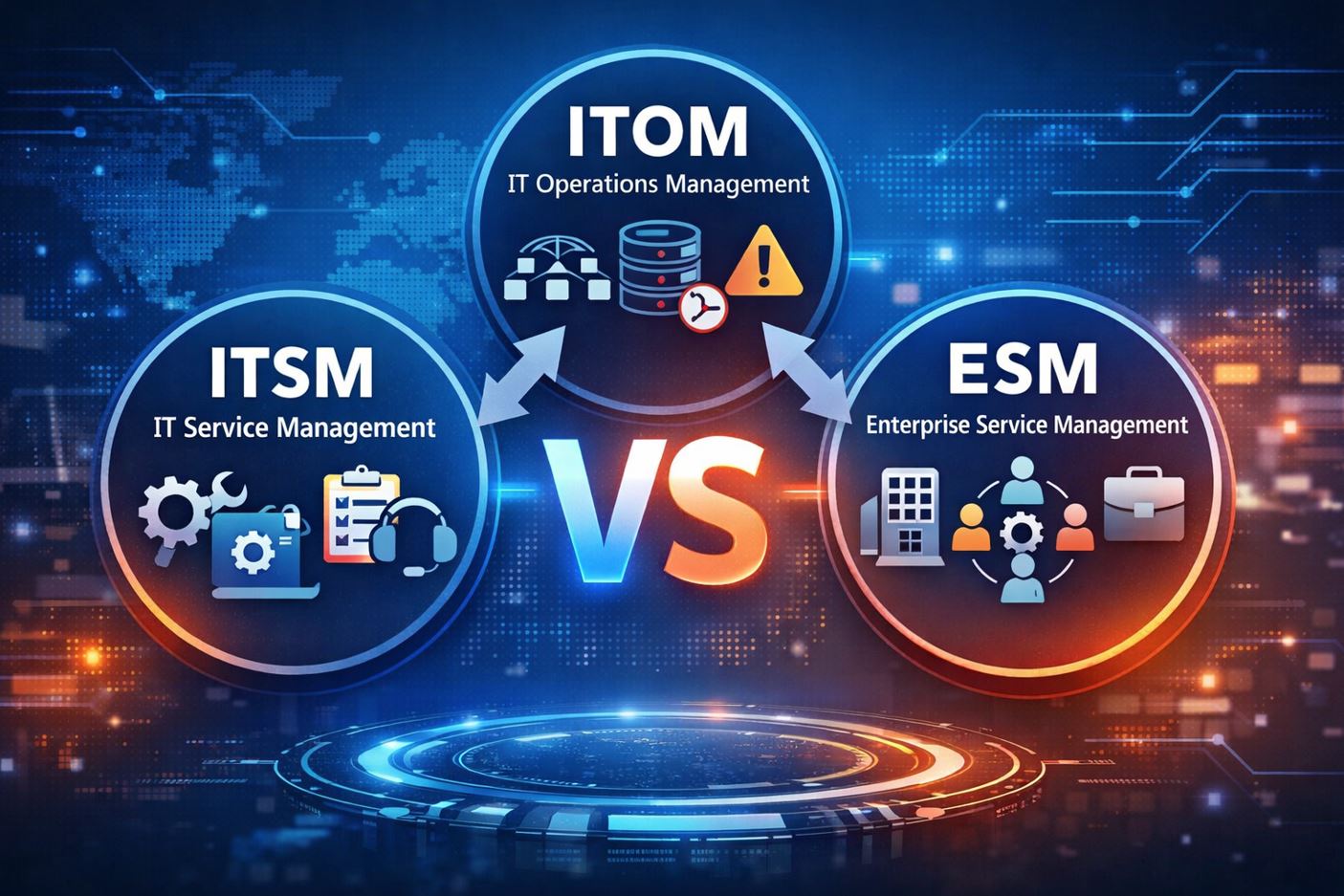
In the rapidly evolving landscape of enterprise technology management, organizations face a bewildering array of acronyms and frameworks promising to optimize operations, enhance service delivery, and improve business outcomes. Among the most frequently discussed yet often confused concepts are IT Service Management (ITSM), IT Operations Management (ITOM), and Enterprise Service Management (ESM). While these approaches share common goals of improving organizational efficiency, they address fundamentally different aspects of technology and service delivery. Consequently, understanding their distinctions, overlaps, and complementary relationships becomes essential for leaders making strategic technology investments and operational decisions.
Table of Contents
- Quick Summary
- What Are ITSM, ITOM, and ESM?
- How Do ITSM, ITOM, and ESM Differ in Their Primary Focus?
- Which ITSM Platforms Support ITSM, ITOM, and ESM Capabilities?
- How Do Freshservice, ManageEngine, and Zendesk Compare Across ITSM, ITOM, and ESM?
- When Should Organizations Prioritize ITSM, ITOM, or ESM Investments?
- What Are the Integration Points Between ITSM, ITOM, and ESM?
- How Do Organizations Successfully Implement ITSM, ITOM, and ESM Together?
- Summing up
- Frequently Asked Questions
- Benefits of Cooperation with Solution for Guru
Quick Summary
IT Service Management (ITSM), IT Operations Management (ITOM), and Enterprise Service Management (ESM) represent three distinct yet interconnected approaches to managing technology and services within organizations. ITSM focuses on delivering and supporting IT services through structured processes like incident management, problem management, and change management. ITOM concentrates on monitoring, managing, and optimizing the technology infrastructure underlying those services, including servers, networks, applications, and cloud resources. ESM extends ITSM principles beyond IT departments to other organizational functions like HR, facilities, legal, and finance, creating unified service delivery experiences across the enterprise.
This comprehensive guide explores the fundamental differences between these approaches, examines when each proves most valuable, and analyzes how leading platforms like Freshservice, ManageEngine, and Zendesk support ITSM, ITOM, and ESM capabilities. Furthermore, we discuss strategic implementation approaches, integration strategies, and success metrics that help organizations maximize value from these complementary disciplines. Whether you’re evaluating technology investments, planning operational improvements, or seeking to understand how these frameworks fit together, this article provides the clarity needed for informed decision-making.
What Are ITSM, ITOM, and ESM?
Understanding the fundamental definitions and purposes of IT Service Management, IT Operations Management, and Enterprise Service Management establishes the foundation for recognizing their differences, overlaps, and strategic applications within modern organizations.
IT Service Management (ITSM): Service-Centric IT Delivery
IT Service Management represents a structured approach to designing, delivering, managing, and improving IT services that support business objectives. Rooted in frameworks like ITIL (Information Technology Infrastructure Library), ITSM emphasizes processes, people, and technology working together to ensure consistent, high-quality IT service delivery. The core philosophy centers on treating IT as a service provider rather than merely a technology function, with clear service catalogs, defined service levels, and customer-focused delivery models.
ITSM encompasses numerous interconnected processes that span the entire IT service lifecycle. Incident management addresses unexpected service disruptions, working to restore normal operations quickly. Problem management investigates underlying causes of recurring incidents, implementing permanent solutions that prevent future occurrences. Change management ensures that modifications to IT infrastructure follow controlled processes minimizing risk and disruption. Request fulfillment handles routine service requests like access provisioning or software installations through standardized workflows.
Additionally, ITSM includes service catalog management, which documents available services and their characteristics; knowledge management, which captures and shares information enabling self-service and efficient problem resolution; and service level management, which establishes agreements defining expected service quality and measures performance against those commitments. These processes create structured frameworks transforming ad-hoc IT operations into predictable, measurable service delivery.
The benefits of ITSM extend beyond operational efficiency to encompass improved user satisfaction, better alignment between IT and business objectives, enhanced visibility into service performance, and more effective resource utilization. Organizations implementing ITSM frameworks report reduced downtime, faster issue resolution, lower operational costs, and increased productivity across both IT teams and service consumers.
IT Operations Management (ITOM): Infrastructure and Application Performance
While ITSM focuses on service delivery processes, IT Operations Management concentrates on the technical infrastructure and applications underlying those services. ITOM encompasses the tools, processes, and practices used to monitor, manage, and optimize IT infrastructure components including servers, networks, databases, applications, cloud resources, and storage systems. The primary objective involves ensuring that technology infrastructure operates reliably, performs optimally, and scales appropriately to meet business demands.
ITOM activities include continuous monitoring of infrastructure health and performance, automated discovery of IT assets and their relationships, event correlation that identifies meaningful patterns within vast streams of monitoring data, and capacity planning that ensures adequate resources exist to support current and future requirements. Furthermore, ITOM encompasses configuration management databases (CMDBs) that maintain accurate inventories of infrastructure components and their interdependencies, enabling better impact analysis and change planning.
Modern ITOM has evolved significantly with cloud computing, containerization, microservices architectures, and DevOps practices. Traditional monitoring focused primarily on physical and virtual infrastructure within data centers. Today’s ITOM must span hybrid and multi-cloud environments, monitor ephemeral containers and serverless functions, track application performance across distributed architectures, and integrate with continuous integration/continuous deployment (CI/CD) pipelines.
The value ITOM delivers manifests through proactive issue identification before users experience problems, optimized resource utilization that reduces infrastructure costs, improved application performance that enhances user experiences, and faster root cause identification when issues occur. Organizations with mature ITOM practices achieve higher availability, better performance, reduced mean time to resolution for infrastructure-related incidents, and more efficient capacity planning.
Enterprise Service Management (ESM): Extending Service Excellence Beyond IT
Enterprise Service Management represents the application of ITSM principles, processes, and technologies to non-IT departments throughout organizations. ESM recognizes that the structured service delivery approaches proven effective for IT departments can equally benefit HR, facilities, legal, finance, procurement, and other business functions. By extending service management practices organization-wide, ESM creates consistent service experiences, breaks down departmental silos, and improves operational efficiency across the enterprise.
ESM enables HR departments to manage employee onboarding, offboarding, benefits inquiries, and workplace requests through structured workflows similar to IT service requests. Facilities teams handle workspace reservations, maintenance requests, and vendor management using the same ticketing and tracking mechanisms IT uses for technology issues. Legal departments manage contract requests, compliance inquiries, and document reviews through formalized processes with defined service levels. Finance teams handle invoice approvals, budget requests, and expense management through structured workflows ensuring appropriate controls and visibility.
The benefits of ESM extend beyond individual departmental efficiency to encompass improved cross-functional collaboration, unified employee experiences regardless of which department they’re interacting with, better visibility into organizational service delivery across all functions, and reduced tool proliferation through shared platforms. Employees benefit from single points of contact for various service needs rather than navigating different systems and processes for each department.
Furthermore, ESM enables data-driven insights spanning organizational boundaries. Leaders gain visibility into service delivery performance across departments, identify best practices that can be shared, and make informed decisions about resource allocation and process improvements. This enterprise-wide perspective proves impossible when departments operate independent, disconnected service delivery systems.
How Do ITSM, ITOM, and ESM Differ in Their Primary Focus?

While ITSM, ITOM, and ESM share common goals of improving organizational operations and service quality, they address fundamentally different aspects of enterprise management and operate at different organizational levels.
Focus Dimension 1: Scope of Services
ITSM focuses exclusively on IT services—the technology-related capabilities delivered to users and business processes. This includes everything from help desk support and device provisioning to application access and infrastructure maintenance. The scope remains bounded within the IT function, addressing how technology services are requested, delivered, supported, and improved.
Conversely, ITOM narrows focus further to the technical infrastructure and operations underlying IT services. Rather than addressing the entire service delivery lifecycle, ITOM concentrates specifically on ensuring that servers, networks, applications, databases, and other technology components operate reliably and perform optimally. ITOM provides the operational foundation upon which ITSM processes depend.
ESM dramatically expands scope beyond IT to encompass service delivery across the entire enterprise. Rather than limiting structured service management to technology, ESM applies these principles to HR services, facilities management, legal support, finance operations, procurement processes, and any other organizational function that delivers services to employees or customers. This enterprise-wide scope transforms service management from an IT-specific discipline into an organizational capability.
Focus Dimension 2: Primary Stakeholders
ITSM’s primary stakeholders include IT service consumers (employees, customers, partners requiring technology services), IT support staff (help desk agents, system administrators, application specialists), and IT leadership responsible for service delivery quality and efficiency. The interactions center on service requests, incident reports, change approvals, and service quality discussions.
ITOM stakeholders comprise IT operations teams (system administrators, network engineers, database administrators, cloud operations specialists), IT architects designing infrastructure solutions, capacity planners ensuring adequate resources, and IT leadership concerned with infrastructure reliability, performance, and cost optimization. The interactions focus on monitoring data, performance metrics, capacity forecasts, and operational efficiency.
ESM stakeholders span the entire organization, including employees requesting services from various departments, service delivery teams across HR, facilities, legal, finance, and other functions, departmental leaders responsible for service quality within their domains, and executive leadership seeking enterprise-wide operational visibility and efficiency. The interactions encompass diverse service requests spanning organizational boundaries, creating unified employee experiences regardless of which department provides services.
Focus Dimension 3: Core Activities
ITSM core activities revolve around service delivery processes including incident management restoring service disruptions, request fulfillment handling routine service needs, change management controlling infrastructure modifications, problem management addressing root causes of recurring issues, and knowledge management capturing information that enables self-service and efficient support. These activities create structured workflows guiding IT services from initial requests through final resolution.
ITOM core activities center on technical operations including continuous infrastructure monitoring detecting performance degradation or failures, event correlation identifying meaningful patterns within monitoring data, automated remediation resolving common issues without human intervention, capacity planning forecasting and provisioning adequate resources, and configuration management maintaining accurate infrastructure inventories. These activities ensure technology infrastructure operates reliably and efficiently.
ESM core activities extend ITSM processes to non-IT contexts including employee onboarding workflows spanning HR, IT, and facilities; contract management processes within legal departments; expense approval workflows in finance; workspace reservation systems managed by facilities; and benefits administration handled by HR. These activities apply proven service management principles to diverse organizational functions, creating consistency while respecting functional differences.
Focus Dimension 4: Technology Platforms
ITSM platforms like Freshservice, ManageEngine, and Zendesk provide ticketing systems, workflow automation, service catalogs, knowledge bases, self-service portals, and reporting capabilities supporting IT service delivery processes. These platforms focus on managing interactions between service providers and consumers, tracking requests through resolution, and measuring service quality.
ITOM platforms include monitoring tools like Nagios, Datadog, and New Relic; configuration management databases like ServiceNow CMDB; automation tools like Ansible and Puppet; and comprehensive suites like ManageEngine OpManager combining multiple ITOM capabilities. These platforms focus on technical infrastructure visibility, performance optimization, and operational automation.
ESM leverages ITSM platforms extended beyond IT contexts. Rather than requiring entirely separate tools, ESM initiatives typically adapt platforms like Freshservice, ManageEngine, and Zendesk to support non-IT service delivery. This platform reuse creates consistency, reduces licensing costs, and accelerates ESM implementation by leveraging existing investments and expertise.
Which ITSM Platforms Support ITSM, ITOM, and ESM Capabilities?
Leading service management platforms increasingly offer capabilities spanning ITSM, ITOM, and ESM, though individual strengths vary significantly. Understanding how Freshservice, ManageEngine, and Zendesk address these three disciplines helps organizations select platforms aligned with specific requirements and strategic priorities.
Freshservice: Unified Service Management with Strong ITSM Foundation
Freshservice delivers comprehensive ITSM capabilities including incident management, problem management, change management, release management, asset management, and knowledge management within an intuitive, cloud-native platform. The solution’s modern interface, powerful automation, and extensive integration ecosystem make it particularly appealing for organizations seeking rapid deployment and high user adoption rates.
For ITOM capabilities, Freshservice provides basic infrastructure monitoring through integrations with specialized monitoring tools rather than native monitoring functionality. The platform’s discovery capabilities automatically identify IT assets across networks, maintaining updated configuration management databases (CMDBs) that support impact analysis and change planning. However, organizations requiring sophisticated infrastructure monitoring, event correlation, or automated remediation typically complement Freshservice with dedicated ITOM tools.
Freshservice’s ESM capabilities shine through its flexible workflow engine and customizable service catalog. Organizations can easily extend the platform beyond IT to support HR onboarding, facilities management, legal requests, and other enterprise services. The unified interface ensures consistent experiences regardless of which department delivers services, while separate portals and workflows accommodate functional differences. Many Freshservice customers report successful ESM implementations spanning multiple departments within months of initial IT service management deployment.
The platform’s pricing structure scales appropriately for ESM implementations, with per-agent licensing enabling cost-effective expansion beyond IT departments. Integration capabilities ensure that Freshservice connects seamlessly with HR systems, facilities management tools, legal document repositories, and financial applications, creating unified workflows spanning organizational boundaries.
ManageEngine: Comprehensive ITOM with Expanding ITSM and ESM

ManageEngine distinguishes itself through exceptionally strong ITOM capabilities delivered through OpManager, Applications Manager, and other specialized tools. These solutions provide comprehensive infrastructure monitoring, application performance management, network mapping, capacity planning, and automated remediation. Organizations prioritizing ITOM often select ManageEngine specifically for these deep technical capabilities.
ServiceDesk Plus, ManageEngine’s ITSM platform, delivers full-featured IT service management including all major ITIL processes. The solution offers both cloud and on-premises deployment options, extensive customization capabilities, and deep integration with ManageEngine’s ITOM tools. This integration enables ITOM monitoring data to automatically create ITSM incidents, correlate infrastructure events with service impacts, and provide operations teams with comprehensive context during incident resolution.
ManageEngine’s approach to ESM involves extending ServiceDesk Plus configurations and workflows to non-IT departments. While powerful, this approach requires more configuration expertise than some competitors, making ManageEngine ESM implementations slightly more complex. However, organizations investing in proper configuration achieve highly customized ESM solutions perfectly aligned with specific departmental requirements.
The ManageEngine ecosystem’s breadth—spanning ITSM, ITOM, security management, endpoint management, and more—creates opportunities for deep integration and unified management. Organizations already invested in ManageEngine products benefit from familiar interfaces, shared data models, and consistent administration across multiple management disciplines.
Zendesk: ESM-Ready Platform with Strong Service Management Foundation
Zendesk built its reputation on customer service management before expanding into ITSM and ESM. This heritage shows in the platform’s exceptional strengths around knowledge management, omnichannel communication, self-service capabilities, and user experience design. Organizations prioritizing employee experiences and self-service adoption find Zendesk particularly compelling.
For ITSM, Zendesk provides comprehensive service management capabilities including incident management, request fulfillment, change management, asset management, and knowledge management. The platform’s ticketing engine, proven through millions of customer service interactions, handles IT service delivery workflows effectively. Integration with ITOM tools enables monitoring alerts to automatically create incidents, though Zendesk lacks native infrastructure monitoring capabilities.
Zendesk’s ESM strengths emerge through its unified approach to service management across organizational boundaries. The platform treats internal employee services and external customer services identically from a technical perspective, enabling organizations to leverage a single platform for IT support, customer service, HR inquiries, facilities requests, and more. This unified approach reduces platform proliferation, simplifies administration, and creates consistent experiences.
The Zendesk marketplace offers hundreds of integrations and applications extending platform functionality across ITSM, ITOM, and ESM contexts. Organizations can connect Zendesk with monitoring tools for ITOM integration, HR systems for ESM workflows, financial applications for approval automation, and collaboration platforms for seamless communication. This extensibility enables customization without complex development efforts.
How Do Freshservice, ManageEngine, and Zendesk Compare Across ITSM, ITOM, and ESM?
Detailed comparison across multiple dimensions helps organizations understand which platform best aligns with specific priorities, existing technology investments, and strategic objectives spanning ITSM, ITOM, and ESM initiatives.
| Capability Category | |  |  |
|---|---|---|---|
| ITSM Core Processes | |||
| Incident Management | Comprehensive with AI-powered automation | Comprehensive with ITIL alignment | Comprehensive with omnichannel support |
| Problem Management | Integrated with root cause analysis | Advanced with analytics | Standard functionality |
| Change Management | Workflow-driven with approvals | CAB support, ITIL-compliant | Basic change workflows |
| Asset Management | Automated discovery, lifecycle tracking | Advanced with agent-based discovery | Basic asset tracking |
| Knowledge Management | Integrated KB with AI search | Comprehensive KB | Excellent KB with search |
| ITOM Capabilities | |||
| Infrastructure Monitoring | Via integrations | Native via OpManager | Via integrations |
| Application Performance | Via integrations | Native via Applications Manager | Via integrations |
| Event Correlation | Limited | Advanced native capability | Via integrations |
| Automated Remediation | Basic through workflows | Advanced through scripts | Basic through workflows |
| CMDB | Built-in, auto-discovery | Comprehensive, auto-discovery | Basic configuration tracking |
| ESM Capabilities | |||
| Multi-Department Support | Excellent with easy configuration | Good with complex configuration | Excellent with unified approach |
| Workflow Flexibility | High – visual workflow builder | Very high – extensive customization | High – business rules engine |
| Department-Specific Portals | Multiple branded portals | Customizable portals | Multiple help centers |
| Cross-Functional Reporting | Good analytics across departments | Comprehensive cross-module reporting | Good with custom dashboards |
| Non-IT Use Cases | HR, Facilities, Legal, Finance | HR, Facilities, Legal, Finance | HR, Facilities, plus Customer Service |
| Platform Characteristics | |||
| Deployment Options | Cloud only | Cloud and on-premises | Cloud only |
| Implementation Complexity | Low – quick setup | Medium to high – more configuration | Low – intuitive setup |
| Pricing Model | Per agent, tiered plans | Per technician, module-based | Per agent, tiered plans |
| Integration Ecosystem | 1000+ integrations | 200+ integrations, deep ManageEngine ecosystem | 1000+ apps and integrations |
| Best Suited For | Organizations wanting modern, unified ITSM/ESM with selective ITOM integration | Organizations needing comprehensive ITOM with strong ITSM/ESM capabilities | Organizations prioritizing ESM and employee experience with ITSM foundation |
Detailed Platform Analysis Across Disciplines
Beyond feature checklists, understanding how platforms approach ITSM, ITOM, and ESM philosophically reveals important differences influencing long-term satisfaction and success.
Architectural Approach
Freshservice employs a unified platform architecture where ITSM and ESM capabilities share common foundations including workflow engines, knowledge bases, and reporting systems. This unified approach simplifies administration and creates consistent experiences but relies on integrations for advanced ITOM capabilities. Organizations comfortable with best-of-breed tool integration appreciate this approach.
ManageEngine offers a suite approach where specialized products address ITSM (ServiceDesk Plus), ITOM (OpManager, Applications Manager), endpoint management, and security. Deep integration between suite components creates powerful unified capabilities while enabling organizations to adopt products selectively based on specific requirements. This modularity appeals to organizations wanting comprehensive coverage across IT management disciplines.
Zendesk takes a service-first approach treating internal and external service delivery identically at the platform level. This philosophy naturally supports ESM while providing solid ITSM foundations. ITOM capabilities depend entirely on integrations, positioning Zendesk as the service management layer orchestrating processes while specialized tools handle technical operations.
Customization Philosophy
Freshservice balances configuration and simplicity, offering customization through visual tools and pre-built templates that accelerate deployment while accommodating organizational differences. This approach proves effective for most standard requirements but may constrain highly complex or unusual use cases.
ManageEngine provides extensive customization including custom modules, fields, workflows, and integrations. This flexibility enables precise alignment with specific requirements but requires more technical expertise and longer implementation timelines. Organizations with complex, unique requirements or those wanting highly tailored solutions benefit from this flexibility.
Zendesk emphasizes configuration over customization, providing powerful business rules, triggers, and automations within defined frameworks. The marketplace extends capabilities through pre-built applications and integrations. This approach accelerates implementation while maintaining platform supportability and upgrade paths.
Total Cost Considerations
Beyond subscription fees, organizations should consider total cost of ownership including implementation services, integration development, training, and ongoing administration.
Freshservice’s simplicity typically reduces implementation and training costs, with many organizations achieving productive deployments within weeks using internal resources. ESM expansion leverages existing platform knowledge, further reducing costs. However, advanced ITOM requirements necessitate additional tool licenses.
ManageEngine’s module-based pricing can prove cost-effective for organizations requiring comprehensive capabilities across ITSM, ITOM, and ESM. Perpetual licensing options for on-premises deployments appeal to organizations preferring capital expenditures. However, implementation complexity may increase consulting costs, particularly for complex customizations.
Zendesk’s per-agent pricing scales as organizations expand ESM implementations but can become expensive for large agent populations. The platform’s simplicity reduces training costs while extensive marketplace offerings minimize custom development expenses. Organizations should evaluate whether external customer service requirements exist, as unified platforms serving both contexts may justify higher costs.
When Should Organizations Prioritize ITSM, ITOM, or ESM Investments?

Strategic prioritization between ITSM, ITOM, and ESM depends on organizational maturity, current pain points, business objectives, and existing capabilities. Understanding decision criteria helps leaders allocate resources effectively and sequence initiatives for maximum impact.
Prioritize ITSM When…
Organizations should focus ITSM investments when IT service delivery lacks structure, consistency, or visibility. Common indicators include frequent escalations to IT leadership for routine issues, wide variation in how similar requests are handled, absence of documentation about available services, limited visibility into request status frustrating users, and difficulty measuring IT service quality or performance.
Furthermore, ITSM priority increases when organizations pursue IT transformation initiatives including cloud migrations, digital transformation programs, or IT organizational restructuring. These changes require structured processes ensuring controlled, predictable service delivery during transition periods. ITSM provides frameworks managing these changes while maintaining service quality.
Organizations experiencing regulatory compliance pressures also benefit from ITSM prioritization. Frameworks like SOC 2, ISO 27001, HIPAA, and GDPR require documented processes, access controls, change management, and audit trails that ITSM naturally provides. Implementing ITSM addresses operational requirements while simultaneously strengthening compliance postures.
Platforms like Freshservice, ManageEngine, and Zendesk provide comprehensive ITSM capabilities suitable for organizations at various maturity levels, from those implementing service management for the first time to those optimizing existing practices.
Prioritize ITOM When…
ITOM investments should take precedence when organizations face infrastructure reliability issues, performance problems, or operational blind spots. Warning signs include frequent unplanned outages, slow application performance affecting productivity, inability to identify root causes quickly, reactive firefighting dominating operations team activities, and inadequate capacity planning causing resource shortages.
Additionally, ITOM becomes critical as infrastructure complexity increases through cloud adoption, hybrid architectures, containerization, or microservices implementations. Traditional monitoring approaches struggle with ephemeral workloads, distributed architectures, and multi-cloud environments. Modern ITOM tools providing comprehensive visibility across these complex landscapes prevent operational chaos.
Organizations pursuing cost optimization through infrastructure consolidation, cloud migration, or resource right-sizing also benefit from ITOM prioritization. Effective optimization requires detailed usage data, performance baselines, and capacity forecasting that ITOM tools provide. Without this visibility, optimization efforts rely on guesswork often producing disappointing results.
ManageEngine offers particularly strong native ITOM capabilities through its OpManager and Applications Manager suite, making it an excellent choice for organizations prioritizing infrastructure and application operations management. Freshservice and Zendesk can integrate with specialized ITOM tools for organizations wanting unified service management platforms.
Prioritize ESM When…
ESM initiatives make sense when organizations have mature ITSM practices, face service delivery challenges beyond IT, or seek operational consistency across departments. Indicators include successful ITSM implementation demonstrating service management value, non-IT departments expressing interest in similar capabilities, employees frustrated by inconsistent experiences across departments, manual processes in HR, facilities, or other functions causing delays, and leadership desire for enterprise-wide operational visibility.
Furthermore, ESM priority increases during organizational transformation initiatives including mergers and acquisitions requiring process standardization, culture change programs emphasizing employee experiences, or digital workplace initiatives modernizing how employees interact with corporate services. ESM provides frameworks unifying service delivery across previously disparate functions.
Organizations facing employee retention challenges may also benefit from ESM investments. Modern employees expect consumer-grade experiences in workplace interactions, including intuitive self-service, transparent request tracking, and responsive support. ESM delivers these experiences across all employee touchpoints, from IT support through HR inquiries to facilities requests.
Platforms like Freshservice and Zendesk excel at ESM implementations with intuitive interfaces, flexible workflows, and unified experiences across departments. ManageEngine supports ESM through extensive customization enabling precise alignment with departmental requirements.
What Are the Integration Points Between ITSM, ITOM, and ESM?
While ITSM, ITOM, and ESM address different organizational domains, they share numerous integration points where data, processes, and workflows intersect. Understanding these connections helps organizations design cohesive service management ecosystems rather than isolated point solutions.
ITOM-to-ITSM Integration: Operational Intelligence Enhancing Service Delivery
Infrastructure monitoring data from ITOM tools automatically creates ITSM incidents when performance thresholds are exceeded or failures occur. This automation enables proactive issue identification before users experience problems, reducing mean time to detect (MTTD) and often preventing incidents entirely through early intervention. For example, when ITOM monitoring detects database server memory approaching capacity limits, automated incident creation alerts operations teams to take corrective action before performance degrades noticeably.
Configuration management databases (CMDBs) maintained within ITOM environments provide critical context for ITSM processes. When incidents occur, CMDB data reveals affected services, dependent systems, and recent changes that might have caused problems. This context accelerates root cause identification and impact assessment. Change management processes query CMDBs to understand which systems might be affected by proposed changes, enabling better risk assessment and planning.
Event correlation within ITOM platforms identifies relationships between multiple infrastructure events, preventing alert storms that could generate hundreds of redundant ITSM incidents. Instead of creating separate tickets for each affected component, intelligent correlation creates single incidents representing underlying problems, dramatically improving operational efficiency and reducing noise.
Capacity planning data from ITOM informs ITSM service catalog offerings and service level agreements. Understanding current infrastructure capacity and growth trends enables realistic commitments about service availability and performance. Similarly, infrastructure performance baselines help establish appropriate priority schemes within ITSM, ensuring that issues truly impacting business operations receive urgent attention.
ITSM-to-ESM Integration: Extending Service Management Practices
ESM implementations leverage ITSM platforms, processes, and expertise, extending proven approaches to new organizational contexts. Rather than reinventing service management for each department, ESM applies ITSM principles while accommodating functional differences. This integration manifests through shared platforms like Freshservice, ManageEngine, and Zendesk supporting both IT and non-IT service delivery.
Knowledge management established within ITSM expands to encompass HR policies, facilities procedures, legal guidelines, and finance processes. Unified knowledge bases enable employees to find answers regardless of topic, improving self-service effectiveness and reducing ticket volumes across all departments. Search functionality doesn’t distinguish between IT articles and HR documentation, creating seamless information discovery experiences.
Cross-functional workflows leverage both ITSM and ESM capabilities, orchestrating processes spanning organizational boundaries. Employee onboarding exemplifies these integrated workflows, involving IT account provisioning, HR paperwork completion, facilities workspace assignments, and security access requests. Unified platforms track these multi-departmental processes end-to-end, ensuring nothing falls through gaps between departments.
Reporting and analytics combine data from ITSM and ESM implementations, providing enterprise-wide visibility into service delivery performance. Leadership dashboards show service quality across IT, HR, facilities, and other functions, enabling meaningful comparisons and identification of improvement opportunities. This integrated visibility proves impossible when departments operate independent service management systems.
ITOM-to-ESM Integration: Infrastructure Supporting Enterprise Services
While less direct than ITSM-ESM connections, ITOM integrations support ESM initiatives by ensuring that applications and platforms enabling non-IT services operate reliably. HR portals, facilities management systems, legal document repositories, and financial applications all depend on underlying infrastructure that ITOM monitors and manages.
For instance, when HR conducts open enrollment periods generating high portal traffic, ITOM capacity management ensures adequate infrastructure resources prevent performance degradation. Similarly, ITOM monitoring detects when facilities management applications experience issues, automatically creating ESM incidents that facilities teams resolve before users notice problems.
Asset management spanning ITOM and ESM provides comprehensive organizational visibility. IT assets tracked within ITOM expand to include facilities equipment, HR resources, legal assets, and other organizational property managed through ESM processes. This unified asset management enables better lifecycle tracking, maintenance scheduling, and cost optimization across all asset types.
How Do Organizations Successfully Implement ITSM, ITOM, and ESM Together?

Implementing integrated ITSM, ITOM, and ESM capabilities requires strategic planning, phased execution, and careful change management. Organizations successfully navigating these initiatives follow proven approaches that balance ambition with pragmatism.
Establish Clear Vision and Objectives
Successful initiatives begin with clear articulation of desired outcomes, business drivers, and success criteria spanning ITSM, ITOM, and ESM. Leadership alignment on these objectives ensures consistent support throughout implementation and provides frameworks for prioritization decisions. Objectives might include improving employee experiences, reducing operational costs, enhancing service reliability, enabling business growth, or strengthening compliance postures.
Moreover, establishing baselines for key performance indicators before implementation enables accurate measurement of improvements. These baselines should span operational metrics like incident resolution times and system availability, business metrics like employee productivity and satisfaction, and financial metrics like IT operational costs and service delivery efficiency.
Assess Current Capabilities and Maturity
Comprehensive assessment of existing ITSM, ITOM, and ESM capabilities reveals starting points and identifies gaps requiring attention. This assessment examines current processes, technologies, skills, and organizational readiness. Maturity models provide structured frameworks for assessment, identifying specific improvement areas and sequencing initiatives appropriately.
Furthermore, assessment should identify existing tools, integration points, data quality issues, and technical debt that might impact implementation. Understanding the current technology landscape prevents surprises during implementation and enables realistic planning.
Design Target Operating Model
The target operating model describes how ITSM, ITOM, and ESM will function once fully implemented, including process flows, organizational structures, technology architecture, and governance mechanisms. This design balances industry best practices with organizational context, creating solutions that fit specific requirements while leveraging proven approaches.
Process design should identify which ITIL processes are most relevant, how ITOM monitoring integrates with service management, and which non-IT functions will adopt ESM. Organizational design clarifies roles and responsibilities across service delivery, operational management, and support functions. Technology architecture specifies platforms, integrations, and data flows connecting various components.
Select Appropriate Platforms and Tools
Platform selection significantly influences implementation success and long-term operational effectiveness. Organizations should evaluate options like Freshservice, ManageEngine, and Zendesk against specific requirements, considering ITSM depth, ITOM capabilities, ESM flexibility, integration ecosystems, pricing models, and vendor stability.
Evaluation criteria should include functional fit assessing how well platforms support required processes, technical fit examining integration capabilities and architectural alignment, user experience evaluating interfaces and self-service capabilities, total cost of ownership considering all implementation and operational expenses, and vendor partnership potential assessing long-term vendor relationships.
Execute Phased Implementation
Rather than attempting comprehensive deployment simultaneously across all disciplines and departments, phased approaches reduce risk and enable learning. A typical phasing strategy might begin with ITSM core processes within IT, expand to ITOM integration enhancing operational visibility, pilot ESM with a single non-IT department, and progressively scale ESM across additional functions based on pilot learnings.
Each phase should include planning, configuration, testing, training, deployment, and stabilization activities. Phase boundaries provide natural checkpoints for assessing progress, gathering feedback, and refining approaches before proceeding. This iterative methodology proves more successful than big-bang implementations attempting everything simultaneously.
Implement Robust Change Management
Technical implementation represents only part of successful ITSM, ITOM, and ESM adoption. Change management addressing people and cultural dimensions proves equally critical. Effective change management includes stakeholder engagement securing buy-in from affected parties, communication campaigns explaining benefits and timeline, training programs developing necessary skills, and reinforcement mechanisms sustaining desired behaviors.
Resistance to change should be anticipated and addressed proactively through involvement, communication, and demonstrated value. Quick wins showing tangible benefits build momentum and overcome skepticism more effectively than mandates or appeals to authority.
Summing up
IT Service Management, IT Operations Management, and Enterprise Service Management represent three distinct yet deeply interconnected approaches to managing technology and services within modern organizations. Understanding their fundamental differences proves essential for making informed investment decisions, designing effective implementations, and maximizing value from service management initiatives.
ITSM focuses on delivering and supporting IT services through structured processes encompassing incident management, problem management, change management, and related disciplines. These frameworks transform ad-hoc IT operations into predictable, measurable service delivery that aligns with business objectives. ITSM provides the foundation upon which mature IT organizations build reliable, efficient service delivery capabilities.
ITOM concentrates on the technical infrastructure underlying IT services, monitoring performance, managing capacity, correlating events, and ensuring operational reliability. While ITSM addresses service processes, ITOM focuses on the technology stack itself, providing visibility and control that enable proactive management. Modern ITOM has evolved to span hybrid cloud environments, containerized workloads, and distributed architectures that characterize contemporary IT landscapes.
ESM extends proven service management principles beyond IT to other organizational functions including HR, facilities, legal, finance, and additional departments. Rather than treating service management as an IT-specific discipline, ESM recognizes that structured service delivery benefits all organizational functions. By applying ITSM principles enterprise-wide, organizations create consistent employee experiences, break down departmental silos, and improve operational efficiency across boundaries.
Leading platforms like Freshservice, ManageEngine, and Zendesk each offer distinct approaches to supporting ITSM, ITOM, and ESM capabilities. Freshservice delivers unified service management with strong ITSM and ESM foundations complemented by selective ITOM integration. ManageEngine provides comprehensive coverage across all three disciplines with particularly strong native ITOM capabilities. Zendesk offers ESM-ready platforms built on proven customer service foundations with solid ITSM support and integration-based ITOM.
Frequently Asked Questions
While technically possible, implementing ESM before establishing solid ITSM foundations typically produces suboptimal results. ITSM provides proven frameworks, processes, and lessons learned that significantly accelerate ESM implementations. Organizations attempting ESM first often struggle with process design, platform configuration, and change management challenges that experienced ITSM practitioners handle more effectively.
Starting with ITSM enables organizations to develop service management expertise, establish platform proficiency, and demonstrate value within IT before expanding to other departments. This approach builds credibility and creates reference implementations that non-IT departments can adapt to their contexts. Furthermore, IT departments typically have stronger technical capabilities and change readiness than other functions, making them ideal proving grounds for service management initiatives.
ITSM, ITOM, and ESM complement DevOps and Agile methodologies rather than conflicting with them. Modern interpretations of these frameworks emphasize flexibility, continuous improvement, and customer focus—values perfectly aligned with DevOps and Agile principles. The perceived tension often stems from outdated, bureaucratic ITSM implementations that prioritize control over speed, creating friction with rapid development practices.
Contemporary ITSM adapted for DevOps contexts emphasizes lightweight change management with automated approvals for low-risk changes, continuous feedback loops improving service quality, and integration with CI/CD pipelines. ITOM tools monitor applications in production, feeding observability data back to development teams and enabling faster issue identification and resolution. This integration creates closed feedback loops where operational insights inform development priorities.
Benefits of Cooperation with Solution for Guru
Navigating the complexities of ITSM, ITOM, and ESM implementation becomes significantly more manageable when partnering with specialists possessing deep expertise across these interconnected disciplines. Solution for Guru offers comprehensive consulting services helping organizations successfully implement, integrate, and optimize service management capabilities spanning IT and enterprise contexts.
Solution for Guru recognizes that effective service management solutions must fit specific organizational contexts including industry requirements, company culture, existing technology landscapes, maturity levels, and strategic objectives. Their consulting approach emphasizes customization and adaptation rather than cookie-cutter implementations that ignore organizational uniqueness.
Whether working with small businesses implementing first ITSM capabilities, mid-market companies expanding into ESM, or large enterprises integrating complex ITOM ecosystems, Solution for Guru tailors approaches to specific situations. They balance industry best practices with pragmatic adaptation, creating solutions that work within real-world constraints while moving organizations toward target states.
For organizations seeking to implement or optimize ITSM, ITOM, or ESM capabilities using platforms like Freshservice, ManageEngine, or Zendesk, partnering with Solution for Guru accelerates success while reducing risks. Their combination of multi-disciplinary expertise, platform-agnostic guidance, proven methodology, integration capabilities, results focus, and tailored approach delivers value far exceeding consulting costs.
Recommended:
- ITSM Change Management
- ITSM Integration: Streamlining IT Service Management for Modern Enterprises
- ITSM Problem Management
- What Are ITSM Ticketing Tools?
- ITSM Jobs: Your Guide to a Thriving Career in IT Service Management
- Why are ITSM Best Practices essential?
- What is an IT Management Service Provider?
- Comprehensive Guide to ITSM Tools: Features, Benefits, and Top Solutions
- What is IT Service Management (ITSM)?