Creatio CRM Implementation Guide for U.S. Businesses

Choosing and implementing the right CRM is one of the most consequential technology decisions a U.S. business can make today. Done well, it transforms how your teams sell, market, and serve customers. Done poorly, it wastes thousands of dollars and months of effort. This guide walks you through everything you need to know about implementing Creatio CRM — from initial planning to post-launch optimization — so your business can get the most out of this powerful platform.
Table of contents
Quick Summary
| Topic | Key Takeaway |
|---|---|
| What is Creatio CRM? | An AI-native, no-code agentic CRM and workflow platform |
| Best suited for | Mid-size to enterprise U.S. businesses across 20+ industries |
| Core strengths | No-code customization, embedded AI agents, rapid deployment |
| Implementation phases | Discovery → Configuration → Integration → Training → Go-Live |
| Industry recognition | Gartner Visionary (2025), Forrester Leader (2024) |
How Does Creatio CRM Relate to the Core Topic of This Guide?
The implementation of a CRM system is not simply a software installation — it is a strategic transformation of how a business manages its entire customer lifecycle. Creatio CRM sits at the very center of that transformation.
Creatio CRM is an agentic CRM and workflow platform built with no-code and AI at its core. Unlike traditional CRM tools that require heavy developer involvement, Creatio allows both business users and IT teams to build, configure, and automate workflows using intuitive visual designers and natural language. This means U.S. businesses can tailor the platform to their exact processes without writing a single line of code.
Furthermore, Creatio unifies three critical business functions — sales, marketing, and customer service — into one cohesive platform. This guide covers the complete implementation lifecycle and explains, at each step, how Creatio’s unique capabilities make the process faster, smarter, and more cost-effective than legacy alternatives.
What Should U.S. Businesses Know Before Implementing a CRM?
Before investing in any CRM implementation, U.S. business leaders must understand the scope of what lies ahead. The global CRM software market currently stands at USD 112.91 billion and projects to reach USD 262.74 billion by 2032 — a clear signal that structured, technology-driven customer management is no longer optional. However, nearly half of all CRM projects fall short of expectations due to insufficient planning.
Why Does Pre-Implementation Planning Matter So Much?
Successful CRM implementation starts long before any software gets configured. Skipping the planning phase leads to misaligned expectations, poor user adoption, and costly rework down the line. In fact, studies consistently show that CRM failures stem not from flawed technology, but from inadequate preparation.
Therefore, before you begin implementing Creatio CRM, ask yourself these foundational questions:
- What specific sales, marketing, or service outcomes do you want to improve?
- Which existing processes are inefficient and need redesign?
- How will you measure success — lead conversion rates, customer retention, response time?
- What systems does the CRM need to integrate with (ERP, accounting, telephony)?
- What is your realistic budget for implementation, training, and ongoing support?
By answering these questions early, your team creates a roadmap that aligns the Creatio implementation with real business goals rather than just IT deliverables.
What Are the Most Common CRM Implementation Mistakes to Avoid?
U.S. businesses frequently stumble over the same preventable pitfalls. Understanding these in advance helps you sidestep them entirely.
| Common Mistake | Impact | How Creatio Helps Avoid It |
|---|---|---|
| Vague business requirements | Misaligned configuration | Discovery workshops with partner support |
| Poor data quality pre-migration | Corrupted records at go-live | Built-in data governance tools |
| Insufficient user training | Low adoption rates | Intuitive no-code UI reduces the learning curve |
| Over-customization too early | Delayed deployment | Pre-built industry templates accelerate setup |
| No post-launch support plan | Performance degradation | Partner-managed support tiers available |
What Are the Core Steps in a Creatio CRM Implementation?

How Do You Assess Your Business Readiness for Creatio CRM?
The first phase of any successful Creatio implementation is a structured discovery and readiness assessment. During this phase, your team — ideally alongside a certified implementation partner — maps out current workflows, identifies bottlenecks, and documents the future-state processes the CRM will support.
Key activities in this phase include:
- Stakeholder interviews across sales, marketing, and service teams
- Documentation of existing customer journey touchpoints
- Identification of key performance indicators (KPIs) to track post-launch
- Technical audit of existing systems requiring integration
- Budget and timeline scoping based on project complexity
Creatio CRM offers pre-built solutions for over 20 industries — including financial services, manufacturing, healthcare, and distribution — which gives U.S. businesses a significant head start. Instead of building from scratch, your implementation team starts with an industry-relevant foundation and tailors it from there.
How Do You Configure Creatio CRM for Your Specific Business Needs?
Once the discovery phase concludes, the real hands-on configuration work begins. This is where Creatio’s no-code platform genuinely shines. Business analysts and system admins can set up modules, user roles, custom fields, dashboards, and automation rules without relying on a developer.
Configuration covers these core areas:
- Sales module: Pipeline stages, opportunity scoring, AI-assisted lead prioritization
- Marketing module: Campaign workflows, audience segmentation, email automation
- Service module: Case management, SLA tracking, omnichannel routing
- Studio Creatio: Custom app building using drag-and-drop process designers
Because Creatio’s Freedom UI provides a modern, intuitive interface, configuring these elements takes days rather than the weeks required by legacy CRM platforms. Additionally, Creatio’s Marketplace offers hundreds of pre-built connectors and templates, further accelerating the configuration phase.
How Should You Handle Data Migration Into Creatio CRM?
Data migration is consistently one of the most underestimated phases of CRM implementation. Businesses accumulate years of customer records across spreadsheets, legacy CRM databases, and fragmented tools. Moving that data into Creatio cleanly and accurately requires careful planning.
A reliable data migration process follows these steps:
- Audit: Identify all source systems and data types (contacts, accounts, deals, activities)
- Cleanse: Remove duplicates, standardize formats, and fill critical gaps
- Map: Match fields from old systems to Creatio’s data structure
- Test: Run a sample migration in a staging environment to validate accuracy
- Execute: Migrate production data with rollback capabilities in place
- Verify: Cross-check migrated records against source data post-migration
Importantly, Creatio’s no-code data tools allow business analysts to handle much of this process independently, reducing the cost and timeline typically associated with migration.
How Do You Integrate Creatio CRM With Your Existing Business Systems?
No CRM operates in isolation. U.S. businesses rely on a wide ecosystem of tools — ERPs, accounting software, telephony systems, marketing platforms, and customer support tools. Creatio’s integration layer makes connecting these systems both practical and reliable.
Creatio supports integration through:
- Native connectors for popular platforms like Microsoft 365, Google Workspace, and Salesforce
- REST API and webhooks for custom integrations
- Marketplace connectors for tools like RingCentral, Zendesk, and Shopify
- Third-party middleware such as Zapier and MuleSoft for complex enterprise scenarios
For example, U.S. fintech companies have used Creatio to replace multiple fragmented software systems with a single unified platform integrated with RingCentral and Zendesk. The result is reduced operational complexity and a dramatically improved customer service experience.
How Do You Train Your Team and Ensure Creatio CRM Adoption?

What Training Approach Drives the Highest Adoption Rates?
Even the most perfectly configured Creatio CRM delivers zero value if your team doesn’t use it consistently. User adoption is the single biggest predictor of long-term CRM success, and it depends entirely on how well you train and support your staff through the change.
Effective Creatio training programs address three distinct groups:
| User Group | Training Focus | Delivery Method |
|---|---|---|
| End Users (Sales, Marketing, Service) | Daily workflows, data entry, reports | Hands-on sessions, video walkthroughs |
| Managers & Supervisors | Dashboards, pipeline monitoring, KPIs | Live workshops, role-specific demos |
| System Administrators | Configuration, user management, integrations | Technical documentation, sandbox practice |
Beyond initial training, businesses that sustain high adoption consistently build internal champions — team members who receive advanced training and serve as go-to resources for their colleagues. This peer-to-peer support model reinforces what formal training delivers.
How Does Creatio’s Interface Support Faster User Adoption?
One major advantage Creatio holds over competitors is its user experience design. The Freedom UI presents a clean, modern interface that feels familiar to users accustomed to contemporary web applications. Moreover, the platform’s AI agents proactively surface recommendations — suggesting the next best action for a sales rep or alerting a service agent to a high-priority case — which reduces the cognitive load on new users.
Consequently, U.S. businesses report notably shorter onboarding timelines with Creatio compared to legacy platforms like Salesforce or Microsoft Dynamics. When users experience early wins quickly, adoption momentum builds naturally.
What Does a Creatio CRM Go-Live Look Like for a U.S. Business?
How Do You Execute a Smooth Go-Live Launch?
The go-live phase marks the transition from a configured test environment to a live production system. This milestone requires careful coordination to minimize disruption to daily operations.
A structured go-live checklist includes:
- Final user acceptance testing (UAT) completed across all departments
- Data migration verified and signed off by data owners
- All integrations tested in production environment
- User credentials and permissions configured correctly
- Helpdesk and support escalation path communicated to all staff
- Rollback plan in place if critical issues arise
- Post-launch monitoring dashboards activated
Most Creatio implementations follow either a big-bang approach (full launch on a single date) or a phased rollout (department by department). For U.S. businesses with multiple locations or complex operations, a phased rollout typically reduces risk while allowing teams to learn from early adopters before the company-wide launch.
What Results Can U.S. Businesses Expect After Implementing Creatio CRM?
The measurable outcomes of a well-executed Creatio CRM implementation are significant. According to independent research by Nucleus Research, organizations using Creatio’s AI-native no-code platform experienced meaningful improvements across their key performance metrics.
Typical post-implementation improvements include:
- Accelerated sales cycles through AI-powered pipeline management and automated lead scoring
- Improved customer retention through personalized, data-driven engagement across all channels
- Streamlined operations through no-code workflow automation that reduces manual effort and human error
- Unified data visibility across sales, service, and marketing on a single platform
- Faster decision-making supported by real-time dashboards and predictive analytics
- Lower IT costs as business users manage most configuration needs without developer support
One U.S. banking institution reported that following their Creatio implementation, their team entered over 93,000 customer notes into the system within a single year — a volume of structured customer intelligence that transformed their ability to deliver personalized service at scale.
How Does Creatio CRM Scale as Your U.S. Business Grows?

Can Creatio CRM Handle Enterprise-Level Complexity?
Scalability is a critical concern for growing U.S. businesses. The last thing any company wants is to outgrow its CRM and face a costly migration just a few years after implementation. Creatio addresses this challenge directly through its composable, cloud-native architecture.
Creatio securely stores customer data on two leading cloud platforms — AWS and Microsoft Azure — ensuring reliability and scalability across North America, Europe, and the APAC region. This means a U.S. business can start with a focused deployment in one department and gradually expand to a full enterprise-wide platform without ever changing the underlying system.
Additionally, Creatio’s pricing model scales with usage rather than locking businesses into rigid enterprise contracts. Monthly subscriptions include all platform updates, technical support, and storage, making total cost of ownership highly predictable.
What Industries Benefit Most From Creatio CRM in the U.S.?
Creatio’s pre-built industry solutions make it particularly effective for U.S. businesses operating in these sectors:
| Industry | Key Creatio Capabilities |
|---|---|
| Financial Services & Banking | Compliance workflows, 360° customer profiles, loan pipeline management |
| Healthcare | HIPAA-compliant patient management, appointment scheduling, billing automation |
| Manufacturing & Distribution | Partner management, order fulfillment, quoting automation |
| Technology & SaaS | Lead-to-revenue orchestration, renewal tracking, usage analytics |
| Business Services | Project management, client communication tracking, service delivery workflows |
| Retail & E-commerce | Loyalty program management, multichannel campaign automation, return handling |
Conclusions: Is Creatio CRM the Right Choice for Your U.S. Business?
After examining every phase of the implementation process, one conclusion emerges clearly: Creatio CRM offers U.S. businesses a genuinely differentiated path to CRM success. Its combination of AI-native intelligence, no-code configurability, and industry-specific templates reduces implementation complexity while simultaneously expanding what the platform can do for your organization.
Equally important, Creatio’s scalable architecture means businesses at any stage — from a mid-size regional firm to a multinational enterprise — can implement and grow with the platform over the long term. The recognition Creatio consistently earns from Gartner (Visionary, 2025 Sales Force Automation) and Forrester (Leader, Low-Code Platforms for Citizen Developers, 2024) reflects a platform that continues to innovate ahead of market demands.
However, technology alone never guarantees results. The businesses that achieve the strongest outcomes from Creatio CRM are those that invest in proper planning, work with experienced implementation partners, and commit to ongoing optimization after go-live. That is precisely why partnering with Solution for Guru adds such meaningful value — their expertise bridges the gap between the platform’s capabilities and your business’s specific goals.
In short, if your U.S. business is evaluating CRM platforms in 2025 and 2026, Creatio deserves serious consideration. And if you want your implementation to succeed from day one, Solution for Guru is the partner to make that happen.
Frequently Asked Questions
Implementation timelines vary significantly depending on the complexity of your business processes, the number of integrations required, and the scope of data migration. For smaller businesses leveraging Creatio’s out-of-the-box capabilities with minimal customization, a basic implementation can complete in four to eight weeks. Mid-market businesses with multiple integrations and custom workflows typically require three to six months. Enterprise-level deployments involving complex multi-department configurations and large-scale data migrations can take six to twelve months or longer.
Creatio uses a modular, usage-based pricing model rather than a flat per-user fee. The overall cost depends on the modules you deploy (Sales, Marketing, Service, or the full CRM Suite), the number of users, and any additional resources such as AI processing capacity or extra storage. Importantly, Creatio’s pricing includes all platform updates, technical support, and access to its full AI functionality — including predictive, generative, and agentic AI — without additional licensing fees. This all-inclusive pricing structure makes Creatio highly cost-effective compared to competitors that charge separately for AI add-ons.
Data security and regulatory compliance are top priorities for many U.S. businesses, particularly in regulated industries like financial services and healthcare. Creatio addresses this directly through its cloud infrastructure. Customer data resides on AWS and Microsoft Azure, both of which maintain the highest levels of security certification. Creatio’s healthcare-specific solution is HIPAA-compliant, making it suitable for hospitals, clinics, and medical centers handling protected health information. For financial services firms, Creatio’s pre-built compliance workflows support data governance, audit trails, and role-based access controls that align with U.S. regulatory requirements.
Why Does Partnering With Solution for Guru Elevate Your Creatio Implementation?
Implementing Creatio CRM independently is technically possible, but partnering with an experienced technology consultancy dramatically improves your chances of success — and the speed at which you see results. Solution for Guru brings exactly the right combination of technical expertise and strategic thinking to your Creatio project.
What Services Does Solution for Guru Offer U.S. Businesses?
Solution for Guru is a leading technology solutions provider specializing in web development, AI, digital strategy, and CRM integrations. Their team combines deep platform knowledge with business consulting skills — a combination that proves essential when configuring a complex tool like Creatio for a specific company’s workflow.
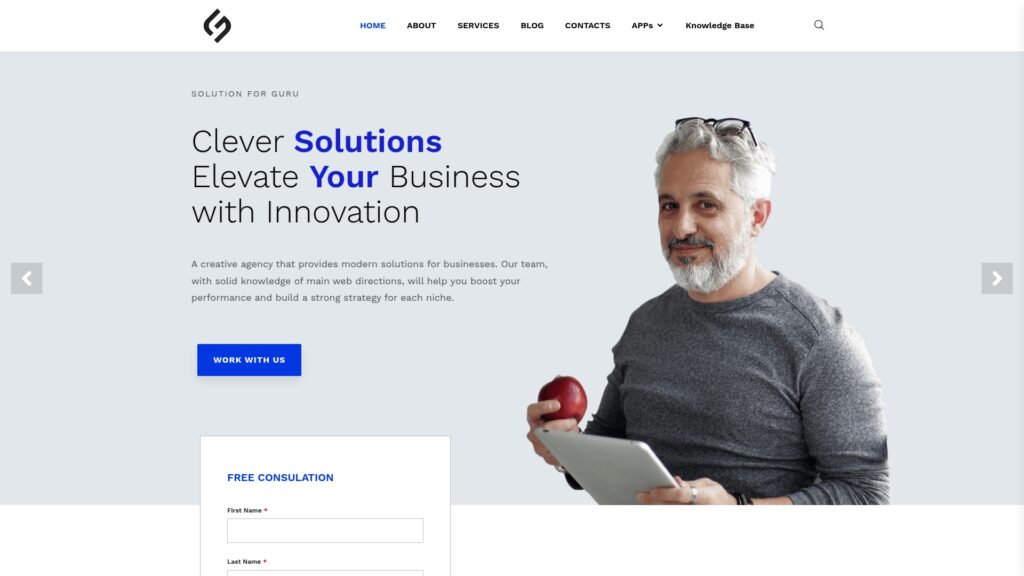
Key services Solution for Guru provides include:
- CRM & SaaS Integration: Configuring and customizing Creatio to integrate seamlessly with your existing business ecosystem
- AI & Automation Solutions: Leveraging Creatio’s AI agents and workflow automation capabilities to eliminate manual bottlenecks
- Custom Web Development: Building complementary web applications that extend Creatio’s functionality for unique business requirements
- Tech Consulting & Strategy: Developing a digital transformation roadmap that places Creatio at the center of your customer operations
- Cybersecurity & Data Protection: Ensuring your Creatio environment meets the rigorous data security standards expected by U.S. enterprise clients
- UI/UX Design: Tailoring Creatio’s Freedom UI to match your brand identity and improve user experience for your teams
Why Should U.S. Businesses Choose Solution for Guru Over Other Consultants?
What distinguishes Solution for Guru from generic IT consultancies is their client-first methodology. Rather than applying a one-size-fits-all template, their experts study each client’s specific workflows, goals, and operational challenges before recommending a configuration approach.
Furthermore, their team’s expertise spans multiple disciplines — from AI and automation to cybersecurity and e-commerce — which means they can address the broader digital ecosystem surrounding your Creatio implementation. This holistic perspective helps U.S. businesses avoid the common pitfall of deploying a CRM that works perfectly in isolation but fails to connect meaningfully with the rest of their technology stack.
Cooperation with Solution for Guru delivers concrete advantages:
- Faster time to value through structured onboarding and pre-built workflow templates
- Reduced implementation risk through thorough testing and phased deployment strategies
- Higher user adoption rates through customized training programs designed for your team
- Ongoing optimization as your business scales and your CRM requirements evolve
- Expert integration support connecting Creatio with ERPs, telephony systems, and marketing tools you already rely on
Recommended:
- How Does Zoho CRM Handle Multi-Pipeline Sales Architecture?
- How Does Creatio Improve Lead Management and Conversion Rates?
- Top CRM-Related Professions Every Modern Company Needs
- Using Zia AI for Predictive Sales Analytics: How Does It Transform Modern Sales Performance?
- Why Creatio CRM Is Gaining Popularity in the U.S. Market
- Can Pipedrive Scale with a Growing Sales Team?
- How Does Zoho CRM Reporting and Analytics Transform Sales Operations?
- Smart CRM Integration with Website and SEO for Growth
- What Are Lead Scoring Models in Zoho CRM and Why Do They Matter?
- Common Pipedrive Setup Mistakes and How to Fix Them
- How to Build Powerful Sales Reports in Pipedrive
- Zoho Projects + Zoho CRM: Managing Sales-to-Project Workflows
- Careers in CRM: Roles, Skills, and Career Paths
- What is CRM System Proficiency?