How to Foster Employee Engagement: A Manager’s Guide

TL;DR:
- Only 23% of employees worldwide are fully engaged at work, with most experiencing hidden disengagement caused by confusion and structural friction. Managers play a crucial role in engagement, with their daily coaching, recognition, and communication practices directly impacting team motivation and retention. Building a strong engagement culture requires consistent manager development, clear role expectations, specific recognition, and transparent communication systems.
Employee engagement is defined as the emotional and practical connection workers feel toward their work, their team, and their organization’s mission. Only 23% of employees are fully engaged at work globally. That number means three out of four people on your team are likely going through the motions. For HR managers and team leaders at small to medium-sized businesses, knowing how to foster employee engagement is not a soft skill. It is a core business function with direct impact on retention, productivity, and culture.
How to foster employee engagement through role clarity and purpose
The single most common cause of disengagement is not low pay or poor perks. It is confusion. Fewer than half of employees understand what is expected of them in their role. That gap creates daily frustration, wasted effort, and quiet disengagement that compounds over time.
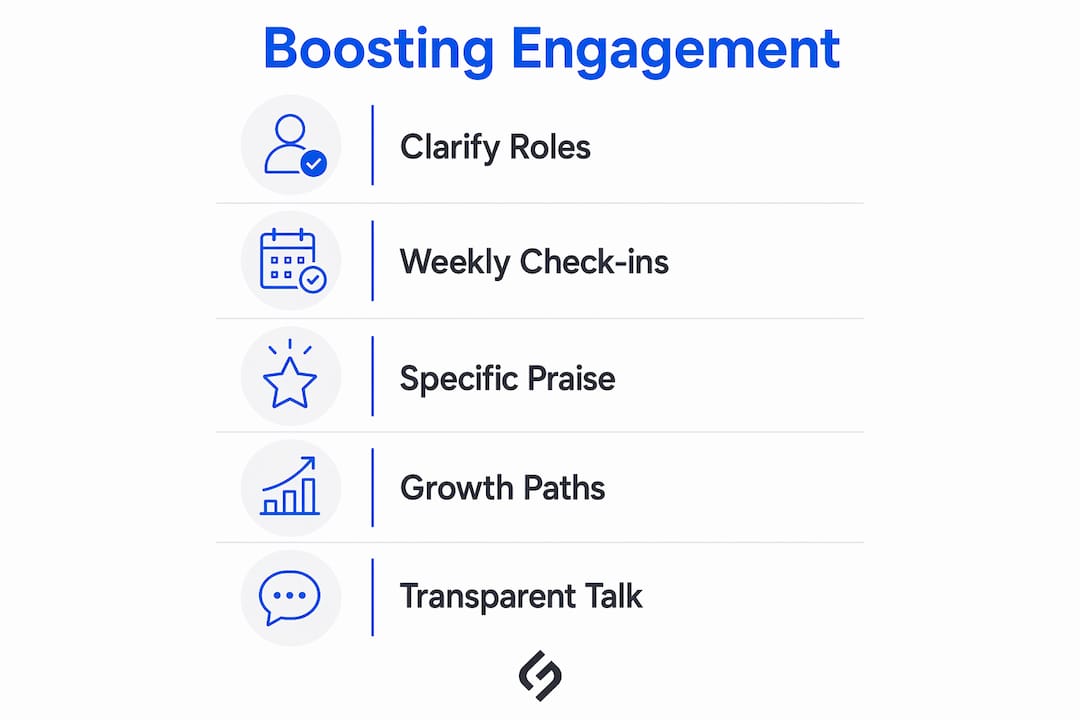
Structural friction causes more disengagement than lack of perks. Structural friction includes shifting priorities, overloaded roles, and unclear decision-making authority. When employees do not know what success looks like in their position, no amount of team lunches or recognition programs will fix the problem.
Clarifying role expectations starts with three specific actions:
- Define success metrics per role. Each team member should know exactly what “good” looks like for their position, measured in outcomes rather than activities.
- Reduce priority overload. When everything is urgent, nothing gets done well. Limit each person’s top priorities to three at any given time.
- Connect daily tasks to the company mission. Fewer than one in three employees feel strongly connected to their company’s mission. Managers who regularly explain why a task matters build that connection deliberately.
Pro Tip: Run a five-minute “clarity check” at the start of each week. Ask each team member to name their top three priorities. If their answers do not match yours, you have found the source of disengagement.
What role do managers play in employee engagement?
Managers account for 70% of the variance in team engagement scores. That single statistic reframes the entire conversation. Engagement is not an HR program. It is a management practice.

The most effective managers treat engagement as a daily discipline, not a quarterly initiative. Managers trained in coaching skills, including strengths-based feedback and recognition, drive measurably higher engagement than those who rely on performance reviews alone. The difference is not personality. It is skill, and skills can be taught.
Building manager capability requires a structured approach:
- Train managers in coaching conversations. Coaching is not therapy. It is asking questions that help employees solve their own problems and grow their own skills.
- Implement weekly 15-minute employee-led check-ins. These short meetings give employees the agenda. They discuss priorities, roadblocks, and progress. The manager listens and removes obstacles.
- Teach managers to apply the Progress Principle. Removing obstacles daily through manager-employee conversations activates intrinsic motivation. Small wins, made visible, build momentum.
- Hold managers accountable for engagement outcomes. Include team engagement scores in manager performance reviews. This signals that people development is core business infrastructure, not optional.
- Provide managers with feedback tools. Structured templates for one-on-ones, growth conversations, and recognition help managers stay consistent even under pressure.
Pro Tip: Give managers a simple one-on-one template with three fixed questions: What are you working on this week? What is slowing you down? What do you need from me? Consistency matters more than creativity here.
Weekly check-ins increase engagement by 3.6 times compared to annual reviews. That gap is not marginal. It reflects how much more effective frequent, small conversations are than infrequent, high-stakes evaluations.
Why does specific recognition outperform generic praise?
Recognition done well is more powerful than monetary rewards for many employees. The key word is “done well.” Generic praise such as “great job” or “keep it up” registers as noise. Specific, timely recognition using the SBI formula registers as genuine.
The SBI model stands for Situation, Behavior, and Impact. Effective recognition names the specific situation, describes the exact behavior observed, and explains the impact that behavior had on the team or the business. This approach transforms recognition from a feel-good ritual into a motivational signal.
| Recognition Type | Characteristics | Effect on Engagement |
|---|---|---|
| Generic praise | Vague, delayed, manager-only | Low retention of motivation |
| SBI-based recognition | Specific, timely, behavior-focused | High motivation and behavior repetition |
| Peer-to-peer recognition | Frequent, informal, culture-driven | Builds psychological safety and belonging |
| Formal reward programs | Infrequent, criteria-based | Useful but insufficient alone |
Building a recognition culture at the team level means making it a habit, not an event. Practical steps include:
- Recognize within 24 hours. Recognition loses impact the longer it is delayed after the behavior.
- Encourage peer recognition. Teams where colleagues recognize each other outperform those where recognition flows only from managers.
- Use recognition in team meetings. A two-minute recognition moment at the start of each meeting normalizes the practice without adding overhead.
For teams exploring recognition ideas beyond verbal feedback, client and team gifting strategies in tech environments offer a practical complement to verbal SBI-based recognition.
How do growth opportunities and psychological safety sustain engagement?
Career development is one of the top drivers of employee retention and long-term engagement. Employees who see a visible path forward stay engaged. Those who feel stuck leave, or worse, stay and disengage.
Intrinsic engagement requires both hygiene factors and motivators. Hygiene factors include fair pay, clear roles, and safe working conditions. Motivators include growth, autonomy, and purpose. Removing hygiene barriers is the floor. Building motivators is the ceiling. Most SMBs focus on the floor and wonder why engagement stays flat.
Psychological safety is the second pillar. Psychological safety enables employees to speak up without fear of embarrassment or retaliation. Teams with high psychological safety surface problems earlier, generate more ideas, and recover from mistakes faster. Leaders build it by responding to questions with curiosity rather than defensiveness.
Practical steps to build growth and safety:
- Hold quarterly growth conversations. These are separate from performance reviews. The focus is on skills, interests, and career direction.
- Create visible development paths. Even in small businesses, a clear progression from junior to senior roles signals that growth is possible.
- Model vulnerability as a leader. Managers who admit mistakes first give their teams permission to do the same.
Pro Tip: Ask each team member one question in your next one-on-one: “What skill do you most want to develop this year?” Then find one concrete way to support it. This single question signals that development is real, not rhetorical.
For teams managing remote or hybrid work, remote work engagement trends show that psychological safety and growth conversations matter even more when teams are distributed.
What communication practices build lasting engagement?
Transparent, frequent communication is the infrastructure that holds all other engagement efforts together. Without it, even strong recognition and clear roles erode under uncertainty and rumor.
Pulse surveys run on a regular cadence, with results acted on visibly, build more trust than annual engagement surveys. The key is closing the loop. When employees see that their feedback changed something, they trust the process. When feedback disappears into a report that no one references, they stop sharing honestly.
Effective communication practices for HR managers and team leaders include:
- Run pulse surveys monthly or quarterly. Keep them short, five to seven questions, focused on specific themes rather than everything at once.
- Share results transparently. Tell the team what the data showed, what you are changing, and what you cannot change and why.
- Communicate proactively during change. Silence during organizational disruption fills with anxiety. Regular updates, even when there is nothing new to report, reduce that anxiety.
- Create two-way channels. Town halls, anonymous suggestion tools, and open-door policies all serve different communication needs. Use more than one.
True engagement is built in daily leadership behaviors rather than one-off programs. Communication is the most visible of those daily behaviors. Every interaction a manager has with a team member either builds or erodes trust.
Key Takeaways
Managers who prioritize role clarity, weekly conversations, specific recognition, and visible growth paths build the conditions where engagement becomes self-sustaining rather than program-dependent.
| Point | Details |
|---|---|
| Role clarity drives engagement | Less than half of employees understand their role expectations; clarifying priorities reduces disengagement at the source. |
| Managers are the primary lever | Managers account for 70% of engagement variance; building their coaching skills produces the highest return. |
| SBI recognition outperforms generic praise | Naming the situation, behavior, and impact makes recognition motivating rather than performative. |
| Growth and safety sustain long-term commitment | Visible development paths and psychological safety keep employees engaged beyond the initial onboarding period. |
| Closing the feedback loop builds trust | Acting visibly on pulse survey results signals that employee input has real influence on decisions. |
What I have learned about engagement after years of watching programs fail
Most engagement initiatives fail for the same reason. They treat engagement as a destination rather than a daily practice. I have watched organizations roll out recognition platforms, redesign office spaces, and launch wellness programs, only to see engagement scores stay flat six months later. The programs were not wrong. The assumption was.
The real work happens in the conversation a manager has on a Tuesday afternoon when a team member is stuck. It happens when a leader admits they made a wrong call and asks the team how to fix it. It happens when someone’s contribution gets named specifically in a meeting rather than absorbed into a vague “team effort.” These moments are not scalable in the traditional sense. But they compound.
The SMB leaders I respect most treat manager development as core business infrastructure, not a training budget line item. They invest in coaching skills, one-on-one habits, and feedback fluency the same way they invest in technology or process. That is the shift that produces lasting results. Programs create awareness. Daily leadership behaviors create culture.
If I had to give one piece of advice to an HR manager starting an engagement initiative today, it would be this: fix the manager layer first. Everything else builds on that foundation.
How Solution For guru supports your engagement infrastructure
Building engagement at scale requires more than good intentions. It requires systems that make consistent communication, feedback collection, and manager accountability easier to maintain. Solution4guru works with small to medium-sized businesses to put the right digital infrastructure in place so that engagement practices do not collapse under operational pressure.
From workflow automation tools that reduce the structural friction your team faces daily, to platforms that support manager-employee communication and performance tracking, Solution4guru builds the technical foundation that keeps engagement programs running. The goal is not to replace leadership. It is to give leaders fewer barriers between intention and action. Reach out to Solution4guru for a free consultation and find out which tools fit your team’s current stage.
FAQ
Employee engagement is the emotional and practical connection a person feels toward their work and organization. Only 23% of employees are fully engaged globally, making it one of the most significant drivers of productivity and retention risk.
Managers account for 70% of the variance in team engagement scores. Their daily behaviors, including how they communicate, recognize effort, and remove obstacles, shape engagement more than any program or policy.
Effective pulse survey questions focus on role clarity, manager support, and growth. Examples include: “Do you know what is expected of you this week?” and “Did your manager remove a barrier for you recently?”
Weekly 15-minute employee-led check-ins increase engagement by 3.6 times compared to annual reviews. Monthly is the minimum effective frequency for sustaining motivation and trust.
SBI stands for Situation, Behavior, and Impact. It is a structured recognition method where the manager names the specific situation, describes the exact behavior observed, and explains the impact that behavior had. This specificity makes recognition motivating rather than generic.
Recommended
- Pipedrive CRM Onboarding and Staff Training: How to Achieve 90%+ Adoption Rates – Solution for Guru
- How to Drive CRM Adoption Across Your Team – Solution for Guru
- People Behind CRM Success: Roles That Drive Adoption and ROI – Solution for Guru
- Understanding Remote Team Management for Modern Businesses – Solution for Guru