Convert Branded Searches Into Trust: ORM Marketing for Marketers

ORM marketing is the ongoing practice of monitoring, shaping, and protecting what people find about a brand across search, reviews, and social channels, with the goal of turning that visibility into measurable trust. The outcome we aim for is discoverable trust: a branded search result, review profile, and social presence that a prospect can verify in minutes and feel confident acting on. The first move is simple. Run a quick audit of your branded search results today.
TL;DR:
- Most branded search results and review profiles should be verified and consistent across all platforms before additional marketing efforts begin.
- A review volume of around 40 recent reviews with active responses and a rating above 4.6 generally signals higher credibility than fewer, static reviews.
- Regular audits, at least monthly, see the most benefit for tracking the accuracy of listings, review activity, and addressing threats or negative content promptly.
- Monitoring responses and review solicitation should be part of a structured process with clear ownership, escalation, and SOPs for handling negative or suspicious content.
- Legal risks involve avoiding fake reviews and disclosing any partnerships or incentives, with platform reporting serving as the primary tool for removing false content.
Table of Contents
- What online reputation management is and how it differs from SEO, PR, and social media
- How ORM affects digital marketing outcomes and the buyer journey
- How to audit your current online reputation
- Core ORM strategies and operational playbook
- Tools, metrics, and KPIs for measuring ORM performance
- Compliance, platform policies, and legal risks
- How we implement ORM in client engagements
- Ongoing operational model: roles, frequency, and SOPs
- Strategies for proactive reputation building through influencer collaborations and partnerships
- Managing negative SEO and fake reviews
- Legal considerations beyond platform policies, such as defamation and takedown requests
- Trust architecture, not damage control
- How we can help you build an ORM program
- FAQ
- Sources
What online reputation management is and how it differs from SEO, PR, and social media
Online reputation management covers every surface where a prospect forms an opinion before they ever talk to sales: the first page of Google, your Google Business Profile, review sites like Yelp or industry-specific platforms, social mentions, and niche forums or community threads. ORM treats these as one connected system rather than separate channels.
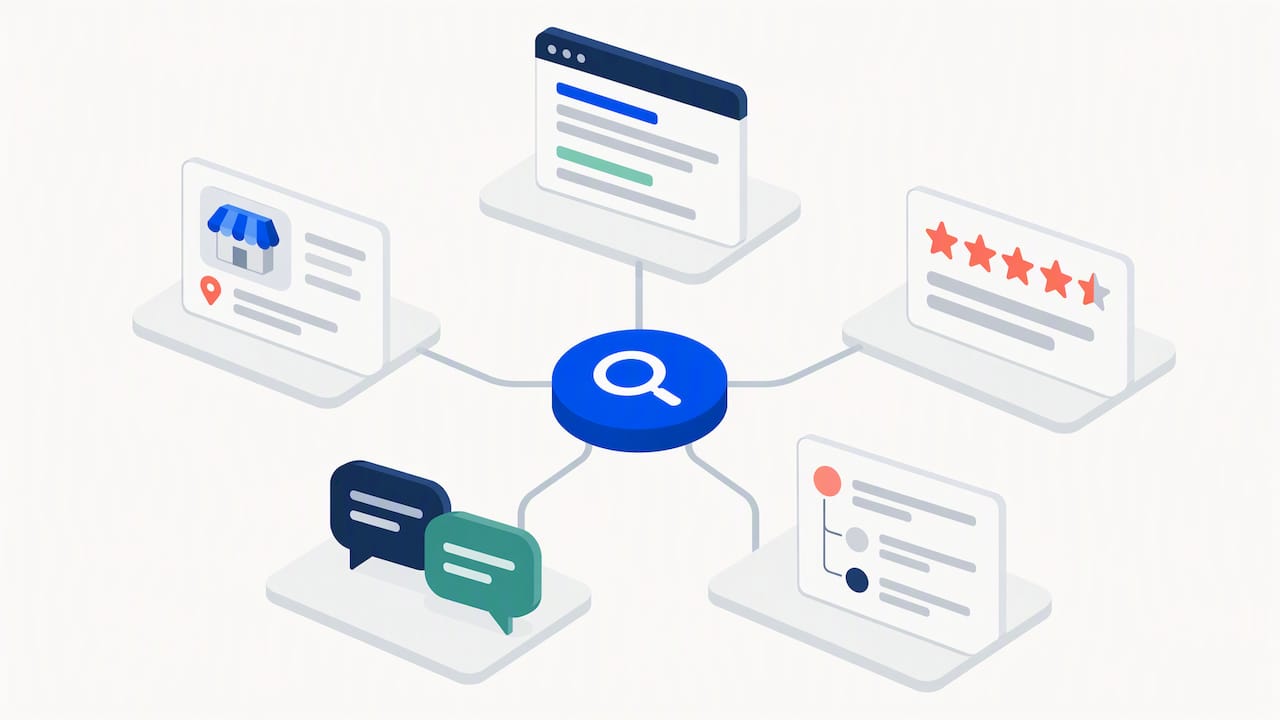
SEO and ORM overlap but are not the same discipline. SEO optimizes for ranking and traffic; ORM uses many of the same technical tools but optimizes for trust and verification. A page can rank well and still damage conversion if it surfaces outdated complaints or inconsistent business details. PR shapes a narrative through media and outreach; ORM focuses on the proof points a stranger can check themselves, star ratings, response patterns, consistent contact information, without needing a journalist in the middle.
The expected outputs of solid ORM work are concrete: a clean first-page search result, active review profiles with recent activity, and directory listings that agree on the same name, address, and phone number everywhere they appear. Those three things, taken together, form the baseline a marketing team should maintain before spending another dollar on acquisition.
How ORM affects digital marketing outcomes and the buyer journey
Reviews and ratings function as a trust layer that sits in front of every other marketing message. A prospect who sees a thoughtful owner response to a critical review often trusts the brand more than one who sees only five-star silence, because the response proves someone is actually listening. Research on review behavior shows that rating volume and detailed, verified reviews correlate strongly with purchase recommendations and buyer trust, often more reliably than a flawless average score alone.
Volume, recency, and response rate now carry more weight than a perfect star average. A profile with 40 recent reviews and a 4.6 rating tends to read as more credible than one with five reviews and a flat 5.0, because the larger pool with active responses reads as real evidence of ongoing operations rather than a curated snapshot.
ORM signals also feed a newer discovery layer. AI systems and search summarization tools pull from directory data, review sentiment, and social mentions to generate the quick answers users now see before they click anything. Marketing teams can track a short list of outcomes tied directly to this shift: branded search click-through rate, review response rate, and the share of first-page results that are owned or positive rather than third-party and uncontrolled.
How to audit your current online reputation
Before building anything new, find out what is already live. A structured audit takes a few hours and tells you exactly where to spend remediation effort first.
- Search your brand name and top product terms and record every result on page one, noting which ones you control and which you do not.
- Check your Google Business Profile for accuracy, photo quality, review count, and how recently you or a competitor last responded.
- Review major platforms relevant to your industry (Yelp, G2, Trustpilot, or sector-specific sites) for rating trends and unanswered complaints.
- Scan directories for NAP consistency, meaning your name, address, and phone number must match exactly across every listing.
- Search forums and community threads where your brand or category gets discussed unprompted, since these often outrank owned pages for long-tail branded queries.
- Sort every finding into threat, opportunity, or neutral, then prioritize threats that rank on page one above anything buried on page two or later.
This triage step matters more than the search itself. A single old complaint ranking in position three deserves faster attention than ten scattered mentions nobody sees.
Core ORM strategies and operational playbook
A working ORM system runs on four connected habits: monitoring, responding, creating, and amplifying. Skipping any one of them turns the other three into guesswork.
- Monitoring: set brand alerts across search, review platforms, and social mentions, with a named owner and a sentiment threshold that triggers same-day escalation for anything clearly negative.
- Responding: use a short template for negative feedback (acknowledge, apologize if warranted, move the conversation offline) and a faster, simpler template for positive reviews that thanks the reviewer by name where possible.
- Review solicitation: ask every customer at a consistent moment in their experience, through the same channel, without offering incentives tied to a positive rating.
- Content and SEO: publish owned pages that directly answer common branded searches, which is one of the practical tactics recommended by Ahrefs’ guidance on auditing and influencing branded search results, helping push outdated or negative pages further down the results.
- Crisis containment: for anything that spikes (a viral complaint, a coordinated review attack), respond publicly within hours with a factual holding statement, then follow through with a documented resolution once the facts are confirmed.
Publishing helpful, well-structured content also supports the SEO side of this work; our guide on building a content marketing strategy for SMBs walks through how to plan pages that answer branded queries directly.
Pro Tip: Keep a shared response log so two team members never answer the same review with conflicting information.
Tools, metrics, and KPIs for measuring ORM performance
Treat ORM like any other marketing function: set targets, track them weekly or monthly, and report trends rather than isolated snapshots.
- Average rating across your primary review platforms, tracked by quarter rather than reacting to single reviews.
- Review volume and velocity, meaning how many new reviews arrive per month and whether that pace is growing or stalling.
- Sentiment score, a rough positive-to-negative ratio across mentions, reviews, and social comments.
- Response rate and response time, since the FTC’s own guidance treats consistent, genuine responses and recent review activity as stronger trust signals than a flawless rating.
- Share of first-page positive assets, meaning how many of the top ten search results for your brand name are owned, neutral, or clearly positive.
Tool categories worth evaluating include brand monitoring platforms, dedicated review management software, listing aggregators that push NAP updates across directories at once, social listening tools, and rank trackers focused on branded SERPs. Report these numbers to leadership quarterly, tied to the same cadence as other marketing KPIs, so ORM reads as infrastructure rather than a side project.
Compliance, platform policies, and legal risks
The FTC’s Consumer Review Rule carries real teeth. Deceptive review practices, including fake reviews, suppressed negative feedback, or undisclosed insider reviews, can draw civil penalties that can reach five figures per violation. The agency has already sent warning letters to businesses flagging possible violations, a signal that enforcement attention is active, not theoretical.
Google applies its own restrictions on top of federal rules. Its policy explicitly disallows incentivized reviews and rating manipulation on Business Profile and Maps, and removes content that violates those terms.
The practical alternative is straightforward: ask every customer the same way, disclose any relationship with a reviewer, and never tie an incentive to a star rating. Transparent requests protect both your legal standing and your credibility.
How we implement ORM in client engagements
Our ORM engagements follow a consistent sequence: audit the branded search landscape, prioritize remediation by what ranks highest and hurts most, update listings and content to close the gaps, then hand off to monitoring and automation so the work doesn’t lapse. We build this into existing marketing operations rather than treating it as a separate cleanup project.
For teams already using a CRM, we connect review and reputation signals directly into that system so a negative review or support ticket triggers the same workflow a sales lead would. Our guide on connecting CRM data with website and SEO efforts covers how that integration typically works in practice.
Ongoing operational model: roles, frequency, and SOPs
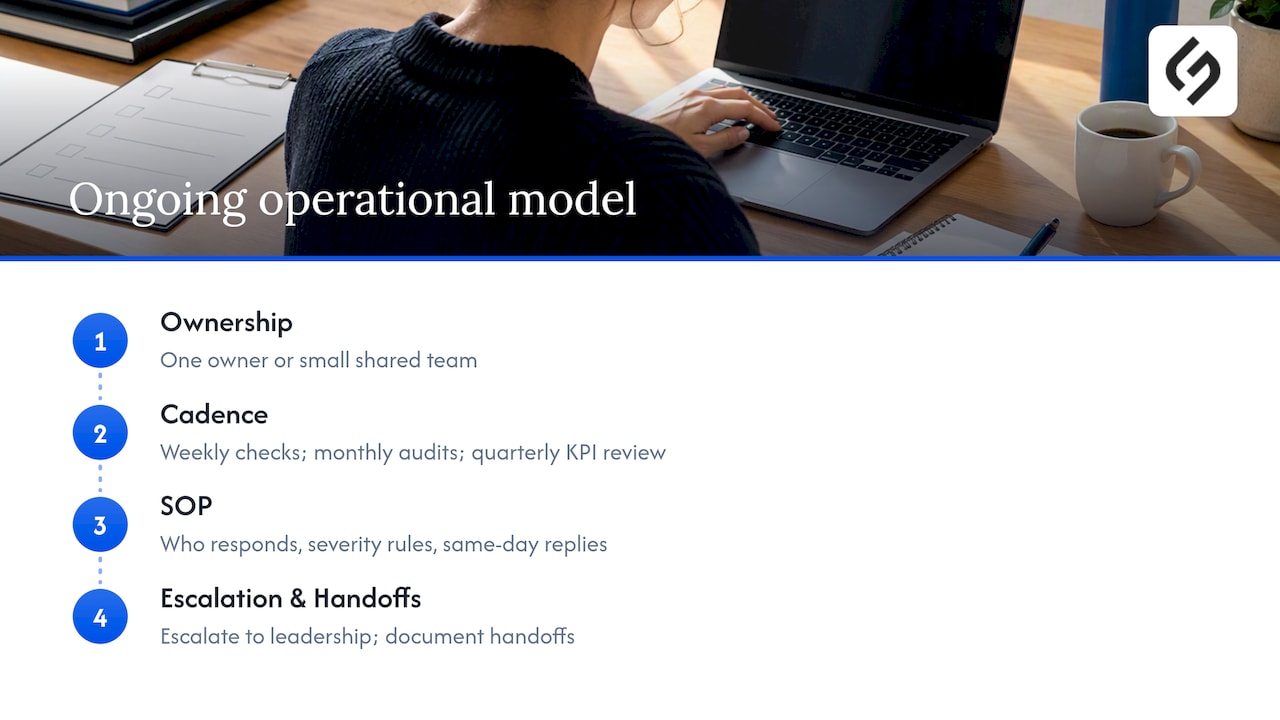
ORM fails most often when it has no owner. A sustainable model assigns one person or small team to monitoring and response, even if that role is shared across marketing and customer support. That owner needs a standing weekly check on new reviews and mentions, a monthly audit of branded search results and directory accuracy, and a quarterly review of KPIs against targets.
A written standard operating procedure removes guesswork from daily decisions. It should specify who responds to what severity of complaint, how fast a response must go out (same business day for anything public and negative is a reasonable baseline), and when an issue escalates from a frontline response to a leadership-reviewed statement. Documenting this once saves hours of improvised decisions later, especially when the usual owner is out.
Frequency matters as much as ownership. Reviews arriving steadily, with timely responses, read as healthier than a profile that goes quiet for months and then gets a burst of attention after a complaint. Build the review-response habit into the same rhythm as social posting or email sends, not as an afterthought triggered only by bad news.
Smaller teams without a dedicated ORM hire often fold this into an existing marketing coordinator’s weekly tasks, with clear escalation rules for anything beyond their authority to resolve. Larger organizations tend to split the role between a customer experience lead, who handles direct responses, and a marketing or SEO lead, who manages content and search visibility. Either structure works as long as the handoff between monitoring and action is written down, not assumed.
Strategies for proactive reputation building through influencer collaborations and partnerships
Reputation building works better when it starts before a crisis forces it. Partnering with credible voices in your industry, whether that’s a respected practitioner, a niche content creator, or a complementary business, gives prospects third-party validation they can’t get from your own marketing copy.
The most durable version of this looks less like a paid endorsement and more like a genuine working relationship: co-hosted webinars, joint case studies, or guest contributions that let an outside voice describe real results in their own words. These collaborations double as review-generation opportunities, since partners and their audiences are often willing to leave detailed, specific feedback after a shared project concludes.
Any paid or incentivized partnership needs clear disclosure under the same FTC framework that governs reviews and testimonials. A sponsored post or paid collaboration that implies an independent recommendation without disclosing payment creates the same legal exposure as an undisclosed incentivized review.
Partnerships also help diversify where your brand shows up in search and social results, which matters for the directory and AI-discovery angle covered earlier. A guest article on a partner’s site, a joint press mention, or a shared case study each adds another legitimate, controllable asset to the pool of content search engines and AI summarization tools draw from when answering branded queries. Treat these placements as reputation infrastructure, not one-off marketing stunts, and revisit them on the same audit cycle as your owned content.
Managing negative SEO and fake reviews
Negative SEO attacks, where a competitor or bad actor tries to damage your rankings or review profile deliberately, require a different response than organic criticism. Fake reviews are the most common version: a batch of suspiciously similar one-star reviews, often posted in a short window, sometimes from accounts with no other activity.
Document the pattern before acting. Screenshot the reviews, note timestamps, and check whether the accounts posting them show other signs of inauthenticity. Most major platforms, including Google, have a reporting mechanism for reviews that violate content policies, and Google’s own guidance confirms it will remove content that violates its prohibitions on fake or manipulated reviews. Reporting through the official channel is almost always faster and more durable than trying to argue the point publicly in a reply.
For suspected negative SEO beyond reviews, such as spammy backlinks pointed at your domain or scraped content republished to confuse search engines, a technical audit of your backlink profile is the right first step before assuming malicious intent. Not every ranking dip is an attack; some are algorithm updates or legitimate competitor improvement.
The broader defense against both fake reviews and negative SEO is the same trust architecture discussed throughout this guide: a steady stream of genuine, recent reviews and consistent directory data make a handful of fake negative signals easier to spot and less damaging when they do appear, because they stand out against an otherwise authentic pattern.
Legal considerations beyond platform policies, such as defamation and takedown requests
Platform reporting tools solve most fake review problems, but some situations cross into genuine legal territory. A review that makes a false factual claim, not just a negative opinion, can meet the bar for defamation in many jurisdictions. The distinction matters: a reviewer saying “the service was slow” is opinion; a reviewer falsely claiming “they stole my deposit” when no such thing occurred is a factual assertion that could be actionable if demonstrably false and damaging.
Before pursuing a legal route, most platforms offer a formal takedown or dispute process for content that violates their terms, and that path is typically faster and less costly than litigation. Save that option for reviews that are clearly fabricated, posted by someone with no verifiable relationship to your business, or that include false statements of fact rather than subjective complaints.
Because defamation law, consumer protection rules, and takedown procedures vary by jurisdiction, a specific, serious case is worth a conversation with legal counsel familiar with your market rather than a generic playbook. What’s consistent everywhere is the FTC’s underlying principle: reviews and testimonials need to reflect honest experiences, and the federal rule’s prohibitions extend to AI-generated or insider reviews posted without disclosure. That standard applies whether the deception comes from a competitor, an employee, or an automated tool.
Trust architecture, not damage control
Most teams still treat ORM as a fire extinguisher: grab it when a bad review goes viral, put it away once the noise dies down. That reactive posture guarantees you’re always behind, responding to a problem a stranger already saw before you did.
Trust architecture flips the sequence. Directory consistency, steady review flow, and clean branded search results become baseline infrastructure, maintained whether or not anything is currently on fire. That same consistency is what AI-driven discovery tools now reward, since they aggregate directory data and sentiment to build their own summaries. A short gut check for any team making this shift: is someone checking branded search weekly, is directory data identical everywhere it appears, and does every review get a response within a day? If any answer is no, you’re still doing damage control.
— Vadim
How we can help you build an ORM program
If auditing your own SERPs raised more questions than it answered, that’s the normal starting point, not a failure. We build ORM programs the same way we approach the rest of a client’s digital presence: as one connected system rather than disconnected tasks.
Our SEO & Digital Marketing work covers the branded content and technical fixes that push negative results down the page, while our CRM integration services connect review and sentiment data directly into the systems your sales and support teams already use. A typical engagement starts with the same audit outlined above, followed by a prioritized remediation plan, listing and content updates, and a monitoring setup so the work keeps running after we hand it off.
If you want a second set of eyes on your current branded search results, schedule a consultation with our team and we’ll walk through what we find.
FAQ
What is obm marketing?
This term is usually a misspelling of ORM marketing, short for online reputation management marketing. It refers to the ongoing practice of monitoring and shaping what people find about a brand across search results, reviews, and social platforms.
What is the difference between SEO and ORM?
SEO focuses on ranking content higher in search results and driving traffic, while ORM focuses on trust and verification, making sure what ranks accurately reflects the brand and doesn’t damage conversion. The two disciplines share technical tools but optimize for different outcomes, and most mature marketing programs run them together rather than separately.
What does ORM stand for in SEO?
In an SEO context, ORM stands for online reputation management, the practice of monitoring and influencing branded search results, reviews, and social mentions. It’s closely tied to SEO because many of the same tactics, like publishing branded content and tracking SERP positions, support both goals at once.
How often should a business audit its online reputation?
A full audit of branded search results, review profiles, and directory listings works well on a monthly cycle, with lighter monitoring happening weekly. Businesses in higher-risk industries or those recovering from a reputation incident often benefit from checking weekly until the picture stabilizes.
Can a business legally ask customers for reviews?
Yes, asking customers for honest reviews is legal and common practice, as long as the request doesn’t offer an incentive tied to a positive rating or suppress negative feedback. The FTC’s Consumer Review Rule specifically targets deceptive practices like incentivized or fake reviews, not the act of requesting reviews itself.
Sources
- The Consumer Reviews and Testimonials Rule: Questions and Answers | Federal Trade Commission
- Prohibited & restricted content – Google Business Profile Help
- The step-by-step guide to online reputation management for digital marketers | Ahrefs