Business Transformation Software: Leaders, Look Past Feature Lists

Business transformation management software is a platform that connects strategy to execution, giving leaders visibility into initiatives, controls to govern them, and data to measure the value they deliver. Research from Kearney finds that overall transformation success remains stuck near a 30 percent baseline, which is precisely why enterprise and mid-market program leaders turn to purpose-built platforms once alignment, adoption, or measurement become persistent blockers. We at Solution4guru work with transformation teams navigating this exact decision and can help assess whether a platform investment fits your program’s maturity.
TL;DR:
- Licensing often accounts for only 15 to 30 percent of total spend; services, data migration, and integration usually drive the larger costs.
- Roughly 60 percent of enterprise software implementations exceed initial budgets by 20 to 40 percent when complexity is underestimated, so phase delivery and lock scope.
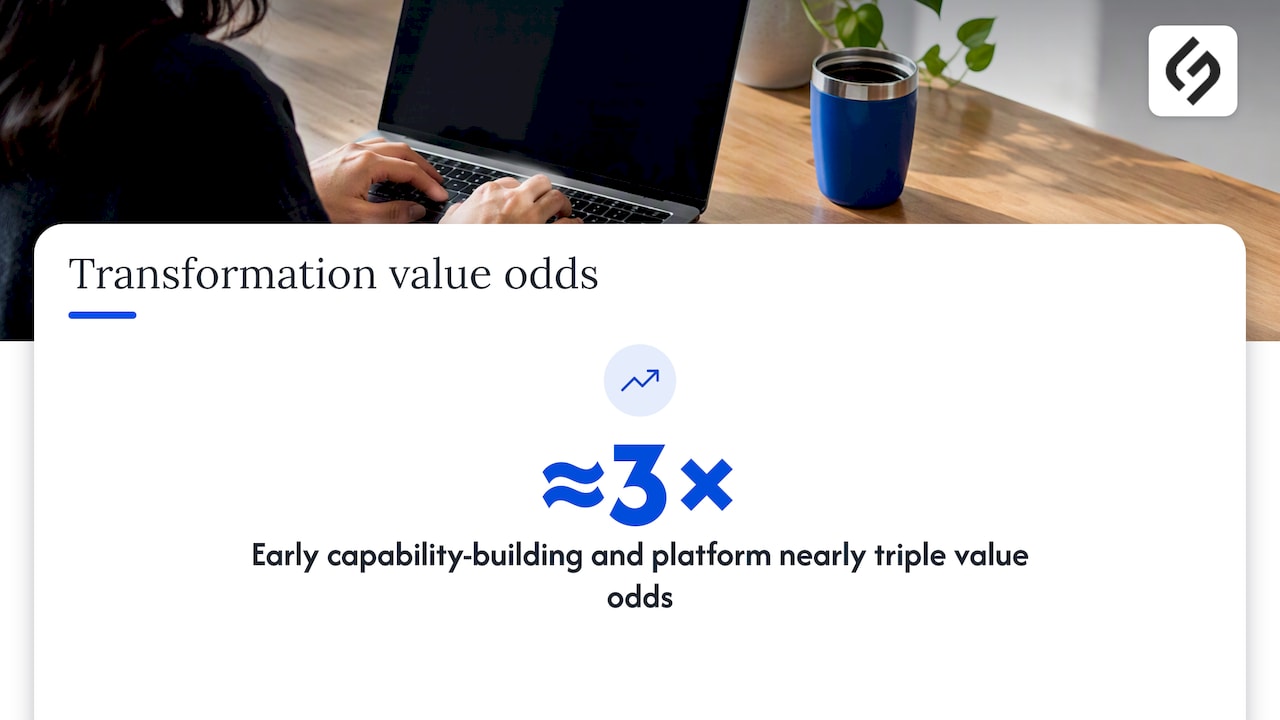
- Organizations that embed capability building and a platform from the start are nearly three times more likely to realize expected value, Kearney reports.
- During demos, bring a stalled initiative and test live dependency conflicts, value calculations, and approval audit trails against your own requirements.
- Treat the platform as a central layer, not another silo, and confirm it can integrate with ERP, CRM, HR, and IT service systems.
Table of Contents
- What These Platforms Actually Do: See, Align, Govern, Manage, Measure
- Core Capabilities to Evaluate Before You Buy
- Benefits and Measurable ROI: Evidence for Your Stakeholders
- Implementation Realities: Timeline, Cost, and How to Control Spend
- How to Evaluate and Choose a Transformation Platform
- Integration and Enterprise Architecture Considerations
- Change Adoption: How to Make the Software Stick
- Where AI Genuinely Helps in Transformation Platforms
- What Successful Transformation Programs Have in Common
- How We Support Transformation Programs at Solution4guru
- FAQ
- Sources
What These Platforms Actually Do: See, Align, Govern, Manage, Measure
Most transformation platforms organize their capabilities around several functions. Seeing means visibility into the current state of initiatives, processes, and dependencies, often through process intelligence or mining tools. Aligning connects individual initiatives back to strategic objectives and KPIs, so sponsors can prioritize a portfolio rather than manage disconnected projects. Governing adds the approval workflows, stage gates, and audit trails that steering committees require. Managing covers day-to-day execution: resourcing, dependency tracking, and bottleneck alerts. Measuring closes the loop by tying realized value back to the original business case.
Typical modules found across this category include:
- Process intelligence and discovery tools that map how work actually flows
- Enterprise architecture modules that document systems, data, and dependencies
- Program and portfolio management for scheduling, resourcing, and reporting
- Adoption and enablement tools, including in-app guidance and training workflows
- Analytics and forecasting dashboards for leadership reporting
The practical outcome leaders look for is a single source of truth that replaces scattered spreadsheets, faster go or no-go decisions on stalled initiatives, and clearer accountability when an initiative underperforms.
Core Capabilities to Evaluate Before You Buy
Vendor feature lists tend to use similar language, so it helps to translate each capability into what you should actually see during a demo.
Visibility and process intelligence. Look for discovery tools that pull from real system logs rather than relying on manager self-reporting. Real-time telemetry matters because stale process maps lead to decisions based on how work used to happen, not how it happens now.
Alignment. Strong platforms let you map every active initiative to a strategic objective and a KPI, then rank the portfolio by expected value and risk. Ask to see how the tool handles a conflict between two initiatives competing for the same resource.
Governance. Check for configurable stage gates, role-based approval chains, and an audit trail that satisfies your compliance function, not just a generic activity log.
Execution and resourcing. The platform should flag dependency risk and capacity constraints before they cause slippage, not after a milestone is missed.
Adoption enablement. In-app guidance, training cascades, and stakeholder engagement tracking indicate the vendor has built for behavior change, not just reporting.
During vendor demos, ask these questions:
- Can you show a live dependency conflict and how the system resolves or flags it?
- How is realized value calculated against the original business case?
- What does the audit trail capture for a rejected approval?
Pro Tip: Bring one of your own stalled initiatives to the demo and ask the vendor to model it live rather than using their canned example.
Benefits and Measurable ROI: Evidence for Your Stakeholders
The single most useful data point for a budget conversation comes from Kearney’s 2026 research. Transformation success has held near a 29 to 30 percent baseline, while organizations that embed capability-building and a purpose-built platform from the start are nearly three times more likely to realize the value they expected, according to the Kearney report. That gap between baseline performance and platform-supported performance is the business case, and it travels well in a steering committee presentation.
Beyond that headline figure, track benefits that map directly to what finance and the executive sponsor will ask about: realized value against the planned business case, the reduction in cost or schedule overruns, time-to-impact for new initiatives, and adoption KPIs that show whether people are actually using new processes.
Translate these into stakeholder-ready targets before you sign a contract: a value target tied to a dollar figure in the business case, an adoption threshold, such as the share of trained users who are active after rollout, and staged milestones that let the steering committee cut losses early if a metric stalls.
Implementation Realities: Timeline, Cost, and How to Control Spend
Software licensing is rarely the largest line item in a transformation program. According to ERP Research, implementation services, data migration, and integration work typically dominate the budget, with licensing often accounting for only 15 to 30 percent of total spend. A separate analysis from erpresearch.com finds that services, customization, and data migration overwhelmingly drive cost, and that roughly 60 percent of enterprise software implementations exceed their initial budget by 20 to 40 percent when complexity is underestimated.
Timelines scale with scope. The Dynamics 365 Implementation Guide describes a phased Initiate, Implement, Prepare, and Operate methodology, with small and mid-market deployments running a few months and multi-module enterprise programs extending much longer, driven again by services and data migration rather than licensing.
To control spend without cutting corners:
- Phase delivery around one business capability at a time rather than a big-bang rollout
- Lock scope before kickoff and manage changes through a formal request process
- Choose an implementation partner with direct experience in your industry’s data model
- Blend onshore oversight with offshore delivery capacity where it fits your governance needs
- Fund change management from the start rather than treating it as a contingency line
How to Evaluate and Choose a Transformation Platform
Selection goes faster when you start from your primary job-to-be-done rather than a feature checklist.
- Name the dominant problem first: portfolio governance, process discovery, enterprise architecture, or adoption, and shortlist vendors built for that job.
- Confirm integration readiness: check available APIs, prebuilt connectors, and whether the platform can serve as a genuine single source of truth against your existing systems.
- Model total cost of ownership, including the license, expected services spend, and any managed services option the vendor offers.
- Verify security, governance, and compliance controls against your industry’s requirements before the demo, not after.
- Score each vendor against key procurement questions: data residency, audit trail depth, API rate limits, uptime guarantees, support response times, training inclusions, contract exit terms, and pricing escalation clauses.
Pro Tip: Score vendors against your own weighted criteria sheet rather than their marketing comparison chart, since every vendor’s chart is built to favor itself.
Integration and Enterprise Architecture Considerations
A transformation platform works best as a central layer that pulls data from existing systems rather than a point solution that creates another silo. Before you commit, map which systems must feed it directly.
- ERP systems for financial and operational data tied to business cases
- CRM platforms for customer-facing initiative impact
- HRIS systems for workforce and capability tracking
- ITSM tools for change and incident data relevant to technology-driven initiatives
- Identity and analytics services for access control and reporting
Our guide to ERP and ITSM integration covers data readiness steps in more depth, including source inventory, master data ownership, and migration sequencing, all of which should be settled before the platform goes live.
Change Adoption: How to Make the Software Stick
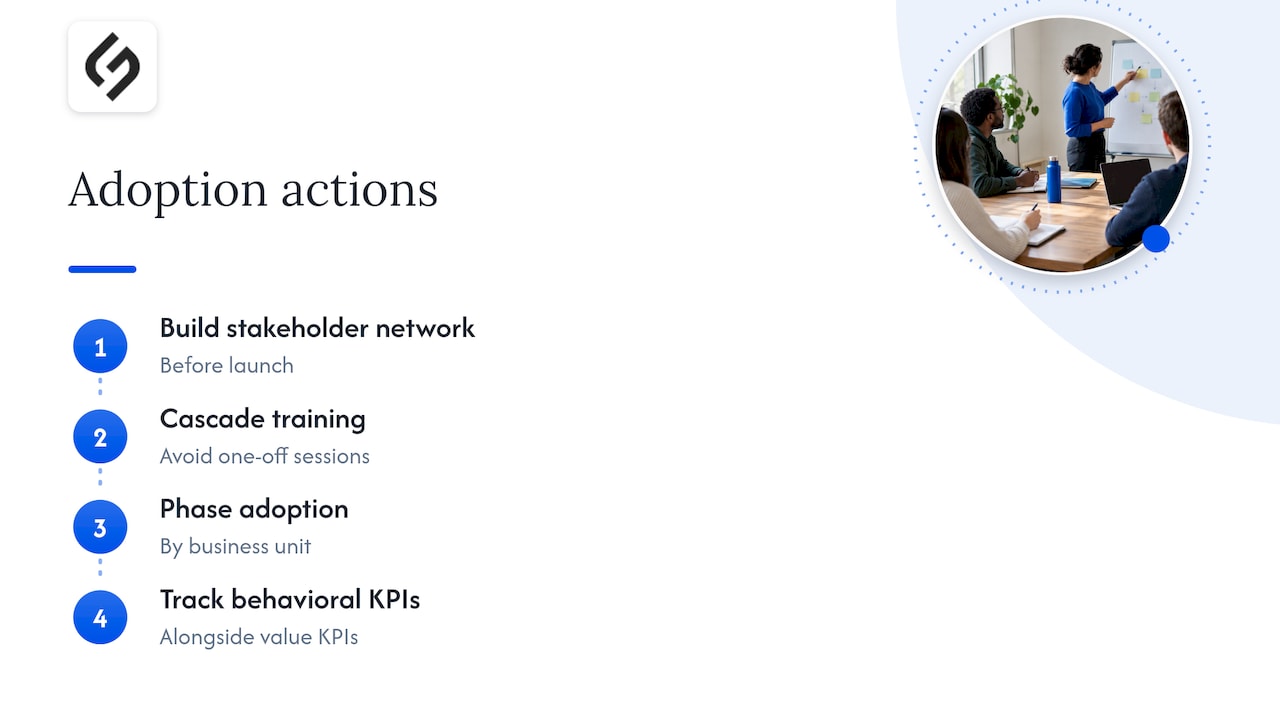
Organizational resistance to new ways of working, not technology, is the primary obstacle to transformation success, according to Kearney’s research. Building capability early, rather than after rollout, is what separates the programs that nearly triple their odds of success from those that stall. Build a stakeholder network before launch, run training in cascades rather than one-off sessions, phase adoption by business unit, and track behavioral KPIs alongside value KPIs so you can see whether people are using the system before you judge whether it worked.
Where AI Genuinely Helps in Transformation Platforms
AI features worth evaluating include predictive risk scoring on at-risk initiatives, resource prioritization across a crowded portfolio, anomaly detection in process data, and what-if simulation for scenario planning. Insist on auditability for any AI-driven recommendation and ask vendors to run a scenario against your own sample data during the demo rather than a prepared dataset.
What Successful Transformation Programs Have in Common
Across the engagements we support, the programs that deliver tend to share several habits: they scope strategy before touching a vendor contract, they fund change management as seriously as they fund the software license, and they roll out in phases tied to measurable milestones rather than a single enterprise-wide launch. Governance frameworks like those detailed by Boards reinforce the same pattern: auditable, stage-gated workflows can offer advantages over informal tracking.
— Vadim
How We Support Transformation Programs at Solution4guru
We help transformation and program leaders turn platform capability into realized value, through digital transformation consulting, CRM and SaaS integration work, and AI and automation implementation.
- Our digital transformation consulting work scopes strategy before any platform decision gets made.
- Our CRM and SaaS integration services support integration with the systems that already run your business.
- Our AI and automation work supports businesses implementing AI and automation.
If your team already has strong internal capability, expanding it with a focused project engagement is usually faster than a full consulting retainer; if alignment, governance, or integration keeps stalling, a partner engagement tends to close that gap sooner. Visit our services page to review what we cover or book a free consultation to talk through your current roadmap.
FAQ
What is business transformation management software?
It is a platform that connects strategic objectives to active initiatives, giving leaders visibility, governance controls, and value measurement in one system. It typically replaces spreadsheets and disconnected project trackers with a single source of truth.
How long does implementation typically take?
Timelines scale with scope: small and mid-market deployments often run a few months, while enterprise multi-module programs extend considerably longer, according to the Dynamics 365 Implementation Guide. Services and data migration, not licensing, drive most of that timeline.
What drives the cost of these platforms beyond the license fee?
Implementation services, data migration, and integration work typically account for the largest share of spend, with licensing often making up only 15 to 30 percent of total cost, per ERP Research. Underestimating complexity is a common reason budgets run over.
How do we measure the ROI of a transformation platform?
Track realized value against your original business case, adoption thresholds such as active usage after rollout, and reductions in cost or schedule overruns. Kearney’s research links early capability-building and platform adoption to a near-tripling of success rates compared with fragmented approaches, as detailed in the Kearney report.
Should we hire a consultant or build this capability internally?
If your team already has strategy, governance, and integration expertise, expanding capacity with a focused engagement is usually enough. If alignment, platform integration, or change management are recurring blockers, working with a consulting partner like our team at Solution4guru tends to close the gap faster than building from scratch.
Sources
- Kearney report: transformation success remains stuck around 30 percent despite surge in AI investments
- Oracle ERP Cloud Implementation Cost (2026) | ERP Research