
Digital Marketing IT Company: How to Choose the Right One

A digital marketing IT company combines two disciplines that used to sit in separate vendors: marketing execution (SEO, content, paid media, lifecycle campaigns) and the technology underneath it (websites, CRM, automation, data integration, security). The best choice for most mid-sized businesses is a partner that can do both, because marketing results increasingly depend on how well the systems behind the campaigns are built and connected. This guide explains what such a company delivers, where the model fits, and how to vet one before signing.
TL;DR
- A digital marketing IT company covers campaigns and the technology stack that supports them: website, CRM, automation, analytics, and data protection.
- Technology spend is rising faster than the ability to use it: 61% of organizations still struggle to use their data effectively, which is the gap this model is meant to close.
- Judge candidates on revenue-linked measurement, integration depth, and the quality of their first 90-day plan, not on their client logos.
- Write a real brief before you contact anyone. A weak brief wastes time on both sides.
- Choose a project engagement for a defined build and a retainer for ongoing optimization.
Table of Contents
- What a Digital Marketing IT Company Actually Does
- How It Differs From a Traditional Agency or an In-House Hire
- When This Model Fits, and When It Does Not
- Seven Criteria for Vetting a Provider
- Write the Brief Before You Talk to Providers
- Project or Retainer: Choosing the Engagement Model
- Red Flags During Evaluation
- Perspective: Strategy First, Tools Second
- Questions to Ask in the First Meeting
- How Solution4Guru Can Help
- FAQ
- Sources
What a Digital Marketing IT Company Actually Does
The phrase covers a wide range, so it helps to separate the layers.
Marketing layer. Search engine optimization, paid search and social, content, email, and reputation management. This is the work most people picture when they hear “digital marketing agency.”
Technology layer. Website development and UX, e-commerce builds, CRM implementation, marketing automation, integrations between SaaS platforms, and the security and data protection that keep those systems trustworthy.
Strategy layer. Deciding which tools and channels deserve investment, how data should flow between them, and which metrics prove that the work is paying off.
A traditional creative or media agency is strong on the first layer. A pure IT consultancy is strong on the second. The hybrid model exists because the layers fail together. A well-targeted campaign that lands on a slow, poorly tracked site, whose leads never reach the CRM, produces no measurable result.
Why the hybrid model has gained ground
Marketing technology now consumes a large share of budgets. According to the 2025 State of Martech report, martech accounts for 31.4% of total marketing budgets, and the average enterprise stack holds 62 tools. The same report finds that 32% of organizations are affected by talent shortages. Buying tools is easy. Configuring them, connecting them, and turning their output into decisions is where most teams stall.
That is the practical argument for a partner that understands both marketing and systems: it addresses the distance between what a company has bought and what it can use.
How It Differs From a Traditional Agency or an In-House Hire
| Criterion | Traditional marketing agency | Digital marketing IT company | In-house team |
|---|---|---|---|
| Campaign execution | Core strength | Strong, tied to systems | Depends on headcount |
| Website and CRM builds | Often subcontracted | Delivered directly | Needs developers |
| Integrations and automation | Limited | Core strength | Slow to staff |
| Data and security | Rarely owned | Included in scope | Needs specialists |
| Speed to start | Weeks | Weeks | Months (hiring) |
| Best for | Brand and media-led growth | Growth that depends on systems and data | Stable, long-term workloads |
There is also a question of relationship type. A procurement guide from the PM Society notes that if you have a fully considered strategy and a one-off project, a vendor-style relationship may suit you, while a more collaborative need points toward an agency partnership. Decide which one you are buying before you shortlist.
When This Model Fits, and When It Does Not
It fits when:
- Your leads come from the website but sales cannot see where they originate.
- You run several tools (CRM, email, ticketing, billing) that do not exchange data cleanly.
- You want automation for lead routing, follow-up, or invoicing but lack engineering capacity. Our guide to automation examples for SMBs shows what quick wins look like.
- A site redesign, a CRM migration, and an SEO program are all on the roadmap and need to be sequenced.
It fits less well when you need only a single narrow service, such as a one-time logo or a short media buy. A specialist is usually cheaper for that.
Seven Criteria for Vetting a Provider
1. Measurement tied to revenue
Traffic and impressions are inputs. Ask how the provider connects activity to pipeline, customer acquisition cost, and closed revenue. The Duke CMO Survey reports that marketing leaders face greater pressure to demonstrate ROI even as their influence grows. A provider who cannot describe how a lead is tracked from first click to signed contract will struggle to defend its own results.
It also helps to test your own efficiency logic. A clear model of how analytics feed decisions, such as the one described in this piece on document analytics and follow-up timing for founders, shows how much faster teams act when signals are visible.
2. Integration depth
Request examples of CRM and SaaS integrations the team has completed, and ask what broke along the way. Our article on integrating a CRM with your website and SEO covers the data points that most often go missing: form source, campaign parameters, and lifecycle stage.
3. A people-first approach to search
Google states that its ranking systems are designed to prioritize helpful, reliable information created to benefit people, not content built to manipulate rankings. A provider that promises ranking shortcuts is selling risk. Look for an SEO method built on expert content, sound technical foundations, and clear site structure.
4. A plan for AI-driven search
Search behavior is shifting toward synthesized answers. An IBM Institute for Business Value study cited in the 2025 CMO report found that, across 300,000 keywords, an AI overview correlated with a 34.5% lower average click-through rate for the top traditional result. Ask each candidate how it adapts content and structured data so that your brand is cited in answers as well as ranked in listings. A credible answer is specific, not a slogan.
5. Responsible use of AI in delivery
AI is now part of daily marketing work. The CMO Survey reports that AI powers 17.2% of marketing efforts, with leaders projecting 44.2% within three years, and that adopters reported lower overhead and higher sales productivity. Ask where the provider uses AI, who reviews the output, and how your data is handled. For examples of automation that personalizes outreach, see how an AI-powered wholesale outreach platform matches buyers to products and manages follow-up.
6. Security and data protection
A company that connects your CRM, website, and payment flows holds the keys to customer data. Ask about access controls, credential handling, backups, and what happens to your accounts when the engagement ends. Your assets (domains, analytics properties, ad accounts, CRM instances) should always be registered in your name.
7. A realistic first 90 days
Request a written plan with milestones: audit, quick wins, build, launch, and first reporting cycle. Vague promises of “growth” are a signal to walk away. A sequenced plan such as the five-phase digital transformation model gives you a reference for what a structured roadmap looks like.
Write the Brief Before You Talk to Providers
Most failed engagements begin with an incomplete brief. The 2025 Pitchcode guidelines state that clients should give shortlisted agencies a clear and complete briefing, including background on the client, its brands, and key challenges. Without it, providers guess, and proposals become incomparable.
A workable brief for a digital marketing IT engagement includes:
- Business goal: a revenue or pipeline target with a deadline.
- Current stack: CRM, CMS, email, analytics, ad accounts, and known pain points.
- Constraints: budget range, compliance needs, internal owners, launch dates.
- Scope boundaries: what is in, what is out, and what is optional.
- Selection criteria: how you will score proposals, and who decides.
The hidden cost of choosing badly
Selection itself costs money. A 2024 agency search report found that companies spend an average of $915 in internal salary cost for every 15-hour search effort, and that 65% of those searching have used Google. A defined scorecard shortens that process and reduces the risk of a mismatch that surfaces six months into a contract.
Project or Retainer: Choosing the Engagement Model
Project engagements suit defined builds: a website redesign, a CRM implementation, a data migration, or an e-commerce launch. Scope, deliverables, and price are fixed up front. Before a redesign, an audit-driven website redesign checklist helps protect SEO equity and accessibility.
Retainers suit work that never really finishes: SEO, content, CRM administration, conversion optimization, and website upkeep. The value comes from continuous improvement rather than a single delivery. A website maintenance checklist shows how much recurring work a live site needs.
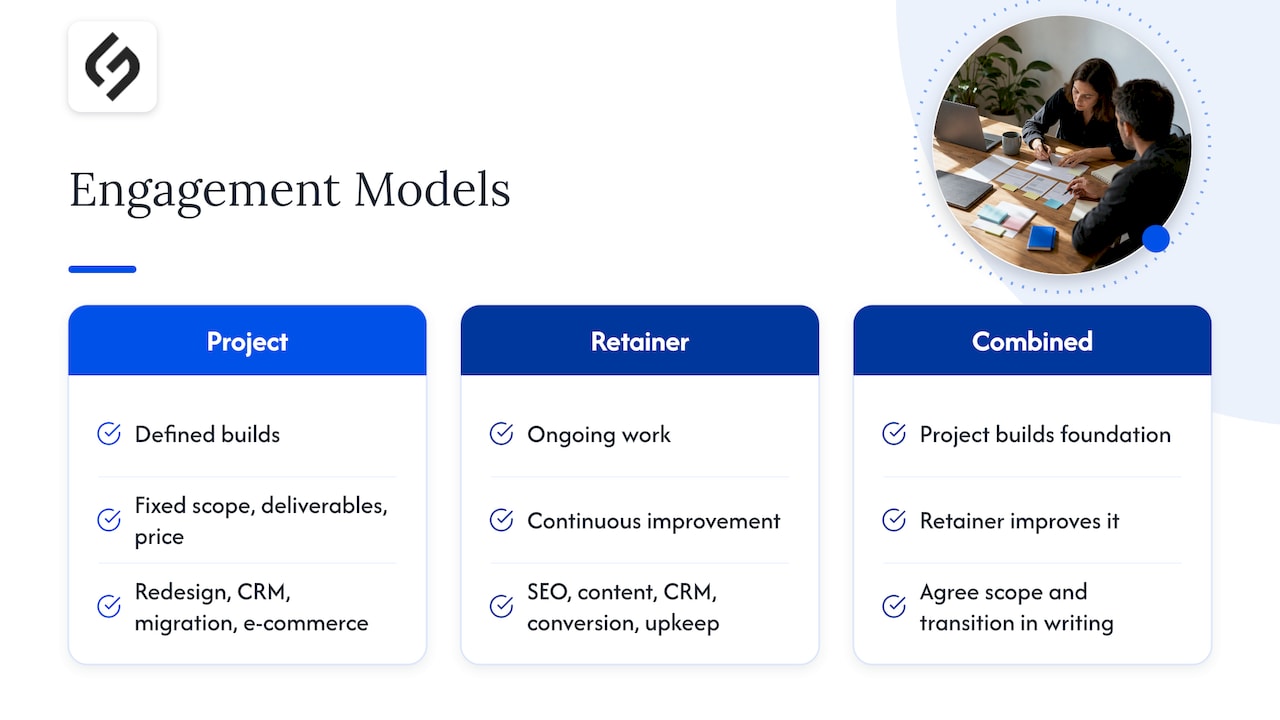
Many businesses combine the two: a project to build the foundation, then a retainer to improve it. Agree in writing how each phase is scoped and how the move from one to the other works.
Red Flags During Evaluation
- Guaranteed rankings or leads. No honest provider controls search algorithms or buyer behavior.
- Template-only delivery. If every client receives the same site and the same automations, your workflows will be forced to fit the template.
- Opaque reporting. You should have direct access to dashboards and raw data.
- No questions asked. A good provider challenges your assumptions during discovery.
- Tool-first recommendations. A recommendation of a platform before an understanding of your process is a sales motion, not strategy. Our view on how CMOs choose a digital marketing platform starts from identity and data, not feature lists.
Perspective: Strategy First, Tools Second
We have seen the same pattern across web, CRM, and automation projects. A business buys a capable platform, switches on the defaults, and then wonders why reporting is unreliable and sales still chase leads by hand. The platform was never the problem. The missing piece was a design for how information should move through the company.
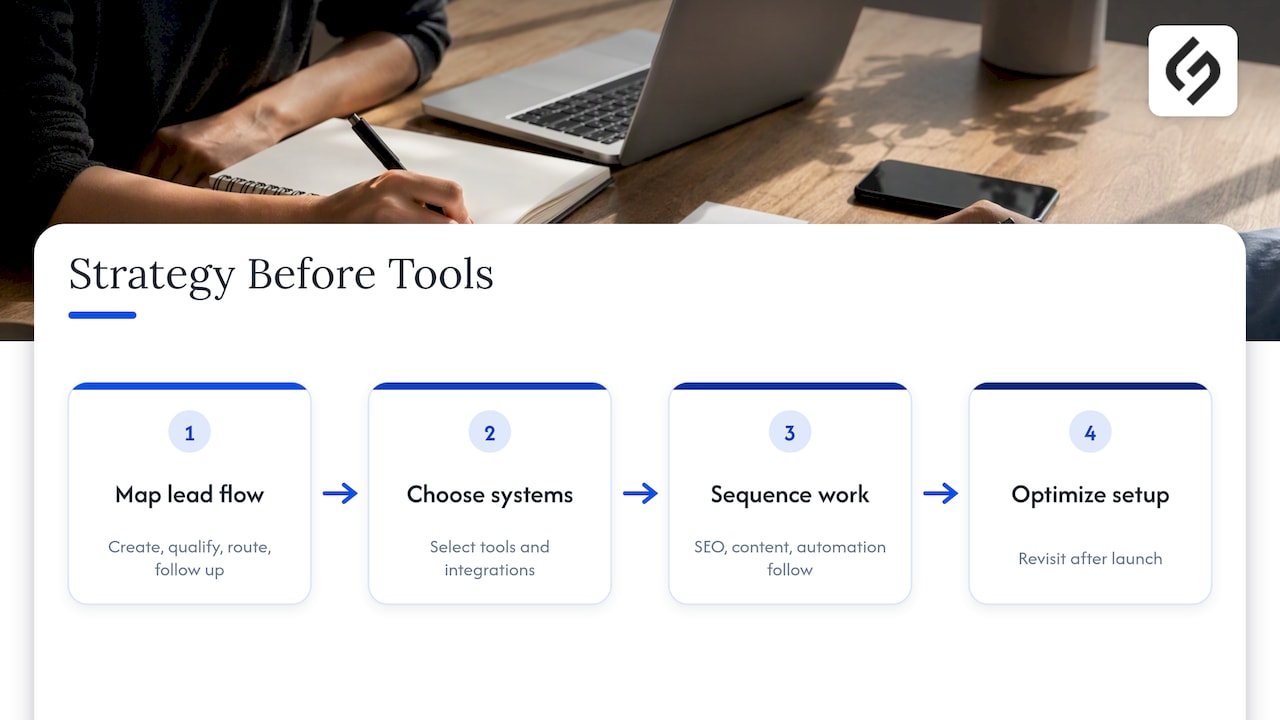
That is why our projects begin with the business model and the workflow, not a template. We map how a lead is created, qualified, routed, and followed up, then decide which systems and integrations support that path. SEO, content, and automation work are sequenced behind it. After launch, we continue optimizing, because a setup that is never revisited drifts out of step with the business.
The 2025 State of Martech report describes CMOs moving toward “Return on Time” as a performance focus: how quickly technology produces measurable outcomes. We agree with that direction. The most useful question to ask any provider, including us, is how soon a client will see a measurable change in a number that matters to the business, and how that change will be verified.
Questions to Ask in the First Meeting
Use these to compare providers on equal terms:
- Which of our current tools would you keep, replace, or retire, and why?
- How will you track a lead from first visit to closed deal?
- Who owns the accounts, code, and data at the end of the engagement?
- How do you use AI in your own delivery, and how is client data protected?
- What would you do in the first 30 days, and what would you need from us?
- What does a failed engagement look like, and how do you handle it?
End each meeting by scoring the provider against your criteria while the conversation is fresh. It is a small habit that makes final comparisons much easier.
How Solution For Guru Can Help
We deliver the full range described above under one roof: custom web development, UI/UX design, SEO and digital marketing, AI and automation, e-commerce, CRM and SaaS integration, cybersecurity, and tech consulting. For teams running on HubSpot, our HubSpot services include implementation, integration, data migration, custom Marketing Hub development, process automation, and ongoing administration. Projects are tailored to each client’s model and workflows, and we offer a free consultation to scope the work. Pricing is set per engagement, so no fixed rates are published.
FAQ
It is a provider that combines marketing services, such as SEO, content, and paid media, with technology work, such as website development, CRM implementation, automation, and integrations. The combination lets one team own both the campaign and the systems that capture and act on the results.
A standard agency concentrates on campaigns and creative, and often relies on other vendors for development and system integration. A digital marketing IT company handles those technical layers directly, which reduces handoffs between suppliers and keeps tracking and data flow consistent.
Most small businesses lack the budget to hire strategists, developers, and analysts at once. An external partner provides those skills on a project or retainer basis. As volume grows, many companies hire a marketing lead in-house and keep a partner for specialized builds.
Prepare a written brief with your business goal, current tools, budget range, constraints, and selection criteria. A clear brief produces comparable proposals and spares both sides from wasted effort, as the Pitchcode guidelines also stress.
Sources
- The State of Martech & Marketing Operations Report 2025
- Marketing’s Strategic Influence Expands, As Does Scrutiny (Duke Fuqua)
- 2025 CMO Study, IBM Institute for Business Value
- Creating Helpful, Reliable, People-First Content (Google Search Central)
- The Agency Search Report (Sortlist)
- Pitchcode 2025