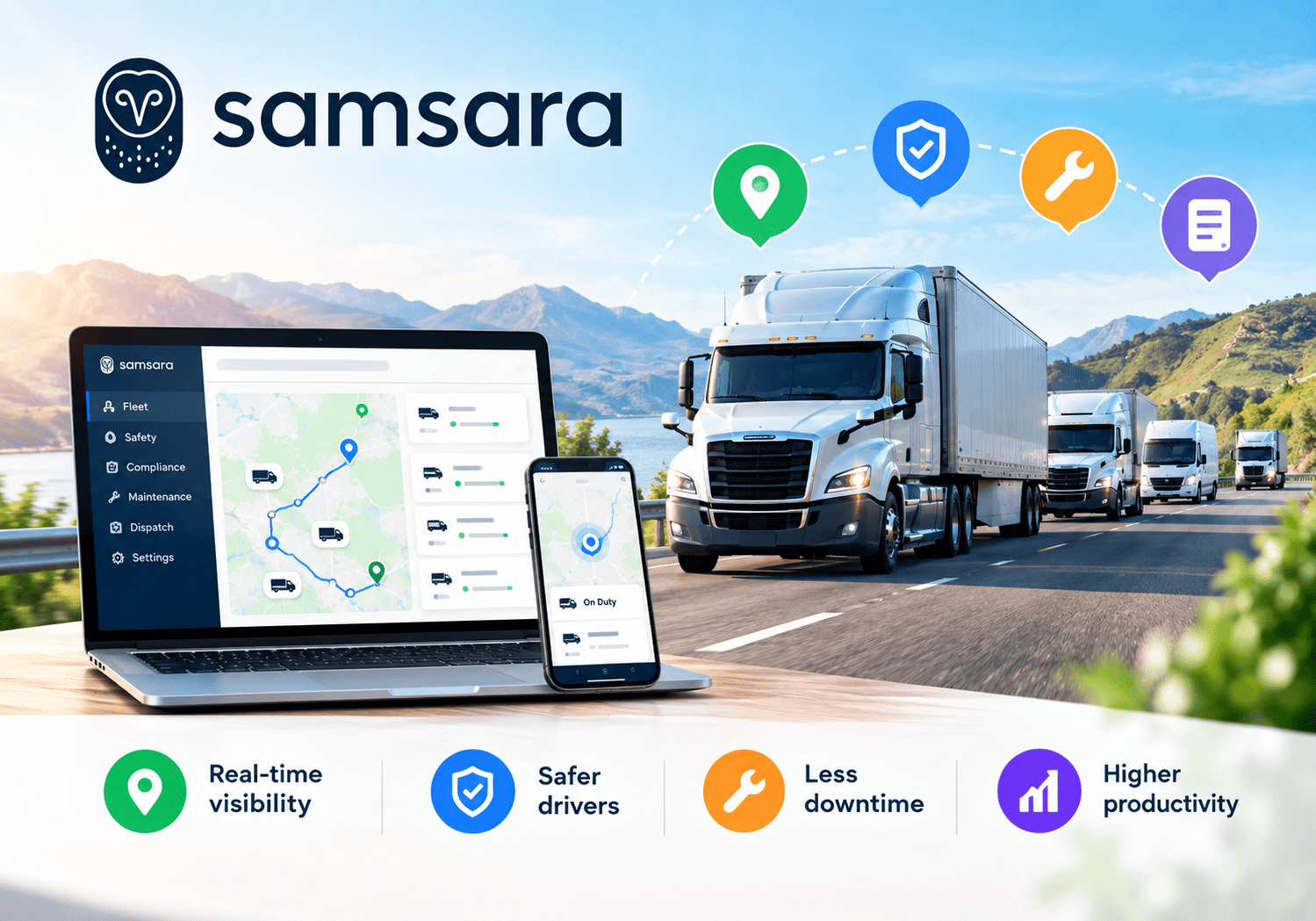
Why Do Construction Companies Choose Motive?

Construction companies run trucks, trailers, and heavy equipment across many job sites at once. Every idle hour, missed inspection, or unsafe trip costs money. Motive gives these fleets one platform for GPS tracking, driver safety, compliance, and asset visibility. This guide explains why construction firms pick Motive, what the platform offers, and what to check before you buy.
Table of contents
What Should You Know About Motive for Construction at a Glance?
- Why construction firms choose it: Motive combines vehicle tracking, equipment monitoring, driver safety, compliance, and fuel spend in one platform.
- Equipment visibility: Hardware options cover heavy equipment, trailers, generators, containers, and small tools.
- Safety: The AI Dashcam detects more than 15 unsafe driving behaviors, and Motive reports that customers cut collisions by 80% on average.
- Compliance: An FMCSA-registered ELD supports hours of service, inspections, and IFTA fuel tax reporting.
- Cost: Motive does not publish pricing, and third-party reviews estimate basic plans at around $25 per vehicle per month before hardware.
- Watch-outs: Maintenance tools stay basic, and some reviewers report billing and support problems.
What Is Motive – GPS Fleet Tracking System & Solutions, and Why Does It Matter to Construction?

What Does Motive Offer?
Motive – GPS Fleet Tracking System & Solutions is a fleet management and telematics platform, formerly known as KeepTruckin. According to a 2026 review, it offers vehicle tracking, driver-behavior monitoring, dash cams, asset tracking, and compliance tools for fleets of all sizes. Motive also sells a fleet card and equipment monitoring, so one account can cover vehicles, equipment, and fuel spend.
What Is the Topic of This Article?
This article explains why construction companies choose Motive. Construction fleets differ from ordinary delivery fleets, because they combine road vehicles with heavy equipment, trailers, and tools that move between job sites. Motive’s construction page positions the platform as an integrated way to protect drivers, equipment, schedules, and budgets.
How Does This Guide Evaluate the Platform?
The sections below follow the questions that a construction operations manager asks: Where is my equipment? Are my drivers safe? Do I meet compliance rules? What will it cost? Along the way, the guide also flags limits that buyers should test before they sign.
What Challenges Do Construction Fleets Face Every Day?

Why Is Construction Fleet Management So Complex?
Construction companies manage several asset types at once: pickup trucks, dump trucks, trailers, excavators, generators, and small tools. Each asset moves between job sites on a changing schedule, and many of them operate away from a fixed yard. Consequently, managers often lose track of where equipment sits, who uses it, and how long it runs.
Which Problems Cost the Most Money?
Motive states on its asset tracking page that underutilized, misplaced, or stolen equipment costs construction companies hundreds of millions of dollars every year. In addition, several other issues drain budgets:
- Idle equipment: Machines sit unused on one site while another site rents the same type.
- Theft and misuse: Unmonitored tools and trailers disappear or serve personal use.
- Unsafe driving: Crashes injure workers and raise insurance costs.
- Compliance gaps: Missed inspections and logbook errors lead to violations.
- Fuel waste: Idling and unauthorized fuel purchases add up quickly.
How Do Fragmented Tools Make It Worse?
Many contractors use one tool for GPS, another for cameras, a third for fuel cards, and spreadsheets for equipment. As a result, data stays in silos, and managers spend time reconciling reports instead of acting on them. Motive – GPS Fleet Tracking System & Solutions addresses this problem by bringing safety, fleet, spend, and equipment data together.
Which Construction Businesses Can Use Motive?
Motive states that it works with all construction sub-industries. Each segment runs a different asset mix. A residential electrician may track a dozen vans, while a civil contractor may track excavators, trailers, and haul trucks across several sites. Because the platform covers vehicles and equipment, both types of firms can start with the assets that cost them the most and expand later.
How Does Motive Track Vehicles and Construction Equipment?
Which Hardware Does Motive Use?
Motive matches the hardware to the asset. According to its construction asset tracking page, the Vehicle Gateway and Asset Gateway cover vehicles and heavy equipment. The Asset Gateway Mini and Motive Beacon track trailers, generators, containers, and small equipment. In addition, Motive integrates with OEM telematics, so mixed fleets can bring machine data into the same dashboard.
| Asset type | Motive tracking option | What managers see |
|---|---|---|
| Pickup and dump trucks | Vehicle Gateway or AI Dashcam Plus | Location, trips, driver behavior |
| Heavy equipment | Asset Gateway or OEM telematics | Location, utilization, equipment health |
| Trailers, generators, containers | Asset Gateway Mini | Location and movement |
| Small tools and equipment | Motive Beacon | Equipment location in the same dashboard |
What Can Managers Do With the Data?
Motive combines GPS asset tracking, telematics, utilization monitoring, and equipment health data in one platform. As a result, teams see where assets are, how they are used, and what condition they are in across job sites. Managers can therefore redeploy underused machines, monitor how each asset gets used, and catch small issues before they become breakdowns.
How Does Real-Time Tracking Support Theft Prevention?
Real-time location data helps teams find missing equipment quickly. Furthermore, Motive states that its fleet management and equipment monitoring tools together help construction companies reduce loss, theft, and misuse. Motive – GPS Fleet Tracking System & Solutions therefore gives contractors a practical way to protect expensive assets that move between locations.
How Does Motive Improve Driver Safety on Construction Fleets?
What Does the AI Dashcam Detect?
Motive’s AI Dashcam detects more than 15 unsafe behaviors, including drowsiness, unsafe parking, and forward collision risks, according to a Motive press release. Earlier announcements also list cell phone use, unsafe lane changes, close following, and speeding. Managers then coach drivers with real examples instead of guesses.
What Is New in AI Dashcam Plus?
Motive launched the AI Dashcam Plus in early 2026. FleetOwner reports that the device runs more than 30 AI models at once and uses dual forward-facing stereo vision for better depth perception. It also adds hands-free two-way calling and an AI voice assistant. Because it combines the Vehicle Gateway and the dashcam in one unit, Motive says installation typically takes under 15 minutes. That speed matters when a contractor needs to equip dozens of trucks.
What Results Does Motive Claim?
Motive reports that customers using its AI Dashcam reduced collisions by 80% and accident-related costs by 63% on average. These figures come from the vendor, so treat them as claims to verify during a pilot. Motive also cites a 2023 Virginia Tech Transportation Institute study that it commissioned, which found the dashcam alerted drivers to four unsafe behaviors two to four times more often than two competing models.
Why Does Safety Matter So Much in Construction?
A single crash can stop a project, injure a crew member, and raise insurance premiums for years. Therefore, Motive – GPS Fleet Tracking System & Solutions attracts construction firms that want video evidence, early warnings, and coaching tools in the same platform that tracks their vehicles.
How Does Motive Help Construction Fleets Stay Compliant?
Which Compliance Tasks Does the Motive ELD Cover?
Construction companies that run commercial vehicles often need to track hours of service, vehicle inspections, and fuel taxes. According to Motive’s ELD page, the Motive ELD is FMCSA-registered, connects to the vehicle’s diagnostic port, and watches for fault codes. It also provides an hours-of-service clock that shows drivers and managers how much time remains in a shift and cycle.
How Does Motive Handle Inspections and Fuel Taxes?
- Electronic DVIRs: Drivers complete pre-trip and post-trip inspections in the Motive app, and defects feed back to managers.
- IFTA reporting: The ELD calculates distance traveled and fuel purchased by jurisdiction, so teams build fuel tax reports in a few clicks.
- Driver app: Motive says its Driver App is the highest-rated e-log app on Google Play and the Apple App Store, with more than 20,000 positive reviews.
Why Does Compliance Automation Protect Your Budget?
Federal enforcement rules carry real penalties, and violations also affect safety scores. Digital records help firms answer audit requests quickly, because the data already sits in one system. Consequently, Motive reduces the manual paperwork that often burdens small construction back offices.
Note that rules depend on vehicle weight, driver type, and state, so confirm with your compliance advisor which requirements apply to each vehicle before you buy ELDs for the whole fleet.
Can Motive Reduce Fuel, Maintenance, and Spending Costs?
How Does the Motive Card Control Fuel Spend?

Motive’s construction page describes the Motive Card as a fleet card that unifies spend and fleet management in one platform, and it says the card helps detect and prevent fraudulent purchases. In practice, a manager can compare fuel purchases against vehicle data instead of reviewing receipts by hand. Motive – GPS Fleet Tracking System & Solutions therefore links where trucks go with what they buy.
What Can Motive Do for Idling and Fuel Waste?
Motive states that its ELD helps fleets minimize idling and fuel waste, which saves money over a year. Construction trucks often idle at job sites, so this feature matters. Moreover, GPS data shows which vehicles spend the most time stationary with the engine running, which gives managers a starting point for coaching.
How Does Motive Support Maintenance?
The platform reads fault codes through the vehicle’s diagnostic port and surfaces equipment health data for assets. Motive also supports service reminders, according to a Fleet Rabbit analysis. However, that vendor sells competing maintenance software and describes Motive’s reminders as basic, without multi-interval scheduling across time, mileage, and engine hours. Therefore, contractors with complex equipment schedules should test the maintenance workflow during a trial.
Does Motive Work at Scale?
Yes. Motive highlights a customer, Cascade, that manages more than 3,000 vehicles with a consolidated view of fleet and spend management on the platform.
How Do Dashboards, Reports, and Mobile Apps Help Construction Managers?
What Does the Fleet Dashboard Show?
According to a 2026 Motive review, managers use the fleet dashboard to view vehicle location, asset movement, routing efficiency, maintenance alerts, and driver performance. The same review notes refresh rates of one to three seconds, though you should confirm real-world performance in your own coverage areas. GetApp’s review summary adds that users value real-time monitoring of vehicle location, speed, and driver behavior.
How Do Drivers and Foremen Use the Mobile App?
Drivers use the Motive Driver App to log hours, complete inspections, and review trips. As a result, field crews handle routine tasks from a phone or tablet instead of paper forms. Meanwhile, office staff see the same data immediately, which shortens the gap between the job site and the back office.
Which Reports Matter Most to Construction Leaders?
- Utilization reports: Compare how many hours each machine runs against how long it sits idle.
- Safety reports: Track coaching progress and repeat behaviors by driver.
- Compliance reports: Review hours-of-service and inspection records.
- Spend reports: Match fuel purchases with vehicle activity.
Together, these views let owners judge whether to buy, rent, sell, or redeploy equipment based on data instead of opinion. In this way, Motive – GPS Fleet Tracking System & Solutions supports both daily operations and long-term planning.
How Does Live Data Improve Scheduling and Dispatch?
Location and utilization data help project managers make faster decisions. For example, a manager can see which truck sits closest to a job site, or which machine has spare hours this week. Consequently, crews wait less for equipment, and teams rent fewer machines that the company already owns. Over time, these small gains add up to shorter schedules and lower equipment costs.
How Much Does Motive Cost, and Does It Pay Off for Construction Firms?

What Do We Know About Motive Pricing?
Motive does not publish flat-rate pricing. Capterra tells buyers to contact Motive for pricing details, and the 2026 review on BestGuide estimates basic plans at around $25 per vehicle per month, with higher rates for AI dashcams and added features. Hardware costs vary significantly. An older TechRadar review listed $20 and $35 per vehicle tiers, so treat those numbers as rough guides rather than current quotes.
What Might a Subscription Cost for Your Fleet?
The table below multiplies the third-party estimates by fleet size. It illustrates the scale of software spending only, and it excludes hardware and add-on modules.
| Fleet size | At $25 per vehicle per month | At $35 per vehicle per month |
|---|---|---|
| 10 vehicles | $250 | $350 |
| 25 vehicles | $625 | $875 |
| 50 vehicles | $1,250 | $1,750 |
How Can You Judge the Return on Investment?
Compare the subscription against the losses you want to reduce. Count avoided equipment theft, fewer idle hours, lower fuel waste, fewer crashes, and less paperwork time. Motive‘s own results, such as an 80% average reduction in collisions, come from the vendor, so run a pilot on a few vehicles and measure your own numbers. After that, request a written quote that lists hardware, subscription tiers, contract length, and cancellation terms. Motive – GPS Fleet Tracking System & Solutions only pays off when you use the data to change behavior.
How Do You Roll Out Motive Across a Construction Fleet?
What Should You Prepare Before Installation?
First, list every vehicle and piece of equipment that needs tracking, and sort them into three groups: road vehicles, heavy equipment, and small assets. Next, decide who will review alerts and coach drivers. In addition, define goals such as fewer idle hours or fewer safety events, so you can measure progress later.
What Are the Rollout Steps?
- Request a quote and a demo that covers your vehicle and equipment mix.
- Pilot the platform on a small group of trucks and machines.
- Install hardware, remembering that AI Dashcam Plus typically installs in under 15 minutes, according to Motive.
- Set up user roles for dispatchers, foremen, and safety managers.
- Train drivers on the Driver App, inspections, and how coaching works.
- Review utilization, safety, and compliance reports weekly during the first month.
- Expand to the full fleet once the pilot meets your goals.
How Do You Win Driver Buy-In?
Drivers accept cameras more easily when managers explain the purpose. Share the safety goals, reward good driving, and use video to clear drivers in disputes as well as to coach unsafe behavior. Furthermore, start coaching with positive feedback so that the program does not feel like surveillance.
How Should You Review Results After 90 Days?
After the first quarter, compare your baseline with the new numbers. Review these indicators:
- Equipment utilization: Check idle hours per machine and rental spend.
- Safety events: Count coachable events per driver and any collisions.
- Compliance findings: Track missed inspections and logbook errors.
- Fuel spend: Compare fuel cost per vehicle with last year.
- Admin time: Estimate the hours your office saves on paperwork.
Then decide whether to expand, adjust the plan, or negotiate your contract.
What Limitations Should Construction Buyers Check Before Choosing Motive?

Where Do Users Report Problems?
Reviews on Capterra are mixed. Some users praise reliability and ease of use, while others report accuracy problems, network issues, difficult billing, and slow customer service. One reviewer also mentions surprise billing for devices they did not use. These comments reflect individual experiences, but they show why you should read the contract carefully and ask about support terms.
Which Product Gaps Matter for Construction?
- Maintenance depth: Motive offers reminders and fault codes, but a competing vendor describes its scheduling as basic for mixed asset types.
- Opaque pricing: The company requires a quote, so comparing offers takes extra effort.
- Hardware dependence: Each asset needs the right device, so costs rise with the number and type of assets.
- Vendor claims: Safety and savings figures come from Motive, so verify them in a pilot.
How Should You Decide?
The table below links common needs to a practical next step.
| Your priority | What to check with Motive |
|---|---|
| Equipment theft and utilization | Hardware options for each asset type and OEM telematics support |
| Driver safety | Dashcam model, coaching workflow, and privacy policies |
| Compliance | Which vehicles need ELDs and how inspections work |
| Maintenance | Whether built-in reminders meet your service schedules |
| Budget | Written quote with hardware, subscription, term, and cancellation rules |
What Is the Bottom Line on Why Construction Companies Choose Motive?
Construction companies choose Motive – GPS Fleet Tracking System & Solutions because it brings vehicles, heavy equipment, small assets, driver safety, compliance, and fuel spend into one platform. That integration reduces the number of tools managers juggle and gives them a single view of where assets are and how crews use them. In addition, the AI Dashcam, the ELD, and the Motive Card cover areas where construction fleets often lose money.
However, buyers should stay realistic. Pricing requires a quote, maintenance tools stay basic, and some reviewers report billing and support issues. Therefore, run a pilot, measure your own results, and compare written quotes before you commit. For many contractors with mixed fleets, Motive offers a strong starting point for safer, more visible, and better-controlled operations.
What Are the Frequently Asked Questions About Motive for Construction?
Yes. According to Motive’s construction asset tracking page, the Vehicle Gateway and Asset Gateway cover vehicles and heavy equipment, while the Asset Gateway Mini and Motive Beacon track trailers, generators, containers, and small equipment. Motive also integrates OEM telematics for equipment health data.
No. Motive asks buyers to request a quote. Third-party reviews estimate basic plans at roughly $25 per vehicle per month, with higher costs for AI dashcams and hardware. Ask for a written quote that covers hardware, subscription tiers, and contract terms.
Does Motive Help With ELD and Inspection Compliance?
Yes. Motive states that its ELD is FMCSA-registered and supports hours-of-service planning, DVIR defect tracking, and automated IFTA reporting. Confirm with your compliance advisor which of your vehicles and drivers fall under these rules.
Why Should You Work With Solution for Guru on Your Fleet Technology?
Who Is Solution for Guru?
Solution for Guru is a tech solutions provider that specializes in web development, AI, and digital strategy. Its team helps businesses integrate software, automate routine work, and build a clear plan for each niche. Motive – GPS Fleet Tracking System & Solutions collects fleet data, and Solution for Guru helps you connect that data to the rest of your business systems.
What Benefits Does Cooperation With Solution for Guru Bring?
- CRM and SaaS integration: The team integrates and customizes CRM systems and SaaS platforms, so customer, project, and fleet-related data support your sales and operations teams.
- Automation: Its AI and automation services streamline repetitive back-office tasks, such as reporting and follow-ups.
- Platform experience: The company works with platforms such as Salesforce, Zoho, Pipedrive, monday.com, Sage, and Zendesk, which helps when your stack already includes several tools.
- Security focus: Cybersecurity and data protection services help safeguard sensitive business information.
- Strategic guidance: Tech consulting covers digital transformation, IT infrastructure, and process optimization.
- Track record: The company reports more than 35 satisfied clients and offers a free consultation.
How Can You Get Started?
Visit solution4guru.com and request a free consultation. Describe your fleet, your current software, and your goals. The team then recommends how to connect a platform such as Motive with your existing business systems.
Recommended
- Driver Safety Monitoring with Azuga: How Can Fleets Reduce Risk and Build Safer Habits?
- Benefits of Using Samsara for Fleet Management
- How Verizon Connect Helps Reduce Insurance Premiums
- How Motive Helps Reduce Insurance Costs
- How Verizon Connect Improves Fleet Productivity
- How Motive Detects Distracted Driving
- Managing Mixed Fleets with Verizon Connect
- How Verizon Connect Improves Driver Accountability
- How Motive Helps Schedule Preventive Maintenance
- How Samsara Improves Fleet Productivity
- How Fleet Managers Use Motive for Compliance Reporting
- How Motive Improves Dispatcher Efficiency
- How Motive Helps Reduce Fleet Operating Costs
- Azuga Review: Features, Pros, Cons, and Best Use Cases
- What Is Azuga Fleet Management Software? A Complete Guide
- Top Reasons Businesses Choose Motive Fleet Management
- Samsara Review: Features, Pros, Cons, and Best Use Cases
- What Is Samsara GPS Fleet Tracking Software?
- Verizon Connect Review: Features, Pros, Cons, and Best Use Cases
- What Is Verizon Connect Fleet Management Software?
- Motive Pricing Plans Explained: How Much Does Motive Cost?
- What Is Motive Fleet Management?
- Offline Tracking: How Do Devices Store Data Without Connectivity?