Verizon Connect Review: Features, Pros, Cons, and Best Use Cases
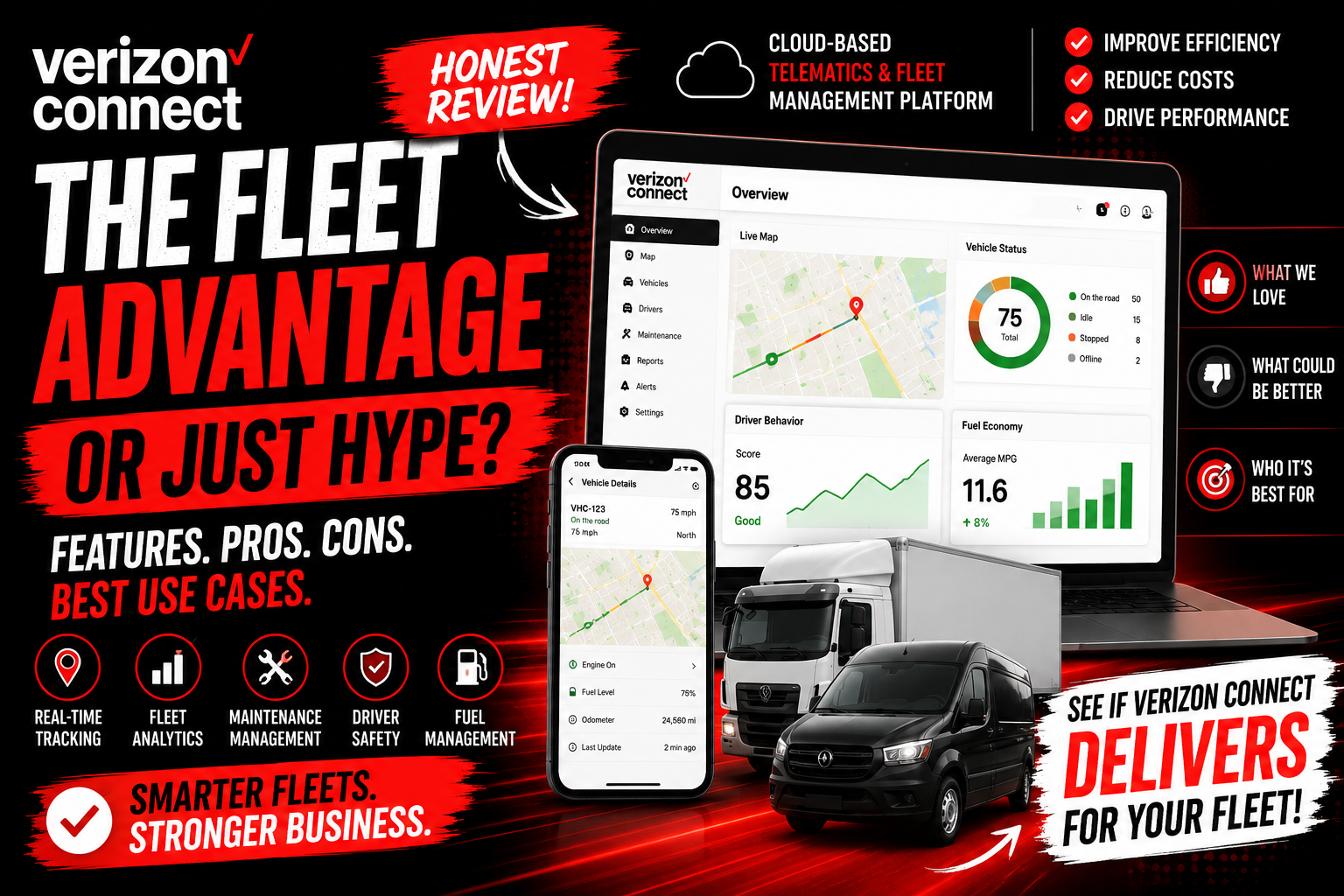
Choosing the right fleet management platform can make or break a company’s daily operations. Verizon Connect is one of the most recognized names in this space, and for good reason: it grew out of Verizon’s 2016 acquisitions of Fleetmatics and Telogis, giving it a massive customer base and deep telematics experience. However, size alone does not guarantee the platform is the right fit for every business. This review breaks down what Verizon Connect actually offers, where it shines, where it falls short, and who should consider it.
Table of Contents
Quick Summary
Before diving into the details, here is a snapshot of what to expect from Verizon Connect: Fleet Management Software and Solutions.
| Category | Overview |
|---|---|
| Best for | Mid-size to large fleets (11–5,000+ vehicles) |
| Core products | Reveal (GPS tracking), Reveal Fleet (field service), AI dashcams, ELD compliance |
| Standout strength | Nationwide network reliability via Verizon’s cellular infrastructure |
| Common complaint | Inconsistent customer support and multi-year contracts |
| Pricing model | Custom quotes, typically requiring a 3-year commitment |
| Ideal industries | Transportation, construction, field service, government fleets |
Verizon Connect combines GPS fleet tracking, asset monitoring, AI-powered dashcams, and compliance tools into one platform. Consequently, it appeals to organizations that need a single dashboard for vehicles, drivers, and equipment. Meanwhile, growing industry data reinforces why this all-in-one approach matters: fleets adopting AI-driven telematics report average cost decreases of 11 to 19 percent across fuel, accident, labor, and maintenance categories, according to Verizon Connect‘s own 2026 Fleet Technology Trends Report. The sections below examine each part of the platform in more depth, so readers can decide whether it matches their operational needs.
What Exactly Does Verizon Connect Do?
Verizon Connect is a cloud-based telematics and fleet management platform designed to track vehicles, monitor driver behavior, and streamline compliance. Fleet managers use it to see near real-time vehicle locations, review driving habits, and generate detailed reports. Because the platform runs entirely in the browser, companies do not need to install desktop software; instead, they access everything through a web dashboard or mobile app.
How Did Verizon Connect Come to Exist?
The company did not start from scratch. Verizon assembled the platform through two major acquisitions: Fleetmatics, which specialized in small and midsize fleet tracking, and Telogis, which brought enterprise-grade routing and navigation technology. As a result, Verizon Connect inherited a wide feature set almost overnight, then layered its own network infrastructure and AI capabilities on top over the following years.
Who Typically Uses This Platform?
Businesses in transportation, construction, wholesale distribution, and government services make up the bulk of Verizon Connect’s customer base. Specifically, organizations operating between 11 and 200 vehicles form a large share of users, though the platform also serves enterprise fleets exceeding 500 vehicles. Additionally, field service companies such as HVAC, plumbing, and electrical businesses rely on the Reveal Fleet product for scheduling and dispatch.
What Core Features Come With Verizon Connect?
Verizon Connect bundles several distinct modules under one login. Understanding each module helps clarify why the platform appeals to larger, multi-department fleets rather than single-purpose tracking needs.
How Does GPS Fleet Tracking Work?

The Reveal platform forms the backbone of Verizon Connect’s offering. It displays vehicle locations on an interactive map and refreshes data quickly, so managers can monitor active routes throughout the day. Furthermore, the Replay feature lets teams revisit a vehicle’s exact path from earlier in the day, which is useful for resolving customer disputes about arrival times or verifying that drivers followed assigned routes.
Beyond location tracking, the system logs ignition status, idle time, and speed exceptions for every vehicle. Idle time tracking, in particular, has produced measurable savings for some customers; one Verizon client in the recycling industry reported saving over $100,000 in fuel costs after reducing idling across its fleet.
What Does the Asset Tracking Module Offer?
Asset tracking extends visibility beyond vehicles to trailers, generators, and heavy equipment. Consequently, companies that rent or move expensive machinery can monitor utilization rates and reduce theft. The system also sends alerts when equipment leaves a designated area, which helps site managers catch unauthorized movement before it becomes a costly loss.
How Does the AI Dashcam System Function?
Verizon Connect’s integrated video telematics uses AI to analyze footage in near real-time. The system automatically ranks events by severity, from minor near-misses to confirmed collisions, so safety managers do not have to sift through hours of irrelevant video. When the AI detects a harsh driving event, it issues an audio alert to the driver immediately, and it uploads a video clip that managers can review within minutes. This combination of instant coaching and documented evidence helps fleets both improve driver behavior and defend against fraudulent liability claims.
Does Verizon Connect Handle Compliance and ELD Requirements?
Yes. The platform automates hours-of-service (HOS) logging, electronic logging device (ELD) requirements, and driver vehicle inspection reports (DVIRs). Because federal regulations change periodically, this automation reduces the administrative burden on dispatchers and helps drivers stay within legal driving limits. Enterprise fleets running FMCSA audits, in particular, benefit from the platform’s built-in reporting tools, which are frequently cited as one of its strongest compliance features.
What About Route Optimization and Field Service Tools?
Verizon Connect also includes routing tools that calculate efficient paths based on traffic, delivery windows, and job locations. For field service businesses, the Reveal Fleet product adds a drag-and-drop scheduling calendar, technician mobile apps, and customer communication tools. Consequently, dispatchers can assign the nearest available technician to an urgent job without manually cross-referencing addresses.
How Does Verizon Connect Support Electric Vehicle Fleets?

As more companies transition to electric vehicles, Verizon Connect has added EV-specific monitoring. The platform now displays charging status, battery-level alerts, and near real-time EV location data on the same live map used for traditional vehicles. This means fleets running mixed EV and combustion vehicles can manage both from a single interface rather than juggling separate systems.
What Role Does AI-Generated Reporting Play?
Verizon Connect’s Operational Insights feature uses generative AI to proactively surface trends without requiring managers to build custom reports. Rather than manually digging through dashboards, users receive automated suggestions tied to real business outcomes, such as recommendations for reducing fuel costs or lowering accident risk. This shift toward predictive, AI-assisted management reflects a broader industry trend; according to Verizon Connect’s own 2026 industry survey, nearly half of fleet professionals now use video telematics, up ten percentage points since 2023. Looking further ahead, the same report indicates that fleets increasingly expect AI tools to become more autonomous, with emerging capabilities like auto-generated insights and agentic AI expected to handle tasks such as predictive maintenance and route optimization with minimal manual input. In other words, the platform is positioning itself less as a passive tracking tool and more as an active decision-support system.
What Reporting and Analytics Options Does the Platform Include?
Data is only useful if it is easy to interpret, and Verizon Connect addresses this through customizable reporting. Fleet managers can generate reports on fuel usage, overtime hours, after-hours vehicle use, and speeding incidents, then export the results for further analysis. Moreover, the system stores historical data long enough to support trend analytics, which means managers can compare performance across months or even years rather than relying on isolated snapshots.
This historical depth also supports internal investigations. For example, if a customer disputes a delivery time, dispatchers can pull the exact route and timestamp data instead of relying on a driver’s memory. Similarly, insurance claims benefit from this documentation, since fleets can present verified location and speed data rather than anecdotal accounts.
How Does Geofencing Improve Daily Operations?
Geofencing allows managers to draw virtual boundaries around job sites, warehouses, or customer locations. Once a boundary is set, the system automatically logs when a vehicle enters or exits that zone, and it can trigger alerts if a vehicle arrives late or leaves early. As a result, dispatchers gain an added layer of accountability without needing to call drivers directly for status updates.
This feature also helps with billing accuracy for service-based businesses. Technicians who charge by time on site can rely on geofence timestamps instead of manual clock-ins, which reduces disputes over billed hours and strengthens trust with customers.
What Does the Onboarding and Implementation Process Look Like?
Getting a fleet fully set up on Verizon Connect involves more than simply logging into a dashboard. Understanding the implementation timeline helps set realistic expectations for new customers.
How Long Does Setup Typically Take?
Initial setup can take longer than some competing platforms, largely because Verizon Connect often installs hardware directly into vehicles rather than relying solely on plug-and-play devices. While this leads to a more integrated, tamper-resistant tracking system, it also means fleets should budget extra time before the platform becomes fully operational. Businesses with large fleets should expect a phased rollout, especially if installation needs to be scheduled around vehicle availability.
What Training and Resources Are Provided During Rollout?
To ease the transition, Verizon Connect assigns a dedicated point of contact to each new account. Additionally, the company provides on-demand tutorials, live webinars, and a searchable knowledge base covering common configuration questions. New administrators can also access e-books and case studies that illustrate how similar businesses configured the platform for their specific industry, which shortens the learning curve considerably.
How Does Verizon Connect Compare to Its Main Competitors?
Understanding how Verizon Connect stacks up against alternatives like Samsara and Motive helps clarify its competitive position in the market.
| Factor |  |  |  |
|---|---|---|---|
| Network reliability | Strong (Verizon cellular backbone) | Depends on third-party carrier | Depends on third-party carrier |
| Interface modernity | Considered dated by reviewers | Frequently praised as modern | Generally well-reviewed |
| Contract length | Often 3-year minimum | More flexible terms available | More flexible terms available |
| Best fleet size | Large enterprise (500+) | Small to enterprise | Small to mid-size |
| Compliance depth | Very strong, FMCSA-focused | Strong | Strong |
| Customer support reputation | Mixed, frequently criticized | Generally positive | Generally positive |
As the table shows, Verizon Connect’s core advantage lies in network dependability and compliance depth rather than user experience. Consequently, the decision often comes down to whether an organization values infrastructure reliability more than interface polish. Fleets that have struggled with connectivity gaps on other platforms may find that Verizon Connect solves a problem competitors cannot, even if it means accepting a steeper learning curve.
Verizon Connect Feature Comparison Table
The table below organizes the platform’s main modules alongside their primary business benefit.
| Feature | What It Does | Primary Benefit |
|---|---|---|
| GPS Fleet Tracking | Near real-time vehicle location and route replay | Improved visibility and accountability |
| Asset Tracking | Monitors trailers, equipment, and machinery | Reduced theft and better utilization |
| AI Dashcams | Detects and ranks harsh driving events | Lower accident rates, faster liability defense |
| Compliance Tools | Automates HOS, ELD, and DVIR reporting | Reduced regulatory risk |
| Route Optimization | Calculates efficient delivery and service routes | Lower fuel and labor costs |
| Field Service Dispatch | Drag-and-drop scheduling for technicians | Faster job assignment |
| EV Monitoring | Tracks charging status and battery health | Simplified mixed-fleet management |
| Operational Insights | AI-generated, proactive data recommendations | Faster, data-driven decision-making |
What Are the Advantages of Using Verizon Connect?
Every platform has strengths that make it worth considering, and Verizon Connect is no exception. The following advantages come up consistently across independent reviews and customer feedback.
Why Does Network Reliability Matter So Much?
Because Verizon Connect runs on Verizon’s own cellular network, it maintains connectivity in rural and remote areas where competitors using other carriers often experience gaps. For companies operating in the trucking or agriculture sectors, where vehicles frequently travel through low-coverage regions, this advantage translates directly into fewer tracking blackouts and more reliable data.
Does the Platform Scale Well for Growing Fleets?
Yes, scalability is one of the platform’s most frequently praised traits. Verizon Connect serves everything from small local businesses to enterprise fleets managing thousands of vehicles. As a company grows, it can add vehicles, drivers, and modules without switching to an entirely different system, which saves on retraining costs and data migration headaches.
How Strong Is the Compliance and Safety Toolset?
Verizon Connect’s compliance features are consistently ranked among the best in the industry, particularly for large trucking operations managing FMCSA audits. Combined with AI dashcams and driver scorecards, the platform gives safety managers concrete tools to reduce accidents; some case studies report accident reductions as high as 87% after adopting integrated video telematics.
What Support Resources Are Available?
Every customer receives a dedicated point of contact along with 24/7 phone, email, and chat support. Additionally, Verizon Connect maintains an online help center with tutorials, live webinars, and monthly feature updates, which helps new users get up to speed without relying solely on support tickets.
What Are the Drawbacks of Verizon Connect?
No platform is perfect, and Verizon Connect has drawn consistent criticism in several areas. Prospective buyers should weigh these carefully before signing a contract.
Is Customer Support Actually a Problem?
Despite offering 24/7 availability, many verified reviews describe long hold times and difficulty reaching knowledgeable representatives. Billing errors and unresolved technical issues appear repeatedly across G2, Capterra, and Trustpilot reviews, which suggests the support experience does not always match the promised service level.
Why Do Long-Term Contracts Concern Some Buyers?
Verizon Connect typically requires a minimum three-year contract when it supplies and installs tracking hardware. Consequently, businesses that are still evaluating their fleet needs may find themselves locked into a lengthy commitment. Exiting the contract early is reportedly difficult, which adds financial risk for companies uncertain about long-term fit.
Does the Interface Feel Outdated?
Several 2026 reviews note that the user interface feels a generation behind newer competitors such as Samsara or Motive. The menu-heavy design can slow down new users, and feature releases have reportedly lagged behind more agile fleet tech companies by 12 to 18 months on average.
Is Pricing a Concern for Smaller Businesses?
Yes, particularly for fleets under 200 vehicles. Reviewers frequently mention that hardware add-ons and advanced features push the total cost higher than expected, making the price-to-feature ratio harder to justify compared to smaller, more agile competitors.
How Reliable Is the Mobile App Experience?
Mobile access is one of the most-used features among Verizon Connect customers, since it lets managers check vehicle locations and resolve issues without sitting at a desktop. Field supervisors, in particular, rely on the app to confirm job completion and communicate with drivers throughout the day. However, this benefit comes with a caveat.
Several verified reviews describe the mobile app as occasionally glitchy, with connectivity issues that interrupt real-time updates. While the underlying data remains accurate once it syncs, the delay can frustrate managers who need instant confirmation during time-sensitive operations. Businesses that depend heavily on mobile-first workflows should test the app thoroughly during a trial period before rolling it out fleet-wide.
Verizon Connect Pros and Cons at a Glance

| Pros | Cons |
|---|---|
| Strong nationwide network coverage | Customer support reviews are frequently negative |
| Scales from small to enterprise fleets | Requires a 3-year contract with installed hardware |
| Robust compliance and ELD tools | Interface feels dated next to newer competitors |
| AI dashcams reduce accidents and liability | Pricing can be steep for fleets under 200 vehicles |
| 24/7 support and dedicated contact | Feature releases lag behind competitors |
Who Should Actually Use Verizon Connect?
Not every business needs the same fleet management solution, so matching the platform to the right use case matters. Below are the scenarios where Verizon Connect tends to perform best.
Is It a Good Fit for Large Enterprise Fleets?
Absolutely. Companies running 500 or more vehicles benefit most from Verizon Connect’s network reliability, compliance depth, and procurement relationships. Enterprises that already have a Verizon business agreement in place will also find onboarding smoother, since procurement teams can leverage existing vendor relationships.
What About Companies Operating in Rural or Remote Areas?
Businesses in trucking, agriculture, or utilities that regularly send vehicles through low-connectivity zones gain a real advantage from Verizon’s cellular backbone. Competitors relying on smaller carrier networks may experience tracking dropouts in exactly these conditions, so this becomes a decisive factor for many rural operators.
Does It Work Well for Government and Public Safety Fleets?
Yes. Government agencies, including law enforcement departments, use Verizon Connect for officer and community safety monitoring. The platform’s compliance reporting and driver behavior tools align well with the accountability standards public sector fleets must meet.
Should Small Businesses Consider It?
Small businesses with fewer than 50 vehicles should weigh the costs carefully. While the platform can technically serve smaller fleets, the pricing structure and contract length often favor larger operations. Businesses in this category may want to compare quotes against more flexible, subscription-based competitors before committing.
Conclusion: Is Verizon Connect Worth It?
Verizon Connect remains one of the most established names in fleet management, and its size is not just marketing; it reflects genuine strengths in network reliability, compliance automation, and scalability. Companies running large or geographically dispersed fleets, especially those already tied to Verizon’s business ecosystem, will likely find real value in the platform’s depth. On the other hand, smaller businesses and companies prioritizing a modern interface or flexible contract terms may want to weigh alternatives before signing a multi-year agreement.
Ultimately, Verizon Connect: Fleet Management Software and Solutions works best as a long-term infrastructure decision rather than a quick trial. Businesses should request a demo, compare pricing against at least two competitors, and read recent user reviews before finalizing a contract, since support quality and pricing terms appear to be the most common points of friction.
Frequently Asked Questions
Verizon Connect does not publish flat-rate pricing; instead, it provides custom quotes based on fleet size, selected modules, and hardware needs. Most contracts run three years, particularly when Verizon Connect supplies and installs the tracking hardware. Additionally, businesses that want AI dashcams or asset tracking modules should expect the quote to rise accordingly, since these are typically offered as add-ons rather than included in a base package. Because pricing varies so widely by industry and fleet size, businesses should request a detailed quote, ask specifically about installation timelines, and compare the total cost against at least one or two competitors before committing to a multi-year agreement.
Yes. Verizon Connect offers API integrations and a marketplace of approved software partners, including fuel management and maintenance providers. This allows businesses to extend the platform’s core functionality without abandoning existing tools. However, some users report that integration setup can require technical assistance, which is where working with an experienced integration partner becomes useful.
It depends on the priority. Verizon Connect generally wins on network coverage and enterprise compliance reporting, while Samsara and Motive are often praised for more modern interfaces and faster feature releases. Fleets operating in rural corridors or requiring FMCSA-heavy compliance tools may lean toward Verizon Connect, while businesses prioritizing user experience might prefer a newer competitor.
How Solution for Guru Can Help You Choose the Right Fit
Selecting and implementing fleet management software involves more than comparing feature lists; it requires evaluating integration needs, data workflows, and long-term scalability. This is where partnering with Solution for Guru adds real value. The team specializes in CRM, SaaS, and business software integrations, helping companies connect platforms like Verizon Connect with existing tools such as CRM systems, payroll software, and project management platforms.
Rather than navigating vendor contracts and technical setup alone, businesses can rely on Solution for Guru’s expertise in custom web development, automation, and system integration to ensure the chosen fleet solution actually fits their broader tech stack. This kind of guidance often prevents costly missteps, such as locking into a platform that later proves difficult to integrate with other core business systems.
Recommended
- Motive Pricing Plans Explained: How Much Does Motive Cost?
- What Is Motive Fleet Management?
- What Is the True Cost Breakdown of Fleet Tracking Systems?
- Offline Tracking: How Do Devices Store Data Without Connectivity?
- Real-Time Tracking vs Passive Tracking: What Are the Key Differences?
- How Vehicle Tracking Systems Reduce Commercial Auto Insurance Costs
- How Does GPS Tracking Work: Satellites, Signals, and Software?
- Can GPS Trackers Be Hacked? Security Risks Explained
- 4G vs 5G GPS Trackers: What’s Changing?
- AI in Fleet Tracking: How Are Predictive Maintenance and Analytics Transforming Fleet Operations?
- Tracking Requirements for Commercial Vehicles in the U.S.
- How Vehicle Maintenance Tracking Software Reduces Costs and Extends Fleet Lifespan?
- Top Benefits of GPS Vehicle Tracking Fleet Management Solutions for Modern Businesses
- Vehicle Tracking Online
- Business Vehicle Tracking: Boosting Efficiency and Accountability on the Road