What Is Motive Fleet Management?

Running a fleet of vehicles, whether it’s a handful of delivery vans or hundreds of long-haul trucks, comes with a long list of operational and regulatory challenges. This is where platforms like Motive, highlighted on Motive – GPS Fleet Tracking System & Solutions, come into play. Motive fleet management is a cloud-based platform that helps companies track vehicles in real time, stay compliant with federal safety regulations, and monitor driver behavior, all from a single dashboard.
Originally built around electronic logging and Hours of Service compliance, the platform has since expanded into a much broader operations tool, covering everything from AI-powered dashcams to fuel card management and equipment tracking. For fleet managers, this means less time chasing paperwork and more visibility into what’s actually happening on the road. But what exactly does Motive fleet management include, and how does it work in practice? In this article, we take a closer look at its core features, how it fits into daily fleet operations, and who it’s best suited for.
Table of Contents
Quick Summary
Motive fleet management is an all-in-one platform that combines GPS tracking, electronic logging device (ELD) compliance, AI-powered dashcams, fuel and spend management, and maintenance tools into a single dashboard. Motive – GPS Fleet Tracking System & Solutions gives fleet managers real-time visibility into vehicle location, driver behavior, and asset health, helping trucking, construction, field service, and delivery operations reduce risk, cut costs, and stay compliant with FMCSA regulations. Read on to learn how the platform works, what it costs, who it fits best, and how it stacks up against other fleet management systems.
What Is Motive Fleet Management?

Motive – GPS Fleet Tracking System & Solutions is a cloud-based fleet operations platform built by Motive Technologies, formerly known as KeepTruckin. Founded in 2013 in San Francisco, the company started as a compliance-focused electronic logging device (ELD) provider and has since grown into a platform used by roughly 100,000 businesses, ranging from owner-operators to large enterprises.
At its core, Motive fleet management brings together GPS tracking, driver safety monitoring, asset tracking, fuel and spend management, and maintenance scheduling in one system. Instead of juggling separate tools for compliance, dispatch, and vehicle diagnostics, fleet managers get a single dashboard that pulls data from hardware devices, mobile apps, and third-party integrations. This consolidation is what distinguishes Motive from simpler GPS-only trackers: it is designed as a full operations platform rather than a single-purpose tool.
Because the platform supports many aspects of daily operations, buyers can evaluate its features and pricing to determine whether it meets their fleet size, industry, and compliance requirements before signing a contract.
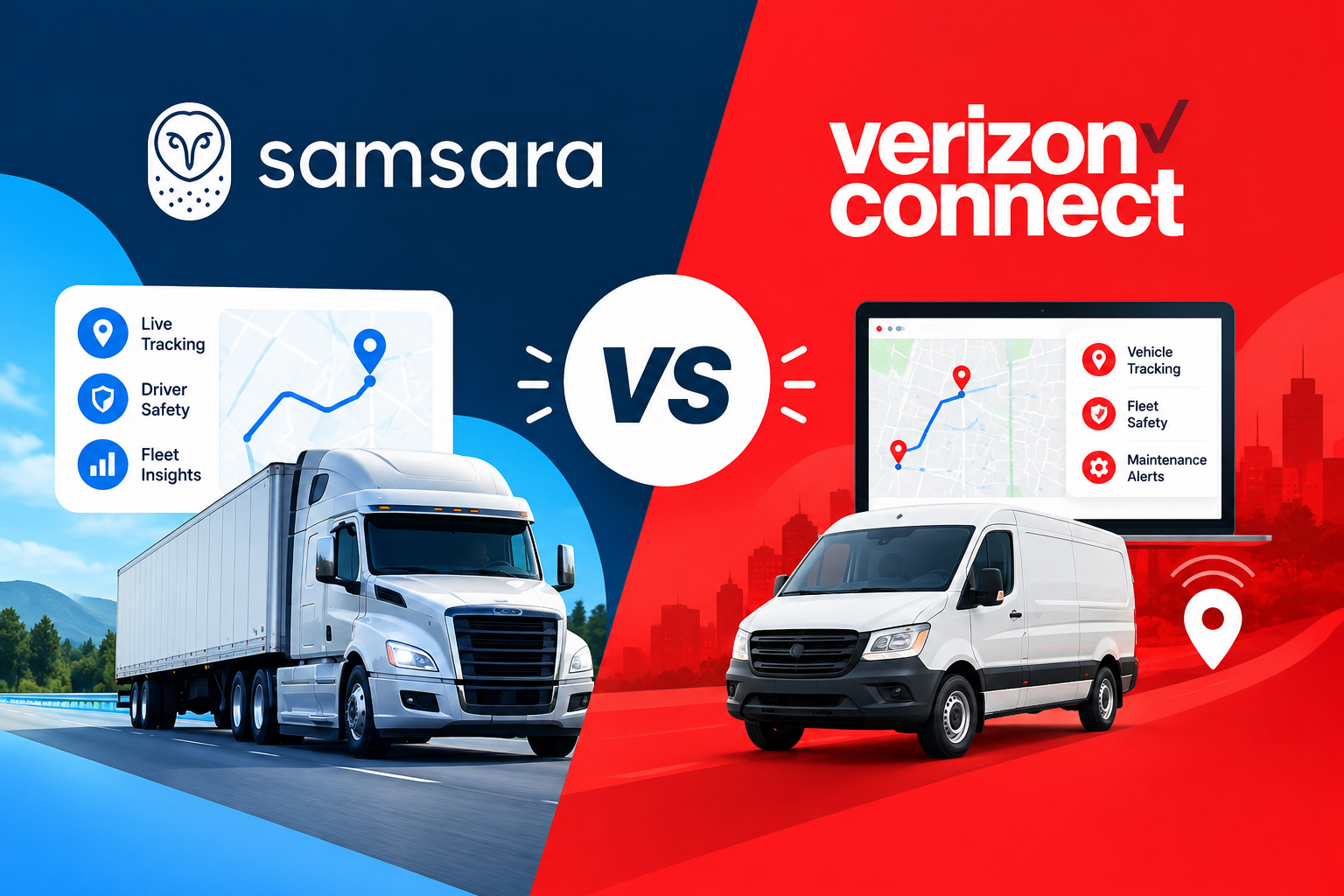
The broader shift toward e-commerce and just-in-time delivery has made fleet visibility a competitive necessity rather than a nice-to-have. Businesses that move goods on a regular basis increasingly rely on continually updated GPS data to manage delivery windows, control fuel costs, and keep drivers accountable. Motive positions itself squarely inside that shift, competing with platforms like Samsara, Verizon Connect, and Geotab for the attention of fleets that need more than a basic location pin on a map.
How Does Motive’s Platform Work?
Motive’s system relies on hardware devices that plug into a vehicle’s engine or run as standalone GPS units, paired with driver-facing and manager-facing mobile apps. Data flows from the vehicle to the cloud dashboard continuously, which is what enables the near real-time visibility that fleet managers rely on for dispatch and safety decisions.
The platform offers two dedicated mobile apps, one built for drivers and one for managers. Although the visual design stays consistent across both, each app is tailored to its audience with different navigation and shortcuts. The manager app mirrors most of the desktop dashboard’s core functions, so a fleet supervisor can track vehicles, review safety footage, check compliance status, and message drivers directly from a phone while away from a desk.
What Technology Powers Motive’s GPS Tracking?
Motive’s vehicle gateways send location updates to the dashboard roughly every one to two seconds, giving managers a fast-refreshing view of where every vehicle is at any moment. The system layers in additional data sources beyond raw location, including vehicle speedometer readings, GPS-based speed, accelerometer data, and gyroscope input. Combined, these signals let the platform automatically flag risky driving events such as hard braking or sharp cornering without requiring a manager to review raw footage first.
For assets that lack built-in telematics, such as trailers or heavy equipment, Motive also offers IoT GPS sensors that report location roughly once per minute. This extends tracking coverage to unpowered equipment that would otherwise be invisible to a standard vehicle-only system.
How Does Motive Pair Drivers, Vehicles, and Assets?
One practical feature of the platform is automatic pairing: Motive links drivers, vehicles, trailers, and equipment together and displays them as a unit in Fleet View or the mobile Fleet App. This reduces the manual work of matching the right trailer to the right truck and makes it easier to catch a mismatched or misrouted asset before it becomes a delivery problem. Furthermore, this pairing feeds directly into proof-of-delivery workflows, since documents captured in the Motive Driver App attach to the correct vehicle-driver combination automatically.
How Do Geofences Fit Into Motive’s Tracking System?
Geofencing lets fleet managers draw virtual boundaries around job sites, depots, customer locations, or restricted zones. Once a geofence is active, Motive sends an alert the moment a vehicle enters or exits that zone, which supports several use cases at once: confirming on-time arrival at a job site, verifying that a vehicle actually left the yard for a scheduled delivery, and flagging unexpected movement outside business hours that could indicate theft or unauthorized use.
Layered on top of geofencing, the platform also overlays live traffic and weather conditions onto the map view. This additional context helps dispatchers reroute vehicles proactively rather than reacting after a delay has already occurred, and it gives customer-facing teams more accurate estimated time of arrival (ETA) data to share during delivery windows.
What Core Features Does Motive Offer?
Motive organizes its capabilities into several product areas: fleet tracking and telematics, ELD compliance, AI-powered dashcams, fuel and spend management, and preventive maintenance. Each area can generally be adopted independently, though most fleets combine at least tracking and compliance from the start.
Rather than treating these areas as separate add-ons bolted together after acquisitions, Motive presents them through one login and one set of reports, which is part of why the platform gets described as an integrated operations system rather than a simple GPS tracker. That said, Motive focuses on compliance and driver safety, where it performs exceptionally well, while offering more limited route optimization and weather alert features than some competitors.
How Does Motive Handle ELD Compliance and Hours of Service?
Motive’s electronic logging devices are FMCSA-registered and automatically track a driver’s hours of service, eliminating most manual log entry. The driver app handles complex HOS scenarios, including team driving, adverse conditions exemptions, and short-haul exceptions, without requiring drivers to interpret the underlying regulations. Alongside HOS tracking, the platform includes DVIR (driver vehicle inspection report) forms and automates International Fuel Tax Agreement (IFTA) reporting, which together make up some of the most mature compliance tooling in the trucking software category.
What Can Fleet Managers Do With Motive’s AI Dashcams?
Motive’s AI dashcams detect more than 20 safety events, including distracted driving, speeding, lane departure, and following-distance violations. When the system detects a high-confidence event, it sends the event directly to the manager. For lower-confidence events, Motive’s Safety Team reviews the footage to reduce false positives, although fleets can skip this step and rely solely on AI validation if they prefer.
What sets the coaching workflow apart is timing: alerts reach drivers in the cab through the mounted device, not hours later in a report. Consequently, drivers get feedback in the moment, which tends to be more effective at changing behavior than a delayed summary email. Managers can also customize which behaviors the dashcams monitor and who receives which alerts, which limits unnecessary footage collection and helps control liability exposure.
How Does Motive Support Fuel and Spend Management?
The Motive Card functions as a combined fuel and expense card that feeds transaction data directly into the platform, matching each purchase to a vehicle, driver, location, and time. This link between fuel spend and telematics data makes IFTA reporting close to automatic and cuts down the manual expense reconciliation that many fleets still do by hand. In addition to the card, the platform’s Fuel Hub tracks consumption trends and flags wasteful behaviors like excessive idling, and it supports a dozen additional fuel integrations through the App Marketplace for fleets that use other card providers.
What Maintenance Tools Does Motive Provide?
Motive automates preventive maintenance alerts based on mileage or elapsed time, which helps reduce unplanned downtime and extends vehicle lifespan. The platform also detects real-time fault codes from the vehicle’s engine, so a developing mechanical issue can surface before it turns into a breakdown on the road. Combined with customizable inspection forms by vehicle type, this gives fleet managers a proactive view of vehicle health rather than a reactive one.
What Integrations Does Motive Support?

Motive has opened its platform to third parties through an App Marketplace that now includes more than 350 integrations, which is one of the broader ecosystems among GPS fleet management platforms. This matters in practice because most fleets already run other software for payroll, dispatch, or maintenance, and a fleet system that cannot talk to those tools tends to create duplicate data entry rather than saving time.
- Fuel and card partners such as WEX, alongside the native Motive Card, for consolidated fuel spend tracking
- Communication tools including Slack and Microsoft Teams for routing alerts to the right team channel
- Manufacturer integrations spanning Stellantis, Volvo, John Deere, and Komatsu for deeper vehicle and equipment diagnostics
- Safety analytics partners like Nirvana Safety, which help managers identify higher-risk drivers using external risk-scoring models
- Maintenance and asset partnerships, including Fleetio, that bring fuel, maintenance, and telematics data into a single operational view
For businesses that already rely on a CRM or dispatch platform, checking the App Marketplace before signing a contract is a practical way to confirm Motive will fit into an existing tech stack rather than replace it entirely.
Which Industries Rely on Motive Fleet Management?
Although Motive’s roots are in long-haul trucking compliance, its customer base today spans a wide range of industries that share a common need: visibility into vehicles, equipment, or personnel operating away from a central office.
How Do Construction and Field Service Teams Use Motive?
Construction companies use Motive to track usage and idle time across a mix of trucks, trailers, and heavy equipment spread across multiple job sites. Because asset tracking does not require the same telematics access as a standard vehicle, contractors can monitor equipment utilization and reduce theft risk even for machinery that predates modern GPS-ready designs.
How Do Delivery and Passenger Transit Operations Use Motive?
Delivery fleets and last-mile carriers lean on Motive’s live location sharing and automatic ETA generation to keep customers informed and reduce inbound status-check calls. Passenger transit operators, meanwhile, benefit from the same real-time visibility to manage on-time performance and respond quickly if a vehicle deviates from its expected route.
How Much Does Motive Cost?

Motive does not publish detailed pricing on its website, so exact costs depend on fleet size, hardware selection, and contract terms negotiated with sales. That said, third-party research and industry surveys point to a fairly consistent tiered structure. The table below reflects commonly reported starting prices as of 2026.
| Plan | Starting Price* | Best For | Key Inclusions |
| ELD | ~$35/vehicle/month | Owner-operators and small fleets | ELD compliance, HOS tracking, DVIR forms, basic GPS, driver app, IFTA reporting |
| Pro (Most Popular) | ~$55/vehicle/month | Growing fleets that need safety tools | Everything in ELD, plus AI dashcam, real-time coaching, advanced analytics, fleet card integration |
| Enterprise | Custom quote | Large or complex operations | Everything in Pro, plus custom integrations, dedicated CSM, enterprise SSO, SLA guarantees |
Most fleets should expect a 12-month contract as the norm, though shorter terms are sometimes available. Buyers evaluating total cost of ownership should also budget for hardware, installation, and any add-on modules like dashcams or asset tracking, since the base ELD price alone rarely reflects the full deployment cost.
Who Should Use Motive Fleet Management?
Motive primarily serves U.S. trucking and logistics operations that need strong ELD compliance along with safety and telematics tools. It also serves construction, field service, food and beverage, oil and gas, passenger transit, delivery, agriculture, and waste and recycling fleets, though its deepest strength remains regulated, safety-focused trucking operations.
Company size matters less than regulatory exposure and safety priorities. A five-truck owner-operator business with strict Hours of Service obligations can benefit from the same compliance backbone as a 3,000-vehicle enterprise fleet, since the underlying ELD and reporting requirements do not scale down for smaller operators. What changes with size is mainly the pricing tier and the depth of support, such as a dedicated customer success manager at the enterprise level.
- Long-haul carriers and regional LTL operators managing complex Hours of Service rules across many drivers
- Owner-operators and small trucking fleets that need affordable, reliable ELD compliance quickly
- Construction and field service companies tracking mixed fleets of vehicles and heavy equipment across multiple job sites
- Delivery and last-mile operations that depend on accurate ETAs and frequent customer status updates
- Trucking companies managing fuel spend across many drivers, where fleet card integration saves significant administrative time
On the other hand, smaller service fleets that do not need ELD compliance, such as a handful of plumbing or HVAC vans operating locally, may find Motive’s feature set larger and more expensive than necessary. Simpler GPS-only trackers can be a better fit in that scenario.
Is Motive’s Platform Secure and Easy to Support?
Motive applies industry-standard security practices, including encryption of data both at rest and in transit, role-based access controls so employees only see the data relevant to their role, and regular backups to protect against data loss. For fleets in regulated industries, it is worth confirming specific certifications such as SOC 2, GDPR, or HIPAA directly with Motive’s sales team, since compliance requirements vary significantly by sector and by the data types a company handles.
Most teams can set up Motive’s core tracking and compliance features within a few days by following the platform’s guided setup, tutorials, and documentation. That said, mastering the platform’s more advanced features, such as custom dashcam event rules or deep App Marketplace integrations, tends to take longer, and new users often need a few weeks before they feel fully comfortable navigating the dashboard’s many sections.
What Are the Pros and Cons of Motive?

No fleet management platform is a perfect fit for every operation, and Motive is no exception. The table below summarizes the trade-offs that come up most consistently in verified customer reviews and independent testing.
| Strengths | Limitations |
| Best-in-class ELD compliance and Hours of Service tracking | Pricing is not published; buyers must request a custom quote |
| AI dashcams with human-reviewed safety events reduce false positives | Typically requires a 12-month contract with limited month-to-month flexibility |
| 350+ third-party integrations across fuel, maintenance, and CRM tools | No dedicated panic button or built-in weather alerts |
| Fast GPS refresh rates for near real-time vehicle visibility | Feature-dense dashboard has a learning curve for new users |
| Fleet card automates fuel tracking and IFTA tax reporting | Best suited to U.S. operations, with limited support outside North America |
How Does Motive Compare to Other Fleet Management Platforms?
Motive competes most directly with Samsara, Verizon Connect, and Geotab. According to independent testing from TechRadar, Samsara edges ahead of Motive on certain features such as custom route locations and SMS-based geofence alerts, yet Motive holds its ground in regulated, safety-focused operations where ELD maturity and driver accountability matter most.
| Platform | Best Known For | Contract Flexibility | Pricing Transparency |
 | ELD compliance, AI dashcams, driver accountability | Often requires a 12-month contract | Quote-based |
 | Broader route optimization and SMS geofence alerts | Contract terms vary by fleet size | Quote-based |
 | Wide integration ecosystem and dual-facing cameras | Contract terms vary by fleet size | Quote-based |
 | Open-platform telematics and data flexibility | Flexible reseller-based terms | Quote-based |
Verizon Connect offers a wide range of add-on modules, including dual-facing cameras and field service tools, although each additional module typically increases the overall cost. Geotab takes a more open-platform approach, giving fleets flexibility to build a custom telematics stack through its reseller network, which can suit businesses that want more control over hardware and software choices rather than a single bundled system.
None of the major enterprise platforms publish transparent pricing, so a side-by-side vendor demo and a request for a detailed quote remain the most reliable way to compare real-world costs for a specific fleet size and hardware mix.
Conclusion: Is Motive Fleet Management Worth It?
Motive fleet management brings GPS tracking, ELD compliance, AI-powered safety monitoring, fuel management, and maintenance scheduling into one platform, which is exactly what makes it attractive to trucking and logistics operations that would otherwise juggle several disconnected tools. Its ELD and Hours of Service tooling remain among the most mature in the category, and its dashcam-plus-human-review approach to safety gives managers a practical way to coach drivers without drowning in false alerts.
Motive – GPS Fleet Tracking System & Solutions is not the cheapest or the most flexible option on the market, particularly given its typical 12-month contract and opaque pricing. However, for regulated fleets that need dependable compliance tooling and a scalable safety program, it remains one of the strongest choices available in 2026. Businesses can compare quotes from Motive with those from competitors like Samsara or Verizon Connect and evaluate a live demo to determine whether the platform fits their needs before signing a contract.
Ultimately, the right decision comes down to matching the platform’s strengths to what a fleet actually needs day to day. A trucking operation drowning in manual HOS paperwork and searching for a defensible safety program stands to gain the most from Motive’s core capabilities. A small local service fleet without ELD obligations may be better served by a lighter, less expensive tracking tool. Either way, getting clear on compliance requirements, fleet size, and budget before requesting a quote will make the sales conversation far more productive.
Frequently Asked Questions
Yes. Motive was founded in 2013 as KeepTruckin and rebranded to Motive in 2022 as the company expanded from a compliance-focused ELD provider into a broader fleet operations platform covering safety, telematics, and spend management.
Motive can continue operating without an active internet connection, though drivers need to periodically reconnect to upload vehicle and personal data. Several paid plans include a built-in Wi-Fi hotspot to make that reconnection easier in areas with limited cellular coverage.
Yes. Motive’s electronic logging device is FMCSA-registered and compliant with Hours of Service mandates in both the United States and Canada, and it has been an approved ELD vendor since 2016. Educational materials from the company also describe broader compliance workflows, including tools that help fleets track and manage their Compliance, Safety, and Accountability (CSA) scores from within the same dashboard used for daily dispatch and tracking.
For many operations, yes. Because Motive combines GPS tracking, ELD compliance, dashcams, fuel card management, and maintenance scheduling in a single system, fleets that previously ran separate point solutions for each function can often consolidate onto one platform. The trade-off is that switching costs rise once an operation is deeply embedded in Motive’s ecosystem, so it is worth confirming data export options and contract exit terms before committing a large fleet to a full migration.
How Can Solution for Guru Help You Get the Most Out of Motive?
Adopting a platform as feature-rich as Motive is only half the battle; getting real value from it depends on smart implementation and ongoing optimization. That’s where Solution for Guru comes in. As a tech solutions provider specializing in CRM, SaaS, and software integrations, the team helps businesses connect Motive with their existing systems, whether that’s payroll software, project management tools, or customer-facing platforms, so fleet data doesn’t sit in a silo.
Beyond integration, Solution for Guru offers strategic guidance on which Motive features actually align with a company’s operations, helping avoid the common trap of underusing (or overpaying for) a powerful platform. Their AI and automation expertise can also help fleets build custom workflows around Motive’s data, turning raw GPS and compliance information into actionable business insights. For companies that want Motive to work as part of a connected, efficient tech ecosystem rather than an isolated tool, partnering with an experienced integration specialist like Solution for Guru can shorten the learning curve and accelerate the return on investment.
Recommended
- What Is the True Cost Breakdown of Fleet Tracking Systems?
- Offline Tracking: How Do Devices Store Data Without Connectivity?
- Real-Time Tracking vs Passive Tracking: What Are the Key Differences?
- How Vehicle Tracking Systems Reduce Commercial Auto Insurance Costs
- How Does GPS Tracking Work: Satellites, Signals, and Software?
- Can GPS Trackers Be Hacked? Security Risks Explained
- 4G vs 5G GPS Trackers: What’s Changing?
- AI in Fleet Tracking: How Are Predictive Maintenance and Analytics Transforming Fleet Operations?
- Tracking Requirements for Commercial Vehicles in the U.S.
- How Vehicle Maintenance Tracking Software Reduces Costs and Extends Fleet Lifespan?
- Top Benefits of GPS Vehicle Tracking Fleet Management Solutions for Modern Businesses
- Vehicle Tracking Online
- Business Vehicle Tracking: Boosting Efficiency and Accountability on the Road