AI for Customer Insights: A Practical SMB Guide

TL;DR:
- AI for customer insights helps businesses analyze customer data to understand behavior, preferences, and future actions. It enables real-time, automated predictions and personalization, giving small and medium-sized businesses a competitive advantage. The effectiveness of AI depends on clean, unified data, ethical practices, and human oversight.
AI for customer insights is defined as the use of artificial intelligence technologies to analyze customer data and generate accurate understanding of customer preferences, behaviors, and future actions. For small and medium-sized businesses, this capability has shifted from a competitive advantage to a baseline requirement. Traditional survey methods and quarterly reports can no longer keep pace with how fast customer behavior changes. AI-driven customer analytics closes that gap by processing data continuously, at a scale no human team can match, and translating raw signals into decisions that improve marketing results and customer retention.
How does AI analyze customer data to generate meaningful insights?
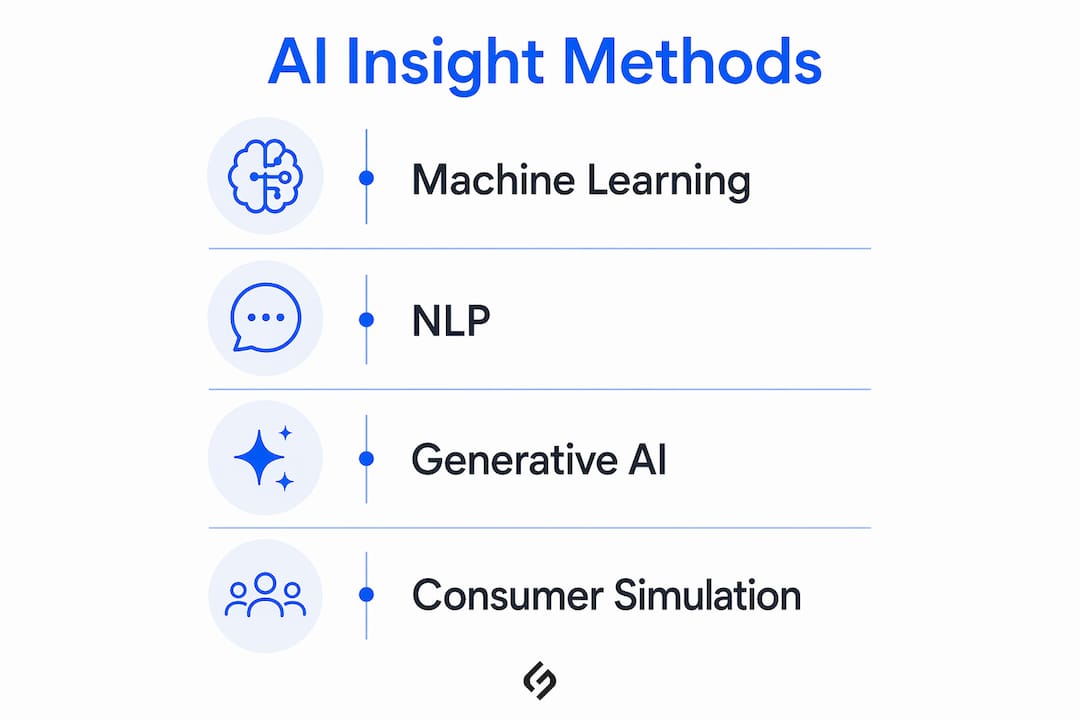
AI analyzes customer data through four primary methods: machine learning, natural language processing (NLP), generative AI, and digital twin simulation. Each method targets a different layer of customer understanding, and the most effective implementations combine all four.

Machine learning identifies patterns in purchase history, browsing behavior, and demographic data to predict what a customer will do next. Deep learning, a subset of machine learning, goes further by incorporating complex inputs like hobbies, work situation, and lifestyle signals to predict customer preferences months in advance. That level of foresight lets marketing teams prepare campaigns before demand peaks, not after.
NLP
NLP powers customer feedback analysis AI. It reads reviews, support tickets, social media comments, and chat transcripts to extract sentiment, intent, and recurring themes. AI sentiment analysis scans real-time customer feedback across diverse touchpoints and surfaces patterns that manual review would miss entirely. A business receiving 10,000 support messages a month cannot read them all. NLP can, and it does so in seconds.
Generative AI takes the output of machine learning and NLP and converts it into summaries, predictions, and anomaly alerts without requiring a data analyst to write a single query. Generative AI shifts analytics from reactive reporting to proactive, real-time intelligence. That means your team sees a problem forming before it becomes a churn event.
Digital twin simulation is the most underused method in the SMB market. Specialized platforms build virtual replicas of customer segments and run marketing scenarios against them. Consumer twin simulations model the behavior of 100,000+ virtual customers in minutes to predict how pricing changes or promotions will land before a single dollar is spent. This replaces expensive A/B testing cycles with fast, low-risk scenario planning.
- Machine learning: Predicts behavior from historical and behavioral data
- NLP and sentiment analysis: Extracts intent and emotion from text-based feedback
- Generative AI: Automates anomaly detection, summaries, and predictions in real time
- Digital twin simulation: Models marketing decisions against virtual customer populations
Pro Tip: Choose specialized AI platforms built for consumer simulation rather than general-purpose large language models. Specialized simulation platforms achieve 91% accuracy in predicting customer behavior by finding consensus-driven insights rather than amplifying extreme opinions.
What are the practical applications of AI-driven customer insights for SMBs?
The most direct business value from AI-driven customer behavior analysis shows up in three areas: personalized marketing, predictive churn reduction, and real-time campaign optimization. Each application is accessible to SMBs today, not just enterprise teams with large data science budgets.
Here is a sequential approach for putting AI customer insights to work:
- Unify your customer data. Consolidate purchase records, website behavior, email engagement, and support history into a single customer profile. AI cannot generate reliable insights from fragmented data sources.
- Deploy sentiment analysis on feedback channels. Connect your review platforms, chat logs, and support tickets to an NLP tool. This creates a continuous feedback loop that replaces the multi-month manual survey cycle with real-time NPS and CSAT monitoring.
- Apply predictive analytics to identify at-risk customers. Machine learning models score each customer by churn probability based on engagement patterns. Your team can then prioritize outreach to high-risk segments before they leave.
- Run simulation-based campaign planning. Before launching a promotion, use digital twin technology to model how different customer segments will respond. This reduces wasted spend on campaigns that underperform.
- Automate personalization at scale. Use AI to trigger personalized email sequences, product recommendations, and offers based on individual behavior signals rather than broad demographic segments.
Pro Tip: Connect your AI insights layer directly to your CRM. Predictive analytics in CRM systems let you act on customer scores automatically, not just report on them.
The business outcomes from this approach are measurable. Personalized engagement reduces churn. Real-time campaign optimization improves return on ad spend. Predictive scoring lets sales and marketing teams focus effort where it produces the highest return. SMBs that implement these steps systematically compete directly with larger players who have been using AI analytics for years.
What data infrastructure and ethical standards does AI require?
AI customer insights are only as reliable as the data feeding them. Clean, unified customer data is a mandatory precondition before deploying any AI analytics tool. Poor data quality produces hallucinated patterns, and those patterns lead marketing teams to make decisions based on signals that do not exist. The damage from a bad AI recommendation can take months to undo.
The infrastructure requirements for reliable AI insights include:
- Unified customer profiles: All data sources must map to a single customer identity. Duplicate records and siloed databases produce conflicting signals.
- Data hygiene protocols: Regular deduplication, validation, and enrichment processes keep the data layer accurate. Data hygiene is a mandatory precursor for AI success, not an optional maintenance task.
- Integration with marketing and CRM platforms: AI insights must connect to the tools your team already uses. Insights that live in a separate dashboard rarely influence decisions. The role of data in marketing strategies depends on this integration being seamless at the system level.
- Privacy and consent management: Customer data collected for AI analysis must comply with applicable privacy regulations. Customers who discover their data was used without clear consent withdraw trust quickly and permanently.
Ethical AI use and strong data infrastructure are not compliance checkboxes. They are the foundation that determines whether AI insights produce competitive advantage or legal and reputational risk. The businesses that treat data ethics as a core practice, not an afterthought, build customer relationships that AI can then strengthen rather than undermine.
Human oversight remains critical even when AI automates analysis. AI identifies patterns and flags anomalies. Humans decide what those patterns mean for the brand and how to act on them. Removing human judgment from that loop produces decisions that are technically correct but strategically wrong. For guidance on balancing AI automation with human decision-making, AI customer retention practices from adjacent industries offer practical frameworks that transfer directly to SMB marketing contexts.
What future trends are shaping AI for customer insights?
The next phase of AI customer analytics moves from insight generation to autonomous action. The defining shift is the rise of agentic AI, which does not wait for a human to read a report and decide what to do next.
Agentic Customer Data Platforms embed AI agents directly in the data layer. These agents observe customer behavior continuously, detect changes in engagement or sentiment, and trigger next-best-action responses automatically. The result is true 1:1 personalization at scale, where every customer interaction is informed by their most recent behavior, not a segment profile built months ago.
Generative AI advances are also compressing the time between data collection and decision-making. Faster, more frequent customer insights from generative AI automation mean marketing teams receive daily or even hourly intelligence rather than monthly reports. That frequency changes how campaigns are managed. Optimization becomes a continuous process, not a post-campaign review.
| Trend | What it means for SMBs |
|---|---|
| Agentic AI in data platforms | Automated next-best actions without manual intervention |
| Generative AI reporting | Daily insight summaries replacing monthly analyst reports |
| Digital twin simulation | Low-cost scenario testing before campaign launch |
| CRM and AI integration | Predictive scores embedded directly in sales workflows |
| Real-time sentiment monitoring | Continuous feedback loops replacing periodic surveys |
The future of AI in business points toward AI systems that do not just inform decisions but execute them within defined parameters. For SMBs, this means the gap between knowing what customers want and acting on that knowledge will shrink to near zero.
Key takeaways
AI for customer insights delivers its greatest value when clean data, ethical practices, and human oversight work together with machine learning and generative AI to produce decisions that improve customer engagement and reduce churn.
| Point | Details |
|---|---|
| Data quality comes first | Unified, clean customer profiles are required before any AI tool produces reliable insights. |
| Specialized platforms outperform general models | Consumer simulation tools achieve 91% accuracy by modeling consensus behavior, not outliers. |
| Generative AI enables real-time intelligence | AI now automates anomaly detection and summaries, replacing slow manual reporting cycles. |
| Agentic AI is the next standard | AI agents embedded in data platforms trigger personalized actions automatically without human prompts. |
| Ethics and oversight protect ROI | Human judgment and privacy compliance prevent AI from producing decisions that damage brand trust. |
Why most SMBs are using AI insights the wrong way
The most common mistake I see is businesses deploying AI analytics tools before their data is ready. They connect a machine learning platform to a fragmented CRM, get confident-looking outputs, and build campaigns around them. Six months later, they cannot explain why results did not improve. The AI was not wrong. It was accurately modeling bad data.
The second mistake is treating AI as a replacement for marketing judgment. AI is an augmentation tool. It tells you what is happening and what is likely to happen next. It does not tell you whether that aligns with your brand values or your long-term customer relationships. I have seen businesses automate personalization so aggressively that customers felt surveilled rather than understood. That is a trust problem, and trust is harder to rebuild than a campaign is to relaunch.
The businesses I have watched succeed with AI-driven customer behavior analysis share one habit: they invest as much time in data preparation and team training as they do in selecting the AI platform itself. The platform is the easy part. Getting your team to act on AI signals consistently, and to question them when something feels off, is where the real competitive advantage lives. SMBs that build that discipline now will be significantly ahead of competitors who are still treating AI as a technology purchase rather than an operational capability.
How Solution For guru helps you put AI insights to work
Building an AI-powered customer insights practice requires more than selecting the right tool. It requires a digital foundation that connects your data, your marketing channels, and your customer-facing systems into a single, coherent operation.
Solution4guru works with small and medium-sized businesses to design and implement that foundation. From digital marketing strategy to CRM integration and AI-ready web infrastructure, the team at Solution4guru builds the systems that make AI insights usable, not just visible. If your business is ready to move from reactive reporting to real-time customer intelligence, explore what Solution4guru offers and request a free consultation to map out your next steps.
FAQ
AI for customer insights is the use of machine learning, natural language processing, and generative AI to analyze customer data and generate accurate predictions about customer behavior, preferences, and sentiment.
Specialized consumer simulation platforms achieve 91% accuracy in predicting customer behavior by modeling values, price sensitivity, and habits across large virtual customer populations.
AI requires clean, unified customer profiles that consolidate purchase history, behavioral data, and feedback from all channels. Fragmented or duplicate data produces misleading outputs that can misdirect marketing strategy.
AI research agents replace multi-month manual survey cycles with continuous real-time feedback loops that extract sentiment, NPS, and CSAT data from live customer interactions across all touchpoints.
Agentic AI refers to AI systems embedded in data platforms that continuously observe customer behavior and automatically trigger personalized next-best actions without requiring human intervention at each decision point.