Sustainable Digital Solutions for SME Business Leaders

TL;DR:
- Sustainable digital solutions reduce environmental impact through energy-efficient infrastructure, lifecycle thinking, and certified emissions measurement.
- Most SMEs benefit from lower costs, improved market positioning, and regulatory compliance by adopting eco-friendly digital practices.
Sustainable digital solutions are eco-friendly digital services and technologies designed to minimize environmental impact while maximizing operational performance and resource efficiency. The industry term for this practice is “digital sustainability,” a discipline that combines green technology solutions with responsible resource management across the full technology lifecycle. For small and medium-sized enterprises, digital sustainability is no longer a corporate social responsibility checkbox. It is a direct path to lower operating costs, stronger brand positioning, and regulatory readiness. The W3C Web Sustainability Guidelines define this approach as systems thinking that balances planet, people, and prosperity, making it a practical framework for any business leader ready to act.
What are the key components of sustainable digital solutions?
Sustainable digital solutions rest on three core pillars: energy-efficient infrastructure, lifecycle thinking, and certified emissions measurement. Each pillar addresses a different layer of your technology stack, from the servers running your applications to the devices your teams use every day.

Energy-efficient infrastructure covers the hardware and cloud services that power your operations. Sustainable cloud providers maximize data density per storage rack and use shared hardware architectures to reduce physical footprint and power consumption. Choosing a provider that operates this way cuts your data center energy draw without requiring any changes to your applications.
Lifecycle thinking extends sustainability beyond energy savings. Responsible product stewardship means designing digital products that minimize environmental impact from production through end-of-life disposal. This includes procurement decisions, software architecture choices, and hardware refresh cycles.
Certified emissions measurement gives you the data to act. Specialized platforms use accredited Bilan Carbone® and GHG Protocol methodologies to deliver granular Scope 3 emissions measurement across suppliers, devices, and cloud services, with access to more than 15,000 emission factors for IT ecosystems. That level of specificity lets you identify your highest-impact areas and prioritize reductions.
Key components to evaluate when building your approach:
- Efficient cloud architecture with high data density and shared hardware
- AI model right-sizing to reduce compute energy without losing performance
- Lifecycle assessments covering design, deployment, and disposal phases
- Certified carbon measurement using GHG Protocol or Bilan Carbone® standards
- Web development practices aligned with W3C Web Sustainability Guidelines
Pro Tip: Start with your cloud and hosting stack. Infrastructure changes deliver the fastest, most measurable reductions in energy consumption and cost.
How do sustainable digital solutions benefit small and medium-sized enterprises?
The business case for eco-friendly digital services is concrete and measurable. SMEs that adopt digital sustainability practices gain advantages across three areas: cost reduction, market positioning, and compliance readiness.
Cost reduction is the most immediate benefit. Energy-efficient infrastructure directly lowers utility and hosting bills. Right-sizing AI models, a technique validated by the UNESCO-supported Resilient AI initiative, reduces energy consumption significantly without losing performance. Smaller models running on affordable hardware cost less to operate than oversized systems running on premium cloud tiers.
Market positioning follows from transparency. Buyers, investors, and enterprise procurement teams increasingly require ESG documentation from their suppliers. An SME that tracks and reports emissions with certified methodologies stands out in competitive bids. Integrating sustainability into your IT service management also enables continuous environmental performance tracking, which feeds directly into ESG reports that procurement teams and investors request.
Compliance readiness is becoming non-negotiable. Regulatory frameworks across North America and Europe are expanding disclosure requirements for digital emissions. SMEs that build measurement infrastructure now avoid costly retrofits later.
The benefits stack up in a clear sequence:
- Reduce energy consumption through efficient infrastructure and right-sized AI
- Measure and document emissions using certified GHG Protocol or Bilan Carbone® tools
- Report performance data to meet ESG and procurement requirements
- Use transparency to strengthen brand credibility with customers and partners
- Reinvest cost savings from efficiency gains into further sustainability initiatives
Stat callout: Platforms using certified, activity-based carbon measurement provide access to more than 15,000 emission factors across IT ecosystems. That depth of data makes it possible to identify and act on your highest-impact emission sources, not just estimate them.
What practical steps can SMEs take to implement sustainable digital solutions?
Implementation does not require a large budget or a dedicated sustainability team. It requires a clear sequence of decisions, starting with measurement and ending with continuous improvement.
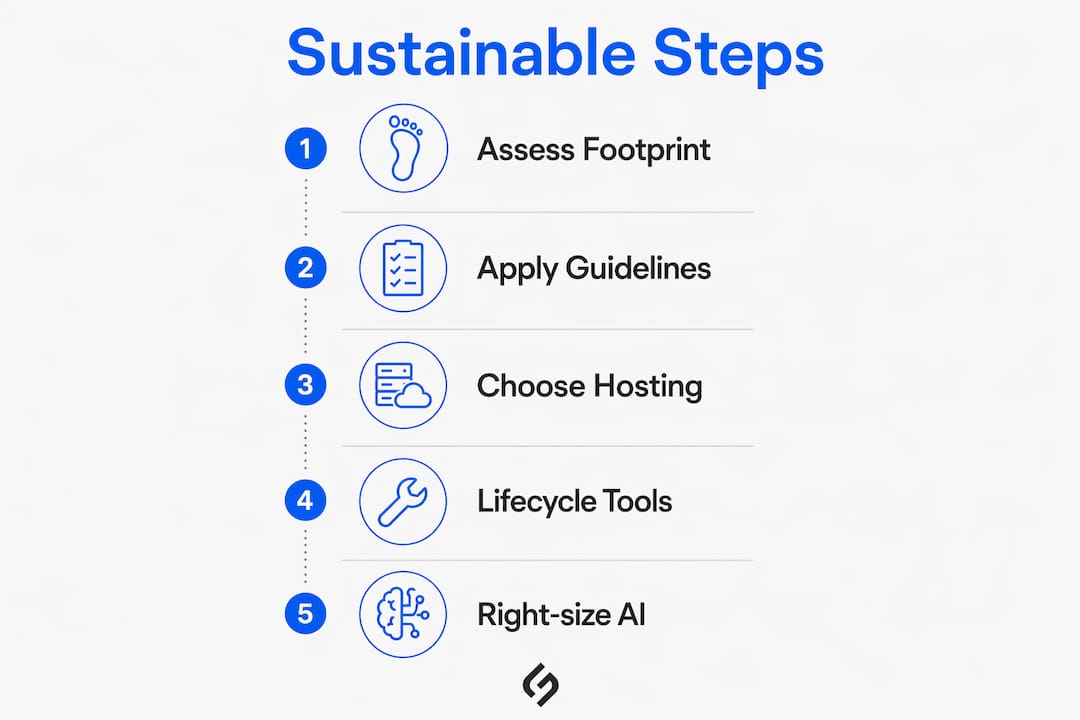
Step 1: Assess your digital carbon footprint. Use a platform that applies GHG Protocol or Bilan Carbone® methodologies to measure emissions across your devices, cloud services, and supply chain. Verdikt, for example, provides certified, activity-based measurement with granular emission factors for IT ecosystems. You cannot reduce what you have not measured.
Step 2: Apply W3C Web Sustainability Guidelines to your web properties. The W3C guidelines cover accessibility, privacy, and security as core sustainability elements, not optional add-ons. Incorporating these standards into your development and procurement process ensures your digital products are ethical and resilient, not just energy-efficient. Solution4guru’s approach to web development best practices aligns directly with these principles.
Step 3: Choose sustainable hosting and cloud storage. Evaluate providers based on technical architecture, specifically data density per rack and shared hardware use, rather than marketing claims alone. Providers that partner with carbon-conscious data centers deliver verifiable reductions in physical footprint and power draw.
Step 4: Adopt lifecycle assessment and digital twin tools. Automated lifecycle assessments using digital twins reveal the environmental impact of software at scale. The ECO:DIGIT project provides platform-independent LCA tools to evaluate mobile, desktop, and cloud-native applications. Pairing these tools with your ITSM platform, as covered in ITSM integration practices, creates a continuous feedback loop between development decisions and environmental outcomes.
Step 5: Right-size your AI workloads. Embedding resource efficiency from the design stage of AI development enables models that perform well while consuming far fewer energy resources. For SMEs using AI-powered tools, working with providers that apply right-sized AI models reduces both compute costs and carbon output simultaneously.
Pro Tip:
Run a lifecycle assessment on your top three software applications before purchasing new hardware. You may find that software inefficiency, not hardware age, is driving your highest energy costs.
| Implementation area | Primary tool or standard | Key outcome |
|---|---|---|
| Carbon measurement | GHG Protocol / Bilan Carbone® | Certified Scope 3 emissions data |
| Web development | W3C Web Sustainability Guidelines | Ethical, accessible, resilient products |
| Cloud hosting | High-density, shared-hardware providers | Reduced data center footprint |
| Software assessment | Digital twin / LCA platforms | Quantified software environmental impact |
| AI workloads | Right-sizing and model compression | Lower compute energy without performance loss |
What are common challenges and how can enterprises overcome them?
Most SMEs hit the same set of obstacles when adopting sustainable tech strategies. Knowing them in advance lets you plan around them rather than react to them.
Data availability and standardization is the most common barrier. Software environmental impact data is inconsistent across vendors and platforms. Standardized, objective data for software environmental impact is essential for developers to design greener applications and identify improvement opportunities. The practical fix is to require standardized emissions reporting from vendors as a procurement condition, not an afterthought.
Balancing sustainability with privacy, accessibility, and security trips up teams that treat these as competing priorities. The W3C Web Sustainability Guidelines treat accessibility, privacy, and security as core sustainability elements, not trade-offs. Building cross-functional teams that include security, accessibility, and sustainability leads avoids the siloed thinking that creates conflicts.
Greenwashing risk is real and reputational. Vague claims about being “carbon neutral” without certified methodology behind them expose your business to scrutiny from customers, regulators, and investors. The defense is specificity: use accredited measurement frameworks and publish the methodology alongside the numbers.
Cross-functional collaboration gaps slow implementation. Sustainability goals that live only in the IT department rarely reach procurement, finance, or operations. The digital transformation challenges that SMEs face most often trace back to organizational silos, not technology limitations. Assign sustainability accountability across departments and tie it to existing performance metrics.
Key strategies to address these challenges:
- Require standardized emissions data from all technology vendors at procurement
- Use W3C guidelines to align sustainability, accessibility, privacy, and security in one framework
- Publish certified measurement methodology alongside any public sustainability claims
- Assign cross-departmental sustainability leads with clear accountability and reporting lines
- Use multi-site cloud connectivity to centralize emissions tracking across distributed operations
Why I think most SMEs are approaching digital sustainability backwards
Most business leaders treat sustainability as a reporting exercise. They measure emissions after the fact, publish a number, and call it progress. That approach misses the point entirely.
The real opportunity is upstream. Embedding resource efficiency from the design stage of AI development enables models that perform well while consuming far fewer energy resources. The same logic applies to every digital product your company builds or buys. If you wait until a system is in production to assess its environmental impact, you have already locked in most of its lifetime energy cost.
What I have seen work is treating sustainability as a design constraint, not a compliance metric. When your development team knows that energy efficiency and lifecycle impact are evaluated alongside performance and cost, the decisions change at the architecture level. That is where the largest reductions happen, and they compound over time.
Transparency is the second piece most SMEs skip. Energy labels and visible efficiency ratings on AI systems and digital products motivate sustainable choices by developers and buyers alike. Publishing your methodology, not just your headline number, builds the kind of credibility that survives regulatory scrutiny and customer due diligence.
The SMEs that will lead on digital sustainability in the next three years are not the ones spending the most on green initiatives. They are the ones embedding sustainability into procurement criteria, development standards, and vendor contracts right now.
How Solution For guru supports sustainable web development
Solution4guru builds web and technology solutions with privacy, accessibility, and security integrated from the start, which aligns directly with the W3C Web Sustainability Guidelines framework. For SMEs ready to move from measurement to implementation, that foundation matters. A website or application built without these principles creates technical debt that compounds over time, both in environmental impact and maintenance cost.
The web development services at Solution4guru cover everything from foundational architecture to advanced digital transformation consulting, with a focus on building systems that perform efficiently and meet modern compliance standards. If your business is ready to align its digital presence with sustainable tech strategies, Solution4guru offers free consultations to map out the right approach for your specific operations. Visit solution4guru.com to get started.
Key Takeaways
Sustainable digital solutions deliver the greatest business value when sustainability is embedded at the design stage, not added as a reporting layer after deployment.
| Point | Details |
|---|---|
| Measure first with certified tools | Use GHG Protocol or Bilan Carbone® platforms to get granular, actionable emissions data across your IT ecosystem. |
| Apply W3C guidelines to web properties | Treat accessibility, privacy, and security as core sustainability requirements, not separate workstreams. |
| Choose infrastructure on technical merit | Evaluate cloud providers by data density and hardware architecture, not marketing claims. |
| Right-size AI workloads | Model compression and right-sizing reduce compute energy costs without sacrificing performance. |
| Embed sustainability in procurement | Require standardized emissions reporting from vendors before signing contracts, not after. |
FAQ
Sustainable digital solutions are eco-friendly digital services and technologies that minimize environmental impact while maintaining or improving operational performance. They apply lifecycle thinking, certified emissions measurement, and energy-efficient infrastructure across the full technology stack.
SMEs use platforms that apply accredited methodologies like the GHG Protocol or Bilan Carbone® to measure Scope 3 emissions across devices, cloud services, and supply chains. These platforms provide activity-based data with thousands of emission factors specific to IT ecosystems.
The W3C Web Sustainability Guidelines are a set of standards advocating systems thinking that balances environmental, social, and economic factors in web design. They integrate accessibility, privacy, and security as core sustainability elements rather than optional features.
Right-sizing AI means compressing or selecting models that deliver required performance using less compute power. The UNESCO-supported Resilient AI initiative demonstrates that model compression maintains performance on affordable devices while significantly reducing energy consumption.
Greenwashing in digital sustainability means making vague or unverified claims about environmental performance without certified methodology to support them. The defense is publishing the specific measurement framework and emission factors used alongside any public sustainability figures.