What Is Conversion Rate Optimization? A 2026 Guide

TL;DR:
- Conversion rate optimization increases the percentage of website visitors who complete desired actions through data-driven methods. It improves revenue, user experience, and marketing efficiency without additional traffic, by using techniques like testing and personalization. CRO is an ongoing process focused on learning from results and aligning all customer touchpoints for sustainable growth.
Conversion rate optimization (CRO) is defined as the systematic, data-driven process of increasing the percentage of website visitors who complete a desired action, such as making a purchase, filling out a form, or signing up for a newsletter. The formula is straightforward: divide total conversions by total visitors, then multiply by 100. If 2 out of 100 visitors convert, the conversion rate is 2%. CRO focuses on maximizing value from existing traffic rather than spending more to attract new visitors. For digital marketers and business owners, that distinction is the difference between sustainable growth and an endless ad spend spiral.
What is conversion rate optimization and why does it matter?
CRO is not about getting more people to your site. It is about getting more value from the people already there. Doubling a conversion rate from 2% to 4% effectively doubles revenue from the same ad budget, without a single additional click purchased. That math makes CRO one of the highest-return activities in digital marketing.
The business case goes further than revenue alone. CRO drives growth by increasing average order value and lowering customer acquisition costs through data-driven approaches integrated across marketing channels. Lower acquisition costs mean each dollar of ad spend produces more profit, compounding over time.
“Conversion rate optimization is not a campaign. It is a permanent operating model for any business that wants to grow without proportionally growing its marketing budget.”
The practical advantages of a strong CRO program include:
- Higher revenue per visitor without increasing traffic costs
- Better user experience that builds trust and reduces friction
- Lower customer acquisition costs as each visitor becomes more likely to convert
- Improved marketing ROI across paid, organic, and email channels
- Sustainable growth built on data rather than guesswork
CRO also separates businesses that scale efficiently from those that plateau. A company spending $50,000 per month on paid traffic with a 1% conversion rate leaves enormous value on the table. Raising that rate to 2% doubles output from the same spend. That is not a marginal gain. It is a structural shift in business performance.
What are the core techniques used in CRO?

A/B testing is only one part of CRO. True optimization also involves user research, data analysis, and UX design, forming a broader strategic approach. Treating A/B testing as the whole discipline is one of the most common and costly misconceptions in digital marketing.
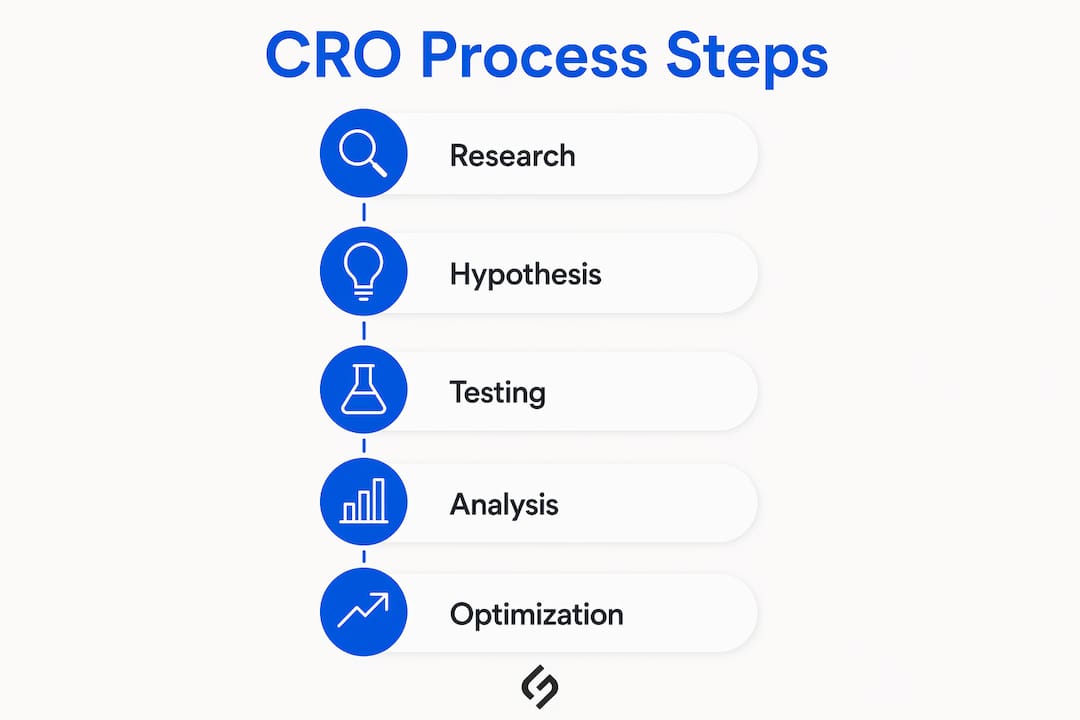
The full toolkit includes several distinct methods, each suited to different questions and stages of the optimization cycle.
| Technique | What it tests | Best used for |
|---|---|---|
| A/B testing | Two versions of a single element | Headlines, CTAs, button colors |
| Multivariate testing | Multiple elements simultaneously | Complex page layouts |
| Usability testing | Real user behavior and friction points | Checkout flows, onboarding |
| User research | Motivations, objections, and intent | Messaging and positioning |
| Heatmap analysis | Click and scroll patterns | Above-the-fold design decisions |
| Predictive personalization | AI-driven real-time content matching | Product recommendations, dynamic offers |
Multivariate testing allows simultaneous evaluation of multiple changes, revealing how design elements interact with each other. That depth of insight goes well beyond what a standard A/B test can provide.
The most significant shift in 2026 is the rise of AI-driven methods. AI advances shift CRO toward predictive personalization, where behavior analysis anticipates user needs and suggests relevant products in real time. This moves optimization from static page experiments to continuous, adaptive experiences.
Pro Tip: Run A/B tests on high-traffic pages first. Statistical significance requires volume. Testing a page that receives 50 visits per month will take months to produce reliable data, while a page with 5,000 monthly visits can yield results in days.
User research deserves particular attention. Surveys, session recordings, and customer interviews surface the “why” behind behavior that analytics alone cannot explain. A heatmap shows where users click. A user interview explains why they did not click on the element you expected them to.
How do you measure and validate CRO efforts?
Measurement is where CRO programs succeed or fail. Without clearly defined conversion events, no test result is meaningful. A conversion event must be specific: a completed purchase, a form submission, a phone call initiated from a click-to-call button. Vague goals produce vague data.
Heatmaps and sentiment analysis from customer reviews provide micro-level user interaction insights and identify friction points that aggregate metrics miss. A funnel report might show a 60% drop-off on the checkout page. A heatmap reveals that users repeatedly click on a non-clickable product image, expecting it to enlarge. That is a fixable problem invisible to standard analytics.
The CRO measurement workflow follows a clear cycle:
- Define the conversion event with precision before any test begins
- Establish a baseline by measuring current performance over a statistically meaningful period
- Form a hypothesis grounded in data, not opinion (“Adding trust badges near the checkout button will reduce abandonment because users cite security concerns in exit surveys”)
- Run the test with sufficient traffic and time to reach statistical significance
- Analyze results including secondary metrics, not just the primary conversion rate
- Document findings whether the test wins, loses, or produces inconclusive results
CRO is a continuous cycle, not a single project. Even unsuccessful tests provide valuable insights and drive iterative improvements. A failed test that reveals a user objection is more valuable than a winning test that raises conversion by 0.1%.
Pro Tip: Use Google Analytics 4’s funnel exploration report alongside a dedicated heatmap tool to cross-reference quantitative drop-off data with qualitative behavior patterns. The combination surfaces problems that neither tool finds alone.
Interpreting results requires discipline. Stopping a test early because it looks like a winner is one of the most common errors in CRO practice. Premature conclusions produce false positives that lead to changes that hurt performance over time.
What are the best practices for implementing CRO effectively?
A CRO strategy requires clear goals, continuous data measurement, hypothesis-driven testing, and user experience improvements that combine to raise conversion rates sustainably. Starting without defined goals is the fastest path to wasted effort.
Practical steps for building an effective CRO program:
- Define specific conversion actions for each page or funnel stage, not just site-wide conversion rate
- Audit your current funnel using analytics to identify the highest-drop-off points before testing anything
- Prioritize tests by potential impact using a scoring framework that weighs traffic volume, ease of implementation, and expected lift
- Align CRO with UX and content teams so design changes, copy updates, and technical fixes move together
- Document every test in a shared log that records hypothesis, results, and next steps
- Avoid testing too many changes at once outside of structured multivariate tests, since simultaneous untracked changes make attribution impossible
- Revisit winning tests after major site updates, since a winning variation from 18 months ago may underperform on a redesigned page
CRO is not the same as SEO. SEO attracts visitors through search visibility. CRO improves what happens after they arrive. Both disciplines are necessary, but they require different skills, tools, and success metrics. Confusing them leads to misallocated resources.
For businesses new to CRO, the best starting point is the page with the highest traffic and the lowest conversion rate. That combination represents the largest gap between potential and actual performance. Fix that gap before expanding the program to lower-traffic pages.
Aligning email marketing campaigns with CRO efforts also produces compounding gains. A well-optimized landing page paired with a targeted email sequence outperforms either tactic in isolation. The web infrastructure supporting those pages matters too. Reliable web hosting for small businesses directly affects page load speed, which is a documented factor in conversion rate performance.
Key Takeaways
Conversion rate optimization produces the highest returns when it operates as a continuous, data-driven discipline rather than a one-time project.
| Point | Details |
|---|---|
| CRO definition | CRO increases the percentage of visitors who complete a desired action using the formula: (conversions / visitors) × 100. |
| Business impact | Doubling a conversion rate from 2% to 4% doubles revenue from the same ad spend, with no additional traffic cost. |
| Beyond A/B testing | Effective CRO combines A/B testing, multivariate testing, usability research, heatmaps, and AI-driven personalization. |
| Measurement discipline | Define conversion events precisely, establish baselines, and document every test result, including failures. |
| Continuous improvement | Failed tests deliver insights that drive future wins; CRO is an ongoing cycle, not a one-time fix. |
CRO in 2026: what I’ve learned about the discipline most teams still get wrong
Most CRO programs I have seen fail for the same reason: teams treat it as a testing queue rather than a learning system. They run A/B tests, declare winners, move on, and wonder why their conversion rate plateaus after the first few wins. The problem is that they are collecting results without building knowledge.
The shift that changes everything is treating every test as a question about your customer, not just a bet on a design change. A winning headline does not just lift conversion. It tells you which message resonates with your audience at that stage of the funnel. That insight should feed your ad copy, your email subject lines, and your sales scripts.
AI-driven predictive personalization is real and it is accelerating. Platforms that serve dynamically personalized content based on behavioral signals are outperforming static pages in nearly every category I have tracked. But AI does not replace the fundamentals. Garbage-in, garbage-out still applies. If your conversion events are poorly defined or your traffic is low-quality, no algorithm fixes that.
The other shift worth watching is multi-channel CRO. Optimizing only the website while ignoring the email sequence, the post-purchase flow, and the mobile app experience leaves significant conversion gains unrealized. The highest-performing teams I have worked with treat every customer touchpoint as a conversion opportunity, not just the landing page.
My honest advice: start simple, measure rigorously, and build a culture where a failed test is celebrated as much as a winning one. The teams that learn fastest win.
How Solution For guru supports your CRO and marketing goals
Building a CRO program requires more than testing tools. It requires clean data, aligned teams, and systems that connect marketing performance to business outcomes.
Solution4guru’s integrated digital services bring together web development, UI/UX design, SEO, and digital marketing under one roof, giving businesses the infrastructure to run CRO programs that actually scale. From building high-converting landing pages to integrating analytics across channels, Solution4guru provides the technical foundation that makes data-driven optimization possible. Explore the full range of digital marketing services to see how each offering supports your conversion goals at every stage of the funnel.
FAQ
CRO, or conversion rate optimization, is the process of increasing the percentage of website visitors who complete a desired action, calculated as (total conversions / total visitors) × 100. It focuses on improving results from existing traffic rather than acquiring new visitors.
A/B testing is one tool within CRO, not the full discipline. Effective CRO also includes user research, usability testing, heatmap analysis, data analysis, and UX design improvements.
SEO drives traffic to a website through search visibility. CRO improves what happens after visitors arrive, converting more of that traffic into customers, leads, or other desired actions.
Results depend on traffic volume and test complexity. High-traffic pages can produce statistically significant results within days. Lower-traffic pages may require weeks or months to generate reliable data.
The primary metric is conversion rate for the defined action. Supporting metrics include bounce rate, average session duration, funnel drop-off rates, and average order value, all of which provide context for interpreting conversion performance.