Samsara Review: Features, Pros, Cons, and Best Use Cases
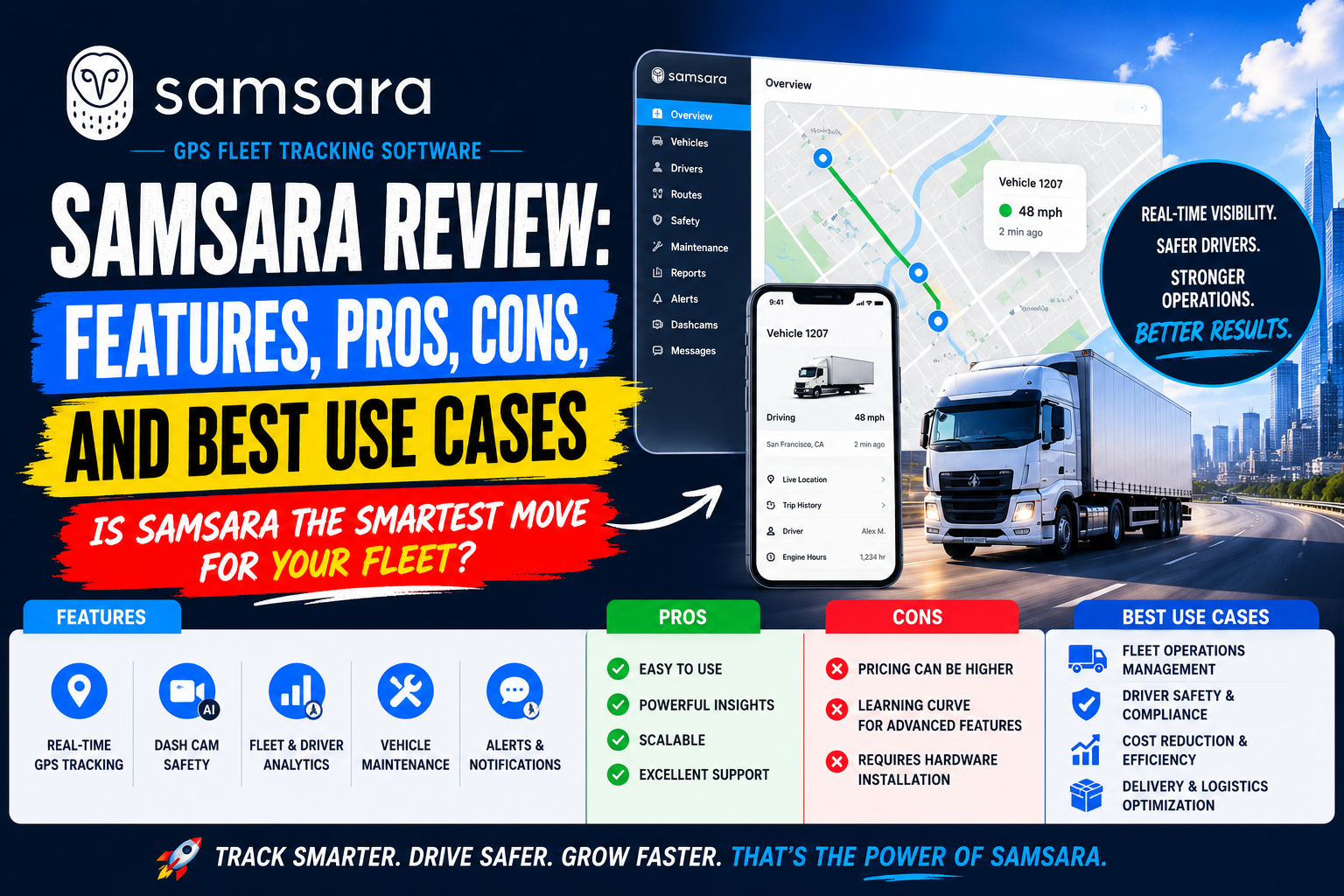
Choosing a fleet management platform is rarely simple. Fleet managers must weigh hardware quality, compliance coverage, pricing structure, and long-term contract terms before committing a budget to any single vendor. On top of that, the wrong choice can mean months of frustrating onboarding, hidden fees, or a system that simply doesn’t scale as the business grows.
Samsara has become one of the most recognized names in this space, and for good reason. Instead of offering a single narrow tool, it combines GPS tracking, AI dash cams, compliance automation, and maintenance software into one connected platform. As a result, many businesses use Samsara to replace three or four separate vendors with a single dashboard.
This review breaks down what Samsara actually offers, where it excels, where it falls short, and which businesses get the most value from it. Whether a company manages three delivery vans or a thousand-truck national fleet, this guide will help decide if Samsara – GPS Fleet Tracking Software fits the operation.
Table of contents
What Is Samsara and Why Does It Matter for Fleet Managers?

Samsara operates what it calls a Connected Operations Platform. Instead of selling a single tool, the company pairs proprietary hardware, such as GPS gateways, dash cams, and asset sensors, with cloud software that turns raw vehicle and equipment data into actionable insights. Businesses use it to monitor vehicle location, track driver safety, manage compliance paperwork, and reduce fuel and maintenance costs from one dashboard.
This matters because fleet managers historically had to stitch together separate systems for tracking, safety, and compliance. Samsara’s pitch is consolidation: fewer logins, fewer vendors, and a single source of truth for fleet data. That said, consolidation only pays off if the platform’s core features genuinely meet a business’s needs, so it’s worth examining the details before assuming bigger is automatically better.
Below is a quick-reference summary before diving into the specifics.
| Category | Samsara Snapshot |
|---|---|
| Product type | GPS fleet tracking and connected operations platform |
| Best for | Fleets of all sizes, especially those needing compliance and safety tools |
| Refresh rate | Real-time, updating location data every second |
| Contract length | Typically multi-year (often 3 years minimum) |
| Minimum fleet size | Generally 3+ vehicles |
| Pricing model | Custom quote based on hardware, features, and fleet size |
| Support | 24/7 phone, email, and chat (chat/ticket hours may be limited) |
| Mobile apps | Samsara Fleet (managers) and Samsara Driver (drivers) |
This snapshot already reveals the topic of this article clearly: Samsara is a serious, enterprise-grade solution, but it comes with trade-offs that smaller or budget-conscious fleets should understand before signing a contract. The rest of this article unpacks each of these points in depth, starting with the platform’s core feature set.
What Features Does Samsara Offer?
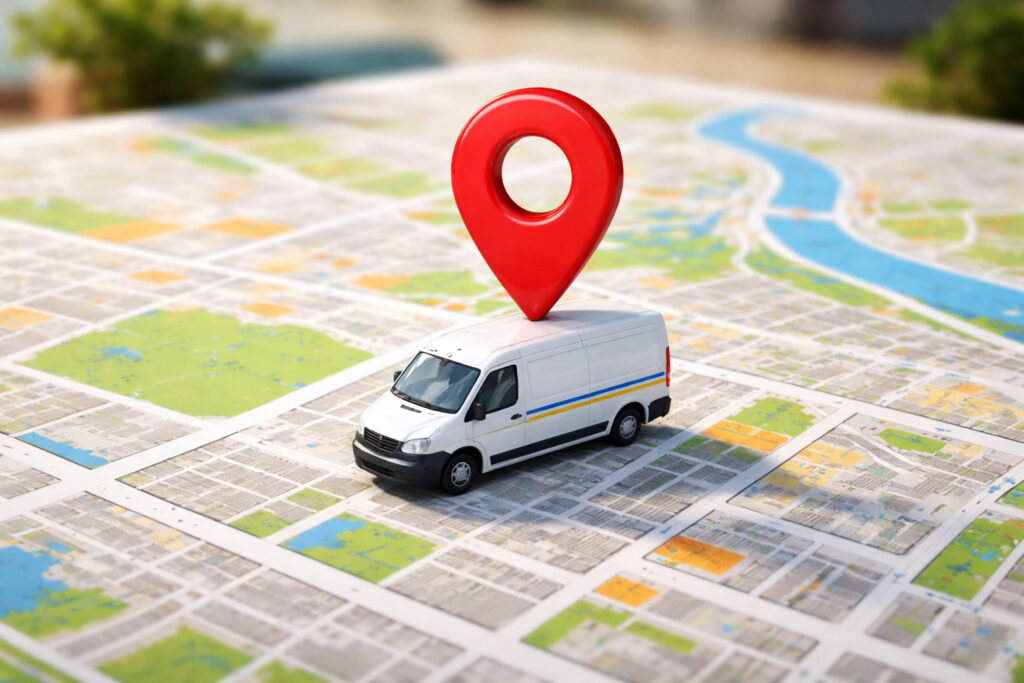
Samsara’s feature set is broad, so it helps to break it down into the categories fleet managers actually use day to day. Each subsection below focuses on one functional area rather than trying to summarize everything at once.
How Does Real-Time GPS Tracking Work?
Samsara’s GPS hardware collects location data every second rather than relying on the 10-second-to-two-minute “breadcrumb” refresh common among competitors. This gives fleet managers a live, “helicopter view” of every vehicle, trailer, and piece of equipment on one map, updated almost instantly.
Managers can filter by driver, vehicle, or gateway, and instantly see current location alongside driver identity. The platform also compares planned routes against the routes actually driven, which helps flag unscheduled stops, detours, or potential moonlighting. Additionally, drivers and dispatchers can share live location links with customers, which improves transparency around delivery windows and reduces the volume of “where is my shipment” calls.
Geofencing rounds out the tracking toolkit. Managers can draw virtual boundaries around job sites, warehouses, or customer locations, and Samsara automatically triggers alerts whenever a vehicle enters or exits those zones. This is particularly useful for confirming on-site arrival times without requiring manual check-ins from drivers.
What Compliance Tools Does Samsara Provide?
Fleets in regulated industries need to document Hours of Service (HOS), Electronic Logging Device (ELD) compliance, International Fuel Tax Agreement (IFTA) reporting, and Driver Vehicle Inspection Reports (DVIR). Samsara’s ELD solution is FMCSA-registered and third-party certified for use in both the United States and Canada, which matters for cross-border carriers.
Rulesets update automatically based on GPS location, so drivers stay on the correct compliance rules without manual input as they cross state or provincial lines. AI-powered geofencing also manages yard moves and unassigned HOS events on its own, which reduces the administrative burden that typically falls on compliance staff. A built-in 4G LTE hotspot keeps the driver app connected even in rural areas with limited cellular coverage, helping avoid compliance gaps caused by dropped connections.
How Does Samsara Support Vehicle Maintenance and Diagnostics?
The platform tracks scheduled preventative maintenance and flags unexpected mechanical issues as they occur. It can alert managers to failing batteries or engine faults before they cause a roadside breakdown, and it automatically generates diagnostic reports for recordkeeping purposes.
Mileage data helps predict when a vehicle needs its next inspection, removing the guesswork from scheduling downtime. Additional sensors can monitor cargo or engine temperature, which helps prevent spoilage or product loss for businesses hauling perishable goods. Managers can also review historical maintenance records for each vehicle, making it easier to decide when a unit is worth repairing versus replacing.
What Safety and AI Dash Cam Features Are Included?
Samsara’s AI-powered dash cams monitor driver behavior and road conditions simultaneously, issuing in-cab alerts for risky behavior such as harsh braking, distracted driving, or following too closely. Some models offer 360-degree visibility using multiple HD cameras streamed directly to the cloud and an in-cab monitor.
A centralized Safety Inbox surfaces flagged events automatically, so safety managers don’t have to review hours of footage manually to find the moments that matter. Fleets also get driver safety scoring, which allows managers to compare drivers against one another and recognize top performers, encouraging safer habits over time. Panic button and crash detection functionality come included at no additional charge in most regions, which is not always the case with competing platforms.
What Integrations and Open Platform Capabilities Exist?
Samsara maintains a marketplace of more than 350 third-party integrations, spanning fuel card providers, maintenance software, and OEM partners such as Ford, GM, and Stellantis. An open API lets larger businesses connect Samsara’s data directly into their own dispatch, ERP, or reporting software.
However, setting up deeper integrations can add time to the onboarding process, so businesses with complex existing tech stacks should plan for a longer implementation timeline. Fleets that only need basic tracking may never touch the API at all, while enterprises running custom software often rely on it heavily to unify data across departments.
How Easy Is It to Set Up Samsara?
Setup is one of the areas where Samsara consistently earns praise, even from reviewers who criticize its pricing structure. After signing up and selecting a plan that fits the fleet’s size and budget, businesses typically receive plug-and-play GPS devices that install into a vehicle’s OBD-II port in a matter of minutes, without requiring a professional installer or extended downtime.
That said, businesses planning to use Samsara‘s more advanced capabilities, such as deep API integrations or multiple third-party apps from the marketplace, should expect a longer setup timeline. Configuring compliance rulesets correctly, connecting fuel card providers, and training dispatchers on the dashboard all take additional time beyond the initial hardware installation. Fleets that under-budget time for this phase sometimes struggle to realize the platform’s full value in the first few months, which is one reason many businesses choose to bring in outside implementation support rather than handling the entire rollout internally.
What Are the Pros of Using Samsara?
Samsara consistently earns praise from independent reviewers and verified users across multiple review platforms. The main strengths include the following.
- True real-time tracking — Location data refreshes every second, rather than in delayed intervals, which is rare among competitors.
- Intuitive dashboard — New users tend to learn the interface quickly, reducing onboarding friction for growing teams.
- Strong compliance automation — ELD, IFTA, and DVIR requirements are handled with minimal manual data entry.
- Comprehensive safety suite — AI dash cams, safety scoring, and panic buttons come bundled without extra fees in most plans.
- Plug-and-play hardware — Devices install into a vehicle’s OBD-II port in minutes, without professional installation in most cases.
- Wide integration marketplace — Hundreds of apps and an open API extend the platform well beyond core telematics.
- Responsive 24/7 phone support — Larger accounts, in particular, report helpful and prompt customer service experiences.
- Scalability — The same platform supports both small fleets and enterprise operations with thousands of vehicles.
Taken together, these strengths explain why Samsara routinely appears on “best of” lists for both startups and large enterprises, even though its pricing and contract structure draw more mixed reactions, as the next section explains.
What Are the Cons of Using Samsara?
No platform is perfect, and several recurring complaints show up across review sites and verified user feedback. Prospective buyers should weigh these carefully against the benefits above.
- Long contract commitments — Many plans require a minimum three-year agreement, which limits flexibility for businesses still testing the waters.
- No public pricing — Buyers must request a custom quote, making it harder to comparison-shop quickly against competitors.
- Samsara-only hardware — The platform does not support third-party hardwired GPS trackers, so businesses are locked into Samsara’s own devices.
- Add-on costs — Certain integrations, particularly maintenance and tire-monitoring apps, carry additional fees beyond the base subscription.
- Inconsistent support for smaller accounts — While large accounts often report strong service, some smaller customers mention slower response times.
- Billing transparency concerns — A number of verified reviewers cite unclear information about pricing increases and upgrade costs.
- Occasional software bugs — Some users report intermittent glitches or connectivity issues within the mobile app.
None of these drawbacks are unique to Samsara among enterprise fleet platforms, but they do mean smaller businesses on tight budgets should read the fine print carefully before signing a multi-year agreement.
How Much Does Samsara Cost?

Samsara does not publish fixed pricing on its website. Instead, cost depends on fleet size, contract length, selected hardware, and which software modules a business needs. Every license generally bundles hardware, cloud software, cables, firmware updates, cellular connectivity, and support into one recurring fee, rather than charging separately for each component.
Volume discounts and multi-year term discounts are available for larger fleets, which is one reason Samsara tends to be more cost-competitive for enterprise buyers than for small operations. The table below summarizes the main factors that influence the final quote.
| Pricing Factor | What It Affects |
|---|---|
| Fleet size | Larger fleets typically unlock volume discounts |
| Contract length | Longer terms, often three or more years, usually lower the per-vehicle cost |
| Hardware selection | GPS gateways, dash cams, and asset trackers are priced separately |
| Add-on modules | Maintenance, tire monitoring, and some integrations cost extra |
| Support tier | Larger accounts may receive more dedicated support resources |
Because Samsara requires a custom quote, businesses should request pricing from multiple vendors and compare total contract value rather than a single monthly rate. Lower-cost alternatives exist for businesses with simpler needs, but they typically offer a narrower feature set than Samsara’s full connected operations platform. It’s also worth asking vendors directly about renewal pricing, since some reviewers note costs can rise after the initial contract term ends.
What Are the Best Use Cases for Samsara?
Samsara fits a wide range of fleet types, but it performs best under certain conditions. The following subsections break down how different business sizes and industries tend to use the platform.
Which Types of Businesses Benefit Most?
Transportation, trucking, and logistics companies represent the largest share of Samsara’s user base, followed closely by construction, field service, and distribution businesses. Companies juggling multiple vendors for compliance, safety, and maintenance often consolidate onto Samsara specifically because it replaces several point solutions with one platform, reducing administrative overhead.
Businesses with mixed fleets, meaning a combination of trucks, vans, trailers, and heavy equipment, also benefit from Samsara‘s ability to track assets beyond just powered vehicles. This flexibility makes it a popular choice for construction companies that need visibility into both trucks and unpowered equipment on job sites.
Is Samsara Right for Small Fleets?
Samsara is frequently recognized as a strong option for small businesses with fewer than 50 vehicles, thanks to its intuitive interface and hassle-free installation. Many small businesses appreciate not needing a dedicated IT staff to manage the system day to day.
However, the multi-year contract requirement and lack of published pricing mean small fleets should carefully evaluate total cost of ownership before signing. Businesses expecting to grow or shrink quickly, or those uncertain about long-term needs, may want to negotiate contract terms upfront rather than accepting a standard multi-year agreement by default.
Is Samsara Right for Large Enterprises?
Larger fleets tend to get the most value from Samsara because volume pricing improves cost efficiency, and the platform’s compliance, safety, and maintenance tools scale well across hundreds or thousands of vehicles. Enterprise fleets also benefit from dedicated account support and deeper API access for integrating fleet data into existing corporate systems.
Enterprises transitioning toward electric or hybrid fleets additionally benefit from Samsara’s fuel efficiency and sustainability reporting tools, which help plan a gradual shift away from traditional combustion vehicles while tracking cost and emissions data along the way.
How Does Samsara Compare to Other Fleet Management Systems?
Understanding how Samsara stacks up against alternatives helps put its pricing and feature trade-offs into context.
| Provider | Refresh Rate | Notable Strength | Notable Trade-off |
|---|---|---|---|
 | Every second | Deepest feature integration, strongest safety suite | Longer contracts, custom pricing only |
 | Frequent intervals | Clean map color-coding by vehicle status | Fewer advanced AI safety features |
 | Frequent intervals | Strong open-platform data ecosystem | Less unified hardware/software experience |
| Budget alternatives (entry-level GPS trackers) | Varies | Lower upfront and monthly cost | Narrower feature set, less compliance automation |
Samsara‘s closest competitors generally match it on basic tracking capability, but reviewers consistently note that Samsara’s real-time refresh rate and combined hardware-software approach give it an edge for businesses that need more than simple location tracking. Fleets primarily focused on cost savings over feature depth may still find budget alternatives more appropriate, particularly if compliance automation is not a priority.
Ultimately, the right choice depends on what a business values most. Fleets that prioritize the deepest possible safety and compliance automation, and that can commit to a longer contract in exchange for volume pricing, tend to lean toward Samsara. Meanwhile, fleets with simpler needs, tighter budgets, or shorter planning horizons often gravitate toward lower-cost alternatives, accepting a narrower feature set in exchange for greater pricing flexibility and shorter commitments.
What Do Real Users Say About Samsara?

Beyond marketing claims, verified user reviews offer a more grounded picture of how Samsara performs in daily operations. Aggregated review data spanning over a thousand verified submissions gives a consistent picture across multiple independent platforms.
How Do Users Rate Samsara’s Core Features?
Reviewers consistently highlight the accuracy and reliability of Samsara’s GPS capabilities, citing its usefulness for tracking vehicle locations, planning efficient routes, and providing accurate estimated arrival times to customers. Detailed trip histories and real-time location updates rank among the most frequently praised aspects, and the vast majority of reviewers who commented on GPS functionality rated it as important or highly important to their operations.
Real-time notifications also draw strong approval. Users report that alerts covering speeding, harsh driving events, and location changes let managers take corrective action immediately rather than discovering problems after the fact. This immediacy is frequently cited as a meaningful improvement over previous tracking systems these businesses used.
What Do Users Say About Support and Billing?
Feedback about customer service is more mixed. Many users appreciate the willingness of support staff to help and follow up on tickets, and sales and technical teams are often described as knowledgeable during the implementation process. At the same time, some reviewers report slower response times, unhelpful support interactions, or feeling unheard on billing questions, particularly when their account size is smaller.
Billing itself is one of the more consistent pain points across review platforms. Users cite high pricing, unexpected increases, and unclear information about upgrade costs as recurring frustrations, even among businesses that are otherwise satisfied with the platform’s core functionality. This reinforces the earlier recommendation that buyers request detailed, written pricing breakdowns before signing a contract, rather than relying on verbal quotes alone.
Conclusion
Samsara has earned its reputation as one of the most complete fleet management platforms available today. Its real-time GPS tracking, automated compliance tools, AI-powered safety features, and wide integration marketplace make it a strong choice for transportation, construction, and field service businesses of nearly any size. Consequently, it consistently ranks among the top recommendations from independent reviewers evaluating fleet technology.
That said, the platform’s multi-year contracts, custom pricing, and hardware lock-in mean it isn’t automatically the right fit for every budget or business stage. Smaller fleets or businesses uncertain about long-term needs should weigh these trade-offs carefully before committing.
Businesses evaluating Samsara – GPS Fleet Tracking Software should request a detailed quote, compare it against total cost of ownership rather than sticker price alone, and consider partnering with an implementation specialist to maximize the platform’s return on investment from day one.
Frequently Asked Questions
Yes. Most Samsara plans require a minimum multi-year commitment, often around three years. Businesses should factor this into their decision-making process, since switching providers mid-contract can be costly and disruptive to daily operations.
Samsara works well for small fleets, particularly those with fewer than 50 vehicles, thanks to its intuitive dashboard and quick hardware setup. However, small businesses should weigh the contract length and custom pricing model against lower-cost alternatives before committing, especially if their needs may change significantly over the next few years.
Yes. Samsara offers an open API and a marketplace with more than 350 third-party integrations, including fuel cards, maintenance tools, and OEM partners. Some integrations may involve additional setup time or fees, so businesses should confirm compatibility with their existing systems before purchase, and consider working with an implementation partner if the integration scope is complex.
Why Partner with Solution For Guru for Your Samsara Implementation?

Selecting the right fleet software is only half the challenge. Configuring it correctly, integrating it with existing systems, and training staff to use it well ultimately determines whether a business actually captures the return on investment. This is where working with an experienced technology partner like Solution For Guru adds real value.
Partnering with Solution For Guru can help businesses in several concrete ways:
- Avoid costly misconfiguration by setting up compliance rulesets, geofences, and safety alerts correctly from day one, rather than discovering gaps after an incident occurs.
- Accelerate onboarding so drivers and dispatchers adopt the platform faster, reducing productivity loss during rollout and cutting down on support tickets during the first weeks of use.
- Integrate Samsara with existing software, including ERP, dispatch, and fuel card systems, without straining internal IT resources or delaying other projects.
- Optimize contract and hardware decisions, helping businesses avoid unnecessary add-on costs or oversized hardware packages that don’t match actual fleet needs.
- Provide ongoing technical support, filling the gaps some smaller Samsara accounts report with direct vendor support, so issues get resolved quickly regardless of account size.
For businesses that want the full benefit of Samsara’s platform without absorbing the entire implementation burden internally, working with a specialized partner such as Solution For Guru can shorten the learning curve considerably and help avoid common rollout mistakes.
Recommended
- What Is Samsara GPS Fleet Tracking Software?
- Verizon Connect Review: Features, Pros, Cons, and Best Use Cases
- What Is Verizon Connect Fleet Management Software?
- Motive Pricing Plans Explained: How Much Does Motive Cost?
- What Is Motive Fleet Management?
- What Is the True Cost Breakdown of Fleet Tracking Systems?
- Offline Tracking: How Do Devices Store Data Without Connectivity?
- Real-Time Tracking vs Passive Tracking: What Are the Key Differences?
- How Vehicle Tracking Systems Reduce Commercial Auto Insurance Costs
- How Does GPS Tracking Work: Satellites, Signals, and Software?
- Can GPS Trackers Be Hacked? Security Risks Explained
- 4G vs 5G GPS Trackers: What’s Changing?
- AI in Fleet Tracking: How Are Predictive Maintenance and Analytics Transforming Fleet Operations?
- Tracking Requirements for Commercial Vehicles in the U.S.
- How Vehicle Maintenance Tracking Software Reduces Costs and Extends Fleet Lifespan?
- Top Benefits of GPS Vehicle Tracking Fleet Management Solutions for Modern Businesses
- Vehicle Tracking Online
- Business Vehicle Tracking: Boosting Efficiency and Accountability on the Road