
Content Marketing for Startups: A Practical Playbook

Content marketing for startups is the practice of publishing useful, specific material that answers the questions of future buyers, so that organic search, email and social channels bring in qualified demand without a large ad budget. It works when it is tied to one customer segment and one business outcome. It fails when it becomes a publishing habit with no commercial purpose. This guide covers how to define the audience, choose formats, set a budget, build a repeatable process and measure results.
TL;DR
- Content marketing earns attention by solving audience problems, which makes it a cost-effective complement to paid advertising for an early-stage company.
- Start narrow: one customer segment, two channels and a named business outcome, then expand only after something works.
- Prioritize bottom-of-funnel assets such as case studies and comparison pages before broad awareness content.
- Budget benchmarks vary widely; treat them as sanity checks, not targets, and track pipeline rather than raw traffic.
- AI makes production cheap, so the durable advantage is original expertise and real relationships with the audience.
Table of Contents
- What content marketing means for an early-stage company
- Step 1: Define the customer before the content
- Step 2: Name one outcome and a small starting scope
- Step 3: Choose formats and channels the team can sustain
- Step 4: Build a process that survives a busy quarter
- How much should a startup spend?
- Measuring what matters
- Content in the age of AI
- Our perspective
- How we help startups connect content to revenue
- Common mistakes to avoid
- FAQ
- Sources
What content marketing means for an early-stage company
Semrush defines content marketing as planning, creating and sharing valuable content to attract and engage a specific audience, build relationships and contribute to business results. The emphasis is on solving problems and answering questions rather than selling directly. Common formats include blog posts, videos, podcasts, infographics, ebooks, newsletters, social posts and webinars.
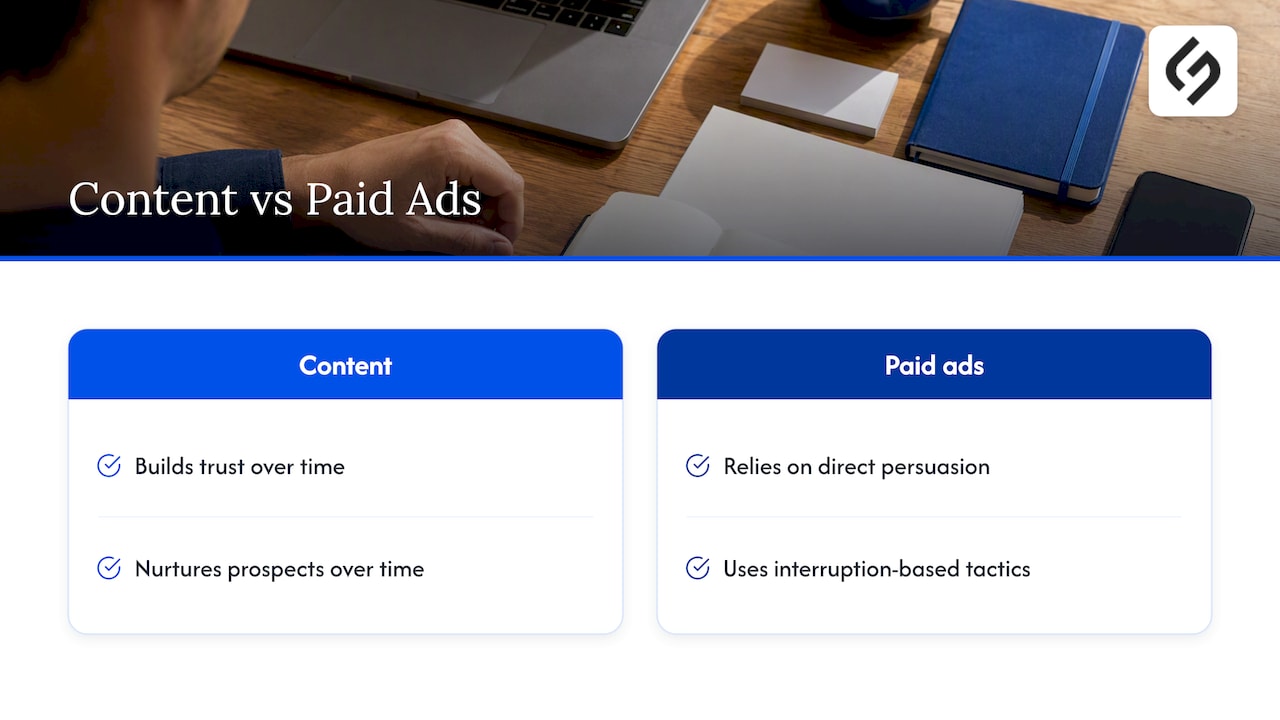
For a startup, the distinction from advertising matters. Shopify’s startup guide explains that content builds trust and nurtures prospects over time, whereas paid advertising relies on direct persuasion. The same guide lists early brand recognition, audience feedback and relatively inexpensive, shareable owned media among the benefits. DigitalOcean’s guide makes a similar case: content can build awareness, lift organic traffic and establish authority more cost-effectively than interruption-based tactics.
High Alpha frames the value in practical demand-generation terms. In its B2B content strategy for early-stage startups, content creates long-term organic traffic, gives prospects additional touchpoints and supplies conversion opportunities such as ebooks, research reports and webinars. That framing is useful: each asset should have a job.
For a broader primer aimed at smaller companies, see our guide on what content marketing is for SMBs.
A realistic view of results
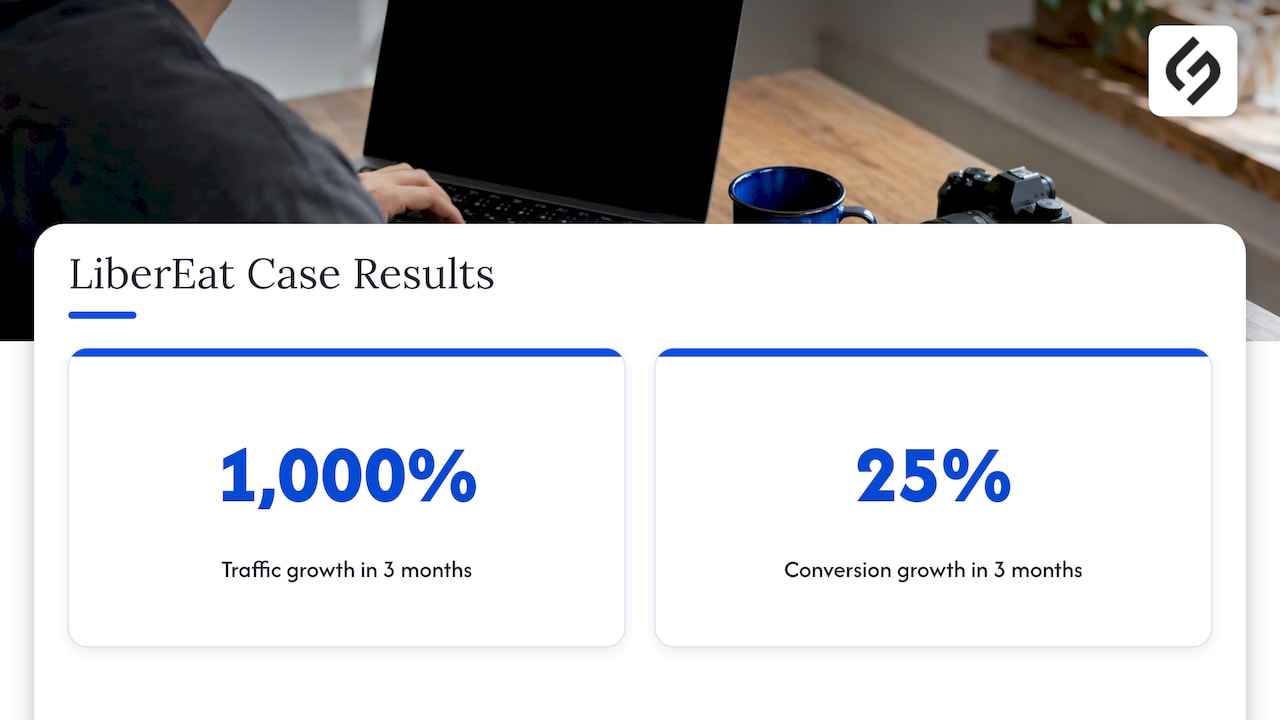
Case examples show what is possible, not what is typical. Semrush’s startup guide reports that LiberEat grew organic traffic by 1,000% and organic conversions by 25% within three months of implementing a content strategy. It is a single company’s outcome, and a startup beginning from near-zero traffic will see percentage jumps that look dramatic on a small base. Planning should assume that organic compounding takes months, not weeks.
Step 1: Define the customer before the content
Most stalled content programs share one root cause: the team wrote for “businesses” in general. Bessemer Venture Partners advises founders to define an ideal customer profile by understanding pains, desired gains, triggering changes, adoption blockers and purchase motivators, and to refine that model through customer conversations.
HubSpot’s Jenny Bergen Clark makes the research point directly: startups should move beyond guessing and use qualitative research, such as customer interviews and sales call reviews, to understand pain points. In practice, that means a short list of inputs:
- Five to ten recorded conversations with current customers or close prospects.
- The exact phrases buyers use to describe the problem, copied verbatim into a shared document.
- The objections that stall deals, collected from the sales team or the founder’s own notes.
- The events that trigger a search for a solution, such as a funding round, a compliance deadline or a failed tool.
Those phrases become topics and headlines. They also keep the copy free of internal jargon that buyers never type into a search box. A structured approach to this research is outlined in our article on research-based user persona development.
Step 2: Name one outcome and a small starting scope
Tyler Hakes, quoted by Relato, recommends a goal-first approach to content ROI: name a specific outcome before spending money, then judge the spend against that result. Relato’s expert roundup also suggests beginning with one customer segment and two channels and prioritizing case studies and other bottom-of-funnel content.
A workable goal statement is concrete and time-bound. Compare these two:
| Weak goal | Stronger goal |
|---|---|
| Increase brand awareness | Generate 20 qualified demo requests per quarter from organic search and email |
| Publish more blog posts | Rank for five comparison queries that active buyers use |
| Grow social following | Build a newsletter list of 1,000 subscribers who match the ideal customer profile |
The figures above are illustrations of the format, not benchmarks. Each startup sets its own numbers from its sales cycle and average contract value.
Why bottom-of-funnel content comes first
Early-stage teams rarely have the traffic to justify broad awareness content. A case study, an implementation guide or a comparison page speaks to someone already evaluating options. If ten people read it and two book a call, the economics are better than a post that attracts ten thousand casual readers. Awareness content earns its place later, once the conversion paths exist.
Step 3: Choose formats and channels the team can sustain
HubSpot’s guidance is that formats should follow team capability and the places where the audience is most engaged. Blog posts, case studies, videos and newsletters can be distributed through owned channels such as the website and email list, as well as social media and community spaces.
A practical way to choose is to match each format to a job and a cost:
| Format | Best job | Typical effort |
|---|---|---|
| Case study | Close deals, reassure prospects | Moderate; needs a willing customer |
| Search-focused article | Capture organic demand | Moderate; compounds over time |
| Newsletter | Stay present with people who are not ready to buy | Low per issue, steady commitment |
| Webinar or video | Demonstrate expertise, generate leads | High; repurposes well |
| Original research | Earn links and press attention | High; strongest for authority |
Two channels is a sound starting limit. A common pairing for B2B is organic search plus email, because the first captures demand and the second keeps the relationship warm. Search deserves particular attention; our guide to how organic search fills a B2B pipeline explains how keyword choice maps to buying stages. If social distribution is part of the plan, building a social media plan that drives revenue covers the planning side.
Step 4: Build a process that survives a busy quarter
Consistency is where most startup programs break. HubSpot’s recommendation is to keep a documented content plan, map content to the customer journey and set up a repeatable distribution loop. It also advises planning from the start to repurpose content across formats and channels.
A minimal operating rhythm looks like this:
- Monthly: review the customer-question list and select two to four topics tied to the stated goal.
- Weekly: draft one primary asset, with a subject-matter expert (often the founder or a product lead) supplying the substance in a 30-minute interview.
- After publication: cut the asset into an email, a few social posts and a short internal sales enablement note.
- Quarterly: update the best-performing pages and retire topics that never earned attention.
HubSpot’s list of common mistakes is worth keeping on the wall: chasing too many channels at once, obsessing over vanity metrics and publishing content with no clear business purpose or target audience. DigitalOcean’s guide also includes a section on mistakes to avoid.
Once content produces leads, the handoff matters as much as the publishing. Prospects who download a guide but hear nothing for a month rarely convert. Our overview of lead nurturing techniques that convert describes how to sequence follow-up.
How much should a startup spend?
Budget questions have no single answer, and the published benchmarks differ by source, year and company type. Three reference points are useful, each with its limits:
- HubSpot’s startup fundraising benchmark guide states that B2B startups typically allocate 20% to 30% of annual revenue to marketing overall. That figure covers all marketing, not content alone.
- Content Marketing Institute’s research on enterprise programs described a common allocation model of 50% to content creation, 25% to management and distribution and 25% to promotion. The research dates from 2014 and reflects larger organizations, so it is best read as a reminder that distribution deserves real money, not as a formula.
- Content Marketing Institute’s manufacturing benchmark report found that marketers in that sector expected to raise investment in video, thought leadership and AI-powered content optimization in 2025. It is an industry-specific signal about where spending is moving.
What drives cost in practice is simpler than any benchmark:
- Who writes. In-house founders are cheap in cash and expensive in time. Freelancers and agencies convert time into cash.
- Depth. Original research and video cost several times what a well-edited article costs.
- Distribution. A strong asset that nobody sees returns nothing, so promotion needs a line in the budget.
- Tooling. Analytics, a CRM and email software are fixed costs that make the results measurable.
A sensible early approach is to fund a small, fixed monthly scope for three to six months, set a decision point and decide with data whether to expand. Spending against a named outcome, as Relato’s experts suggest, makes that decision straightforward.
Measuring what matters
Traffic is the easiest number to report and the weakest proof of success. Content Marketing Institute’s guidance on designing content marketing metrics advises aligning measurement with a shared objective and asking whether content builds relationships that may influence buying, rather than treating raw traffic as success on its own.
A lean measurement stack for a startup:
| Question | Metric | Where to find it |
|---|---|---|
| Is anyone finding us? | Organic sessions to pages tied to buying topics | Web analytics, search console |
| Is content converting? | Demo requests, trial sign-ups, newsletter sign-ups per page | Analytics goals, CRM |
| Is it reaching the right people? | Share of leads that match the ideal customer profile | CRM |
| Is it influencing revenue? | Pipeline and closed deals with a content touchpoint | CRM attribution |
The last row depends on clean CRM data. Without it, content gets credit only for last-click conversions, which undervalues the case study read three weeks before a sales call. For teams choosing tools to connect these dots, how CMOs choose a digital marketing platform sets out the evaluation criteria.
Content in the age of AI
AI tools have lowered the cost of producing text to nearly zero, which means competitors can publish the same generic advice at the same speed. Robert Rose of Content Marketing Institute argues that as AI commoditizes production, the defensible value of content marketing becomes the depth of the relationship built with the audience, a point made in the measurement guidance cited above.
For a startup, that argues for using AI to speed up outlines, editing and repurposing, while keeping the substance human: proprietary data, customer stories, opinionated positions and first-hand product knowledge. The same logic applies to outbound. Teams that pair content with outreach can see how AI personalization at scale lets relevant messaging reach the right accounts without losing the expertise that made the content worth reading.
Our perspective
We work with small and mid-sized businesses on web development, SEO, CRM integration and automation, and one pattern repeats: content underperforms when it sits apart from the rest of the marketing system. A well-written article on a slow, inaccessible or poorly structured website converts poorly. A strong lead magnet with no CRM workflow behind it produces a list and no pipeline.
Our view is that startups should treat content as one component of a connected system:
- Strategy first. Define the buyer, the outcome and the measurement before the editorial calendar.
- Site foundations. Fast pages, clear information architecture and accessible design help both rankings and conversion. Our website accessibility guidance covers the standards involved.
- Tailored, not templated. A content plan should reflect the business model and sales workflow, not a generic checklist.
- Ongoing optimization. Publishing is the start. The gains come from updating pages, tightening calls to action and reading the CRM data.
A startup with limited capacity does better publishing six excellent, conversion-ready assets than sixty forgettable ones.
— Vadim
How we help startups connect content to revenue
Content works best when the website, search presence and CRM are built to support it. We design and build custom websites, handle SEO and digital marketing, and implement and integrate CRM platforms, including HubSpot, so that leads from content are captured, routed and followed up. If the plan needs a technical foundation or an audit of what is already in place, our team can scope it with you in a free consultation.
Explore our HubSpot and CRM services or see the full range of web development, SEO and digital marketing services.
Common mistakes to avoid
- Writing for everyone. Without a defined customer profile, topics drift and conversion falls.
- Starting with awareness content. Case studies and comparison pages should exist before broad thought pieces.
- Spreading across too many channels. Two channels done well beat five done occasionally.
- Reporting traffic as success. Tie reports to leads, pipeline and revenue.
- Publishing and forgetting. Update top performers and fix what underperforms.
- Ignoring the follow-up. A form with no nurture sequence wastes the lead.
FAQ
What are the 5 P’s of content marketing?
There is no single official list, and different publishers name them differently. A commonly used version covers planning, production, publishing, promotion and performance, which maps neatly to the process described above. Whatever framework is chosen, it should cover the full cycle from goal to measurement.
How do you start content marketing with a small team?
Choose one customer segment, two channels and one business outcome. Interview a handful of customers, turn their questions into topics, and publish case studies and comparison content first. Review results after three to six months before expanding.
How much do startups pay for marketing?
HubSpot’s benchmark guide reports that B2B startups typically allocate 20% to 30% of annual revenue to total marketing. Content is a share of that, and the right amount depends on stage, sales cycle and who produces the work. A fixed monthly scope with a review date is a safer way to begin than a large commitment.
How long does content marketing take to work?
Organic search results typically build over months rather than weeks, and case examples such as LiberEat’s three-month growth should not be read as a norm. Early signals include rising impressions for target queries and conversions from bottom-of-funnel pages. Revenue impact depends on the length of the sales cycle.
Sources
- The Complete Guide to Content Marketing for Startups (DigitalOcean)
- What Is Content Marketing? (Semrush)
- The Definitive Guide to Content Marketing for Startups (Semrush)
- Content Marketing for Startups: Strategy Guide (Shopify)
- A Simple Yet Effective B2B Content Strategy for Early-Stage Startups (High Alpha)
- A B2B founder’s guide to generating demand from scratch (Bessemer Venture Partners)
- Why your startup needs a content strategy (HubSpot)
- Content marketing for startups: what 8 experts would do (Relato)
- HubSpot for Startups and LinkedIn Fundraising Benchmark Guide
- Marketing Research: How Enterprises Structure, Scale, and Spend (Content Marketing Institute)
- Manufacturing Content Marketing Benchmarks, Budgets, and Trends (Content Marketing Institute)
- How To Design Content Marketing Metrics (Content Marketing Institute)
- AI Personalization at Scale: A B2B Outreach Playbook