
Business Process Reengineering and Digital Transformation

Business process reengineering (BPR) and digital transformation are closely linked but not interchangeable. BPR redesigns how work gets done. Digital transformation applies digital technology to operations and to the value a company delivers to customers. When the two are combined, technology is chosen to serve a redesigned process, not to preserve an old one. When they are separated, organizations often end up with expensive software wrapped around the same inefficient steps.
This guide explains the relationship, shows when to redesign instead of digitize, outlines a practical sequence of steps, and identifies the technologies and risks leaders should weigh before committing budget.
TL;DR
- BPR is the redesign; digital transformation is the enabler. BPR can act as a catalyst by identifying where digital technologies can produce better business outcomes.
- Digitizing a broken process has limited value. Research recommends using digital capabilities to redesign processes rather than simply replacing existing technology with a newer version.
- The method matters more than the tool. Analyze current processes, involve stakeholders, model, test, implement and keep evaluating.
- Security and compliance belong in the design phase, not at launch.
- Start small. A single high-friction workflow is a better first project than a company-wide overhaul.
Table of Contents
- What business process reengineering means
- What digital transformation adds
- BPR versus digital transformation: a side-by-side view
- When to reengineer and when to simply digitize
- A step-by-step approach to reengineering for digital transformation
- Technologies that support reengineered processes
- Benefits and risks
- Perspective: why we start with the process, not the platform
- How Solution4guru supports process-led transformation
- FAQ
- Sources
What business process reengineering means
BPR is the practice of fundamentally rethinking and redesigning business processes to improve organizational performance. The term gained prominence in the early 1990s, when Michael Hammer argued in a Harvard Business Review article that companies should “obliterate” outdated work rather than automate it. The original approach was radical: start from a blank sheet, question why each step exists, and rebuild around the outcome the customer or the business needs.
Contemporary practice is more measured. Academic work on the subject notes that the radical approach of early-1990s BPR evolved into the more incremental approach of business process management (BPM), and that BPM and digital innovation are best viewed as two sides of the same coin. In practice, most organizations today reengineer in focused waves: one process family at a time, with measurable targets and a managed rollout.
What digital transformation adds
Digital transformation uses digital technologies to change operations and create new value for customers. It can take two forms. A company may change an existing business model or build a new one, and changing an existing model implies changing existing business processes. That second sentence is the bridge between the two disciplines: a transformation that does not touch processes is a technology refresh, and a process redesign that ignores available technology leaves performance on the table.
For a deeper view of how transformation programs are staged, see our five-phase digital transformation model.
BPR versus digital transformation: a side-by-side view
| Dimension | Business process reengineering | Digital transformation |
|---|---|---|
| Core question | How should this work be done? | How can technology change what we do and offer? |
| Primary focus | Workflows, roles, handoffs, decision points | Platforms, data, customer experience, business model |
| Typical scope | A process or a group of related processes | Organization-wide capability, often over several years |
| Starting point | Current-state analysis and desired outcomes | Strategy, customer needs and technology options |
| Typical risk | Resistance to changed roles | Tool adoption without process change |
| Success measure | Cycle time, error rate, cost per transaction | Revenue, retention, agility, customer satisfaction |
The table shows why the two work together. BPR supplies the design discipline; digital transformation supplies the capabilities and the strategic mandate.
When to reengineer and when to simply digitize
Not every process needs a redesign. Digitizing is appropriate when the process is already sound and the problem is manual effort: moving a form online, for example, or replacing a spreadsheet with a database that follows the same logic.
Reengineering is the better path when any of the following is true:
- Steps exist only because of a past system limitation. Approvals, re-keying and reconciliations often survive long after the reason for them has gone.
- Handoffs between departments cause most of the delay. Faster software does not shorten a queue that is caused by ownership gaps.
- The process produces rework. If a large share of invoices, orders or tickets must be corrected, the design is the defect.
- Customers experience the internal structure. When a customer must repeat information to several teams, the process mirrors the org chart instead of the customer’s need.
The research position is direct: organizations should use digital capabilities to redesign business processes, because substituting existing technology with a newer one has limited value. A simple test helps. If the new system could be configured to reproduce the old process step for step, ask why those steps are needed before configuring it.
A step-by-step approach to reengineering for digital transformation
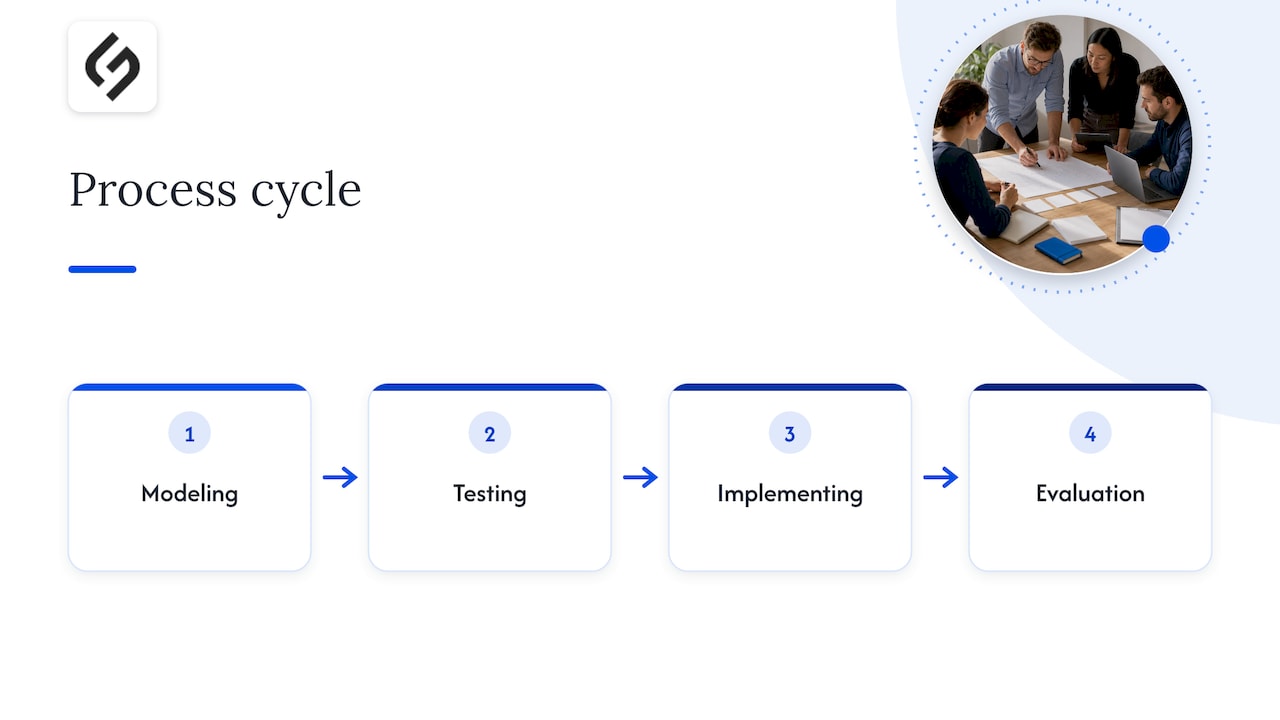
Research describing the combination of information technology and process redesign points to a repeatable pattern: analyze existing processes to find gaps, involve all stakeholders in design, and use technology to enable new ways of working. It typically runs as a cycle of modeling, testing, implementing and continuous evaluation. The following sequence turns that pattern into a project plan.
1. Choose the process and define the outcome
Select a process with visible cost, delay or customer impact. State the target in operational terms: days to onboard a client, hours to close the month, percentage of leads contacted within an hour. Without a number, there is no way to judge the redesign.
2. Map the current state
Document what actually happens, not what the policy says. Interview the people who perform the work, and trace real cases from start to finish. Our guide to mapping, building and improving a business process workflow covers the mapping techniques in detail.
3. Identify gaps and root causes
Mark duplicate entries, waiting time, approvals that never reject anything, and points where data leaves the system and returns by email. Separate symptoms from causes. A late invoice is a symptom; an unclear approval owner is a cause.
4. Design the future state with stakeholders
Include the people who run the process, the teams that depend on its outputs, and, where relevant, IT and compliance. Designs made without operators tend to fail at the exception cases, which are the cases that consume the most time.
5. Select technology to fit the design
Only now should software enter the discussion. Requirements come from the future-state map, which keeps vendor demos from setting the agenda. Leaders weighing platforms can use our perspective on business transformation software and why feature lists mislead.
6. Pilot, measure and adjust
Test the redesigned process with a small group or a single product line, ideally in short Agile iterations. Compare results against the target from step 1, collect feedback from the operators and refine before wider rollout.
7. Roll out, train and keep evaluating
Training, clear ownership and a review schedule are part of the project, not an afterthought. Processes drift as markets, regulations and tools change, so continuous evaluation is what keeps a redesign from decaying into the old habits.
Technologies that support reengineered processes
Academic work on this topic lists a common set of enabling technologies: cloud computing for infrastructure, APIs for integration, AI to transform business processes, and robotic process automation (RPA) for repetitive manual tasks. Each answers a different design need.
| Technology | Best suited to | Design question to ask |
|---|---|---|
| Cloud platforms | Scalable infrastructure and shared access to data | Which processes are limited by where data lives? |
| APIs and integrations | Connecting CRM, finance, support and marketing systems | Where is data re-entered by hand today? |
| AI | Classification, extraction, prediction, drafting | Which decisions follow patterns that a model could learn? |
| RPA and workflow automation | Rule-based, high-volume, repetitive tasks | Is the rule stable enough to automate safely? |
Two practical notes. First, automation applied after redesign is far more durable than automation applied to the current state, because the rules it encodes have already been questioned. Second, document-heavy processes are a common AI candidate; our comparison of AI document processing and traditional OCR explains where each approach fits. For smaller teams, small business workflow automation and practical automation examples such as lead routing and invoices show what early wins look like.
Benefits and risks
What organizations can gain
Well-run reengineering shortens cycle times, reduces errors and rework, lowers cost per transaction and improves the customer experience. The strategic upside is also documented: a 2017 study by Bughin and colleagues, cited in recent research, found that companies that fully digitize operations can achieve up to five times more revenue growth than less digitized counterparts. That figure describes an association across firms, not a guaranteed result for any single project, and it should be treated as a directional indicator.
Where projects go wrong
- Treating technology as the strategy. Buying a platform before the process is redesigned reproduces old problems at a higher license cost.
- Underestimating change management. Redesign alters roles and decision rights. Affected staff need a voice in the design and a clear explanation of what changes for them.
- Skipping security and compliance. Cybersecurity is important in transformation projects, and organizations need to ensure their processes are secure and compliant with data protection regulations. Access rights, data retention and audit trails are easiest to build into the new design rather than add afterward.
- Scope too large. A program that redesigns everything at once loses momentum. Sequence the work by business value and readiness.
- No governance after launch. Without an owner and a review cadence, exceptions pile up and workarounds return. See our guidance on governing business automation workflows in the first 90 days.
Perspective: why we start with the process, not the platform
In our work with small and mid-sized businesses, the most expensive mistakes rarely come from choosing the wrong software. They come from configuring good software around a process nobody has examined. A CRM, for example, can only be as clear as the lead handoff rules behind it. If sales and marketing disagree about when a lead is qualified, the platform will record that disagreement faithfully.
For that reason we begin engagements with strategy and workflow, and we tailor implementation and integration to each client’s business model instead of applying a template. The build is only the first stage. We consider ongoing optimization part of the work, because a redesigned process reveals new bottlenecks once volume moves through it.
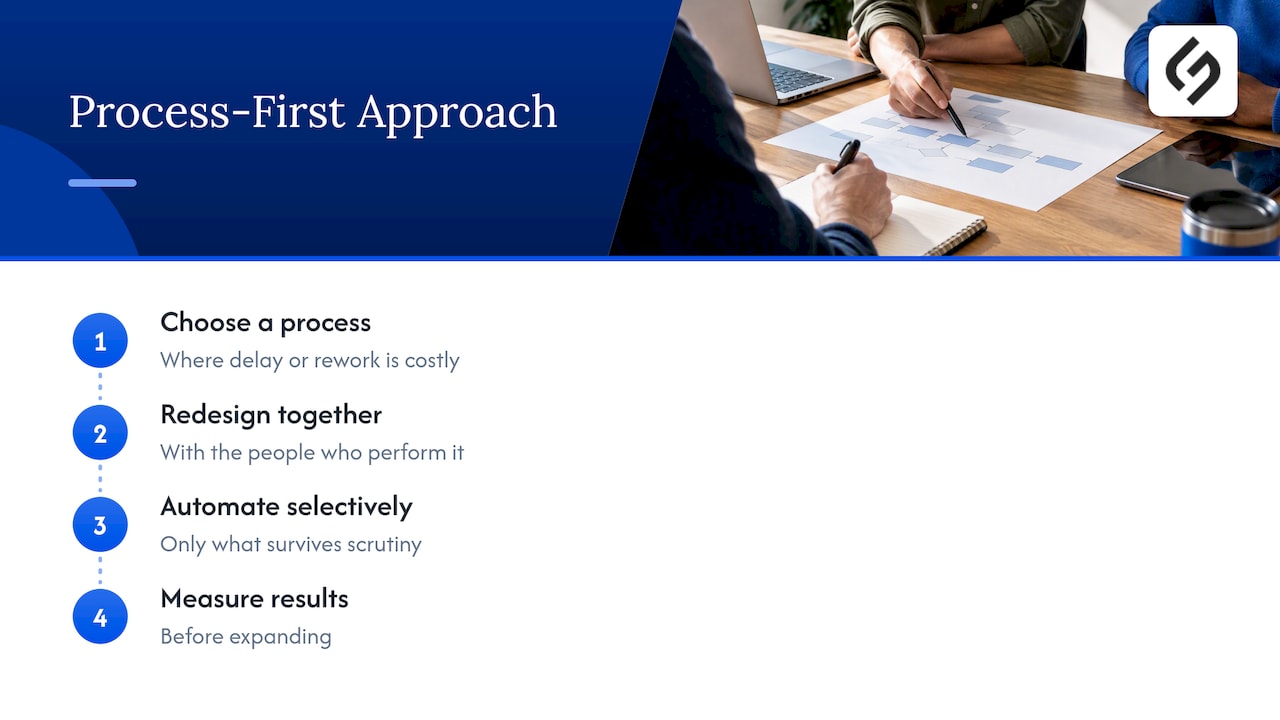
Our advice to leaders is consistent: pick one process where delay or rework is costly, redesign it with the people who perform it, automate only what has survived scrutiny, and measure the result before expanding. Transformation is the accumulation of those decisions, not a single purchase. For the leadership side of this, see what leaders tend to miss in the first 90 days of a business transformation.
How Solution For guru supports process-led transformation
Solution4guru is a digital agency that combines tech consulting and strategy with implementation: custom web development, CRM and SaaS integrations, AI and automation solutions, and cybersecurity and data protection. Teams that run their pipeline in HubSpot can also use our HubSpot implementation, integration, data migration and process automation services. To discuss a specific process, start with a free consultation through our main site.
FAQ
Yes, although it is practiced differently. The radical, clean-slate style of the early 1990s has largely given way to incremental, continuously managed redesign under the banner of BPM. The underlying question, whether a process should exist in its current form, remains central to any digital program.
It can succeed in narrow cases where processes are already sound and the goal is simply to reduce manual effort. In most programs, however, a change in business model or customer experience requires processes to change as well. Skipping the redesign usually means paying for new technology that delivers limited value.
Duration depends on scope, the number of teams involved and the technology needed. A single workflow can often be mapped, redesigned and piloted in weeks, while cross-department or customer-facing redesigns take longer. Running the work in short pilot cycles gives early evidence and limits risk.
Start with processes that are high in volume, visible to customers, or prone to errors and rework. Choose one where success can be measured in a clear number, such as cycle time or error rate. A quick, credible result builds support for larger changes.
Sources
- An algorithmic method for business process reengineering and digital transformation (ACM, 2023)
- Building a complementary agenda for business process management and digital innovation (European Journal of Information Systems, 2020)
- Mastering digital transformation through business process management (JEMI, 2020)
- Strategic redesign of business processes in the digital age (Data & Knowledge Engineering, 2024)
- The New Industrial Engineering: Information Technology and Business Process Redesign (MIT Sloan Management Review, 1990)