
Digital Marketing Agency for Startups: How to Choose One

A digital marketing agency for startups is an outside team that runs acquisition channels (search, content, paid media, email, social) and the measurement behind them, so founders can test demand without hiring a full in-house department. The right agency fits the company’s stage, ties its work to revenue rather than activity, and is open about cost and contract terms. This guide covers what such an agency does, which services matter at each stage, what US pricing looks like, how to set a budget, and how to vet a candidate.
TL;DR
- Startup marketing is about testing: the best agencies help validate the product, the audience and the channel before scaling spend.
- US agency retainers commonly span roughly $1,500 to $50,000 or more per month, so scope and stage decide the budget, not the average.
- Judge an agency on lead quality and pipeline, not on clicks, impressions or lead volume.
- Define the problem and success metrics first, meet the people who will do the work, and read the contract for amendment fees and exit terms.
- Sequence services: foundation (site, tracking, CRM), then one or two channels, then expansion.
Table of Contents
- What a startup marketing agency does
- Does digital marketing pay off for startups?
- Services by growth stage
- Optimizing for lead quality, not volume
- What a digital marketing agency costs
- Setting a budget when funds are limited
- How to vet an agency before hiring
- Perspective: strategy before channels
- Where Solution4guru fits
- FAQ
- Sources
What a startup marketing agency does
Marketing for an established company usually optimizes a known model: the audience is understood, the offer is stable and the channels have history. A startup has none of that. Research published in Technological Forecasting and Social Change describes digital marketing as a mediator between digital interaction and startup growth, working through product and market testing, customer engagement and partnership development. That framing explains what a good agency does differently for early-stage clients.
In practice the work falls into four layers:
- Positioning and audience definition. Who buys, why now, and what language they use. Without this, every channel underperforms.
- Foundation. A website that converts, analytics and event tracking, and a CRM that records where each lead came from.
- Channel experiments. Small, time-boxed tests in search, paid social, content, email or outbound, each with a stated hypothesis and a stop rule.
- Reporting and iteration. A regular review of cost per qualified lead, pipeline created and learnings, followed by reallocation of budget.
An established brand can buy scale. A startup is mostly buying information about what works, which is why speed of learning matters more than the size of the first campaign.
Does digital marketing pay off for startups?
The evidence is encouraging but conditional. The U.S. Small Business Administration’s Office of Advocacy reported in January 2023 that digital tools can help small businesses grow and compete, and participants also said that more marketing does not always produce more revenue when it is not employed effectively. A 2019 TechnoMetrica survey for the Small Business & Entrepreneurship Council found that 89% of small business owners said online advertising helps them find new customers and drive sales. That is self-reported, and dated, but it matches what most founders experience: channels work when they are measured and fail when they are not.
The practical conclusion is that the question is rarely whether to use digital marketing. It is whether the startup has the measurement and focus to learn from it.
Services by growth stage
Not every startup needs every service. Buying a full-funnel package before the product has a defined buyer is a common and expensive mistake.
| Stage | Main question | Services worth buying |
|---|---|---|
| Pre-launch or early traction | Does anyone want this? | Positioning, landing page and site, analytics setup, a small paid or outbound test, user research |
| Seed to early revenue | Which channel can acquire customers repeatably? | SEO foundations, content, paid search or social tests, email, CRM setup |
| Series A and growth | How do we scale without losing efficiency? | Lead nurturing, marketing automation, conversion optimization, attribution, brand and reputation work |
| Scaling or expansion | How do we defend and extend? | Multi-channel programs, account-based marketing, integration of marketing and sales data |
Several of these topics have their own guides. On the foundation side, an audit-driven website redesign checklist covers SEO and accessibility checks, and a primer on content marketing for small and mid-sized businesses explains how to build a content engine. Once leads arrive, lead nurturing techniques determine how many of them become pipeline. For teams automating follow-up, a look at marketing automation for small businesses shows how to get early returns without a large stack.
Optimizing for lead quality, not volume
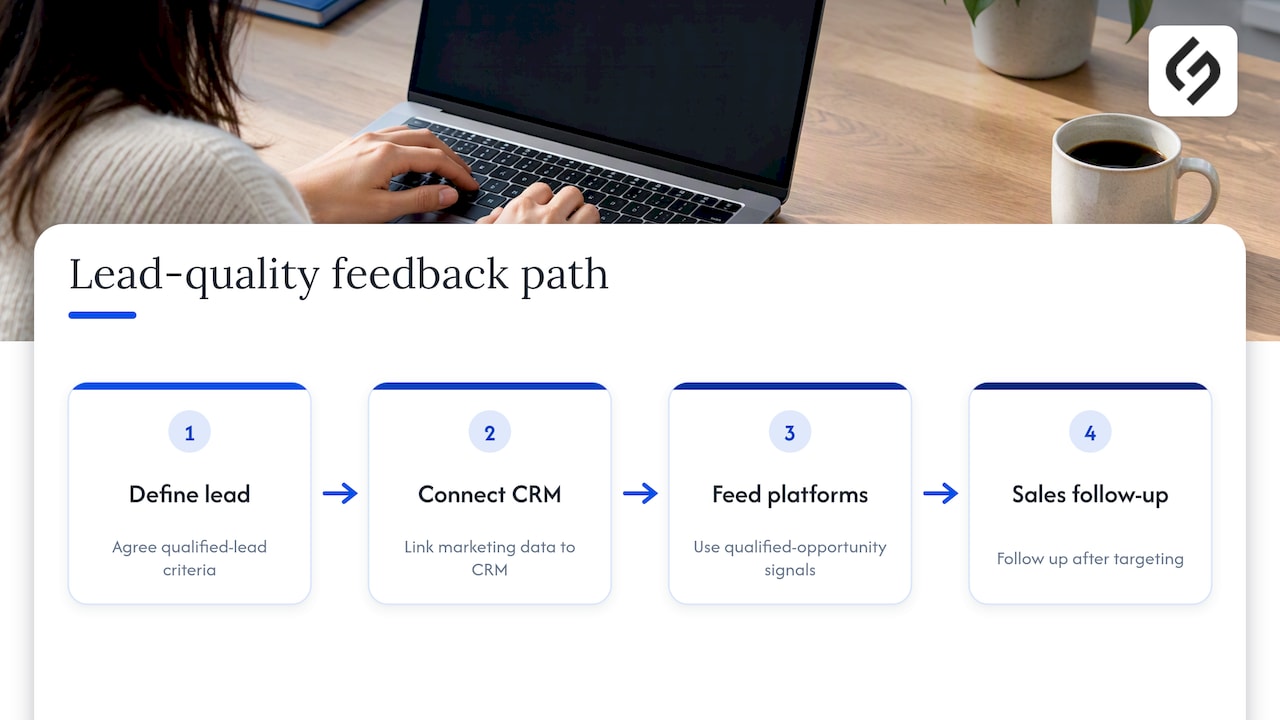
Startups often set agencies a volume target: more leads, more traffic, more followers. Volume is easy to deliver and easy to misread. A Google case study from Saudi Arabia illustrates the alternative: after moving from basic lead conversion optimization to value-based bidding, the software company Rewaa reported a 96% increase in ROAS and a 45% decrease in cost per sales-qualified lead. It is a vendor-published result from a different market, so treat it as an illustration of method rather than a benchmark. The lesson holds: feed the ad platforms and the reporting with downstream signals such as qualified opportunities, not form fills.
This requires the agency and the startup to share a definition of a qualified lead and to connect marketing data to the CRM. It also requires the sales process to follow up. Guidance on improving outbound and LinkedIn prospecting with AI for Series A and B startups shows how a sales-side process can complement paid and organic channels once targeting is clear.
What a digital marketing agency costs
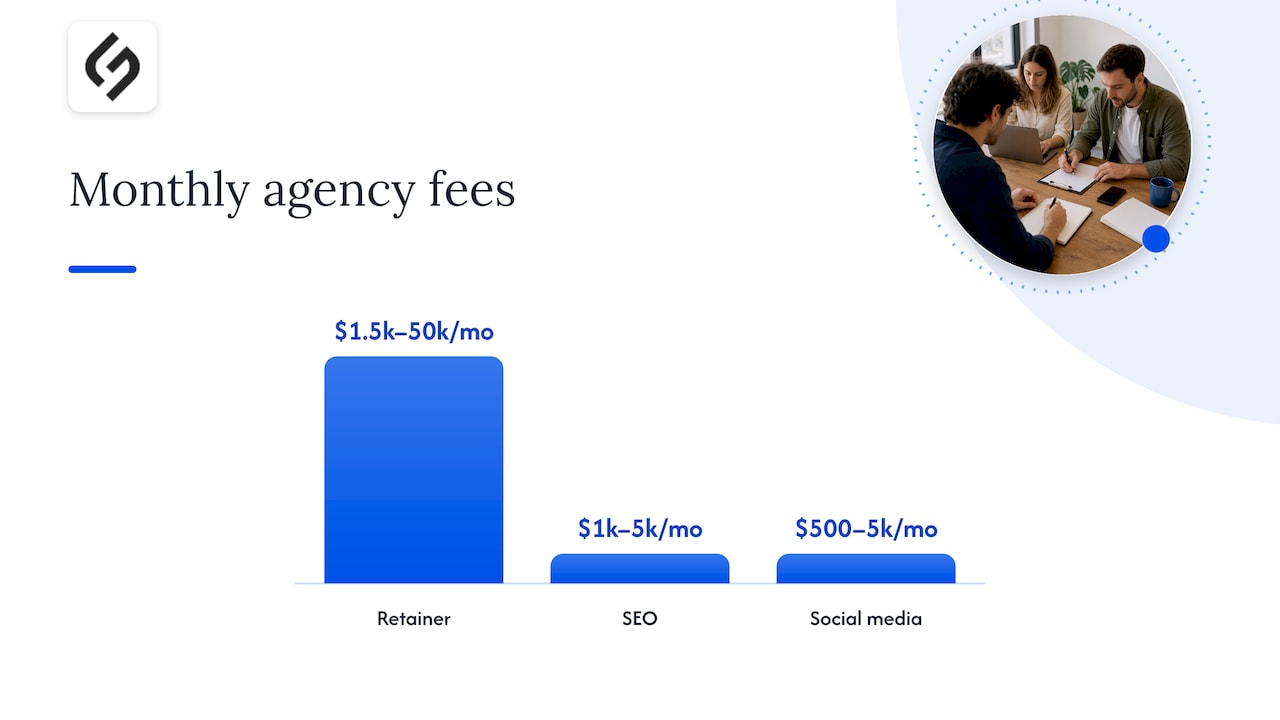
Published US figures vary widely because agencies price by different models. One 2026 pricing roundup reports hourly rates of $50 to $400, retainers from $1,500 to $50,000 per month, and several other models, including project fees, performance-based pricing and hybrids. The same roundup lists typical ranges by service: SEO at $1,000 to $5,000 per month, PPC management at 10% to 20% of ad spend or a flat monthly fee, and social media management at $500 to $5,000 per month. These are market ranges from a secondary compilation, not quotes, and individual agencies differ.
What moves the price:
- Scope. One channel costs far less than an integrated program.
- Seniority of the team. Strategy led by senior staff costs more than execution by junior staff, but it also changes the quality of decisions.
- Ad spend. Media budget is usually separate from the agency fee. Confirm which is which.
- Technical work. Tracking, CRM integration, site development and automation are often project-priced on top of a retainer.
- Contract term. Longer commitments may lower the monthly rate but raise the cost of a poor fit.
Contract hygiene matters as much as the headline fee. A 2025 UK client survey by Up to the Light found that 26% of clients identified hidden costs, often amendment fees or charges not explained in advance. The sample is British, but the pattern is worth testing in any market: ask what counts as a change request, how it is priced, and how to exit.
Setting a budget when funds are limited
Limited funds argue for narrower scope, not a cheaper version of everything. A workable approach:
- Start from the goal. Decide how many customers or qualified opportunities are needed in the next two quarters, then work backward through conversion rates to the number of leads required. Early assumptions will be rough; label them as assumptions.
- Separate fee from media. Fix a monthly agency scope, then set an experimental media budget with a stop-loss for each test.
- Fund the foundation first. Tracking and CRM setup make every later dollar measurable. Skipping them wastes spend.
- Pick one or two channels. Concentrate on the channel where the buyer already looks for a solution.
- Use a project before a retainer. A scoped audit, strategy or setup project lets both sides test the relationship at lower risk.
- Review quarterly. Reallocate toward channels with the lowest cost per qualified lead and cut the rest.
For context on overall spending levels, the American Marketing Association distinguishes the strategy, a long-term blueprint identifying audience, positioning, objectives and metrics, from the plan, which turns it into actions, timelines, responsibilities and budgets. A budget written before the strategy tends to fund activity rather than outcomes.
How to vet an agency before hiring
Define the problem and the measurable success criteria before contacting anyone. TrinityP3’s agency selection guidance recommends comparing relevant case studies, speaking with references, meeting the actual delivery team, and running a workshop on a real but limited strategic challenge to test the agency’s thinking, collaboration and process. A short paid workshop reveals more than a polished pitch.
Questions to put to every candidate:
Strategy
- How will you decide which channels to test first, and what would make you stop a test?
- What do you need from us to define the target buyer?
Reporting
- Which metrics will you report, and how do they connect to pipeline and revenue?
- Will we have direct access to ad accounts, analytics and the CRM?
Results
- Which clients at our stage and in our model can we speak to?
- What did you do when a campaign underperformed?
Contract
- What is the minimum term and the notice period?
- What triggers extra fees, and who owns the accounts, creative and data at the end?
Pressure to prove value is real on the client side too: in the Up to the Light research, about 77% of marketing directors felt a growing need for agencies to justify spending with return on investment. A startup should expect the same discipline from its agency.
Warning signs include guaranteed rankings or lead counts, vanity-metric reports, reluctance to introduce the delivery team, and refusal to give account ownership. For a wider comparison framework, see this guide on choosing a digital marketing IT company, and for experience-led work, this guide on choosing a digital customer experience agency.
Perspective: strategy before channels
We see the same pattern in early-stage engagements. Founders arrive asking for a channel, such as SEO or paid social, when the more urgent gap is the system around it: a site that explains the offer, tracking that shows what happened, and a CRM that shows which leads became customers. Our approach is to tailor the work to the business model and workflows rather than apply a template, and to keep optimizing after launch instead of treating setup as the finish line.
We also think startups should resist buying breadth. One well-measured channel, connected to the CRM, teaches more than five channels reported in separate dashboards. When the data is joined up, decisions about budget become straightforward, and an agency relationship can be judged on pipeline rather than on trust alone.
Where Solution For guru fits
We are a digital agency that combines SEO and digital marketing with the technical layer startups often lack: custom web development, UI/UX design, CRM and SaaS integrations, AI and automation, and HubSpot implementation and management. That combination suits teams that want marketing, site and CRM built to work together, under a strategy-first approach. Explore the full range of services or the HubSpot and CRM services, and talk to us about a scoped starting point.
FAQ
Yes, when it is measured. Research links digital marketing to startup growth through testing, customer engagement and partnerships, but SBA-reported small business feedback also notes that more marketing does not guarantee more revenue. Focus and tracking decide the outcome.
Published 2026 US ranges put retainers between about $1,500 and $50,000 or more per month, with SEO and social services often at the lower end and integrated programs at the higher end. Ad spend is usually extra. Request a written scope and quote from each candidate.
There is no single figure. Set the amount from the number of qualified leads or customers needed, fund tracking and CRM first, and start with one or two channels. A scoped project before a retainer limits risk.
An agency fits when several specialties are needed at once (site, search, paid, automation) and volume does not justify full-time hires. An in-house marketer fits once the channel mix is proven and needs daily ownership. Many companies combine a lead marketer with an agency for specialist work.
Sources
- Linking the potentials of extended digital marketing impact (ScienceDirect, 2023)
- U.S. SME Access and Use of Digital Tools (SBA Office of Advocacy, 2023)
- Online advertising delivers big benefits for small businesses (SBE Council, 2019)
- Maximising ROI: From clicks to conversions (Think with Google, 2025)
- Digital marketing agency pricing models (2026)
- What Clients Think 2024/25 (Up to the Light)
- Develop a Winning Marketing Strategy (American Marketing Association)
- How to Choose a Marketing Agency in 7 Steps (TrinityP3)