
SEO and Lead Generation: How Organic Search Fills a B2B Pipeline

SEO generates leads when it attracts the right people at the moment they research a problem, then gives them a clear reason to identify themselves. Rankings and traffic are only the first half. The second half is a conversion path, a tracking setup and a handoff to sales that turns a search visit into a qualified opportunity. This guide explains each part in the order a business should build it, with the figures that matter and the mistakes that most often stall results.
TL;DR
- SEO lead generation means earning visibility for searches that signal buying intent, then converting those visits through forms, offers and a connected CRM.
- B2B buyers research long before they speak to sales, so content must educate and build trust first.
- Organic search tends to have a low cost per lead, but those leads often need nurturing. Judge the channel by cost per opportunity and revenue, not cost per lead alone.
- Without GA4 conversion events and a CRM connection, SEO ROI cannot be proven or defended.
- AI search features now shape vendor shortlists, which makes firsthand expertise and clear authority signals more valuable than keyword volume.
Table of Contents
- What SEO Lead Generation Actually Means
- Why Buyers Reach Sales Late
- Building the Strategy: Five Steps
- Connecting SEO to Your CRM
- Nurturing Organic Leads
- Measuring SEO Lead Generation Properly
- Timelines and Cost Expectations
- Our Perspective
- Where Solution4Guru Can Help
- Common Mistakes to Avoid
- FAQ
- Sources
What SEO Lead Generation Actually Means
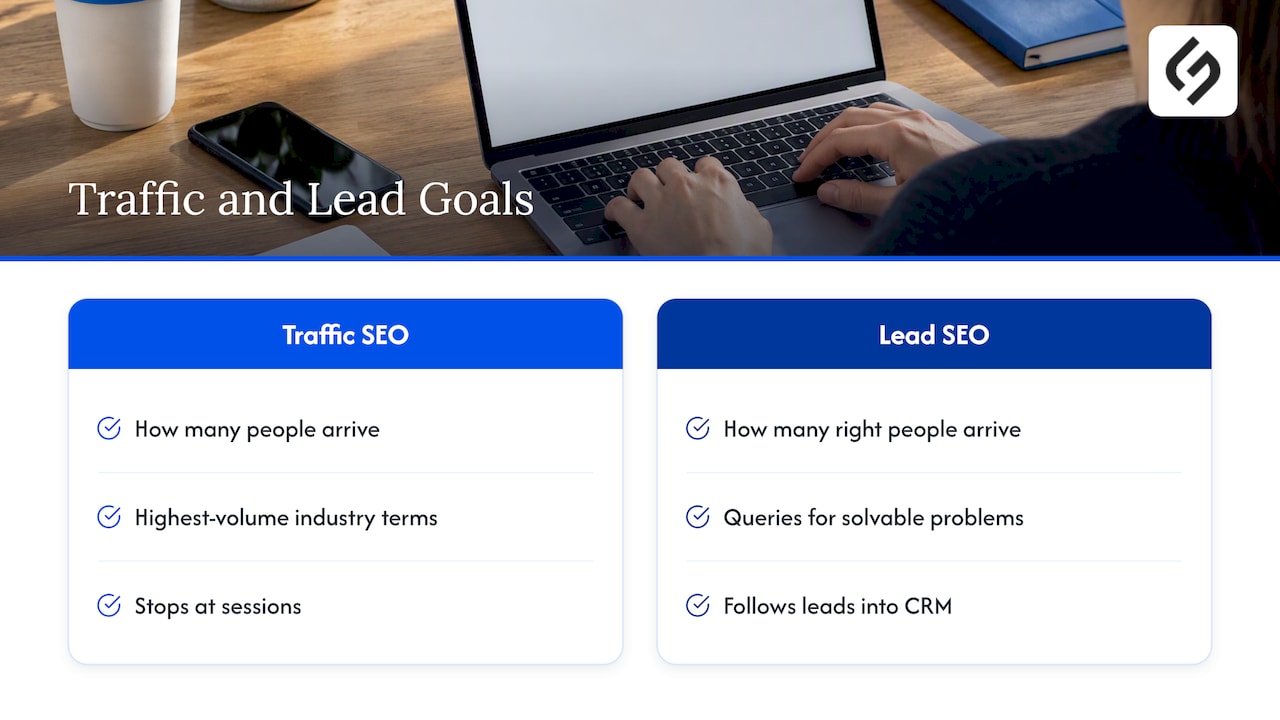
SEO lead generation is the use of search engine optimization to attract qualified prospects and capture their contact details. It differs from general SEO in its goal. A traffic-focused program asks how many people arrive. A lead-focused program asks how many of the right people arrive, what they do next and how many become customers.
That distinction changes decisions at every level. Keyword selection favors queries that indicate a problem a company can solve, not the highest-volume terms in the industry. Content is built to move a reader toward an action. Reporting follows the lead into the CRM instead of stopping at sessions.
For small and mid-sized businesses, the appeal is practical. Paid campaigns stop producing the day the budget stops. A well-built organic asset, such as a service page or a detailed guide, can keep attracting inquiries for years with periodic updates.
Why Buyers Reach Sales Late
The case for SEO as a lead source rests on how B2B purchasing now works. Research from 6sense shows that buyers select a favored vendor before engaging sellers, and that the pre-contact favorite wins the deal roughly 80% of the time. The same report finds that B2B buying cycles shortened from 11.3 months in 2024 to 10.1 months in 2025, and that sales outreach does not rank among the top five resources buyers consult.
The implication is direct. By the time a prospect fills in a form, much of the decision is already made. Content that answers questions, compares options honestly and shows real experience is the sales conversation that happens first. A company absent from those early searches is rarely on the shortlist.
AI search is changing the shortlist
Discovery is also moving. G2’s 2025 buyer behavior research reports that 79% of software buyers say AI search has changed how they conduct research, and that generative AI chatbots are the leading source influencing vendor shortlists. Traditional search remains important, but it is no longer the only entry point.
Google’s own guidance on optimizing for generative AI features in Search points in the same direction as its long-standing advice: create helpful, people-first content that shows real expertise. Content produced mainly to manipulate rankings is the content least likely to be cited, clicked or trusted.
Building the Strategy: Five Steps
A lead-oriented SEO program follows a predictable sequence. Skipping steps is the most common reason that traffic grows while inquiries do not.
1. Define the buyer and the problem
Start with the people who sign contracts, not the people who read blogs. Identify the job titles, company sizes and triggers that lead to a purchase. A finance director replacing an aging system searches differently from a founder looking for a first CRM. Write these profiles from sales conversations and closed deals, not assumptions.
2. Map keywords to intent
Group search terms by what the searcher wants to do:
| Intent | Example query pattern | Best page type | Lead action |
|---|---|---|---|
| Problem-aware | “why do leads go cold after a form fill” | Educational guide | Newsletter, checklist |
| Solution-aware | “CRM integration for website leads” | In-depth article, comparison | Resource download, consultation |
| Vendor-aware | “HubSpot implementation partner” | Service page | Consultation request |
| Evaluation | “how to choose a digital agency” | Selection guide, case study | Direct inquiry |
Bottom-of-funnel pages produce fewer visits but the warmest leads. Top-of-funnel pages build the audience and the authority that make those commercial pages perform.
3. Create content that earns trust
The strongest B2B content contains something a generic summary cannot: a worked example, a real process, a figure from actual projects, an honest statement of when a solution is the wrong choice. A Google-commissioned whitepaper on the B2B buyer journey, published by NRG, concludes that buyers respond to unfiltered, human-first content that feels real and honest.
Practical rules that follow from this:
- Answer the question in the first paragraph, then add depth.
- Name specific tools, steps and trade-offs.
- Put an author or team with real experience behind the page.
- Update high-performing pages on a schedule and show the update date.
4. Fix the technical foundation
Lead pages must load quickly, work on mobile, be crawlable and meet accessibility standards. A redesign is a frequent moment when organic leads are lost, since URLs change, content is thinned and forms break. A phased website redesign checklist covering SEO and WCAG 2.2 helps protect existing rankings while improving usability.
5. Build conversion paths
Every page that ranks should lead somewhere. That does not mean a pop-up on every article. It means a relevant next step matched to intent:
- A short form on service pages with only the fields sales truly needs.
- A downloadable checklist or template on educational guides.
- A clear consultation option on comparison and case study pages.
- Internal links that move readers from informational pages to commercial ones.
Shorter forms usually capture more submissions, but too little information produces leads that sales cannot qualify. The right balance is found by testing and by asking sales which fields they actually use.
Connecting SEO to Your CRM
A form submission is not a lead until someone can act on it. When website data lives in one system and sales activity in another, nobody can say which keywords produce revenue. Connecting the two solves three problems: leads are routed to the right owner quickly, the source of each lead is stored on the contact record, and closed deals can be traced back to the page that started the relationship.
Our guide to integrating a CRM with a website and SEO covers the mechanics. For teams that receive more inquiries than they can handle manually, lead routing and other automation examples for SMBs show how to assign, notify and follow up without delay.
Speed matters here. An inquiry that waits two days for a reply is an inquiry that has probably contacted a competitor. Automated acknowledgment, round-robin assignment and task creation are low-cost fixes with a visible effect.
Nurturing Organic Leads
Organic leads arrive with different levels of readiness. Many are early-stage researchers who downloaded a guide, not buyers asking for a quote. Scrapine’s benchmarks report that organic search has the lowest median cost per lead, at $35, but note that these leads often require significant nurturing before they are sales-ready.
A nurture sequence bridges that gap. It typically includes a short welcome series, content tied to the original topic, a case study and a low-pressure invitation to talk. The techniques are covered in detail in our article on lead nurturing that converts prospects. Scoring based on behavior, such as visiting pricing or service pages, helps sales focus on people who are actually ready.
Measuring SEO Lead Generation Properly
Measurement is where most programs are weakest, and where defending a budget becomes difficult. Two principles apply.
Use both Search Console and GA4
The two tools show different stages. Google explains that using Search Console and Google Analytics together gives a more complete picture of how an audience finds and experiences a site. Search Console shows impressions, queries and clicks before the visit. GA4 shows behavior and conversions after it. Neither alone answers whether SEO produced revenue.
Track lead events, not just page views
Google’s GA4 documentation lists recommended events for lead workflows, including generate_lead for an initial form submission and close_convert_lead for a qualified lead that becomes a customer. Passing parameters such as the lead source and a value allows revenue-based reporting. If these events are not implemented, the data to prove ROI does not exist.
A workable minimum setup:
- Fire generate_lead on every form that represents real interest.
- Store the original organic landing page and query category on the CRM contact.
- Send a closed-won signal back to analytics, or report it from the CRM.
- Review monthly by page group, not only by sitewide totals.
Sales KPIs should sit alongside these figures. Teams on specific platforms can use our guides to tracking sales KPIs in monday CRM and Pipedrive sales KPIs.
Judge by opportunities and revenue
Cost per lead is a convenient number and a misleading one when used alone. A channel with a low cost per lead is not better if its leads never reach a contract. Scrapine’s analysis argues for moving to cost per opportunity or revenue ROI, and observes that organic search leads often convert to paying customers at higher rates than paid digital leads. Treat these as benchmarks to test against your own data, not promises. Industries, deal sizes and definitions of “lead” vary widely.
A simple worked example shows why. Suppose organic generates 40 leads a month and paid generates 40. If organic produces 4 opportunities and paid produces 2, organic costs half as much per opportunity even before comparing spend. The calculation only works when opportunity data reaches the reporting layer.
Timelines and Cost Expectations
SEO is a compounding investment, not an instant channel. New content typically needs months to gain traction, and competitive commercial terms take longer. Plan for a first measurable lead trend over a quarter or two, with stronger results as pages mature and authority builds. Any agency promising a fixed number of leads by a fixed date deserves scrutiny.
On cost, the question “how much do SEO leads cost” has no single answer. Published medians differ by source, industry and the way a lead is defined. The more useful calculation is internal: take average deal value, gross margin and close rate, then work out what a lead or opportunity is worth. That ceiling tells you how much organic investment is reasonable.
Our Perspective
We see the same pattern in most SEO engagements. A company invests in content and rankings, traffic rises, and then the question arrives: where are the customers? In almost every case the answer is not in the keywords. It is in what happens after the click: a form that goes to a shared inbox, a CRM that does not record the source, a follow-up that happens days later, and no way to connect revenue to the page that earned it.
For this reason we approach SEO as part of a connected system, not a standalone service. Strategy comes first: who the buyer is, what they search and what the business is ready to deliver. Then comes implementation across the site, the content, the CRM and the automation that links them. We design these around the client’s business model and workflows instead of applying a template, and we continue optimizing after launch, since search behavior and AI-driven discovery keep changing.
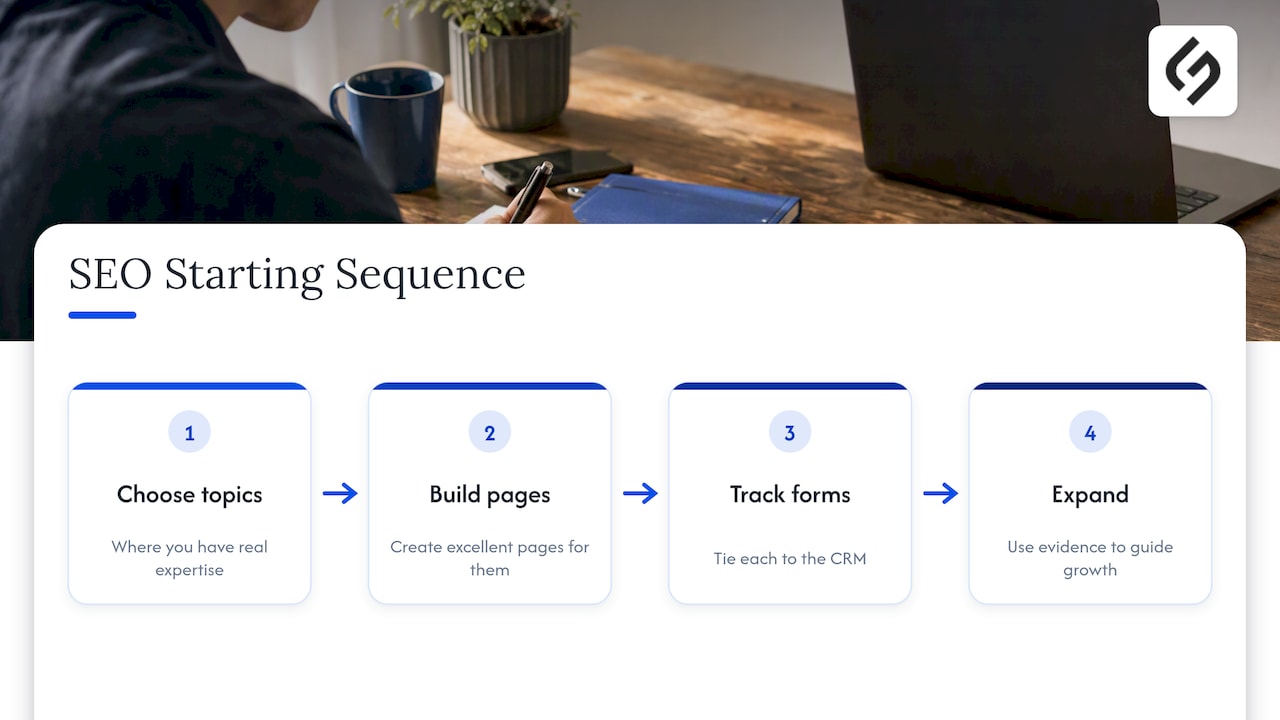
Our advice to any business starting out is modest. Pick a small number of commercial topics where you have real expertise. Build excellent pages for them. Track every form and tie it to the CRM. Then expand from evidence. That order protects budget and produces answers early.
— Vadim
Where Solution4Guru Can Help
We combine SEO and digital marketing, custom web development, CRM and SaaS integrations and AI and automation solutions so that organic traffic, conversion paths and sales follow-up work as one system. For companies using HubSpot, our HubSpot implementation, integration and ongoing management services cover setup, data migration and process automation. A free consultation is the practical starting point for reviewing where leads are currently being lost.
Common Mistakes to Avoid
- Chasing volume. High-traffic keywords with weak intent fill reports, not pipelines.
- Publishing without expertise. Thin or generic articles are hard to differentiate from AI summaries and are unlikely to build trust.
- Gating everything. Locking all useful content behind forms reduces visibility and trust. Gate only assets with clear value.
- Ignoring existing pages. Updating a page that already ranks often beats writing a new one.
- Measuring only form fills. Fills without qualification and close data hide the real performance.
- Neglecting brand searches. Prospects often verify a vendor by searching its name. Reviews and brand results influence whether they proceed, a topic covered in our piece on converting branded searches into trust.
FAQ
What does SEO mean in lead generation?
SEO stands for search engine optimization: improving a website so it appears for relevant searches. In lead generation, it specifically refers to attracting prospects who are searching for a solution and converting them into contacts through forms, offers and consultations. The goal is qualified inquiries, not traffic alone.
How much do SEO leads cost?
It depends on industry, deal size and how a lead is defined. Scrapine’s benchmark data reports a median of $35 per lead for organic search, though other published datasets show higher B2B figures. A more reliable measure is cost per opportunity or per closed customer, calculated from your own CRM data.
How can SEO boost sales?
SEO boosts sales by putting your business in front of buyers during research, when vendor preferences form. Strong service pages, honest comparisons and case studies build trust, while a fast follow-up process turns inquiries into meetings. Tracking events in GA4 and the CRM shows which pages contribute to closed deals.
How long does SEO take to generate leads?
Most programs need several months before lead volume changes noticeably, and competitive terms take longer. Updating existing pages and fixing conversion paths can produce earlier gains than publishing new content. Treat early months as a period of building and measuring.
Sources
- The B2B Buyer Experience Report for 2025, 6sense
- G2 2025 Buyer Behavior Report for CMOs
- Google’s Guide to Optimizing for Generative AI Features on Google Search
- Google B2B Buyer Journey Whitepaper, NRG
- Cost Per Lead Benchmarks 2025, Scrapine
- Using Search Console and Google Analytics Data for SEO, Google Search Central
- Events, Google Analytics for Developers