Hybrid Manager Playbook: Research, Cut Meetings, Avoid Contractor Risk

The best hybrid managers lead with outcomes, not hours worked or seats filled. That means setting role-specific deliverables, standardizing communication norms, running short weekly coaching check-ins, and building visible systems so remote and in-office contributions get equal credit. Hybrid work is not a temporary accommodation to manage around. It is a permanent operating model that rewards structure over supervision.
TL;DR:
- Hybrid leaders must focus on outcome-based expectations with specific, measurable deliverables rather than vague goals or proximity indicators.
- Clear systems like shared trackers, decision logs, and written norms replace excessive meetings and improve communication discipline.
- Managers should conduct brief weekly one-on-ones, ensure remote contributions are visible, and foster psychological safety to prevent proximity bias.
- Infrastructure must include reliable hardware, integrated collaboration tools, and secure, redundant systems to support consistent productivity and reduce technical failures.
- Managing contractors requires outcome-based agreements and separate onboarding to ensure compliance and avoid worker misclassification.
Table of Contents
- What Are the Core Principles of Managing Hybrid Teams?
- How Do You Set Expectations and Measure Outcomes in a Hybrid Team?
- How Should Hybrid Teams Communicate and Run Meetings?
- How Do You Coach and Develop People You Rarely See in Person?
- What Tools Give Hybrid Teams a Single Source of Truth?
- How Do You Manage Contractors on a Hybrid Team Without Legal Risk?
- How Do You Prevent Burnout in a Hybrid Team?
- How Do You Design Hybrid Policies That Teams Actually Follow?
- Weekly Hybrid Leader Checklist
- How Do You Onboard New Hires Successfully in a Hybrid Team?
- How Do You Manage Time Zone Differences on a Hybrid Team?
- How Do You Build Team Culture and Inclusion Across Remote and In-Office Staff?
- What Tech Support and Infrastructure Does Hybrid Work Require?
- What Productivity Metrics Actually Work for Hybrid Teams?
- What I’ve Learned Watching Hybrid Systems Succeed and Fail
- How Solution4Guru Helps Teams Build Hybrid Systems That Stick
- Sources
- FAQ
What Are the Core Principles of Managing Hybrid Teams?
Managing hybrid teams well comes down to four interlocking habits, not a single trick or tool. Leaders who succeed with hybrid teams focus on clearer systems and outcome-based management rather than increased oversight. Piling on more check-in meetings does not fix a hybrid team. Replacing ambiguity with clarity does.
Four principles anchor every tactic in this guide:
- Clarity systems instead of more meetings. Shared trackers, decisions logs, and written definitions of “done” replace the need for constant verbal updates.
- Outcomes over proximity. Judge work by what got delivered, not by who was visible in the office that day.
- Psychological safety and equitable access to information. Remote staff need the same access to context, feedback, and stretch opportunities as people sitting near the manager’s desk.
- Deliberate design of in-person time. Office days should be reserved for the work that genuinely benefits from being in a room together, like whiteboarding a roadmap or resolving a tense client issue, not routine status updates.
Gallup research shows managers account for roughly 70% of the variance in team-level engagement. That single number should reframe how you think about hybrid strategy. The tools matter, but your behavior as a manager matters more.
How Do You Set Expectations and Measure Outcomes in a Hybrid Team?
Outcome-based management only works if the outcomes are specific enough to be measured without a manager physically watching the work happen. Vague goals like “stay productive” or “be responsive” invite exactly the kind of activity-tracking and proximity bias that make hybrid teams dysfunctional.
Follow this sequence when you set expectations for each role:
- Write role-specific deliverables. Define what “good” and “great” look like for each function, in plain language a new hire could understand without asking follow-up questions.
- Pick 2 to 3 outcome metrics per role. Choose ones that are simple to track and hard to game, such as tickets resolved, deals closed, or features shipped, and set a cadence, weekly or biweekly, to review them.
- Log deliverables in a shared tracker. Avoid time-based proxies like hours logged or “green dot” activity in chat tools. Those measure presence, not contribution.
- Use the same outcome data in development conversations. When performance calibration and outcome tracking pull from the same source, employees stop wondering whether they are being judged on results or optics.
This system also protects you during performance conversations. If a manager needs to raise a concern, pointing to a documented, outcome-based record is far more defensible, and far less confrontational, than pointing to a hunch about someone’s engagement.
How Should Hybrid Teams Communicate and Run Meetings?
Communication breakdowns, not distance, cause most hybrid team friction. A team that agrees on channel rules and meeting discipline up front avoids the daily low-grade chaos of people guessing whether a Slack message needs an instant reply or a formal follow-up email.
Set these norms explicitly, in writing, rather than assuming everyone will infer them:
- Define what counts as urgent (needs a reply within the hour), non-urgent (reply by end of day), and decision-required (needs a documented answer, not a quick reaction).
- Protect blocks of focused time on the calendar and cap meeting length and frequency, especially recurring ones that have outlived their purpose.
- Open virtual meetings with 3 to 5 minutes of unstructured personal connection before diving into the agenda.
- Use a standard meeting template: agenda, decisions made, and named action owners, and record sessions so people in different time zones or on focus-time blocks are not penalized for missing a live call.
A pre-registered field experiment involving 193 hybrid teams found that collaboration norms around focused time, after-hours communication, and meeting timing genuinely improved employees’ sense of time control and connection, but only for teams that actually discussed, adopted, and stuck to them. Norms imposed from the top without buy-in showed weaker results.
Pro Tip: Draft your team’s communication norms as a one-page document and review it in a live meeting, not by email. Teams that discuss norms together are far more likely to actually follow them than teams handed a memo.
How Do You Coach and Develop People You Rarely See in Person?
Coaching is where proximity bias does the most quiet damage. Managers naturally give more informal feedback, more stretch assignments, and more hallway encouragement to the people they physically see every day. Left unchecked, that pattern quietly stalls the careers of remote and hybrid-schedule employees.
- Run a short, consistent weekly one-on-one built around four questions: what went well, what’s blocking you, what’s the priority this week, and what support do you need.
- Audit stretch assignments and public recognition regularly to confirm remote staff get equal shots at visible, career-building work.
- Keep contributions visible through a shared tracker and a decisions log, so a remote employee’s wins don’t disappear simply because no one saw them happen.
- Document performance conversations around outcomes and behaviors, never around presence, badge swipes, or webcam usage.
Consistent, structured coaching cadence is one of the clearest levers a manager has, since managers themselves are the largest single driver of how engaged a hybrid team feels.
What Tools Give Hybrid Teams a Single Source of Truth?
Every hybrid team needs one place where priorities, owners, and status live, so no one has to ask “wait, who’s handling this?” in three different chat threads. That single view is what actually prevents the meeting sprawl that hybrid work tends to generate.
- Maintain one transparent work tracker or dashboard showing current priorities and who owns each item.
- Keep documentation async-first: meeting notes, a running decisions log, and short written summaries after every significant call.
- Choose collaboration tools that actually match your team’s size and meeting cadence, and integrate them where possible so people are not toggling between five disconnected apps.
- Where contractors are part of the team, include their status and deliverables in the same management view rather than tracking them separately and invisibly.
Getting the visibility layer right also solves problems outside pure office work. One partner resource on managing distributed creative teams shows how the same principle, making progress visible without a physical room to check in, applies just as much to video production crews as it does to software teams.
How Do You Manage Contractors on a Hybrid Team Without Legal Risk?
Contractors introduce a compliance dimension that most hybrid guides skip entirely, and getting it wrong is expensive. The line between managing a contractor’s outcomes and directing their hours or methods is also the line regulators use to determine worker classification.
- Manage contractors through outcome-based agreements. Specify deliverables and deadlines, not schedules, methods, or which hours they should be logged in.
- Keep onboarding and documentation for contractors entirely separate from your employee process. Mixing the two tracks is one of the fastest ways to blur the classification line.
- Use a freelancer management system or an employer-of-record service to centralize contracts, payments, and records in one place.
- Audit role drift periodically. A contractor who has quietly started attending daily standups and taking direction like an employee has drifted into misclassification risk.
Managing contractors by outcomes is both a best practice and a compliance necessity: directing a contractor’s hours or methods, rather than their results, is one of the clearest signals regulators use to flag worker misclassification.
Teams handling sensitive contractor data across personal devices and home networks should also review their remote access security and compliance controls, since a contractor working from an unsecured connection creates a data risk long before it becomes a classification one.
How Do You Prevent Burnout in a Hybrid Team?
Hybrid work quietly extends the workday. Without a physical commute to signal “the day is over,” employees drift into checking messages at 9 p.m., and managers who reward that habit, even unintentionally, train their whole team to do it.
- Set explicit team norms for focused, meeting-free work blocks and use delayed-send settings so after-hours messages don’t create pressure to respond immediately.
- Avoid stacking heavy meetings into Monday mornings or Friday afternoons, the two windows where people are least equipped to absorb dense discussion.
- Run brief weekly workload reviews so overloaded team members get rebalanced before they burn out, not after.
- Reward outcomes and quality of work, not constant online availability or fast reply times.
Harvard Law School’s internal guidance on hybrid work practices notes that meeting load and coordination costs tend to climb in hybrid environments unless a team deliberately designs around them.
How Do You Design Hybrid Policies That Teams Actually Follow?
Policies imposed without input tend to get quietly ignored, which is worse than having no policy at all. MIT Sloan recommends treating hybrid as a permanent structure, with transparent, organization-wide guardrails and enough flexibility for individual teams to set their own schedules where the work benefits from it.
- Publish clear guardrails at the organizational level: minimum in-office expectations, core overlap hours, and any non-negotiables.
- Within those guardrails, ask each team to propose its own anchor days, chosen for moments when being in the same room genuinely adds value.
- Document boundaries and expectations up front, in writing, so nobody discovers the real rules only after breaking one.
- Track perceived fairness with a short pulse survey and adjust. Teams that help design their own schedule consistently rate the resulting policy as fairer than one handed down without input.
Smaller, less spread-out teams also tend to stick to shared norms more consistently than large, highly distributed ones, which is worth factoring in before rolling the same policy out company-wide.
Weekly Hybrid Leader Checklist
Print this or drop it into your own weekly routine. It replaces a dozen scattered check-ins with three habits.
- Team priorities doc: List 3 to 5 items for the week with a named owner and due date for each.
- Weekly 1:1s: Run the 10-minute script, wins, blockers, priorities, support, for every direct report, and log a one-line meeting summary with decisions and owners.
- Norms adherence check: Spot-check whether focused-time blocks and response-window commitments are actually holding, and flag drift before it becomes the new normal.
Practical hybrid playbooks consistently point to this kind of lightweight system, a priorities document, a decisions log, and a meeting summary template, as the replacement for meeting overload, not an addition to it.
How Do You Onboard New Hires Successfully in a Hybrid Team?
A new hire’s first month sets the tone for how included they feel for the next two years, and hybrid onboarding fails most often when it simply mirrors an in-office process with a video call bolted on. Structure matters more here than almost anywhere else in hybrid management.
Assign a peer buddy, not just a manager, for the first 30 days. New hires ask more questions to a peer than to a supervisor, and a buddy fills the informal knowledge gap that used to happen organically at a shared coffee machine. Build a written 30/60/90-day plan with explicit outcomes for each phase, so a remote hire has the same roadmap clarity as someone sitting three desks from their manager.
Schedule at least one in-person visit within the first 60 days if geography allows it. Meeting teammates face to face early accelerates trust in a way that months of video calls struggle to replicate. If travel isn’t feasible, front-load video calls with cameras on and personal check-ins rather than jumping straight into task training.
Document everything a new hire needs, tool access, team norms, decision-making authority, and who owns what, in a single onboarding hub rather than scattering it across emails and verbal explanations. New hires without in-office peers to absorb unwritten rules from need those rules written down explicitly. Assign an outcome-based 30-day goal so the new hire has something concrete to aim for, rather than a vague sense they should “get up to speed.”
How Do You Manage Time Zone Differences on a Hybrid Team?
Time zone spread is not a scheduling inconvenience to shrug off. It’s a structural constraint that should shape how your team communicates by default. Teams that treat every time zone gap as an exception to route around end up with a small group perpetually working odd hours to accommodate everyone else.

Identify a core overlap window, even just two or three hours, where synchronous conversation happens, and protect it fiercely for decisions that genuinely need real-time discussion. Everything outside that window should default to asynchronous communication: recorded updates, written decisions, and documented context that doesn’t require someone to be awake at 11 p.m. to participate.
Rotate meeting times that must include distant time zones, rather than always asking the same region to join at an inconvenient hour. It’s a small gesture, but a lopsided pattern where one region always sacrifices sleep for meetings breeds quiet resentment fast.
Record every meeting that includes a widely spread team and pair it with a written summary. Nobody catching the recording the next morning should have to guess what was decided. And when you’re hiring into new regions, treat time zone spread as a factor in role design, not an afterthought. Some roles genuinely need overlap hours with a specific team; others don’t, and forcing overlap where it isn’t needed just adds unnecessary strain.
How Do You Build Team Culture and Inclusion Across Remote and In-Office Staff?
Culture in a hybrid team doesn’t happen by accident the way it sometimes did in a shared office. It has to be built deliberately, or the informal bonds that used to form over lunch simply never form at all for remote staff.
Watch for a two-tier culture forming, where in-office employees get pulled into casual decisions and remote employees find out about them later, secondhand. That gap is corrosive, and it’s almost always unintentional. The fix is procedural: route decisions through the same shared documentation regardless of who happened to be in the room when the idea came up.
Create intentional, low-stakes connection moments that don’t require travel: a virtual coffee rotation, a shared team channel for non-work chat, or a monthly show-and-tell where people share something outside of work. These sound minor, but they replace the incidental bonding that used to happen naturally in a shared physical space.
Rotate who leads meetings and who gets credit publicly for wins, so recognition doesn’t default to whoever the manager happens to see most often. When you do bring the team together in person, protect that time for relationship-building and complex problem-solving, not routine status updates that could have been handled asynchronously. In-person time is scarce and valuable; treat it that way.
What Tech Support and Infrastructure Does Hybrid Work Require?
Hybrid teams run on infrastructure that’s easy to overlook until it fails, usually at the worst possible moment, like mid-presentation to a client. Solid infrastructure is what makes all the process design in this guide actually usable day to day.
Confirm every employee has reliable video conferencing hardware, decent bandwidth, and access to the same collaboration stack, regardless of whether they’re working from a home office or a corporate desk. Inconsistent tooling between locations creates a second-class experience for whichever group has the weaker setup, and it’s usually the remote group.
Set a clear, fast internal support path for tech issues that doesn’t require someone to physically walk to the IT desk to get help. A remote employee locked out of a system at 8 a.m. needs a ticket resolved in minutes, not a same-day promise. Standardize security requirements, VPNs, multi-factor authentication, encrypted file sharing, across every location a team member works from, since a mixed environment of secured office networks and unsecured home Wi-Fi is a real liability.
Finally, build redundancy into anything mission-critical: cloud-based document access, meeting recordings, and shared drives that don’t depend on any one person’s laptop. When infrastructure fails, it fails invisibly for whoever’s remote, and they’re often the last to get help.
What Productivity Metrics Actually Work for Hybrid Teams?
Most productivity metrics inherited from office-era management measure the wrong thing entirely for a hybrid team; hours logged, badge swipes, or time active in a chat tool, all track presence, not output. None of them tell you whether the work that mattered actually got done.
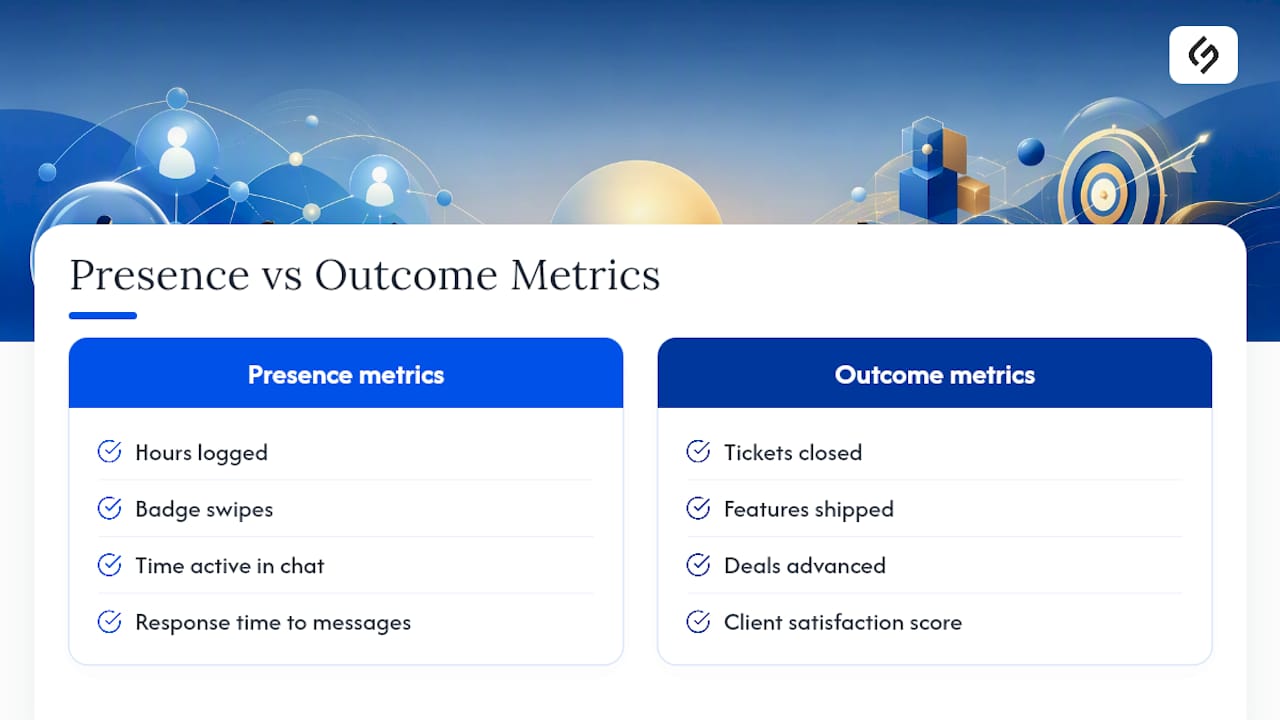
Replace those proxies with metrics tied directly to the outcomes defined earlier in each role’s deliverables: tickets closed, features shipped, deals advanced, client satisfaction scores, or whatever concretely represents value for that function. Track cycle time, how long it takes work to move from assigned to complete, since a lengthening cycle time often signals a bottleneck in communication or approval, not a motivation problem.
Pair quantitative metrics with a short qualitative pulse check every quarter, asking whether people feel they have the context and support to do their job well. A team can hit every number on a dashboard and still be quietly disengaged if collaboration feels broken. Watch for metrics that inadvertently reward always-on behavior, like response time to messages, since those quietly punish focused, deep work and reward constant interruptibility instead.
Review metrics as a team, not just top-down. When people understand why a metric matters and see how it’s calculated, they’re far more likely to trust it rather than treat it as surveillance dressed up as data.
What I’ve Learned Watching Hybrid Systems Succeed and Fail
The hybrid teams that struggle almost always have the same root problem: too many meetings trying to substitute for a documentation system that doesn’t exist. Solution4Guru engagements that focus on building a single shared tracker, a decisions log, and a clear tool stack tend to cut meeting volume noticeably within a few weeks, simply because the information people were meeting to exchange now lives somewhere they can find it themselves.
The most common pitfall isn’t a bad tool choice. It’s skipping the step where the team actually agrees on the norms together before rolling them out. A policy handed down top-down gets followed halfheartedly. A policy the team helped write gets followed because people feel ownership over it.
If your hybrid team is drowning in status meetings and still missing deadlines, that’s usually a systems problem, not a people problem, and it’s worth diagnosing before adding another layer of oversight.
How Solution For Guru Helps Teams Build Hybrid Systems That Stick
Building the tracker, decisions log, and tooling stack this guide describes takes real technical setup, not just good intentions. Solution For Guru designs and integrates the process automation, CRM and SaaS platform connections, and custom internal tools that turn “we should track this better” into a system your team actually uses every day.
If your current setup is a patchwork of spreadsheets, disconnected apps, and a Slack channel nobody trusts as the source of truth, that’s exactly the gap our tech consulting and automation work addresses. We start with a free consultation to map your current tools against what your hybrid team actually needs, then build the integration or custom platform that closes the gap. Whether that means connecting your project tracker to your CRM or building a lightweight internal dashboard from scratch, it beats another year of duct-taping tools together. Get started with a consultation and see what a properly integrated hybrid workflow looks like for your team.
Sources
- How To Manage Remote Teams Without Micromanaging (Forbes, Apr 2026)
- Can Setting Team ‘Collaboration Norms’ Improve the Employee Experience of Hybrid Workers? (HBS pre-registered experiment)
- Understanding and managing remote workers (Gallup)
- Hybrid work is here to stay. Here are 7 ways to manage your workforce (MIT Sloan)
- Hybrid work best practices (Harvard Law School PDF)
FAQ
The best approach combines outcome-based expectations, standardized communication norms, and consistent weekly coaching, backed by a shared tracker that gives everyone equal visibility into work and decisions.
A short, structured 10-minute weekly one-on-one covering wins, blockers, priorities, and support needs works better than a longer, less frequent check-in for keeping hybrid employees connected and unblocked.
Document contributions in a shared tracker, audit who gets stretch assignments and recognition, and base performance conversations on outcome data rather than who happens to be visible in the office.
Yes. Solution For Guru builds and integrates the process automation, CRM connections, and custom tracking tools that give hybrid teams a single, reliable source of truth for priorities and progress.