Why Testimonials Matter: Build Trust and Drive Conversions

Testimonials are one of the highest-ROI trust signals available to marketers, reducing buyer uncertainty and directly lifting conversion rates. Before reading further, take three immediate actions: place your strongest client quote in your homepage hero or pricing page, record your current conversion rate as a baseline, and send one testimonial request this week using the template in Section 6.
This guide covers the evidence behind why testimonials work, the formats that perform best at each funnel stage, how to collect and use them legally, and how to measure their impact with precision.
Quick-start checklist:
- Add one specific, outcome-focused testimonial to your homepage hero or pricing page today
- Note your current page conversion rate so you have a baseline to measure against
- Draft a short testimonial request email using the template in the collection section below
Key Takeaways
Testimonials are a high-ROI trust signal that reduce buyer uncertainty, lift conversion rates, and supply the peer-specific evidence that no marketing copy can replicate.
| Point | Details |
|---|---|
| Place testimonials strategically | Add outcome-focused quotes near pricing CTAs and homepage heroes for the highest conversion impact. |
| Collect with a template | Time requests within 48 hours of a customer milestone and ask two specific questions about problem and result. |
| Measure conversion lift | Run an A/B test and track assisted conversions in your CRM, not just last-click attribution. |
| Comply with FTC rules | Disclose incentives, state typical vs. atypical results, and retain written consent for every testimonial published. |
| Match format to funnel stage | Use video and UGC at awareness; use case studies with quantified outcomes at the decision stage. |
Table of Contents
Why testimonials are an essential marketing asset
Testimonials work because they reduce uncertainty. A prospect reading your marketing copy has no way to verify your claims independently. A peer who has already solved the same problem provides exactly the concrete, use-case detail that general advertising cannot supply.

The mechanism has three layers. First, social proof: when buyers see that others like them made a purchase and benefited, the perceived risk of doing the same drops. Second, trust transfer: a credible reviewer lends their credibility to your brand. Third, specificity: a testimonial that names a problem, describes the action taken, and states a measurable result gives a prospect a mental model for their own outcome.
Those three layers translate directly into marketing outcomes:
- Higher click-through rates on ads that feature a short client quote alongside the headline
- Increased landing-page conversions when a relevant testimonial appears near the primary call-to-action
- More demo or trial signups when a case-study excerpt addresses the exact objection a prospect is weighing
The concrete benefits of using testimonials in marketing
The benefits of customer testimonials extend well beyond a credibility bump on the homepage. Each benefit below maps to a specific business objective.
- Trust and credibility: A specific, attributed quote from a real customer carries more weight than any brand claim. Specificity is the key variable.
- Objection handling: Testimonials that name a concern (“I was worried about the setup time”) and then resolve it preemptively neutralize the most common sales barriers.
- Social proof at scale: Star ratings and review counts signal consensus, which is particularly persuasive for first-time buyers who have no prior relationship with the brand.
- Conversion lift: Placing a relevant testimonial near a pricing table or sign-up form consistently reduces friction at the decision point.
- SEO and long-tail keyword capture: Customer language in testimonials often matches the exact phrases prospects type into search engines, adding natural keyword variation to product and service pages.
- Sales acceleration: A sales team that shares a relevant case study or quote during a proposal shortens the evaluation cycle.
- Staff morale and investor confidence: According to Forbes, positive client feedback also reinforces team performance and can strengthen a company’s narrative for investors and partners.
For measurement guidance on each of these benefits, see the KPI section later in this article.
Key statistics: the evidence that testimonials move outcomes
Survey data from Statista show a majority of U.S. shoppers regard online reviews and testimonials as influential when deciding on new purchases. That single finding reframes testimonials from a “nice to have” into a pre-purchase information source that buyers actively seek out.
Striking finding: Research collated by HubSpot finds that in some surveys, consumers trust reviews nearly as much as personal recommendations from people they know — a benchmark that no paid advertising channel approaches.
The table below summarizes the core evidence base.
| Finding | Source |
|---|---|
| Majority of U.S. shoppers say reviews influence new-purchase decisions | Statista (U.S. survey) |
| Reviews trusted nearly as much as personal recommendations in some surveys | HubSpot research compilation |
| Individual reviews resolve buyer uncertainty by supplying concrete use-case detail | Marketing Science / INFORMS |
| Review valence and volume correlate with retailer sales elasticities; effects vary by product type | Journal of Marketing meta-analysis (26 studies) |
| Crowd-based star ratings can have substantially larger aggregate effects on consumer welfare than professional critics in some categories | American Economic Review |
A meta-analysis of 26 empirical studies found that both review valence (average rating) and review volume correlate with sales elasticities, with the size of the effect varying by product type and buyer involvement level. High-involvement purchases, where buyers deliberate longer, show the strongest sensitivity to review quality.
Research published in the American Economic Review provides causal estimates showing that crowd-based star ratings can have substantially larger aggregate effects on consumer welfare and sales than traditional professional critics in certain categories. The implication for marketers: volume and authenticity of peer reviews matter more than a single polished endorsement.
Testimonial formats and where to place them by funnel stage
Different formats serve different purposes. Choosing the wrong one for the wrong stage dilutes impact.
Formats and their primary use:
- Short text quotes: Fast to scan, easy to embed anywhere. Best for homepage hero sections, pricing pages, and email campaigns.
- Video testimonials: Convey emotion and authenticity that text cannot replicate. Most effective at the awareness stage, where a prospect is still forming an impression of the brand.
- Case studies: Structured narratives (problem, solution, outcome) that address procurement-level scrutiny. Essential for B2B sales cycles. See how teams use case studies to demonstrate ROI for a practical format reference.
- Star ratings and review counts: Aggregate social proof. Effective on product pages, Google Business profiles, and retargeting ads where a quick trust signal is needed.
- User-generated content (UGC): Photos, social posts, and unscripted reviews from real customers. Particularly persuasive for consumer products because they are visually authentic.
Placement by funnel stage:
- Awareness: Video testimonials and UGC on social ads and blog posts establish initial credibility.
- Consideration: Short quotes near feature descriptions and comparison pages address specific objections.
- Decision: Case studies and ROI-focused quotes on pricing pages and proposal documents close the gap between interest and commitment.
- Post-purchase: Onboarding emails that include peer success stories reduce buyer’s remorse and improve retention.
The general rule: match the level of detail to the stage. High-level social proof works early; specific, metric-driven outcomes work late. For guidance on UX best practices for testimonial placement on product and landing pages, the principles of visual hierarchy and proximity apply directly.
How to collect credible testimonials and use them effectively
Prioritize recent, specific, and measurable testimonials from customers who match your target buyer profile. A quote that names a problem, describes the solution, and states an outcome with a metric or timeframe (“reduced churn 18% in three months”) outperforms generic praise in every context, according to HubSpot’s practitioner guidance.
Step-by-step collection process:
Identify candidates. Flag customers who have hit a measurable milestone: a renewal, a significant ROI moment, or a positive support interaction. Use CRM workflows to trigger a request at that moment, when recall is fresh, as recommended by Salesforce.
Time the ask. Send the request within 48 hours of the milestone. Delayed requests produce vaguer, less enthusiastic responses.
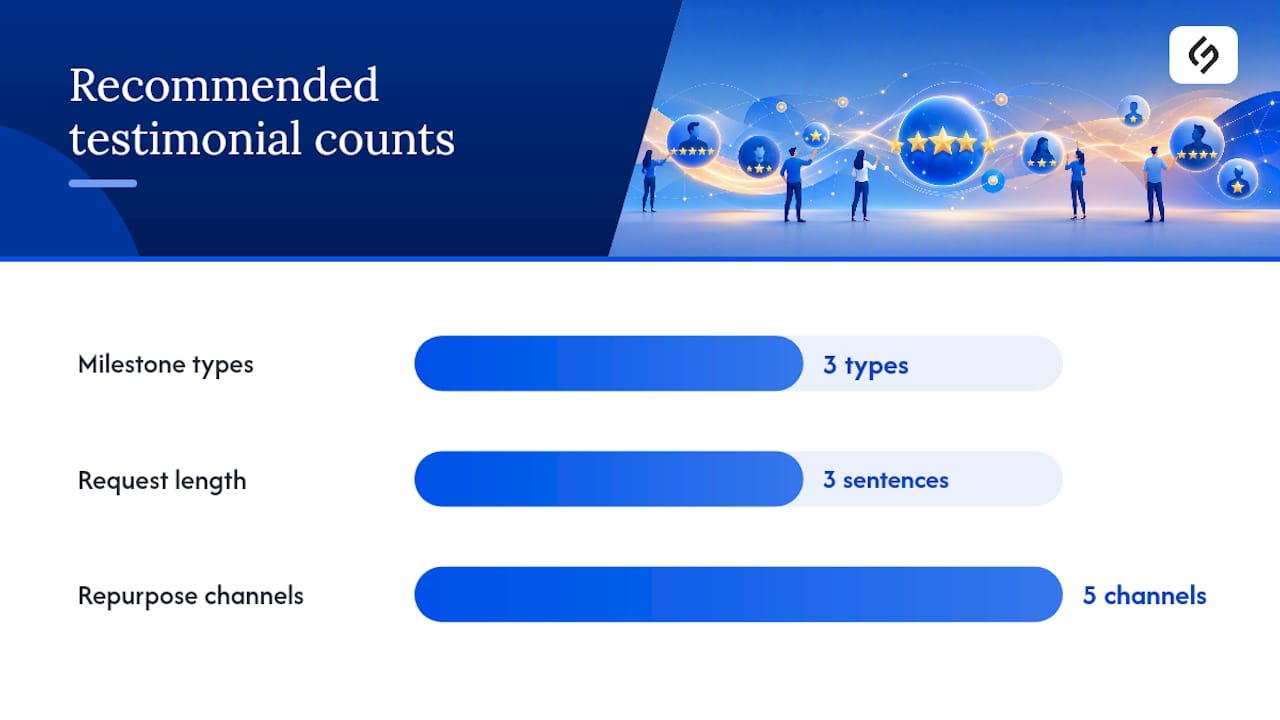
Use a short request template. Keep it to three sentences:
Offer optional incentives. A discount on the next renewal or a charitable donation in the customer’s name can increase response rates without compromising authenticity. Avoid cash payments for testimonials, as these create FTC disclosure obligations (see the legal section below).
Get written permission. Obtain a signed release covering the quote, the customer’s name, title, company, and any photo or video. Document this in your CRM.
Edit for clarity, not meaning. Light editing for grammar and length is acceptable. Add a short note such as “edited for length with permission” to preserve authenticity, as advised by the U.S. Small Business Administration.
Permission checklist before publishing:
- Written consent for the quote and attribution
- Consent for photo or video use
- Confirmation that the testimonial reflects the customer’s genuine experience
- Documentation stored in your CRM or legal file
Pro Tip: Repurpose one well-crafted testimonial across your landing page, sales deck, email nurture sequence, and organic social posts. A single strong quote, distributed across five channels, multiplies its reach without requiring additional collection effort.
U.S. legal and ethical guidelines for testimonials and endorsements
Comply with FTC endorsement guidelines: disclose any material connection between your brand and the reviewer, and never edit a testimonial in a way that creates a false impression.
FTC guidance summary: The Federal Trade Commission’s Guides Concerning the Use of Endorsements and Testimonials in Advertising require that any material connection — including free products, discounts, affiliate relationships, or employment — be clearly and conspicuously disclosed. Typical results must be stated when an individual’s result is atypical. Consult legal counsel before launching a paid endorsement program.
Compliance checklist:
- Disclose incentives (discounts, free products, affiliate fees) clearly near the testimonial
- State whether the result shown is typical or atypical for your average customer
- Do not edit quotes to remove negative qualifications or change the meaning
- Obtain and retain written consent for every testimonial you publish
- Apply the same disclosure standards to social media posts, video reviews, and influencer content
## How to measure the effect of testimonials on your marketing
Measure conversion lift, click-through rate, assisted conversions in your CRM, time on page, and SEO keyword impressions. These five metrics together give a complete picture of testimonial impact across the funnel.
Basic A/B test process:
- Set a hypothesis. Example: “Adding a specific, outcome-focused testimonial near the pricing CTA will increase form submissions by a measurable margin.”
- Define your success metric. Primary: form submission rate. Secondary: time on page and scroll depth.
- Size your sample. Run the test until each variant has received enough sessions to reach statistical significance. Most A/B testing tools (Google Optimize alternatives, VWO, or Optimizely) calculate this automatically.
- Set a duration. Run for a minimum of two full business weeks to account for day-of-week variation. Do not stop early based on early results.
- Interpret results. A consistent lift in the primary metric across the full test period indicates the testimonial is contributing. Check assisted conversions in your CRM to capture mid-funnel influence that last-click attribution misses.
KPIs to track and tools to use:
- Conversion rate: Google Analytics 4 or your CRM’s goal tracking
- CTR on ads featuring testimonials: Google Ads or Meta Ads Manager
- Assisted conversions: CRM pipeline reports (Salesforce, HubSpot CRM, Pipedrive)
- Time on page and scroll depth: GA4 engagement metrics or Hotjar
- SEO keyword impressions: Google Search Console, filtering for pages where testimonials appear
For a broader framework on measuring digital marketing ROI, including attribution models and CRM integration, that resource covers the full measurement stack.
What research says about why testimonials persuade
Testimonials reduce uncertainty and are most persuasive when they provide concrete, buyer-specific use cases rather than general praise. That finding comes from peer-reviewed work in marketing science, not just practitioner intuition.
Research published in Marketing Science (INFORMS) finds that individual reviews resolve buyer uncertainty by offering concrete use-case details that complement general marketing claims. The practical implication: a testimonial that describes the buyer’s specific situation before the purchase, the action taken, and the outcome afterward is structurally more persuasive than a generic endorsement.
Research finding: The same INFORMS study shows that reviews contrast with marketing claims by giving concrete scenarios. Testimonials that specify the buyer situation and outcome are more persuasive than those that offer only positive sentiment.
The meta-analysis of 26 studies cited earlier reinforces this: review valence and volume both matter, but their relative weight shifts by product category and buyer involvement. For high-consideration purchases, detailed, contrastive testimonials (ones that acknowledge a concern and then resolve it) outperform uniformly positive ones.
Practical implications for marketers:
- Favor testimonials that name a specific problem, not just a positive outcome
- Seek out reviewers whose profile matches your target buyer so prospects can self-identify
- For high-involvement B2B purchases, prioritize case studies with quantified results over short quotes
- A reviewer with recognized expertise or a recognizable company name adds an additional credibility layer
An editorial perspective on testimonials in practice
The most common mistake marketers make with testimonials is treating them as decoration rather than evidence. A quote placed in a sidebar or a rotating carousel rarely changes behavior. The same quote, positioned directly adjacent to the specific objection it resolves, consistently does.
The sequencing principle matters more than most guides acknowledge. Early in the funnel, a prospect needs to believe the outcome is possible for someone like them. Late in the funnel, they need to believe it is achievable for them specifically. Those are different jobs, and they require different testimonials. A video from a recognizable peer works at awareness. A detailed case study with a named metric closes the deal at the decision stage.
One insight that rarely appears in standard guides: the testimonial request itself is a relationship touchpoint. A well-timed, specific ask — one that references the customer’s actual milestone — signals that you are paying attention. Customers who feel recognized are more likely to respond, and more likely to give you the specific, outcome-oriented quote that actually converts.
Ready to put testimonials to work on your website?
Collecting strong testimonials is only half the equation. Displaying them in the right place, with the right UX context, determines whether they convert. Solution4guru’s team helps businesses design and build testimonial sections, landing pages, and conversion flows that turn social proof into measurable results.
Explore UX design best practices for placing testimonials where they have the greatest impact, or review the web development fundamentals behind building pages that load fast and display social proof credibly.
Sources
- Marketing Science (INFORMS): Individual reviews resolve uncertainty
- American Economic Review (AEA): crowd ratings versus professional critics
- Statista: Importance of online reviews to new purchases (U.S.)
- HubSpot: Why customer reviews and testimonials convert
FAQ
Testimonials reduce buyer uncertainty by supplying concrete, peer-sourced use-case details that marketing copy cannot provide. Research published in Marketing Science (INFORMS) finds this uncertainty-reduction mechanism is the primary driver of review persuasiveness.
The core benefits include increased trust and credibility, objection handling, social proof, conversion lift near decision points, SEO keyword variation from natural customer language, and accelerated sales cycles.
Survey data from Statista show a majority of U.S. shoppers regard reviews and testimonials as influential in new-purchase decisions, and HubSpot research finds consumers trust reviews nearly as much as personal recommendations in some surveys — a level of influence that most paid content formats do not reach.
Yes. The FTC requires clear disclosure of any material connection between the brand and the reviewer, including discounts, free products, or affiliate relationships. Typical results must be stated when an individual result is atypical.
Run an A/B test with and without the testimonial on a high-traffic page, tracking form submission rate as the primary metric. Supplement with assisted-conversion data from your CRM and SEO keyword impressions from Google Search Console to capture mid-funnel and organic impact.