How Do Businesses Use Freshservice for IT Asset Visibility?
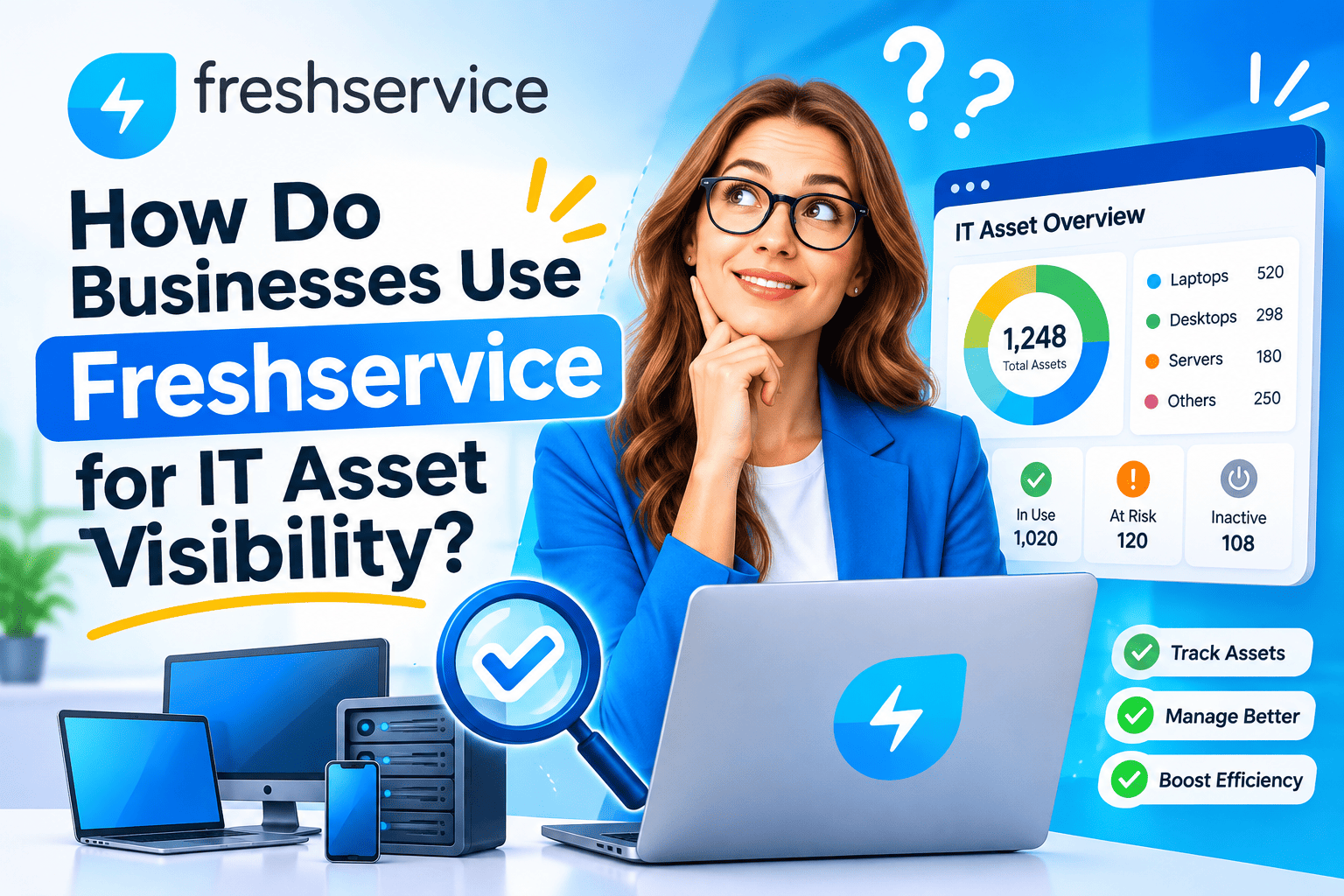
Most IT teams manage more devices, applications, and cloud resources than they can name. Laptops leave the office, employees sign up for software on their own, and virtual servers appear and disappear within days. Without a reliable inventory, teams struggle to fix incidents, control costs, and pass audits. This article explains how businesses use Freshservice to gain clear, up-to-date visibility into their IT assets and shows how to build that visibility step by step.
Table of contents
Quick Summary
The table below answers the main questions before the detailed sections begin.
| Question | Short Answer |
| What is IT asset visibility? | An accurate, current view of every hardware, software, cloud, and contract asset a business owns or uses |
| How does Freshservice help? | It discovers assets automatically, stores them in an asset inventory and CMDB, and links them to tickets, changes, and contracts |
| Which tools matter most? | Discovery Agent, Discovery Probe, cloud discovery, software asset management, and relationship mapping |
| Who benefits? | IT teams, finance, security, and any business that wants fewer surprises in audits and outages |
| Main challenge | Discovery only works when teams set it up well and keep processes clean |
| Next step | Start with a hardware inventory, then add software, cloud, and relationship mapping |
How Is Freshservice ITSM Related to IT Asset Visibility?

IT asset visibility sits at the heart of service management. Every incident, request, and change involves an asset, such as a laptop, a server, or a business application. Freshservice ITSM connects those assets to the work that IT performs. When an employee reports a problem, the agent sees the device, its configuration, and its history on the same screen as the ticket.
Moreover, Freshservice combines service management with asset management in one platform. According to Freshworks, the platform now unifies IT asset management, IT operations management, and IT service management. As a result, teams do not need to reconcile a separate asset spreadsheet with a separate ticketing tool. The data flows both ways: discovery updates the inventory, and the inventory improves every ticket.
What Will This Article Explain?
This guide first defines asset visibility and shows why it matters. Next, it covers discovery methods, the CMDB, software and cloud visibility, and the link between assets and service desk work. Then it offers a rollout plan, metrics, and common mistakes. Finally, it shows how an implementation partner such as Solution for Guru can help teams reach reliable visibility faster.
Why Do Businesses Struggle With IT Asset Visibility?

How Large Is the Visibility Gap?
Industry research shows that the problem is growing. Flexera’s 2026 State of IT Asset Management report, based on a survey of 512 technology professionals worldwide, found that only 31% of organizations have accurate visibility into AI software. The same report found that complete IT asset visibility fell to 36%, and that 59% of respondents said wasted AI spend increased year over year.
Audits add pressure. Flexera reports that 48% of respondents faced a software audit in the last year, and 44% said they spent more than $1 million on audits over the past three years. These numbers come from a vendor survey, so teams should treat them as indicators, not universal rules. Even so, they show that guesswork about assets has a real price.
| Flexera 2026 Finding | Figure |
| Organizations with accurate visibility into AI software | 31% |
| Organizations with complete IT asset visibility | 36% |
| Respondents reporting higher wasted AI spend | 59% |
| Respondents audited in the last year | 48% |
| Respondents spending over $1 million on audits in three years | 44% |
Which Everyday Problems Does Poor Visibility Cause?
Poor visibility shows up in ordinary ways. Teams often experience the following problems:
- Slow incident response because nobody knows which systems connect
- Paying for software licenses that nobody uses
- Missing or stolen devices that stay on the books
- Unpatched machines that no one realizes exist
- Shadow IT applications that bypass security review
- Failed audits and unexpected vendor bills
What Does Asset Visibility Include?
Which Asset Types Should a Business Track?
A complete view covers more than computers. Businesses should track hardware, software, cloud resources, contracts, and the people who use them. Each category answers a different business question, so teams should plan for all of them, even if they start with only one.
| Asset Type | Examples | Question It Answers |
| Hardware | Laptops, desktops, servers, printers, network gear | What do we own, and who has it? |
| Software | Installed applications, licenses, SaaS subscriptions | What do we run, and are we compliant? |
| Cloud resources | Virtual machines, storage, services | What do we pay for, and is it still in use? |
| Contracts | Leases, warranties, support agreements | What expires, and when? |
| Relationships | Which server supports which service | What breaks if this component fails? |
What Is the Difference Between an Asset Inventory and a CMDB?
An asset inventory lists items and their financial and ownership details. A configuration management database (CMDB) goes further, because it records how items relate to each other and to business services. Freshservice supports both. The inventory tracks what a business owns, while the CMDB shows how pieces connect, so teams can assess the impact of a change or outage before it happens.
How Does Freshservice Discover IT Assets Automatically?
What Does the Discovery Agent Do?
Manual inventories go stale quickly, so Freshservice offers automated discovery. According to Freshservice’s support documentation, the Discovery Agent is a lightweight application that installs on Windows, Mac, or Linux computers. It updates Freshservice with hardware and software information in real time, and it keeps reporting after a machine leaves the corporate network. That feature matters for laptops, because remote and hybrid employees rarely stay inside the office.
What Does the Discovery Probe Do?
The Discovery Probe takes a different approach. It is a Windows application that an organization installs on a server. The probe scans the network by domain or IP range and refreshes asset records on a schedule that the team sets. Freshservice documents that the probe integrates with Microsoft SCCM out of the box and can sync user information from Active Directory. Teams therefore use the probe for desktops and servers that rarely move.
| Method | Best For | How It Works |
| Discovery Agent | Laptops and remote devices | Installs on the device and reports in real time, even off the network |
| Discovery Probe | Desktops, servers, and network gear | Scans the network on a schedule and can read SCCM and Active Directory data |
| Cloud discovery | Cloud infrastructure | Finds resources and relationships across providers such as AWS, Azure, and VMware |
Can Teams Combine Both Methods?
Yes. Freshservice states that using both the agent and the probe on the same machine updates the asset once, without creating duplicates. This design lets teams mix methods while keeping one clean record for each device. A practical setup uses the agent for mobile devices and the probe for the data center and office network.
How Does Freshservice Improve Cloud and Infrastructure Visibility?

Cloud resources change faster than physical hardware, so manual tracking fails almost immediately. Freshservice’s cloud discovery is part of cloud management and is available on the Growth, Pro, and Enterprise plans when inventory is enabled. It finds cloud resources and the relationships between them, and it identifies resources that nobody uses anymore so that teams can reduce waste. In addition, a self-service cloud catalog lets employees request actions such as enabling, resizing, or removing a resource.
Freshworks has also expanded this area. In a March 31, 2026 announcement, the company described continuous infrastructure discovery and dependency mapping from its Device42 acquisition, now operating natively in Freshservice. The company said new customers receive the updated ITAM immediately, while existing customers move to it in phases during 2026 and early 2027. Teams that already use Freshservice should therefore ask their account contact about their migration timing.
- Find cloud resources across several providers in one inventory.
- Identify idle resources that still generate cost.
- Map which cloud services support which business applications.
- Offer employees a controlled catalog instead of ad hoc requests.
How Does the Freshservice CMDB Show Relationships Between Assets?
Why Do Relationships Matter?
A list of assets tells a team what exists, but a map of relationships tells the team what matters. When a database server slows down, the service desk needs to know which applications and users depend on it. According to Freshworks, the CMDB records how assets associate with each other, and discovery captures dependencies automatically and continuously. Freshworks describes this as a self-documenting CMDB.
How Does the CMDB Support Incidents and Changes?
Relationship data helps in two situations. During an incident, the team sees connected systems immediately instead of hunting for dependencies. Before a change, the team can assess upstream and downstream impact so it can plan around risky moments. Freshworks also states that the CMDB keeps an audit trail of incidents, problems, and changes tied to each asset. Consequently, teams can learn which assets cause repeated trouble and replace them with evidence rather than opinion.
| Situation | How CMDB Visibility Helps |
| Major incident | Shows connected systems and affected services quickly |
| Planned change | Reveals upstream and downstream impact before deployment |
| Root cause analysis | Links problems to the assets involved |
| Asset retirement | Shows what depends on a system before the team shuts it down |
How Does Freshservice Help Control Software and SaaS Licenses?

Which License Problems Does Software Asset Management Solve?
Software spending often grows faster than hardware spending, creating audit risk. According to Freshservice, its software asset management discovers on-premises and SaaS software, standardizes the data, and builds a license inventory. It also centralizes contracts, monitors expirations, and sends renewal alerts. As a result, teams stop paying for unused licenses and avoid rushed renewals.
How Does Freshservice Find Shadow IT?
Employees often adopt SaaS tools without telling IT. Freshservice says its software asset management finds SaaS applications, including shadow IT; tracks usage and licenses; controls spend; and flags upcoming renewals. With visibility into these applications, a business can decide whether to approve, replace, or block each one. This control matters for security and cost, because unmanaged applications often hold company data.
- Build one inventory of installed and SaaS software.
- Flag unused or underused licenses for reclamation.
- Identify expired, unlicensed, and over-licensed software.
- Receive renewal alerts before contracts lapse.
- Review shadow IT applications each quarter.
Freshservice offers software asset management as part of its ITSM platform or as a standalone product, so teams can choose the model that fits their environment.
How Do Assets Connect to Daily Service Desk Work?
Visibility pays off most when it shapes daily work. Because Freshservice links assets to tickets, an agent who opens a case sees the user’s device and its history. The agent can check whether the machine is up to date, whether it has failed before, and whether a warranty still applies. This context shortens troubleshooting and reduces back-and-forth with the user.
Furthermore, asset data supports the full lifecycle. When a new employee joins, the team assigns a device and records it. When the employee changes roles, the team updates the assignment. Then, when the employee leaves, the team recovers the device and marks it for reuse or disposal. Each step creates a clear record, which reduces lost equipment and speeds up audits.
| Lifecycle Stage | Typical Action in Freshservice | Benefit |
| Procure | Record purchase, contract, and warranty details | Clear ownership and cost data |
| Deploy | Assign the asset to a user or location | Fast, accurate onboarding |
| Maintain | Link tickets and changes to the asset | Full service history |
| Review | Check usage, age, and license status | Better renewal decisions |
| Retire | Recover, wipe, and dispose of the asset | Lower security and compliance risk |
How Does Asset Visibility Support Security and Compliance?

Which Security Risks Does a Current Inventory Reduce?
Security teams cannot protect what they cannot see. An unknown laptop may miss patches, and an unapproved application may store company data outside approved systems. Freshworks states that its updated approach helps teams detect unauthorized changes, aging systems, and compliance gaps. Because the Discovery Agent reports hardware and software details in real time, security teams can spot machines that fall out of policy sooner. In turn, they can contact the owner, patch the device, or retire it.
How Does Visibility Help With Audits?
Software vendors audit customers regularly, and the Flexera survey shows how common audits are. A current license inventory shortens audit preparation because the team already knows what it runs and owns. Freshservice’s software asset management identifies expired, unlicensed, and over-licensed software, which lets teams fix problems before an auditor finds them. Contract records with expiration dates also reduce the risk of running software without valid support or licenses.
- Keep proof of purchase and license terms attached to each record.
- Review over-licensed and unlicensed software every quarter.
- Retire devices with documented data wiping.
- Store change history so auditors can follow each decision.
How Does Asset Visibility Help Finance and Procurement?
Finance teams want to know what IT spends and why. Asset data answers both questions. When a business knows how many licenses it owns and how many people use them, it can negotiate renewals with facts. When it knows the age and warranty status of its devices, it can plan refresh cycles instead of reacting to failures. Freshservice supports this work through contract tracking, renewal alerts, and usage flags for unused licenses.
In addition, visibility helps procurement avoid duplicate purchases. A team that sees an idle laptop in storage can reassign it rather than buy a new one. Similarly, a team that sees three departments paying for similar SaaS tools can consolidate them. Each decision seems small, but together they reduce waste across the year.
| Finance Question | Asset Data That Answers It |
| Which licenses can we cancel? | Usage and last-activity data for each application |
| When should we replace devices? | Age, warranty, and ticket history by device |
| What will renewals cost next quarter? | Contract dates and renewal alerts |
| Do we already own what we plan to buy? | Inventory of idle or unassigned assets |
| Which cloud resources still generate cost? | Cloud discovery results and usage flags |
How Do Different Businesses Use Freshservice Asset Visibility?
How Do Small and Midsize Businesses Use It?
Small IT teams usually start with the basics. They deploy the Discovery Agent on laptops, record ownership, and link devices to tickets. This simple setup already ends the spreadsheet problem, and it gives the team a clear view of who has what. Later, they add software tracking to cut unused subscriptions.
How Do Larger or Hybrid Organizations Use It?
Larger organizations manage servers, cloud platforms, and many locations. They often combine the Discovery Agent and Probe, enable cloud discovery, and invest in relationship mapping for critical services. They also assign dedicated asset owners, since scale demands clear accountability. As Freshworks expands its dependency mapping, these teams gain a clearer view of how infrastructure supports business services.
| Business Profile | Typical Starting Point | Typical Next Step |
| Small team, mostly laptops | Agent on every laptop, basic inventory | Software and contract tracking |
| Midsize, office and remote | Agent plus probe, ticket links | Cloud discovery and renewals |
| Large or hybrid | Full discovery and CMDB design | Dependency maps and change impact checks |
How Can a Business Roll Out Asset Visibility in Freshservice?
A phased plan keeps the project manageable. Follow these steps:
- Weeks 1 to 2: Define goals, identify asset types, and decide who owns the inventory.
- Weeks 2 to 4: Deploy the Discovery Agent to laptops and the Discovery Probe to the office network, and import existing records.
- Weeks 4 to 6: Clean duplicates, standardize names, and set asset ownership and locations.
- Weeks 6 to 8: Add software and contract data, and set renewal alerts.
- Weeks 8 to 10: Connect cloud discovery and build the first relationship maps for critical services.
- Weeks 10 to 12: Link assets to tickets and changes, train agents, and review the first metrics.
After the first quarter, the team should review data quality monthly and expand discovery to remaining environments.
Which Metrics Show That Asset Visibility Improves?
Teams should measure outcomes, not effort. The following metrics give a balanced view.
| Metric | What It Reveals |
| Discovery coverage | The share of devices that discovery finds compared with known counts |
| Record accuracy | How many asset records contain current owners, locations, and status |
| Unused license rate | How much software spend the business can reclaim |
| Mean time to resolve | Whether asset context speeds up incident resolution |
| Audit preparation time | How long the team needs to produce license evidence |
| Unmanaged assets found | How many unknown devices or applications surface each month |
Teams should record a baseline before launch. Without it, nobody can prove that visibility improved anything.
Which Mistakes Should Teams Avoid With Asset Visibility?

- Treating discovery as a one-time project: assets change daily, so review data every month.
- Ignoring ownership: assign a named owner for the inventory and for each asset class.
- Skipping data cleanup: duplicates and inconsistent names weaken every report.
- Tracking only hardware: software and cloud spending often hides the largest savings.
- Building a CMDB that nobody uses: link it to incidents and changes from day one.
In short, visibility succeeds when teams use the data in daily decisions. A smaller inventory that stays accurate beats a huge one that nobody trusts.
What Are the Conclusions About Freshservice and IT Asset Visibility?
Businesses use Freshservice to replace guesswork with a living inventory. Discovery agents and probes find devices, cloud discovery finds infrastructure, software asset management tracks licenses and shadow IT, and the CMDB shows how everything connects. Because Freshservice ITSM links this data to tickets and changes, asset visibility improves daily service work instead of sitting in a separate report.
Nevertheless, tools alone do not create visibility. Teams still need clear ownership, clean data, and a habit of reviewing results. Freshworks also continues to change its asset capabilities, so existing customers should confirm their plan features and migration timing. To begin, a business should inventory its laptops, add software and cloud data, and map its critical services. Finally, a partner such as Solution for Guru can guide the rollout and help the team reach reliable visibility sooner.
What Are the Most Frequently Asked Questions About Freshservice and IT Asset Visibility?
Yes. Freshservice offers a Discovery Agent for Windows, Mac, and Linux computers, a Discovery Probe that scans the network, and cloud discovery for cloud resources. Some features depend on the plan, so teams should confirm details with Freshworks.
Yes. According to Freshservice, its software asset management builds a license inventory, tracks contracts and renewals, flags unused licenses, and finds SaaS applications, including shadow IT. It is available inside Freshservice ITSM or as a standalone product.
Not always. A small business can start with a simple asset inventory and add relationship mapping when its systems grow more complex. However, even small teams benefit from knowing which assets support critical services, so they should plan for a CMDB as they grow.
What Are the Benefits of Cooperation With Solution for Guru?
Why Does an Asset Visibility Project Need Implementation Support?
Asset projects touch IT, finance, security, and procurement, so poor setup creates problems across departments. Solution for Guru helps businesses avoid those problems. The company specializes in CRM and software implementation, and it works with platforms such as Freshservice ITSM. A partner brings structure and experience to a project that internal teams often squeeze between daily tickets.
How Does Solution for Guru Close Common Implementation Gaps?
| Common Gap | How Solution for Guru Helps |
| Unclear scope | Defines asset classes, owners, and success measures |
| Messy asset data | Plans and supports data cleanup and migration |
| Weak discovery setup | Configures agents, probes, and scheduling to match the environment |
| Unused CMDB | Designs relationships and links them to incident and change workflows |
| Low adoption | Trains agents and managers to use asset data in daily work |
| No improvement cycle | Supports regular reviews and expansion over time |
What Results Can Businesses Expect?
- Faster launch: a guided plan shortens the path from licensing to reliable data.
- Cleaner data: accurate records improve every ticket, change, and audit.
- Lower risk: an experienced consultant catches design mistakes early.
- Better adoption: trained teams trust and use the inventory.
Businesses that want to explore this option can visit the Solution for Guru website and discuss their asset goals with the team.
Recommended:
- How Does Freshservice Improve IT Service Delivery?
- How ManageEngine ServiceDesk Plus Supports IT Cost Management
- Using Webhooks and Automation APIs in Freshservice
- Using ManageEngine for IT Change Auditing and Governance
- How ITSM Platforms Support Digital Transformation Initiatives
- Building Advanced Incident Routing Logic in Freshservice
- Using Orchestration Center in Freshservice for IT Automation
- Common Freshservice Implementation Mistakes and How to Avoid Them
- Choosing and Implementing the Right ITSM Model for Your IT Team
- Best Practices for IT Asset Lifecycle Management Using ITSM Platforms
- How to Measure ITSM Success After Implementing Freshservice
- How Automation in Freshservice Helps Prevent IT Bottlenecks
- Multi-Tenant ITSM Architectures: What MSPs Should Know
- How Role-Based Access Control Improves ITSM Security
- How Self-Service Portals Improve Employee Experience in Freshservice
- ERP and ITSM Integration: Improving Operational Visibility Across Departments
- Integrating Endpoint Management Tools with Freshservice
- ManageEngine Asset Management (ITAM): Why Businesses Trust It to Control Their IT Assets
- Why Mid-Sized Companies Choose Freshservice Over Enterprise ITSM Platforms
- Best Reporting and Analytics Dashboards for IT Operations Teams in Freshservice
- How ITSM Platforms Support IT Compliance and Audit Readiness
- How ITSM Tools Support Internal IT Risk Management
- How AI Is Changing ITSM Workflows in Freshservice?
- How ITSM Platforms Like Freshservice Support Digital Transformation
- Freshservice CMDB Explained: Structure, Relationships, and Best Practices