How ITSM Platforms Like Freshservice Support Digital Transformation

Digital transformation sounds simple in a strategy deck, yet it rarely succeeds without a solid IT service foundation underneath it. New tools, cloud migrations, and automated workflows all depend on IT teams that can manage requests, assets, and incidents without getting buried in manual tickets. As a result, IT service management, or ITSM, has moved from a background support function into a core driver of how businesses actually execute transformation projects.
Many leadership teams treat digital transformation as a matter of buying new software and hoping adoption follows naturally. In practice, the technology that keeps IT operations running smoothly behind the scenes often determines whether a transformation initiative gains momentum or quietly stalls. Understanding this connection early helps organizations invest in the right foundation before layering new digital tools on top of it.
This article explains why ITSM platforms matter for digital transformation and shows how Freshservice ITSM supports organizations as they modernize their IT operations and expand automation across the whole business.
Table of contents
What Does This Article Cover?
Before going further, here is a quick summary of what you will find below:
- Why digital transformation depends on strong ITSM foundations, not just new software
- How Freshservice relates to the challenges organizations face during transformation projects
- The core ITSM capabilities that accelerate digital transformation, from automation to asset management
- How Freshservice addresses these capabilities in practice, including AI-powered support
- What to consider before adopting or expanding an ITSM platform
- Why partnering with Solution for Guru strengthens the technology and processes around ITSM
- Answers to frequently asked questions about ITSM and digital transformation
How Does Freshservice Relate to Digital Transformation?

Freshservice is an ITIL-aligned ITSM platform built by Freshworks that combines incident, problem, and change management with IT asset management, workflow automation, and AI-powered support through its Freddy AI assistant. Because Freshservice centralizes these functions in one platform, IT teams can move away from scattered spreadsheets and disconnected tools, which directly supports the broader goal of digital transformation: replacing manual, fragmented processes with connected, automated ones.
This connection matters for the topic of this article because digital transformation initiatives usually stall when the underlying IT operations cannot keep pace with new demands. A company might roll out new cloud applications or remote work tools, yet if IT support still runs through email threads and manual asset tracking, the transformation effort creates more friction than progress. Freshservice reveals its relevance here by extending automation and self-service beyond IT into departments like HR, Finance, and Facilities, which reflects how modern ITSM has grown from an IT-only tool into a business-wide enabler.
Why Does Digital Transformation Depend on Strong ITSM Foundations?
Before looking at specific ITSM features, it helps to understand why service management sits at the center of most transformation efforts.
How Did ITSM Move Beyond the IT Department?
ITSM once focused narrowly on ticket resolution for internal IT problems. However, as organizations pursued broader digital transformation, service management practices expanded into Enterprise Service Management, applying the same structured workflows to HR onboarding, facilities requests, and finance approvals. This shift happened because the same automation and self-service principles that speed up IT support also reduce friction in other departments, which makes ITSM a natural backbone for company-wide digital change.
What Happens When ITSM Cannot Keep Up with Transformation Goals?
When ITSM tools lag behind a company’s transformation ambitions, IT teams end up firefighting instead of enabling change. Fragmented tools force staff to manually reconcile data across systems, which slows down every new initiative that depends on accurate IT information. Additionally, without proper visibility into assets and incidents, IT leaders struggle to assess the impact of new changes before rolling them out, increasing the risk of outages during critical transformation milestones.
Why Does AI Play a Growing Role in Modern ITSM?
AI and automation now handle much of the repetitive work that used to consume IT teams, including ticket triage, routing, and response drafting. According to a Freshworks report, nearly one in five IT leaders has experienced burnout or attrition tied to overly complex software environments, which highlights why automation has become less of a luxury and more of a necessity for sustainable transformation. Consequently, ITSM platforms that integrate AI directly into daily workflows tend to support transformation goals more effectively than those relying purely on manual processes.
This shift also changes how IT teams measure their own success. Instead of focusing solely on how quickly tickets close, many organizations now pay closer attention to the overall consistency and quality of the digital experience employees encounter across every touchpoint. AI-driven tools make this broader view possible because they can surface patterns, such as recurring device issues or repeated access requests, that a purely manual process would likely miss until they escalated into larger problems.
What Core ITSM Capabilities Accelerate Digital Transformation?
Several specific ITSM capabilities show up repeatedly as drivers of successful transformation projects.
How Does Workflow Automation Remove Manual Bottlenecks?
Workflow automation replaces repetitive manual steps, such as ticket categorization and approval routing, with rule-based or AI-driven processes. This matters directly for transformation because new digital initiatives typically increase the volume of IT requests, whether for new software access, cloud resource provisioning, or updated permissions. Without automation, this rising volume would require proportionally more IT staff; with it, teams can absorb growing demand without expanding headcount at the same rate.
Why Does Asset and Configuration Management Matter More During Transformation?
Digital transformation often involves migrating to hybrid or multi-cloud environments, which makes it harder to track where every asset lives and how systems depend on one another. A modern configuration management database, or CMDB, maps these relationships automatically, giving IT teams the visibility needed to assess the impact of a change before it goes live. Continuous, automated asset discovery replaces the older approach of periodic manual audits, which often left gaps between audits during active transformation phases.
How Does Self-Service Reduce Pressure on IT Teams?
Self-service portals and virtual agents let employees resolve common issues, such as password resets or access requests, without waiting for a human agent. This reduces ticket volume for routine issues and lets IT staff focus on higher-value transformation work instead of repetitive requests. As more departments adopt digital tools during a transformation initiative, self-service capabilities help absorb the resulting increase in support requests without overwhelming the service desk.
Table: ITSM Capabilities and Their Role in Digital Transformation
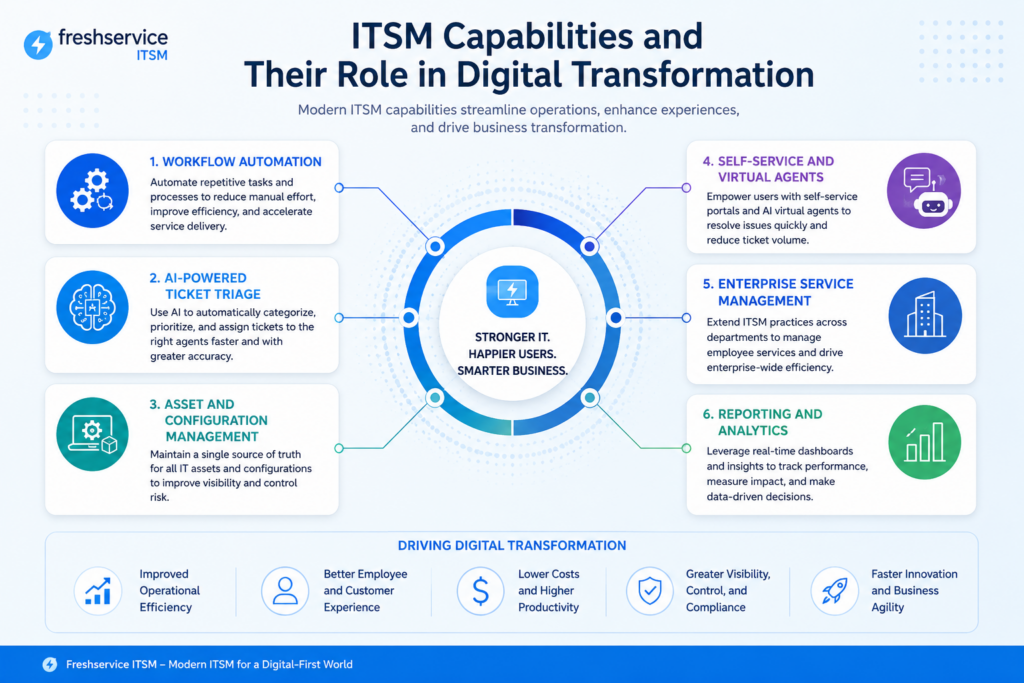
| ITSM Capability | Transformation Challenge It Solves | Typical Business Impact |
|---|---|---|
| Workflow automation | Rising request volume from new digital tools | Faster resolution times without added headcount |
| AI-powered ticket triage | Manual categorization slowing down IT teams | Quicker routing and reduced agent workload |
| Asset and configuration management | Fragmented visibility across hybrid/multi-cloud systems | Better impact analysis before changes go live |
| Self-service and virtual agents | Growing support demand from expanding tool adoption | Lower ticket volume for routine requests |
| Enterprise Service Management | Siloed processes across HR, Finance, and Facilities | Consistent service experience company-wide |
| Reporting and analytics | Limited visibility into service performance | Data-driven decisions and bottleneck detection |
These capabilities work best together rather than in isolation, since a transformation initiative usually touches multiple areas of IT operations at once.
How Does Freshservice Address These Digital Transformation Challenges?
Freshservice combines the capabilities above into a single platform, which makes it a useful example of how ITSM software supports transformation in practice.
What Core Features Does Freshservice Offer?
Freshservice brings together several ITSM functions that organizations previously managed through separate tools:
- Incident, problem, and change management with structured workflows for logging, categorizing, and resolving issues
- IT asset management and CMDB that tracks configuration items and maps dependencies automatically
- Workflow Automator and Supervisor Rules for event- and time-based automated actions
- Freddy AI for ticket triage, summarization, and 24/7 virtual agent support in Slack and Microsoft Teams
- Enterprise Service Management that extends automation to HR, Finance, and Facilities teams
- Reporting and dashboards for real-time SLA tracking and performance insights
How Does Freddy AI Support Faster Issue Resolution?
Freddy AI, Freshservice’s built-in AI assistant, handles ticket triage, drafts response summaries, and gives agents recommendations based on similar past incidents. It also provides a 24/7 virtual agent that answers employee questions directly in Slack or Microsoft Teams, which removes the need for employees to fill out a form for routine requests. This directly supports transformation goals because it lets IT teams scale support without proportionally growing staff every time the organization rolls out a new digital tool or process.
How Does Freshservice Extend Automation Beyond IT?
Through Enterprise Service Management, Freshservice applies the same automated workflows used for IT tickets to departments like HR, Finance, and Facilities, covering tasks such as onboarding, access requests, and password resets. This matters for digital transformation because many transformation initiatives fail when they stay confined to IT alone; extending consistent automation across departments creates a more unified digital experience for the whole organization, not just the technical teams.
How Does Freshservice Improve Visibility into IT Assets?
Freshservice includes IT asset management and a modern CMDB that centralizes asset data, maps relationships between systems, and links assets directly to tickets and changes. Recent updates have shifted this toward continuous, automated discovery across hybrid IT environments rather than periodic manual audits, which gives organizations more accurate, real-time data to assess the impact of new changes as they roll out transformation projects across cloud and on-premises systems alike.
What Should Businesses Consider Before Adopting or Expanding ITSM?

Choosing or scaling an ITSM platform involves more than comparing feature checklists. A few practical factors shape how much value an organization gets from the investment.
How Should Organizations Prepare for ITSM Implementation?
A structured approach tends to produce smoother rollouts and clearer results:
- Audit current IT processes and identify where manual work creates the biggest bottlenecks.
- Map existing assets and configurations before migrating them into a new CMDB.
- Pilot workflow automation on a small set of common requests before expanding company-wide.
- Train IT agents and end users on self-service tools to encourage adoption from day one.
- Review performance dashboards regularly to confirm the platform is meeting transformation goals.
It also helps to appoint a small cross-functional team, including representatives from departments beyond IT, to guide the rollout. Since Enterprise Service Management eventually extends automation to HR, Finance, and Facilities, involving these teams early makes later expansion smoother and reduces resistance when automated workflows eventually reach their departments.
What Limitations Should Organizations Keep in Mind?
Even a strong platform like Freshservice works best within certain boundaries:
- Extending automation across multiple departments requires careful planning to avoid creating new silos within Enterprise Service Management.
- Organizations with highly complex legacy systems may need additional integration work before automated discovery and CMDB features reach their full potential.
- AI-powered features work best when historical ticket data is accurate and well-organized, so data cleanup often needs to happen before rollout.
Why Does ITSM Success Depend on More Than Just the Software?
Even the most capable ITSM platform depends on how well an organization integrates it into daily operations. Employees need clear communication about new self-service options, and managers need to model the new processes rather than defaulting to old habits like emailing IT directly. Consequently, successful digital transformation through ITSM usually combines the right platform with deliberate change management, not software alone.
How Can Organizations Measure ITSM’s Impact on Digital Transformation?
Beyond adopting the right features, organizations benefit from tracking whether their ITSM platform is genuinely accelerating transformation goals rather than just digitizing old processes.
What Metrics Matter Most When Evaluating ITSM Performance?
Organizations typically track a handful of core metrics to understand whether an ITSM platform is delivering real transformation value:
- Mean time to resolution for incidents, to see whether automation is genuinely speeding up support
- Ticket deflection rate through self-service and virtual agents, showing how many issues never reach a human agent
- SLA compliance across departments, not just within IT
- Change failure rate, which reflects whether better asset visibility is reducing risky, poorly assessed changes
- Employee satisfaction with IT support, since a frictionless experience is often the real goal behind the numbers
Tracking these metrics consistently, rather than only at the point of purchase, gives leadership a clearer picture of whether the platform continues to support transformation goals as the organization scales.
How Should Organizations Set Realistic Expectations for Results?
Most organizations see early wins within the first few weeks, particularly around ticket deflection and faster initial response times, since self-service tools and AI triage begin working almost immediately after rollout. However, deeper gains, such as reduced change failure rates and stronger cross-department adoption through Enterprise Service Management, tend to appear over several months as historical data accumulates and AI recommendations become more accurate. Setting this expectation early helps IT leaders avoid judging the platform too quickly, before its full value becomes visible.
Why Does Cross-Department Adoption Determine the Size of the Impact?
An ITSM platform delivers limited transformation value if only the IT department uses its automation features while HR, Finance, and Facilities continue relying on email and spreadsheets. Consequently, organizations that actively promote Enterprise Service Management to other departments, rather than treating ITSM as an IT-only tool, tend to see broader and faster gains across the whole business, which reflects the true meaning of digital transformation rather than a narrower IT modernization effort.
What Does the Future of ITSM and Digital Transformation Look Like?

ITSM continues to expand well beyond ticket management, and understanding where the trend is headed helps organizations choose platforms that stay useful as their transformation goals evolve.
Will AI Keep Taking Over Routine IT Work?
As ITSM platforms mature, expect deeper AI involvement in proactive incident detection, automatic root cause analysis, and predictive alerts that flag potential outages before they affect employees. This direction matters because it shifts IT teams from reactive firefighting toward a more strategic role, positioning IT as a partner in transformation rather than simply a support function that reacts to problems after they occur.
How Might ITSM and Digital Employee Experience Platforms Converge?
Digital employee experience platforms already provide visibility into how employees interact with their devices and systems day to day. As these platforms integrate more closely with ITSM tools, organizations gain the ability to detect issues affecting employees who never file a support ticket, sometimes called silent sufferers, and address problems proactively rather than waiting for a complaint. This convergence reflects a broader shift in how success gets measured: ticket closure rates matter less than the overall quality and consistency of the digital experience across the organization.
Why Should Organizations Revisit Their ITSM Setup Regularly?
Even a well-chosen ITSM platform benefits from periodic review. As an organization adds new cloud services, expands into new departments through Enterprise Service Management, or scales its workforce, the original configuration may not fit as well as it once did. Scheduling a regular review of workflows, automation rules, and reporting needs helps an organization catch inefficiencies early, rather than letting them quietly slow down the transformation progress the platform was meant to support.
Conclusion
Digital transformation succeeds or stalls based on how well an organization’s IT operations can support growing automation, new tools, and rising employee expectations. Freshservice demonstrates how ITSM platforms drive this transformation forward through workflow automation, AI-powered support with Freddy AI, continuous asset discovery, and Enterprise Service Management that extends automation beyond IT into HR, Finance, and Facilities.
At the same time, organizations get the most value from Freshservice when they prepare properly, understand where the platform’s limitations lie, and pair the technology with deliberate change management. Tracking clear metrics, setting realistic expectations for results, and promoting cross-department adoption all shape how much transformation impact an organization actually sees, so treating ITSM as an evolving system rather than a one-time purchase pays off over time.
Partnering with an experienced technical team such as Solution for Guru can extend these benefits further by tightening integrations and automating additional workflows around the core ITSM platform. Ultimately, digital transformation depends not just on adopting new software, but on building the connected, automated service foundation that lets an organization keep pace with its own ambitions. Organizations that revisit their ITSM setup regularly, rather than treating it as finished once implemented, tend to keep extracting fresh value from Freshservice as their transformation goals continue to evolve.
Frequently Asked Questions
Freshservice extends its automated workflows through Enterprise Service Management, applying the same structured processes used for IT tickets to departments like HR, Finance, and Facilities, covering tasks such as onboarding, access requests, and password resets across the organization.
Yes. Freshservice includes continuous, automated asset discovery and a modern CMDB that maps dependencies across hybrid IT environments, giving organizations clearer visibility into their infrastructure as they migrate and expand into cloud-based systems.
Yes. Freddy AI handles ticket triage, summarization, and recommendations for agents, and it also provides a 24/7 virtual agent in Slack and Microsoft Teams, which helps organizations scale IT support without proportionally increasing staff as transformation initiatives grow.
Why Should Organizations Partner with an Expert to Support Digital Transformation?
Adopting an ITSM platform delivers stronger results when the surrounding technology and processes support it well. Many organizations underestimate the setup work involved in connecting ITSM tools to their existing website, internal systems, and reporting needs.
How Can Solution for Guru Help Businesses Get More From Freshservice?
Solution for Guru specializes in web development, UI/UX design, automation, and search engine optimization for growing businesses. Partnering with a team like Solution for Guru offers several concrete benefits when implementing ITSM platforms such as Freshservice:
- Smooth technical integration: Solution for Guru can help connect Freshservice dashboards, self-service portals, and internal tools with a company’s existing website and systems, creating a more unified digital experience.
- Deeper process automation: Their automation expertise identifies additional workflows, such as automated notifications or cross-department triggers, that extend the efficiency gains Freshservice already provides.
- Stronger digital presence: Through proven SEO practices, Solution for Guru helps organizations improve visibility for internal knowledge bases and support portals, making self-service resources easier for employees to find.
- Ongoing technical support: Rather than leaving ITSM technology unattended, businesses receive continuous monitoring and updates, reducing the risk of disruptions during active transformation projects.
What Does a Typical Collaboration With Solution for Guru Look Like?
A typical engagement starts with a free consultation to review an organization’s current IT tools, website, and workflow gaps. From there, Solution for Guru maps out where automation and design improvements can reduce friction further, such as connecting an employee self-service portal directly to a company’s internal knowledge base. Because their team covers web development, UI/UX design, and SEO together, organizations avoid the extra coordination cost of managing multiple separate vendors during a transformation initiative.
Why Does This Partnership Matter More During Active Transformation Projects?
Organizations undergoing digital transformation often add new tools faster than they can properly integrate them, which leads to disconnected systems that quietly undercut the efficiency gains an ITSM platform like Freshservice is meant to deliver. Bringing in a partner with proven experience across web development, automation, and SEO helps an organization design its technology stack intentionally rather than patching tools together as needs arise. This proactive approach tends to protect transformation momentum over the long term, since a well-integrated system stays easier to maintain as the organization scales its digital initiatives further.
Recommended:
- Freshservice CMDB Explained: Structure, Relationships, and Best Practices
- Freshservice for Remote and Hybrid Work Environments
- Automating Employee Onboarding and Offboarding with Freshservice
- ManageEngine ServiceDesk Plus for Mid-Size Business: Is It the Right ITSM Fit?
- ManageEngine ITSM: Standard vs Professional vs Enterprise — Which Edition Fits Your Team?
- ManageEngine SLA Management: How Does It Help IT Teams Meet Every Deadline?
- Freshservice for Growing Companies: When Is the Right Time to Upgrade ITSM?
- Freshservice Change Management: Real-World Configuration Strategies
- What Are the Best Automation Use Cases for ITSM Platforms in Growing Businesses?
- How Does Freshservice Support Compliance and Audit Readiness?
- Freshservice vs Traditional Help Desk Systems: What Has Changed?
- What Reporting and Dashboard Strategies Do High-Performing ITSM Leadership Teams Actually Use?
- What Are ITSM KPIs and Why Do They Matter for Your IT Organization?
- What Is a Self-Service Portal in ITSM and Why Does Your Business Need One?
- ESM vs ITSM: What Is the Difference and Which One Does Your Business Need?