Verified Top 10 SaaS Platform Companies for Researchers, Plus Method

This page is a curated catalog of notable SaaS platform companies, built for professionals and researchers who need a fast shortlist and a deeper categorized roster for vendor evaluation. What follows covers a top-10 highlight list, a full categorized breakdown by function, our selection methodology, current market trends in AI and pricing, and a step-by-step way to turn this list into a vendor pilot. Entities referenced include API-first platforms, recurring-revenue business models, and evaluation frameworks used by firms like Solution4guru.
TL;DR:
- Platform vendors like Salesforce, Atlassian, and Rippling support extensive extensions through APIs, marketplaces, and open ecosystems, distinguishing them from single-purpose SaaS tools.
- Larger SaaS companies with strong market capitalization tend to offer broader product breadth, funding access, and scale, influencing enterprise procurement choices.
- Evolving AI integration and usage-based pricing models increase complexity, requiring deeper evaluation of cloud strategy, API maturity, and security responsibilities.
- The core tradeoffs in SaaS selection involve balancing platform depth versus speed, customization risks, and consolidation versus best-of-breed integrations.
- Conducting shortlisting, technical due diligence, and structured pilots over three to six months can mitigate risks and clarify ROI before multi-year commitments.
Table of Contents
- What Are SaaS Platform Companies, and Which Ones Lead the Market?
- 1. The Top 10 SaaS Platforms Every Researcher Should Know
- The Full Roster: SaaS Companies Grouped by Function and Industry
- How This List Was Built and Verified
- What’s Actually Changing in SaaS Platforms Right Now
- Turning This List Into a Vendor Shortlist and Pilot Plan
- The Tradeoffs Nobody Puts in the Vendor Deck
- Get Expert Help Evaluating and Integrating Your Next SaaS Platform
- Sources
- FAQ
What Are SaaS Platform Companies, and Which Ones Lead the Market?
SaaS platform companies sell software delivered over the internet on a subscription basis, but “platform” is the operative word that separates the leaders from single-purpose apps. A true platform vendor gives customers an extensible foundation, meaning APIs, app marketplaces, and administrative controls that let a business build on top of the core product rather than just use it as delivered. Salesforce, Shopify, and Atlassian all fit this definition because third parties can extend their core products through official marketplaces and public APIs.
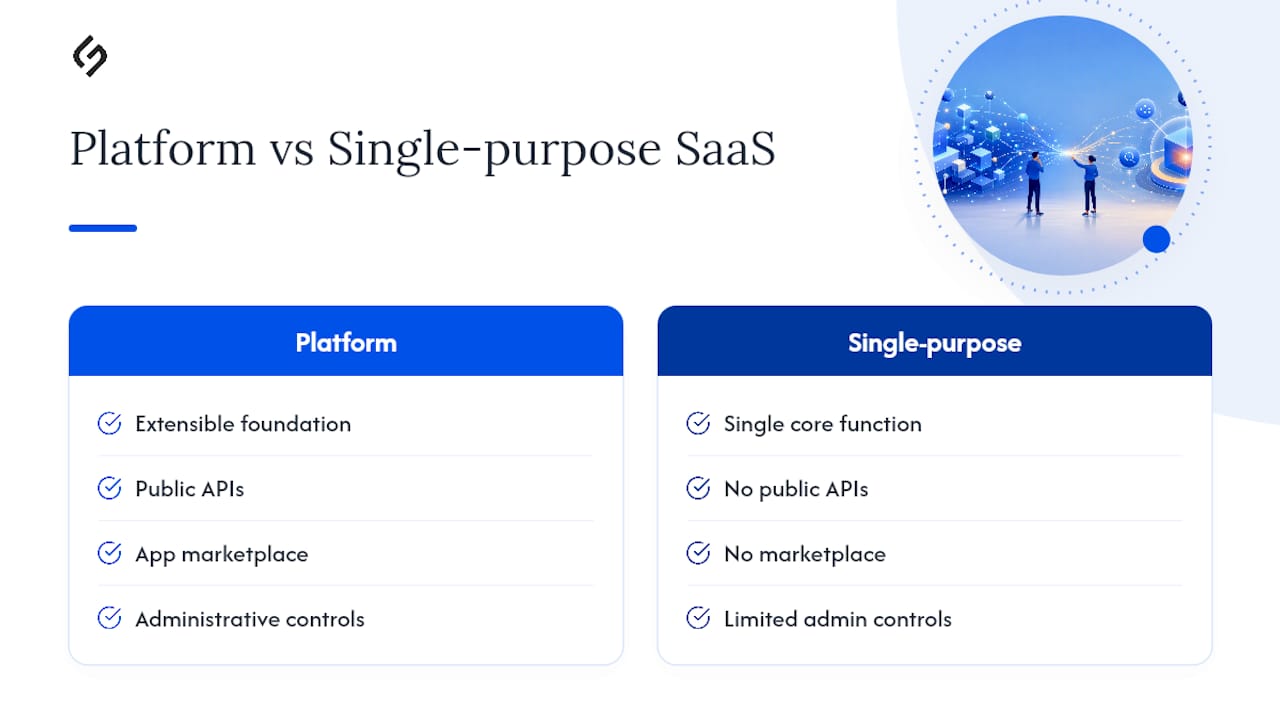
The distinction matters for anyone doing vendor research. A payroll tool that only processes paychecks is SaaS. A workforce platform like Rippling that layers payroll, IT device management, and HR compliance into one extensible system with open APIs is SaaS at the platform tier. Market capitalization is one useful, if imperfect, signal of that tier. Weekly-updated market-cap trackers show the largest public SaaS firms consistently pulling ahead on scale, funding access, and product breadth, which is precisely why enterprise buyers weight company size so heavily during procurement.
1. The Top 10 SaaS Platforms Every Researcher Should Know
Before diving into the full categorized roster, here’s a working shortlist of ten companies that show up repeatedly across enterprise procurement conversations, market-cap trackers, and industry roundups. Each one anchors a different corner of the SaaS market, so use this list as a quick orientation before you dig into narrower categories.
1. Salesforce
The customer relationship management category still runs through Salesforce, and its Data Cloud and Agentforce additions push the platform toward AI-assisted sales and service workflows. Best for: enterprises that need a CRM backbone with a mature partner ecosystem and thousands of prebuilt integrations on its AppExchange marketplace.
2. Dropbox
Dropbox built its name on file sync but has quietly become a document collaboration and e-signature hub for small and mid-sized teams. Best for: distributed teams that want simple file infrastructure without the administrative weight of a full enterprise content system.
3. Adobe
Adobe’s Creative Cloud and Experience Cloud products cover everything from design software to customer data platforms, making it one of the few vendors spanning creative tooling and marketing technology. Best for: organizations running both brand production and digital experience management under one vendor relationship
4. Atlassian
Jira and Confluence remain the default project-tracking and documentation stack for software teams, and Atlassian’s marketplace hosts thousands of third-party add-ons. Best for: engineering and product organizations that need issue tracking tightly wired into their development workflow.
5. Shopify
Shopify’s all-in-one commerce platform handles storefronts, payments, inventory, and fulfillment logistics for merchants ranging from single-founder shops to large retail brands. Best for: direct-to-consumer businesses that want commerce infrastructure without stitching together separate checkout, inventory, and shipping vendors.
6. Zoho
Zoho’s suite, anchored by Zoho One, bundles dozens of business applications, from CRM to finance to HR, under a single subscription. Best for: cost-conscious small and mid-sized businesses that want broad functional coverage without paying enterprise software prices app by app.
7. Rippling
Rippling combines payroll, benefits, IT device management, and compliance into a single employee-system-of-record, a structure few HR vendors replicate. Best for: growing companies that want to avoid running separate systems for HR, IT provisioning, and finance operations.
8. Coda
Coda blends documents, spreadsheets, and lightweight applications into one flexible workspace, positioning itself against both Google Docs and traditional database tools. Best for: teams that build custom internal tools and trackers without wanting to hire developers to do it.
9. Workday
Workday dominates enterprise HR and financial management for large organizations, particularly those with complex global payroll and workforce planning needs. Best for: enterprises with thousands of employees that need unified human capital management and financial planning in one system.
10. ServiceNow
ServiceNow started in IT service management and has expanded into a broader workflow automation platform used across HR, customer service, and security operations. Best for: large enterprises standardizing incident management and internal service requests across multiple departments.
A few patterns are worth flagging here. Several of these companies, notably Salesforce, Shopify, and Atlassian, appear in Built In’s roster of notable SaaS firms, reinforcing that they’re not just popular but structurally significant to how the category evolved. Others, like Rippling and Coda, are newer entrants proving that platform breadth can be built fast when a company designs for extensibility from day one rather than bolting it on later.
The Full Roster: SaaS Companies Grouped by Function and Industry
A ten-company shortlist is useful for orientation, but real vendor research requires scanning by function. Below is a categorized roster covering the functional areas where most procurement decisions actually happen.
CRM and sales platforms
- Salesforce: the market-standard CRM with the deepest partner and integration ecosystem. Best for enterprises needing extensive customization.
- HubSpot: combines CRM with inbound marketing and content tools. Best for growing companies building marketing and sales alignment from scratch.
- Zoho CRM: part of the broader Zoho suite, priced for smaller sales teams. Best for budget-sensitive organizations already using other Zoho apps.
Collaboration and productivity platforms
- Atlassian (Jira, Confluence): the standard for engineering-led project tracking and documentation. Best for software teams running agile workflows.
- Dropbox: file storage and sync with lightweight collaboration features layered on top. Best for teams that need simple, reliable file infrastructure.
- Coda: documents that behave like applications, blending text, tables, and automation. Best for teams building custom internal tools without engineering support.
Commerce and payments platforms
- Shopify: end-to-end commerce infrastructure from storefront to fulfillment. Best for direct-to-consumer and retail brands of any size.
- Adobe Commerce: enterprise-grade commerce tooling tied into Adobe’s broader Experience Cloud. Best for large retailers already invested in Adobe’s marketing stack.
HR and workforce platforms
- Workday: enterprise human capital management with deep financial planning integration. Best for large, multinational organizations with complex payroll needs.
- Rippling: unified payroll, benefits, and IT device management. Best for mid-sized companies that want fewer systems of record.
- Zoho People: HR management as part of the wider Zoho ecosystem. Best for smaller teams standardizing on Zoho across departments.
Security and infrastructure platforms
- ServiceNow: workflow automation extending into security operations and IT service management. Best for enterprises consolidating IT and security ticketing.
- Cloud infrastructure providers like Microsoft Azure supply the AI, data, and platform services that many SaaS vendors build on top of, which is why a vendor’s underlying cloud strategy increasingly matters during evaluation.
Developer and platform tools
- Atlassian: beyond Jira, its developer tools (Bitbucket, and formerly Trello integrations) support the full software delivery lifecycle. Best for teams standardizing their entire development pipeline on one vendor.
- Coda: its API and automation layer let technical teams extend documents into lightweight applications. Best for organizations that need custom workflows without a dedicated engineering build.
Vertical and industry-specific SaaS
- Workday: increasingly tailored modules for healthcare, higher education, and government workforce management. Best for regulated industries with specialized compliance needs.
- ServiceNow: vertical packages for telecom, financial services, and government IT operations. Best for enterprises in regulated sectors needing compliance-ready workflow automation.
This grouping deliberately mixes public market leaders with smaller, notable platforms rather than trying to profile every company exhaustively. The goal is a working roster you can use to build a shortlist by function, not a database entry for every SaaS company in existence. Indeed’s list of top SaaS companies is a useful cross-reference if you want to sanity-check whether a vendor you’re considering shows up consistently across independent sources, a decent proxy for market visibility.
How This List Was Built and Verified
Inclusion on this roster isn’t arbitrary. Every company here met three baseline criteria before making the cut.
- Recurring-revenue SaaS model. The company sells subscription access to software rather than one-time licenses or services, which is the defining economic trait of the category.
- Platform or API capability. The product supports extension through APIs, app marketplaces, or integration ecosystems, distinguishing it from a single-purpose tool.
- Signaled scale. The company is publicly traded, has raised notable funding, serves a large customer base, or holds a category-leading position recognized by independent industry sources.
Verification ran through official company product pages, market-cap and funding trackers, and cross-checks against independently published rosters. Where a company’s claimed capability (an API, a marketplace, an AI feature) couldn’t be confirmed on the vendor’s own site, it was left off the shortlist rather than included on trust.
This list gets revisited periodically as market conditions shift, new platforms scale, and established vendors get acquired or go private. If you think a company belongs here and isn’t listed, or you’ve found a fact that’s changed, that’s worth flagging for the next update.
Pro Tip: When you’re vetting a SaaS vendor for a partnership or integration project, don’t stop at the vendor’s own marketing page. Check whether their API documentation is public and current. A platform that hides its API docs behind a sales call usually means integration will cost you more time than the vendor admits upfront.
What’s Actually Changing in SaaS Platforms Right Now
Three shifts are reshaping how SaaS platforms compete and how buyers should evaluate them, and none of them are cosmetic.
AI is moving from a bolted-on feature to core infrastructure. Cloud providers like Microsoft Azure now offer platform-level AI and data services, including Foundry, Fabric, and IQ, that SaaS vendors build directly into their products rather than developing from scratch. This is why a growing number of SaaS platforms now ship AI agents that draft emails, summarize records, or flag anomalies without the vendor having built a proprietary AI stack. The practical implication for buyers: a vendor’s cloud and data strategy is now part of product evaluation, not a separate IT conversation.
Pricing is fragmenting away from flat seat-based subscriptions. Usage-based and consumption pricing, where you pay for what you process rather than how many people log in, has become common enough that buyers can no longer assume seat counts predict their bill. This shift creates real risk: license sprawl, where departments accumulate overlapping subscriptions nobody tracks centrally, tends to worsen as pricing models get more complex rather than simpler.
Security expectations have hardened around a shared-responsibility framework. Under this model, the vendor secures the underlying cloud platform, but the customer is responsible for configuration, access controls, and data governance. That means role-based access control (RBAC) granularity, data residency options, and audit logging aren’t nice-to-haves anymore. They’re baseline requirements for any enterprise-grade SaaS evaluation.
A few other patterns worth tracking:
- Marketplace and app-store ecosystems, the kind Shopify and Atlassian have built, increasingly determine how “sticky” a platform becomes once a business builds workflows on top of it.
- Consolidation continues as larger vendors acquire smaller point solutions to round out platform breadth rather than build every feature natively.
- Go-to-market strategy is shifting too. More vendors lean on content and search-driven acquisition rather than pure outbound sales, which changes how buyers discover and shortlist new platforms in the first place.
None of these trends make vendor selection simpler. If anything, the growing number of pricing models and AI feature claims means due diligence now takes longer than it did five years ago, even as the tools promise faster deployment.
Turning This List Into a Vendor Shortlist and Pilot Plan
A roster is only useful once it becomes a decision. Here’s how to move from this list to an actual pilot.
- Run a quick-screen pass. Check basic fit, existing integrations, security posture, pricing model, and API maturity for each candidate. Eliminate anything that fails on two or more counts before investing more time.
- Go deeper on finalists. Review SLA terms, historical uptime, data residency options, export capabilities, and audit-log depth. This is where vendors that looked identical in the quick-screen often separate.
- Design a bounded pilot. Scope the pilot narrowly, define two or three success metrics upfront, and set a three-to-six-month window with clear stakeholder sign-off before expanding usage.
If you’re already running multiple SaaS subscriptions across departments, a platform-evaluation checklist built around these same steps can save real time during procurement season.
Pro Tip: Run a license audit before your pilot ends, not after. Teams that wait until renewal season to check actual seat usage almost always discover they’re paying for licenses nobody has touched in months.
The Tradeoffs Nobody Puts in the Vendor Deck
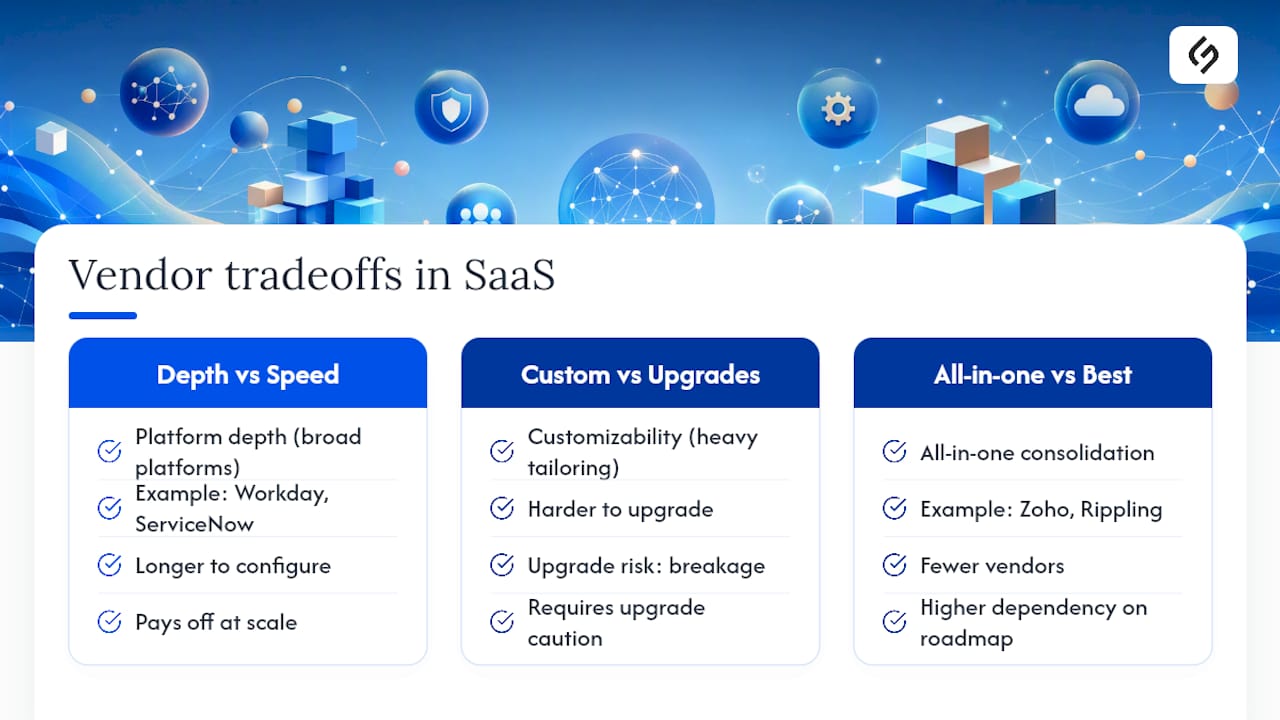
Every SaaS selection comes down to three tensions vendors rarely name outright. Platform depth versus speed to value: the broadest platforms, Workday and ServiceNow among them, take longer to configure but pay off at scale. Customizability versus upgrade risk: heavily customized instances of any platform become harder to upgrade without breaking something. All-in-one consolidation versus best-of-breed integration: bundling everything under Zoho or Rippling reduces vendor count but increases dependency on one company’s roadmap.
We weigh these tradeoffs with clients constantly, and the right answer depends entirely on organizational risk tolerance, not on which platform has the flashiest AI feature. If you want a tailored read on where your stack sits on these tradeoffs, that’s a conversation worth having before signing a multi-year contract.
Get Expert Help Evaluating and Integrating Your Next SaaS Platform
Reading a roster tells you who the players are. It doesn’t tell you whether Rippling’s API will actually talk to your existing accounting system, or whether Shopify’s checkout flow will handle your specific tax jurisdictions without custom development. That gap between vendor marketing and real integration cost is where most SaaS projects go over budget.
Solution For guru works directly with businesses evaluating, integrating, and piloting SaaS platforms, handling the technical due diligence that vendor sales calls tend to gloss over: API-first maturity checks, connector ecosystem mapping, and pilot design that actually measures ROI instead of just usage. If you’re staring down a shortlist of platforms and need someone to pressure-test the integration cost before you sign, start with a look at how web development and integration work actually supports platform rollouts, then reach out for a free consultation on your specific vendor list.
Sources
- 128 SaaS Companies to Know 2025 | Built In
- Cloud Computing Services | Microsoft Azure
- Understanding the shared responsibility model in SaaS | Cloud Security Alliance
- The 50 Biggest SaaS Companies in the U.S. (Updated Weekly)
FAQ
A platform-tier SaaS company provides APIs, app marketplaces, or integration ecosystems that let customers extend the product, unlike single-purpose apps that only do one job.
SaaS delivers ready-to-use software over the internet, PaaS provides a framework for developers to build custom applications, and IaaS supplies raw computing infrastructure like servers and storage that other layers run on.
Market conditions, acquisitions, and funding events shift company standing regularly, so a roster like this needs periodic review rather than a one-time publication.
Under the shared-responsibility model, the vendor secures the cloud platform itself, but your organization is responsible for configuring access controls, RBAC, and data governance correctly.
Yes. Solution for guru runs technical due diligence on API maturity, integration cost, and pilot design so businesses can evaluate a shortlist before committing to a multi-year contract.
A bounded pilot window of three to six months, with two or three clearly defined success metrics, is generally long enough to reveal real integration friction and ROI.