Why Does SEO Matter for Your Business Growth?

SEO matters because it puts your business in front of people at the exact moment they are searching for what you offer, making organic search a durable, trust-building source of customers that compounds over time. Organic search drives the largest share of website traffic, accounting for 53.3% of all website traffic (Ahrefs), making it the single largest channel available to most businesses. Unlike paid advertising, that visibility is earned, not rented, and it does not disappear the moment a budget runs out.
Three outcomes explain why the investment holds up:
- Intent-driven traffic: Searchers arrive with a specific need, which means they convert at higher rates than audiences reached through cold channels.
- Brand trust: Appearing prominently in organic results signals authority. Users consistently place high trust in Google’s organic listings and featured snippets.
- Lower customer acquisition cost: Once pages rank, traffic accumulates without incremental spend per click.
Table of Contents
- What is SEO, and how does it work for your site?
- How search engines find, rank, and reward your content
- What are the four core pillars of SEO?
- What concrete business benefits does SEO deliver?
- When will you see SEO results, and how do you measure them?
- How does SEO compare to paid advertising?
- How do you get started with SEO in the next 30–90 days?
- Is SEO still relevant in an AI-driven search environment?
- Why does SEO produce compounding returns over time?
- Common SEO myths worth addressing directly
- Key Takeaways
- The case for treating SEO as a long-term asset
- How Solution4guru can help you build organic growth
- Useful sources
- FAQ
What is SEO, and how does it work for your site?
Search engine optimization (SEO) is the practice of improving a website’s content, structure, and authority so that search engines can understand it, index it, and connect it with the right audience through unpaid results. It is earned media, not purchased placement.
A simple scenario illustrates the mechanics. A homeowner types “best water heater repair near me” into Google. A local plumbing company that has optimized its service page for that query, earned a few authoritative backlinks, and maintained a fast-loading mobile site appears on page one. The homeowner clicks, reads a clear service description, and books an appointment. No ad spend changed hands.
SEO is not about tricking search engines. It is about making content easy to find and genuinely useful to the people searching for it. — Google Search Central
Search engines act as cataloguers: they crawl the web, index what they find, and serve the most relevant, trustworthy results for each query. Understanding that three-step process is the foundation for every SEO decision you make.
How search engines find, rank, and reward your content
The process runs in three stages. First, search engine bots crawl the web by following links from page to page. Second, they index the content they discover, storing it in a massive database. Third, when a user submits a query, the engine ranks indexed pages by relevance, authority, and technical quality.
The primary signals that determine where a page lands include:
- Content relevance: Does the page clearly address the searcher’s intent, using the language and depth they expect?
- Authority and links: Do credible external sites link to this page, signaling that others vouch for it?
- Technical health: Is the site crawlable, free of broken pages, and structured so bots can read it efficiently?
- User experience: Does the page load quickly, display correctly on mobile, and keep visitors engaged?
Around 90.63% of pages receive zero traffic from Google. That figure reflects what happens when content is published without addressing these signals deliberately.
Pro Tip: Fix technical health before anything else. A page with brilliant content that search engines cannot crawl or that loads in five seconds on mobile will not rank, no matter how well it is written. Start with a technical SEO audit to remove those blockers first.

What are the four core pillars of SEO?
Every SEO effort maps to one of four pillars. Treating them as a framework, rather than a checklist, helps prioritize work that actually moves rankings.
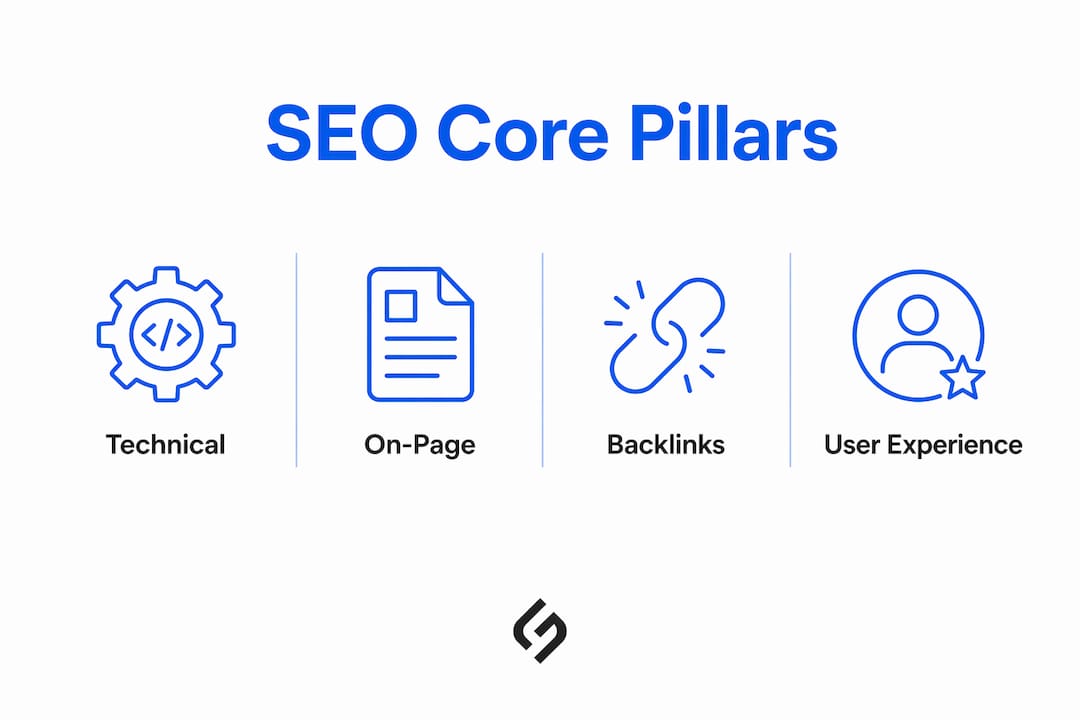
| Pillar | What it covers | Starter actions |
|---|---|---|
| Technical SEO | Crawlability, site speed, mobile usability, structured data | Fix broken links; submit XML sitemap; pass Core Web Vitals; add schema markup |
| On-page / Content | Page relevance, title tags, headings, internal linking | Match page content to search intent; write descriptive title tags; use H1–H3 hierarchy |
| Backlinks / Off-page | External authority signals, brand mentions | Earn links through original research; guest posts on relevant sites; digital PR |
| User experience | Engagement, mobile design, page layout | Reduce bounce rate with clear CTAs; optimize for mobile-first; improve readability |
For content specifically, writing SEO content that ranks requires matching the format and depth a searcher expects, not just inserting keywords. A “how to” query needs a step-by-step guide. A “best X” query needs a comparison. Getting that match right is what separates pages that rank from pages that sit idle.
Quick first-audit checklist:
- Verify Google Search Console is set up and ownership confirmed
- Submit an XML sitemap
- Run a page-speed test (Google PageSpeed Insights)
- Check that all key pages return a 200 status code
- Confirm the site is mobile-responsive
What concrete business benefits does SEO deliver?
The business case for SEO rests on five outcomes that translate directly to revenue and brand equity.
- Intent-driven traffic: 3.5 billion searches happen on Google every day. Ranking for queries your buyers use puts your business in front of an audience that is already looking for a solution.
- Higher conversion potential: Organic visitors arrive with specific intent, which typically produces stronger conversion rates than audiences reached through interruption-based channels. Targeted content aligned to buyer intent amplifies that effect further.
- Brand credibility: Appearing in prominent SERP features, such as featured snippets and knowledge panels, signals authority. Survey data shows a majority of users trust information they find through Google’s organic results.
- Long-term cost efficiency: Once a page ranks, it can generate traffic for months or years without incremental cost per visit. Paid ads stop the moment the budget is paused.
- Local visibility: For businesses serving a specific geography, local SEO, including Google Business Profile optimization and location-specific pages, connects them with nearby buyers at the point of decision.
Consider a small software consultancy that publishes a detailed guide answering a common client question. That single page, properly optimized, can rank for dozens of related queries, attract backlinks from industry blogs, and generate qualified leads continuously. No ad budget required after the initial content investment.
When will you see SEO results, and how do you measure them?
Practitioners consistently report that meaningful SEO results take 6–12 months. Treating SEO as a short campaign rather than a sustained program is the most common reason businesses abandon it before it pays off.
| Phase | Timeframe | What to expect |
|---|---|---|
| Audit and fixes | — | Technical blockers removed; Search Console data flowing; baseline established |
| Early traffic wins | 3–6 months | Impressions rising; long-tail keywords gaining positions; crawl errors resolved |
| Meaningful ranking gains | 6–12 months | Target pages entering top 10; organic sessions growing measurably |
| Compounding growth | 12+ months | Authority building; new pages rank faster; traffic and leads compound |
KPIs worth tracking from day one:
- Organic sessions (Google Analytics or equivalent)
- Impressions and click-through rate (Google Search Console)
- Keyword ranking clusters (not individual keywords)
- Conversions attributed to organic traffic
- Backlinks earned over time
For measurement, use Google Search Console as the primary source of search-specific data. Segment organic traffic in your analytics platform to isolate it from direct and referral channels. Establish a baseline in month one so you can measure incremental gains accurately. For a structured approach to tracking returns, measuring digital marketing ROI requires the same baseline-and-segment discipline.
How does SEO compare to paid advertising?
The two channels serve different purposes, and the most effective programs use both deliberately.
Paid search (PPC) delivers immediate visibility. You pay per click, results appear the day a campaign launches, and traffic stops when the budget runs out. SEO builds over months, but the traffic it generates is free per visit and persists long after the initial work is done. SEO is an owned, compounding asset; paid advertising rents attention.
The right question is not “SEO or ads?” It is “what does each channel do best at this stage of growth?” Ads buy time while SEO builds the foundation. The businesses that win long-term run both in parallel, then shift the balance as organic traffic matures.
Two scenarios clarify the allocation logic. A product launch needs immediate visibility: run PPC to generate early sales data while simultaneously building SEO foundations for the category terms you want to own in 12 months. A business pursuing long-term category leadership should prioritize SEO as the primary channel and use paid ads tactically for high-competition terms or seasonal spikes. The digital marketing channel mix that works is almost always a blend, not a binary choice.
How do you get started with SEO in the next 30–90 days?
The first 90 days are about removing blockers and establishing a foundation, not chasing rankings.
- Set up Google Search Console and verify site ownership.
- Submit your XML sitemap so Google can discover all key pages.
- Run a page-speed test using Google PageSpeed Insights and fix critical issues.
- Audit for broken links and crawl errors inside Search Console’s Coverage report.
- Identify 5 high-opportunity pages that already have some impressions but rank outside the top 10.
- Optimize title tags and meta descriptions on those pages to match search intent precisely.
- Publish one or two intent-matching articles that answer specific questions your buyers ask.
- Begin simple link outreach: reach out to partners, suppliers, or industry directories for a mention.
- Connect Google Analytics and set up conversion tracking so you can attribute leads to organic traffic.
- Review common pitfalls to avoid undoing your work. SEO mistakes that kill rankings are often technical oversights that take minutes to fix once identified.
Pro Tip: Prioritize in this order: fix technical blockers first, then optimize pages with clear intent-match potential, then build links. Reversing that sequence wastes effort because links to a technically broken page produce no ranking benefit.
For small-business owners specifically, improving online presence starts with these same foundational steps before any paid channel is added.
Is SEO still relevant in an AI-driven search environment?
The short answer: yes, and the fundamentals matter more, not less. AI-powered search features, including Google’s AI Overviews and generative answer engines like Perplexity, still source their answers from high-quality, well-structured content. The SERP layout is changing; the underlying requirement for authoritative, useful content is not.
Three practical adaptations keep your SEO effective as AI reshapes search:
- Structure content for AI extraction: Use clear headings, concise definitions, and named entities. AI systems pull from content that is easy to parse, which is the same structure that has always helped human readers.
- Strengthen expertise and trust signals: Author credentials, cited sources, and up-to-date information all feed the E-E-A-T signals (Experience, Expertise, Authoritativeness, Trustworthiness) that Google’s quality guidelines emphasize. These signals are harder to fake and harder to replicate quickly.
- Maintain strong internal linking and content freshness: AI overviews favor sites that demonstrate depth across a topic. A well-linked content library covering a subject comprehensively outperforms a single optimized page.
Industry analysis confirms that what is disappearing is gameable, low-quality tactics, not SEO itself. The businesses that built authority on genuinely useful content are gaining visibility in AI-driven results, not losing it.
Why does SEO produce compounding returns over time?
SEO functions as infrastructure, not a campaign. Each well-optimized page that earns a ranking begins attracting organic clicks. Those clicks generate engagement signals. Some visitors link back to the page from their own sites, which increases the page’s authority. That authority lifts the entire domain, so new pages rank faster than the first ones did.

Budgeting SEO as infrastructure rather than a recurring campaign reframes expectations and enables this compounding effect. A business that treats SEO as a one-time project stops before the curve bends upward.
To illustrate the trajectory: a business that invests consistently in technical fixes, intent-aligned content, and measured link building through the first 12 months typically sees organic traffic and lead volume grow at an accelerating rate in months 13–24, without proportional increases in spend. The enterprise SEO framework follows the same compounding logic at larger scale.
The recommended sequencing is: resolve technical issues first, then publish content that matches the specific intent of your best-fit buyers, then build and measure link acquisition. Skipping the technical phase means content and links produce diminished returns.
Common SEO myths worth addressing directly
Misconceptions about SEO lead businesses to either abandon it too early or invest in tactics that no longer work.
- Myth: “SEO is dead.” Organic search still accounts for 53.3% of all website traffic (Ahrefs). What is dead is keyword stuffing, link schemes, and thin content. Quality-focused SEO is more durable than ever.
- Myth: “Results should appear within weeks.” Practitioners consistently report a 6–12 month horizon for meaningful gains. Expecting faster results leads to premature abandonment.
- Myth: “Paid ads make SEO unnecessary.” Ads and organic search serve different buyer moments. Ads capture demand; SEO builds the authority that makes every other channel more effective.
- Myth: “More content always means better rankings.” Publishing high volumes of low-quality or duplicate content can harm a site’s standing. Intent-matched, well-structured pages outperform volume every time.
- Myth: “SEO is a one-time project.” Search algorithms update continuously, competitors publish new content, and user behavior shifts. SEO requires ongoing maintenance, not a single setup.
The distinction between outdated “gameable” tactics and durable quality practices is the clearest way to evaluate any SEO advice you encounter. If a tactic relies on tricking an algorithm rather than serving a user, it has a short shelf life. Validate claims by checking your own Search Console data and referencing Google Search Central’s documentation directly.
Key Takeaways
SEO matters because it delivers intent-driven organic traffic that compounds over time, builds brand authority, and reduces customer acquisition costs in ways that paid advertising cannot replicate.
| Point | Details |
|---|---|
| Organic search dominates traffic | Organic search drives 53.3% of all website traffic, making it the largest single channel (Ahrefs). |
| Results require patience | Meaningful ranking gains typically take 6–12 months; plan sequencing accordingly. |
| Four pillars structure the work | Technical SEO, on-page content, backlinks, and user experience each require deliberate attention. |
| SEO and ads complement each other | Use paid search for immediate visibility while SEO builds long-term organic authority. |
| Solution4guru delivers the full stack | Solution4guru provides technical audits, content strategy, and ongoing SEO management to build compounding organic growth. |
The case for treating SEO as a long-term asset
Most businesses underestimate SEO not because they misunderstand the tactics, but because they misframe the investment. They budget it like a campaign, measure it at 60 days, and conclude it does not work. That is the wrong frame entirely.
The businesses that win in organic search treat it the way they treat their website infrastructure: as something that requires upfront build, ongoing maintenance, and a multi-year horizon. The compounding effect is real, but it only materializes for organizations willing to stay the course past the first six months.
There is also a credibility dimension that rarely gets discussed plainly. Appearing in organic results, especially in featured snippets or knowledge panels, carries a trust signal that no paid placement can replicate. Users know the difference, even when they cannot articulate it. That trust transfers to the brand, and it accumulates with every additional ranking the site earns.
The practical implication: start with the technical foundation, build content that genuinely answers buyer questions, and measure incrementally. Do not wait for a perfect strategy before beginning. The businesses ranking today started their SEO work 12–18 months ago.
How Solution For guru can help you build organic growth
Solution For guru works with businesses that want organic search to become a reliable, growing source of qualified leads, not a side project that never gets prioritized.
The engagement starts with a free technical and content audit: a prioritized list of what is blocking your rankings, which pages have the highest near-term potential, and a sequenced roadmap covering technical fixes, content development, and link acquisition. You receive a clear picture of where you stand and what to do next, without a long-term contract required to get started.
Solution4guru’s team covers the full scope: web development fundamentals that support technical SEO, UX improvements that reduce bounce rate, content strategy aligned to buyer intent, and ongoing measurement. Whether you need a one-time audit or a managed SEO program, the starting point is the same: a conversation about your current visibility and your growth targets.
Request a free consultation to receive your prioritized audit within five business days.
Useful sources
| Source | What it covers |
|---|---|
| Google Search Central — SEO Starter Guide | Primary technical guidance from Google on crawling, indexing, and content quality |
| Ahrefs — Why SEO Is Important | Data on organic traffic share, zero-traffic pages, and trust signals |
| Moz — Beginner’s Guide to SEO | Foundational explanation of SEO concepts and organic vs. paid distinctions |
| Forbes Agency Council — SEO: What It Is and Why It’s Important | Practitioner perspective on timelines, sequencing, and common failure modes |
| Ribatai — Why Is SEO Important? | Business-case analysis of SEO as compounding infrastructure vs. paid advertising |
| JS Interactive — Is SEO Dead? | Analysis of how AI-driven search changes tactics without eliminating SEO’s core value |
FAQ
SEO connects your business with buyers at the exact moment they are searching for a solution, delivering intent-driven traffic that converts more reliably than cold outreach. Organic search accounts for 53.3% of all website traffic, making it the largest available channel for most businesses.
Yes. AI-driven search features change how results are displayed, but they still source answers from authoritative, well-structured content. The businesses that invested in quality SEO are gaining visibility in AI Overviews, not losing it.
The four pillars are technical SEO (crawlability and site speed), on-page content (relevance and structure), backlinks and off-page authority, and user experience including mobile usability. Addressing all four in sequence produces the most durable results.
No. What is becoming irrelevant are low-quality tactics like keyword stuffing and link schemes. Organic search remains the dominant traffic source for most websites, and helpful, well-structured content continues to be what search engines reward.