Creating a Value Proposition That Wins Customers

TL;DR:
- A value proposition clearly communicates the unique benefit a business offers to a specific customer segment and why it matters. It is a structured statement that answers what they offer, who it is for, what outcome it provides, and why it’s better than alternatives. Regular testing and updating with real buyers help ensure the message remains clear and effective.
A value proposition is defined as a concise statement that communicates the unique benefit a business delivers to a specific customer segment, and why that benefit matters more than any alternative. Creating a value proposition is the single most important messaging task a business owner faces. Without it, marketing campaigns scatter, sales conversations stall, and customers choose competitors by default. The best value propositions answer four questions in plain language: what you offer, who it is for, what outcome it delivers, and why you are the better choice. This guide gives you the frameworks, validation methods, and pitfall warnings to build one that actually converts.
What is a value proposition and what questions must it answer?
A value proposition is not a tagline, a mission statement, or a list of features. It is a structured claim that answers four core questions: What do you offer? Who is it for? What value do you deliver? What makes you different? Every effective proposition must address all four, or it leaves buyers with unanswered objections.
The “who” question deserves more precision than most business owners give it. A specific buyer profile names the role, the urgency, and the budget. “Small business owners” is too broad. “Founders of service businesses with under 10 employees who are losing clients to faster competitors” is a buyer profile that creates immediate recognition. That specificity is what makes a proposition feel personal rather than generic.
The “what makes you different” question requires naming a credible alternative. Naming a credible alternative your buyer currently uses, such as spreadsheets, a freelance agency, or a legacy software platform, increases persuasiveness and motivates switching behavior. Buyers are already using something. Your proposition must explain why the switch is worth the effort.
The components of a strong value proposition include:
- A named buyer profile with a specific problem or urgency
- A measurable outcome the buyer receives (time saved, revenue gained, risk removed)
- A credible alternative the buyer currently uses
- A clear differentiator that explains why your solution wins the comparison
- Plain language that requires zero industry knowledge to understand
These components form the foundation of any value proposition framework worth using.
How do you craft a clear, compelling value proposition?
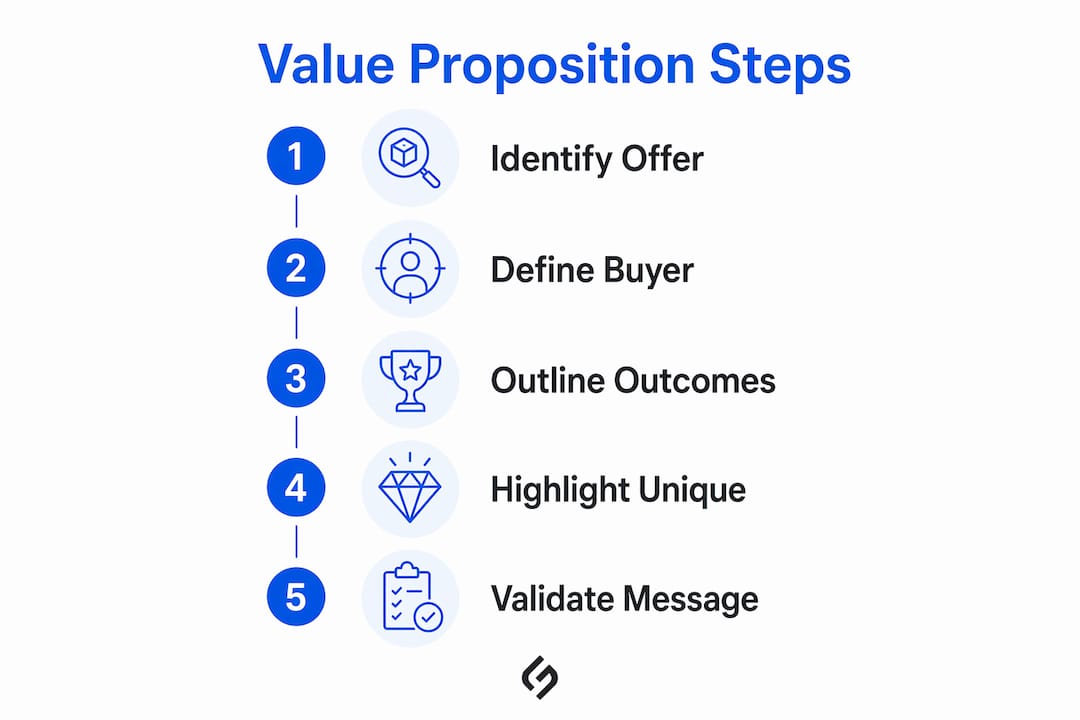
Clarity beats creativity every time. A proposition that sounds clever but requires three readings to understand will lose buyers at the first impression. Effective value propositions use a one-sentence headline plus a brief subheadline of two to three short sentences. That structure forces discipline and removes the temptation to cram in too many ideas.
The most reliable method for crafting a strong value proposition is to draft at least three competing frameworks simultaneously. Drafting three competing frameworks prevents feature overload and helps identify the strongest message based on audience reaction rather than internal preference. The three frameworks worth using are:
- Jobs-to-be-Done: Frame the proposition around the job the buyer is trying to accomplish. “We help [buyer] get [job done] without [obstacle].” This format focuses on the task, not the product.
- Classic Positioning: Use the structure “For [buyer] who [need], [product] is a [category] that [benefit]. Unlike [alternative], we [key differentiator].” This format forces direct comparison and differentiation.
- Before/After: Describe the buyer’s situation before using your product, then contrast it with life after. This format makes the outcome tangible and emotionally resonant.
After drafting all three, read each one aloud to someone outside your industry. The version they understand fastest is your starting point.
Pro Tip: Apply the “So What?” test to every sentence in your draft. If a statement lists a feature, ask “So what does that mean for the buyer?” Keep asking until you reach a concrete outcome. Statements that fail this test list only features without explaining life after using the product.

A standard layout that aids rapid customer understanding includes a headline, a short explanation, three to five benefits listed in plain terms, and supporting visuals where possible. This layout improves both comprehension and retention. Keep the headline under 10 words. Keep each benefit to one line. Remove any word that does not add meaning.
How do you validate your value proposition with real buyers?
Internal consensus is the enemy of a good value proposition. A team that agrees on messaging has not validated anything. Successful validation depends on surviving contact with actual buyers, not internal team agreement.
The fastest validation method is the cold-read test. Show your draft proposition to five to ten people who match your buyer profile. Give them no explanation and no context. Ask them to read it once and then explain back to you what the business does, who it is for, and why they would choose it. Testing with 5–10 target users without explanation reveals gaps that internal review never catches.
A second method is the landing page headline test. Run your proposition as the headline on a simple landing page or email subject line for at least one week. Measure click-through rate and time on page. These numbers tell you whether the message creates enough interest to earn attention. This approach also connects directly to email marketing campaigns where subject line performance is a direct proxy for proposition clarity.
The validation process should surface answers to these questions:
- Can buyers repeat back what you do after one reading?
- Do they identify themselves as the intended customer?
- Do they understand the outcome without asking follow-up questions?
- Do they use any of your words, or do they rephrase everything in their own language?
Pro Tip: When buyers rephrase your proposition in their own words, write down exactly what they say. Their language is almost always clearer than yours. Use it verbatim in your next draft.
Jargon confuses target buyers, and testing with actual customers is the only reliable way to identify unclear messaging. If a buyer cannot explain your proposition after reading it, the proposition fails. Revise and retest. This cycle of iteration is what separates a proposition that converts from one that merely exists. For additional guidance on invention validation steps, the same principles of external testing and buyer feedback apply directly to messaging validation.
What are the most common value proposition mistakes to avoid?
Most value propositions fail for predictable reasons. Knowing the patterns in advance saves months of lost revenue.
- Feature soup: Listing product features without connecting them to outcomes is the primary cause of failed conversions. Focusing on customer outcomes like time saved or risk removed outperforms feature lists every time. Buyers do not purchase features. They purchase results.
- The Jargon Trap: Industry terms that feel natural inside a company create confusion outside it. The Jargon Trap is a frequent pitfall where technical language reduces message effectiveness precisely when clarity matters most. If your proposition requires a glossary, rewrite it.
- Treating it as permanent: A value proposition is a hypothesis, not a finished document. Value propositions require continuous testing as competitors move and buyer preferences shift. A proposition that worked 18 months ago may now describe a commodity.
- Vague promises: Phrases like “world-class service” or “best-in-class solutions” communicate nothing. Every competitor uses the same language. Replace vague claims with specific, measurable outcomes tied to a named buyer problem.
- Skipping the alternative: Failing to name what the buyer currently uses leaves the differentiation argument incomplete. Buyers are always comparing. If you do not frame the comparison, they will frame it themselves, often unfavorably.
Avoiding these mistakes does not require a large budget or a marketing team. It requires discipline, external feedback, and a willingness to rewrite until the message is unmistakably clear.
Key Takeaways
A value proposition is a testable hypothesis, not a permanent statement, and it must answer four specific questions to convert buyers effectively.
| Point | Details |
|---|---|
| Answer four core questions | Cover what you offer, who it is for, what outcome it delivers, and why you win the comparison. |
| Draft three frameworks | Use Jobs-to-be-Done, Classic Positioning, and Before/After simultaneously to find the strongest message. |
| Validate with real buyers | Show your draft to 5–10 target buyers with no explanation and measure whether they can repeat it back accurately. |
| Eliminate features, name outcomes | Replace feature lists with measurable results like time saved or risk removed to improve conversion. |
| Treat it as a living document | Revisit and retest your proposition regularly as competitors move and buyer expectations change. |
Why most value propositions stay broken longer than they should
Most business owners write a value proposition once, post it on their website, and never revisit it. I have seen this pattern repeatedly across businesses at every stage. The proposition gets written during a launch sprint, approved by the founding team, and then treated as settled. Six months later, the market has shifted, a new competitor has entered, and the messaging still reflects assumptions made before the first customer ever signed on.
The uncomfortable truth is that most founders are too close to their own product to write a clear proposition without external input. They know every feature, every technical detail, and every edge case. That knowledge becomes a liability when writing for a buyer who knows none of it. The solution is not to hire a copywriter and walk away. The solution is to build a habit of testing messaging the same way you test a product: with real users, real feedback, and a willingness to be wrong.
The businesses I have seen get this right share one trait. They treat their value proposition as a living part of their business strategy, not a one-time deliverable. They run it through cold-read tests with new prospects. Also, they watch how sales teams actually describe the product in calls. They update the language when buyers consistently rephrase it. That discipline compounds over time into messaging that feels effortless because it reflects exactly how buyers already think.
How Solution4guru supports your messaging and growth
Building a clear value proposition is only the first step. Putting it to work across your marketing channels, customer communications, and sales process requires the right infrastructure.
Solution4guru gives business owners an integrated platform that connects CRM, project management, and digital marketing tools in one place. You can track customer feedback, manage landing page tests, and run targeted email campaigns to measure how your proposition performs with real audiences. The Solution4guru platform also supports broader digital transformation efforts, from web development to SEO, so your value proposition reaches the right buyers through every channel. Explore the full range of business services available to support your market positioning from day one.
FAQ
A value proposition is a one-to-two sentence statement that tells a specific buyer what you offer, what outcome they get, and why you are a better choice than what they currently use.
Start by answering four questions: what you offer, who it is for, what measurable outcome it delivers, and what makes it different from the buyer’s current alternative. Then draft three versions using the Jobs-to-be-Done, Classic Positioning, and Before/After frameworks and test each with real buyers.
An effective value proposition uses a single headline sentence plus a subheadline of two to three short sentences. The headline should be under 10 words and immediately clear to someone outside your industry.
A value proposition should be treated as a hypothesis and refined in response to market signals regularly. Revisit it whenever a significant competitor enters your market, buyer feedback shifts, or conversion rates drop without an obvious cause.
A tagline is a short, memorable phrase designed for brand recall. A value proposition is a structured claim that explains a specific outcome for a specific buyer. Taglines support brand awareness; value propositions drive purchase decisions.