Digital Transformation Project Plan: A Practical Playbook

A well-executed digital transformation project plan follows five phases: Assess, Vision, Prioritize, Execute, and Measure. Each phase produces specific deliverables, has a named executive owner, and feeds a governance gate before the next phase begins. Expect 12–24 months for a mid-sized organization to move from assessment through a scaled first capability, with a 90–180-day pilot anchoring the execution phase.
Executive readiness checklist:
- Executive sponsor identified and formally authorized
- Current-state assessment commissioned (technology, data, people, process)
- Business outcomes defined with measurable KPIs attached
- Pilot use case selected based on value vs. complexity scoring
- Governance model and RACI documented and distributed
- Budget and resource plan approved before Phase 3 begins
Scope note: this plan is designed for mid-to-large organizations. Smaller businesses should compress phases and reduce governance overhead accordingly.
Key Takeaways
A successful digital transformation project plan requires five sequential phases, a named executive sponsor, outcome-tied KPIs, and a 90-day pilot cycle to build momentum and prove value before scaling.
| Point | Details |
|---|---|
| Five-phase structure | Assess, Vision, Prioritize, Execute, and Measure; each phase requires a governance gate before the next begins. |
| Assessment is non-negotiable | 70% of significantly delayed programs skipped or underinvested in the assessment phase; budget 4–8 weeks minimum. |
| Three-tier KPIs | Track delivery, capability, and outcome metrics; baseline all Tier 3 metrics before any go-live. |
| 90-day execution cycles | Pilots should show measurable results within six months; use 90-day cycles as the program’s governance rhythm. |
| Solution For guru | Provides assessment, roadmap, implementation, UX, and integration services for organizations at any phase of transformation. |
Table of Contents
- What does a digital transformation project plan actually cover?
- Phase-by-phase digital transformation project plan (Assess → Vision → Prioritize → Execute → Measure)
- Who runs the program? Sponsors, transformation office, and RACI
- What KPIs and business case metrics actually matter?
- How should you choose architecture, platforms, and integration approaches?
- How does change management connect to brand identity and customer experience?
- What are the most common pitfalls and how do you mitigate them?
- What does a practical 90–180 day pilot timeline look like?
- What should leaders do in the first 30, 60, and 90 days?
- Why does customer and user focus belong at the center of the plan?
- How should you budget and allocate resources for a transformation program?
- What data governance and security considerations apply during transformation?
- What does post-implementation maintenance and continuous improvement look like?
- How do legacy systems affect your integration and process redesign?
- What actually separates programs that succeed from those that stall?
- Solution4guru helps you move from plan to execution
- Sources
- FAQ
What does a digital transformation project plan actually cover?
Most organizations treat digital transformation as a technology procurement exercise. IBM’s practitioner guidance is direct on this point: leaders frequently mistake a technology upgrade for genuine transformation, when the real work is integrating digital investments with business strategy, customer experience, and measurable outcomes. That distinction determines whether a program delivers lasting value or produces an expensive system that nobody uses.
A rigorous digital transformation implementation plan covers five domains: product and service innovation, physical and digital assets, internal processes, decision-making infrastructure, and organizational structure. Stanford Online’s transformation framework adds a sixth that most plans omit: measurable KPIs tied to each domain, tracked from day one, not retrofitted after go-live.
The practical implication is that your plan must answer three questions before a single vendor is contacted: What business outcome are you trying to move? Who owns accountability for that outcome? How will you know, within 90 days, whether you are on track?
Phase-by-phase digital transformation project plan (Assess → Vision → Prioritize → Execute → Measure)
Formal roadmaps reduce rework and accelerate milestone completion. Organizations that skip or compress phases pay for it in mid-program surprises, scope creep, and delayed value realization. The five-phase structure below is sequenced by dependency, not by stakeholder preference.
Phase 1: Assess (weeks 1–8 for mid-sized; weeks 1–16 for large enterprise)
Purpose: Establish an honest baseline across four domains before committing resources.
Key activities:
- Technology infrastructure audit (systems inventory, integration map, technical debt register)
- Data quality and governance review (completeness, ownership, lineage)
- People and skills gap analysis (digital literacy, role readiness)
- Process maturity assessment (automation potential, handoff friction, compliance exposure)
Primary deliverables: Current-state assessment report, capability heat map, risk register draft.
Governance gate: Executive sponsor sign-off on assessment findings before Phase 2 begins.
One analysis found that 70% of significantly delayed programs had skipped or underinvested in assessment. Four to eight weeks feels slow when leadership is eager to act, but compressing this phase inflates cost and delay risk downstream.
Phase 2: Vision (weeks 6–10)
Purpose: Translate assessment findings into a target-state vision tied to business outcomes.
Key activities:
- Define transformation ambition (operational efficiency, new revenue models, customer experience uplift)
- Map target-state capabilities to business outcomes
- Align executive team on scope, sequencing, and non-negotiables
Primary deliverables: Target-state vision document, transformation charter, executive alignment memo.
Governance gate: Board or executive committee endorsement of the vision and investment envelope.
Phase 3: Prioritize (weeks 10–14)
Purpose: Score and sequence initiatives so the team executes the highest-value work first.
Key activities:
- Score each initiative on value (revenue impact, cost reduction, risk mitigation) vs. implementation complexity
- Map technical dependencies to identify what must be built before other capabilities can function
- Sequence the initiative backlog into a phased roadmap
Primary deliverables: Prioritized initiative backlog, dependency map, phased roadmap with investment estimates.
Governance gate: Program steering committee approval of the roadmap and resource plan.
Phase 4: Execute (months 3–18, in 90-day cycles)
Purpose: Deliver working capabilities through time-boxed pilots and iterative builds.
Key activities:
- Launch pilot with defined success criteria and a six-month or shorter proof-of-value window
- Run 90-day execution cycles with mid-cycle risk checkpoints and retrospectives
- Integrate change management activities in parallel with technical delivery
Primary deliverables: MVP/pilot artifacts, adoption metrics, updated risk register, retrospective outputs.
Governance gate: Pilot review at day 90 and day 180 with go/no-go decision for scaling.
Phase 5: Measure (ongoing from month 3)
Purpose: Track outcomes, report to leadership, and feed learning back into the backlog.
Key activities:
- Baseline KPIs captured before go-live
- Monthly dashboard reporting to program steering committee
- Quarterly executive summary with ROI narrative
- Annual roadmap refresh based on measured outcomes
Primary deliverables: KPI dashboard, quarterly executive report, updated roadmap.
| Phase | Duration (mid-size) | Key Output | Governance Gate |
|---|---|---|---|
| 1. Assess | 4–8 weeks | Assessment report, capability heat map | Sponsor sign-off |
| 2. Vision | 4–6 weeks | Transformation charter, target-state vision | Executive committee endorsement |
| 3. Prioritize | 3–4 weeks | Prioritized backlog, dependency map | Steering committee approval |
| 4. Execute | 3–18 months (90-day cycles) | MVP artifacts, adoption metrics | 90/180-day pilot review |
| 5. Measure | Ongoing from month 3 | KPI dashboard, quarterly executive report | Roadmap refresh gate |
Who runs the program? Sponsors, transformation office, and RACI
Governance failures, not technology failures, cause most program derailments. The roles below are the minimum viable structure for a mid-sized transformation program.
Core roles:
- Executive Sponsor: Holds ultimate accountability. Removes organizational blockers, controls the investment envelope, and chairs steering committee reviews. Without a named sponsor at C-suite level, the program will stall at the first cross-functional conflict.
- Program Lead / PMO: Responsible for day-to-day delivery, risk management, and reporting cadence. Owns the master plan and coordinates across workstreams.
- Transformation Office: A small central team (2–5 people) that maintains the roadmap, enforces standards, and provides shared services (data, architecture, change management) to product teams.
- Product Owners: Embedded in each initiative workstream. Accountable for delivering specific capabilities and measuring adoption within their domain.
- Change Champions: Frontline staff and middle managers who model new behaviors, surface adoption barriers, and relay feedback to the transformation office. Identified in Phase 1, activated in Phase 2.
- Architecture and Data Leads: Provide technical guardrails, integration standards, and data governance oversight across all workstreams.
Compact RACI:
Central vs. distributed structure: Keep the transformation office central for governance, standards, and measurement. Embed product owners and change champions directly in business units. This hybrid avoids the two failure modes: a central team that becomes a bottleneck, and fully distributed teams that drift from the shared roadmap.
Pro Tip: Identify change champions during the assessment phase, not after go-live. Prosci’s practitioner research shows that embedding change management from the start and equipping internal champions early materially improves adoption rates. Ask department heads to nominate one respected peer who is curious about change, not necessarily the most senior person.
What KPIs and business case metrics actually matter?
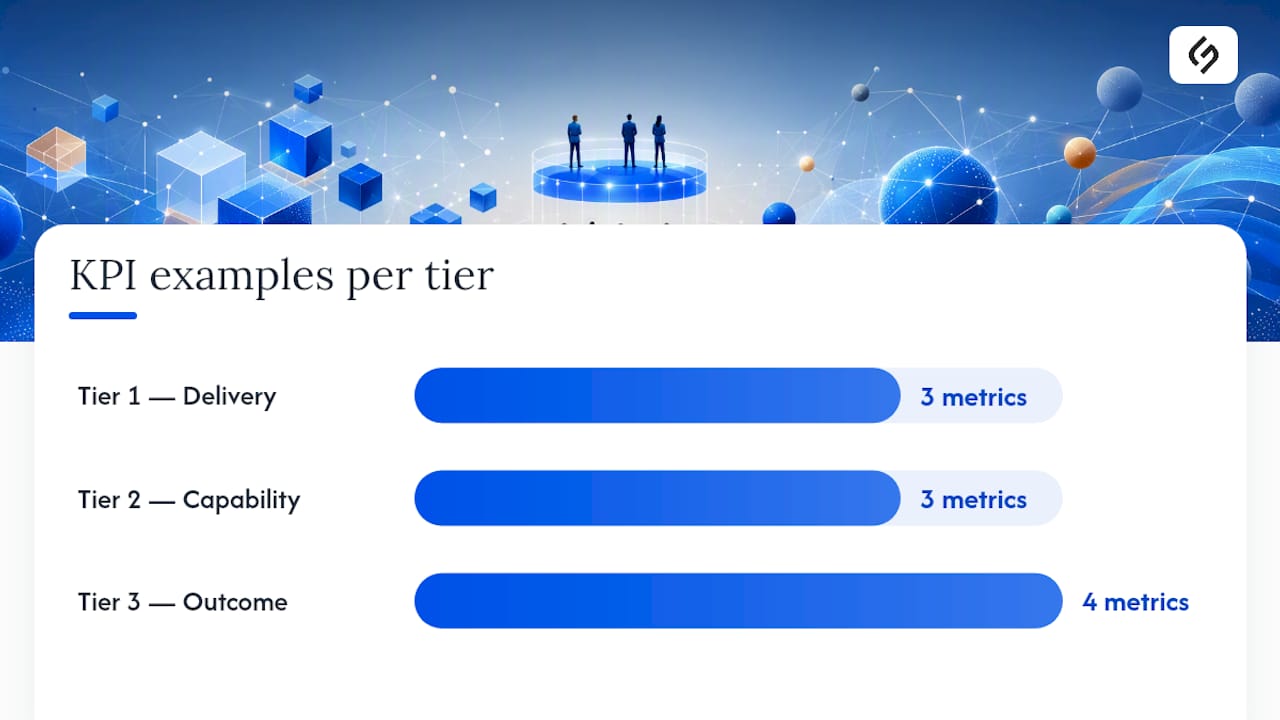
The most common measurement failure is tracking delivery metrics (tasks completed, systems deployed) while ignoring whether the business moved. A three-tier KPI model prevents this.
First Tier: Delivery metrics (track weekly during execution)
- Percentage of milestones delivered on schedule
- Defect rate and rework hours per sprint
- Budget variance vs. plan
Second Tier: Capability metrics (track monthly)
- System adoption rate by user group
- Process cycle time before vs. after implementation
- Data quality score (completeness, accuracy)
Third Tier: Outcome metrics (track quarterly)
- Revenue attributable to new digital capabilities
- Cost per transaction or cost per unit served
- Customer satisfaction score (CSAT) or Net Promoter Score (NPS)
- Risk reduction indicators (compliance incidents, downtime events)
Stanford Online’s framework explicitly calls out CSAT, NPS, and cost-per-unit improvements as the metrics that sustain executive confidence and justify continued investment.
Building the business case: Structure benefits in three categories: revenue growth (new channels, faster time-to-market), cost reduction (automation, process efficiency), and risk mitigation (compliance, resilience). Apply a 3–5 year total cost of ownership window that includes licensing, integration, training, and ongoing maintenance. Payback logic should show when cumulative benefits exceed cumulative costs, with sensitivity ranges for adoption rate and implementation delay. For guidance on building the ROI narrative, the digital marketing ROI framework from Solution4guru applies the same benefit-categorization logic to digital initiatives.
Measurement checklist:
- Baseline all Tier 3 metrics before any go-live
- Assign a named owner for each KPI (not a team, a person)
- Confirm data sources exist and are accessible before committing to a metric
- Report Tier 1 weekly to the PMO, Tier 2 monthly to the steering committee, Tier 3 quarterly to the executive sponsor
Recommended reporting cadence:
| Audience | Frequency | Format | Content |
|---|---|---|---|
| PMO / workstream leads | Weekly | Status dashboard | Milestones, risks, blockers |
| Steering committee | Monthly | 2-page report | Capability metrics, budget variance |
| Executive sponsor | Quarterly | Executive summary | Outcome metrics, ROI narrative, roadmap update |
| Board | Annually | Strategic review | Program value, next-phase investment case |
How should you choose architecture, platforms, and integration approaches?
Technology selection is where most programs go wrong, and the error is almost always sequencing: teams choose a platform before they have defined the capability or use case it needs to serve. EY’s analysis reinforces this: firms with clear digital strategies that balance organic build with partnerships and acquisitions report higher returns on digital investment. The platform follows the strategy, not the other way around.
Selection principle: Define the capability and use case first. Then shortlist technologies that meet your constraints on scalability, integration, total cost of ownership, security posture, and ecosystem fit.
Vendor evaluation checklist:
- Does the platform expose open APIs and support data portability? Proprietary data formats create lock-in.
- What is the 3–5 year TCO, including licensing, implementation, training, and support?
- How does the vendor’s security and compliance posture align with your regulatory requirements?
- What is the vendor’s ecosystem (partners, integrations, marketplace)? A thin ecosystem signals future integration cost.
- What are the contractual exit provisions? Can you migrate data without vendor assistance?
Legacy integration checklist:
- Map data ownership and lineage for every system being integrated or replaced
- Identify API adapters or middleware requirements before finalizing architecture
- Assess cutover risk: can you run old and new systems in parallel during transition?
- Document rollback procedures for each integration point
Architecture patterns for incremental modernization:
- Strangler fig pattern: Gradually replace legacy functionality by routing new requests to modern services while the legacy system handles existing traffic. Low disruption, long timeline.
- Anti-corruption layer: Insert a translation layer between legacy and modern systems to prevent legacy data models from polluting new architecture.
- API-led integration: Expose legacy capabilities as APIs, enabling new front-ends and services to consume them without touching core systems.
For context on how AI and automation capabilities fit into this architecture picture, Solution4guru’s AI in business overview covers realistic implementation expectations.
Pro Tip: Watch for these procurement red flags that signal vendor-led scope creep and lock-in: a vendor who insists on a proprietary data format, a contract with auto-renewal clauses and no data-export SLA, and a statement of work that ties all customization to the vendor’s professional services team. Each one transfers control of your roadmap to the vendor.
How does change management connect to brand identity and customer experience?
The most technically successful implementations fail when the people side is treated as a training event scheduled for the week before go-live. Prosci’s research is unambiguous: change management embedded from the assessment phase, led by internal champions, produces materially better adoption outcomes than post-launch training programs.
Practical change management steps:
- Map the change impact by role in Phase 1, not Phase 4
- Design role-based learning paths tied to specific capability releases, not generic “digital skills” courses
- Align incentives: if performance reviews still reward the old behavior, adoption will stall regardless of training quality
- Run structured retrospectives at each 90-day cycle to surface resistance early and adjust the approach
Brand and customer experience alignment is the dimension most transformation plans omit entirely. Academic research on identity in digital transformation identifies brand identity as a distinct transformation dimension alongside structure and process. Failing to synchronize new digital capabilities with the brand’s established identity creates a disjointed customer experience, where the back-end has been modernized but the customer-facing touchpoints feel inconsistent or unfamiliar.
Practically, this means mapping customer journeys to each transformation initiative before design begins. If a new self-service portal replaces a high-touch service model, the UX must reflect the brand’s voice, visual identity, and service promise, not just the vendor’s default template. Technology’s role in CX delivery makes the same point: the distinction between a pure technology upgrade and a genuine business-model evolution shows up most visibly in the customer experience.
Digital transformation that ignores brand identity risks delivering a technically functional system that customers do not recognize as belonging to the organization they chose to do business with. The technology works; the relationship breaks.
Pro Tip: Ask one question in every design review: “Does this experience reflect who we are to our customers?” If the answer requires a long explanation, the design needs revision.
What are the most common pitfalls and how do you mitigate them?
Understanding digital transformation challenges before they materialize is the difference between a program that recovers quickly and one that loses executive confidence permanently.
Common pitfalls:
- Skipping the assessment phase: Teams underestimate technical debt and data quality issues, then discover them mid-execution when cost and schedule impact is highest.
- Lack of executive alignment: Multiple executives with competing priorities, no single sponsor, and no governance gate to resolve conflicts.
- Choosing technology before use cases: Platform selection driven by vendor relationships or market trends rather than defined capability needs.
- Poor data quality: Migrating dirty data into new systems produces unreliable outputs and erodes user trust faster than any technical failure.
- Underinvesting in change management: Treating adoption as a training problem rather than a behavioral and incentive design problem.
Risk register:
| Risk | Probability | Impact | Mitigation |
|---|---|---|---|
| Assessment phase compressed or skipped | High | High | Mandate a minimum 4-week assessment; gate Phase 2 on sponsor sign-off of findings |
| Executive sponsor disengages mid-program | Medium | High | Formalize sponsor commitment in the transformation charter; schedule monthly sponsor briefings |
| Vendor lock-in from platform selection | Medium | High | Require open APIs, data portability SLA, and exit provisions in all contracts |
| Data quality issues discovered post-migration | High | Medium | Run data profiling in Phase 1; include data remediation as a Phase 3 workstream |
| Low user adoption at go-live | Medium | High | Activate change champions in Phase 2; baseline adoption targets in pilot success criteria |
| Scope creep from stakeholder additions | High | Medium | Enforce change control process; all scope additions require steering committee approval |
Operational red flags that should trigger an immediate review:
- Adoption rate below 50% at 30 days post-go-live
- Two consecutive sprints with more than 20% milestone slippage
- Executive sponsor missing two consecutive steering committee meetings
- A vendor requesting contract amendments that expand their scope without a corresponding business case
What does a practical 90–180 day pilot timeline look like?
Pilots should be modular, quantifiable, and designed to show measurable results within six months or less. PTC’s practitioner guidance frames pilots as proof-of-value initiatives: if a pilot cannot demonstrate ROI within that window, it is either the wrong use case or the wrong scope.
90–180 day pilot timeline:
Scaling sequence after a successful pilot: Build foundational capabilities first (data infrastructure, integration layer, identity and access management), then layer domain-specific capabilities on top. Attempting to scale a pilot before the foundation is stable is the most common cause of post-pilot program failure.
Milestone checklist for each deliverable:
- Success criteria defined before the sprint begins (not after)
- Named owner for each deliverable (not a team)
- Evidence artifact specified (what document or dashboard proves completion)
- Review date confirmed in the program calendar
To adapt this template for smaller organizations, Solution4guru’s SME digital playbook offers a compressed version of the same phase structure.
Pro Tip: Use the 90-day cycle as a program rhythm and retrospective input, not just a delivery container. At each 90-day mark, ask three questions: What did we learn that changes our assumptions? What should we stop doing? What should we accelerate? Feed the answers directly into the next cycle’s planning.
What should leaders do in the first 30, 60, and 90 days?
Authorization is not the same as momentum. The first 90 days set the program’s credibility with the organization. Miss the early checkpoints and you lose the window of executive attention that makes cross-functional cooperation possible.
30-day actions (assessment and authorization)
- Name the executive sponsor and publish the appointment organization-wide. Owner: CEO or COO.
- Commission the current-state assessment across all four domains (technology, data, people, process). Owner: Program Lead.
- Conduct stakeholder mapping to identify key influencers, resistors, and decision-makers. Owner: Transformation Office.
- Establish the governance structure: schedule the first steering committee meeting and distribute the RACI. Owner: Program Lead.
- Identify and brief change champion candidates in each major business unit. Owner: HR lead and Transformation Office.
Evidence to present at the 30-day review: Assessment scope document, stakeholder map, governance charter, list of change champion nominees.
60-day actions (vision and prioritization)
- Complete the current-state assessment and present findings to the executive sponsor. Owner: Program Lead.
- Run vision workshops with senior leadership to define the target state and business outcomes. Owner: Executive Sponsor and Transformation Office.
- Score and sequence the initiative backlog using value vs. complexity and dependency mapping. Owner: Program Lead and Architecture Lead.
- Select the pilot use case based on the highest value-to-complexity ratio with a clear six-month proof-of-value window. Owner: Steering Committee.
- Finalize the budget and resource plan for the pilot phase. Owner: CFO and Program Lead.
Evidence to present at the 60-day review: Assessment report, target-state vision document, prioritized backlog, pilot brief with success criteria, approved budget.
90-day actions (pilot launch and stakeholder alignment)
- Launch the pilot with baseline KPIs captured before go-live. Owner: Product Owner.
- Activate change champions with role-based briefings and adoption monitoring responsibilities. Owner: Transformation Office.
- Deliver the first stakeholder communication to the broader organization explaining the program purpose, timeline, and what changes for each group. Owner: Executive Sponsor.
- Run the first mid-cycle risk checkpoint and update the risk register. Owner: Program Lead.
- Present the 90-day progress report to the steering committee with adoption metrics and early outcome indicators. Owner: PMO.
Evidence to present at the 90-day review: Pilot go-live confirmation, baseline KPI report, adoption dashboard, updated risk register, stakeholder communication record.
Why does customer and user focus belong at the center of the plan?
A digital transformation strategy that optimizes internal processes without mapping those changes to customer outcomes tends to produce efficiency gains that customers never notice and sometimes actively resent. The customer journey is the organizing principle that keeps transformation initiatives connected to revenue and retention.

Map every initiative in the Phase 3 backlog to at least one customer touchpoint. Ask: does this change make the customer’s experience faster, clearer, or more reliable? If the answer is no, the initiative belongs in a supporting tier, not a priority slot. UX design best practices applied during the design phase prevent the most common failure: a technically sound system with a user experience that drives customers back to the old process.
Measure customer impact from the pilot phase. CSAT and NPS baselines captured before go-live give you the evidence to demonstrate that the transformation delivered value to the people it was supposed to serve, not just to the IT department’s uptime metrics.
How should you budget and allocate resources for a transformation program?
Budget estimation for digital transformation fails most often because organizations scope the technology cost and forget the people cost. The remainder covers change management, training, data remediation, integration work, and ongoing maintenance.
Resource allocation priorities:
- Assessment phase: Allocate dedicated internal staff time (not just vendor hours). The people who know where the technical debt and process gaps are sit inside your organization.
- Change management: Budget at least 15–20% of total program cost for change management activities. Programs that treat this as a line item to cut when budgets tighten consistently report lower adoption rates.
- Data remediation: If the assessment reveals significant data quality issues, budget a separate workstream. Migrating poor-quality data into a new system is not a technical problem; it is a business problem that requires business ownership and dedicated resources.
- Contingency: Hold 10–15% of the total budget in contingency, controlled by the executive sponsor, not the PMO. This prevents the program from stalling when an integration takes longer than estimated or a vendor delivers late.
Human resource planning should identify skill gaps in Phase 1 and address them through a combination of internal development, targeted hiring, and external partners. Attempting to run a transformation program entirely with existing staff who carry full operational responsibilities is one of the most reliable ways to miss every milestone.
What data governance and security considerations apply during transformation?
Data governance is not a post-implementation concern. Every phase of the transformation touches data, and decisions made in Phase 1 about ownership, classification, and lineage determine whether the program’s measurement framework is credible and whether the organization can defend its data practices to regulators.
Governance actions by phase:
- Phase 1 (Assess): Inventory all data assets, classify by sensitivity, identify current ownership, and document lineage. Flag any data that crosses jurisdictional boundaries.
- Phase 2 (Vision): Define the target-state data governance model, including ownership policies, access controls, and retention schedules.
- Phase 3 (Prioritize): Include data remediation as a workstream in the backlog if the assessment identified quality issues. Assign a data lead to each initiative.
- Phase 4 (Execute): Apply security controls to every integration point. Require penetration testing before any new system goes live. Enforce role-based access control from day one.
- Phase 5 (Measure): Audit data quality quarterly. Track data incidents as a Tier 2 capability metric.
For a detailed framework on building a data strategy that supports transformation KPIs, Solution4guru’s digital transformation data strategy guide covers ownership models, lineage documentation, and governance structures in depth.
Security considerations specific to transformation programs include: expanded attack surface from new integrations, credential management during system migrations, and third-party vendor access to sensitive data during implementation. Each of these requires explicit controls documented in the risk register and reviewed at every governance gate.
What does post-implementation maintenance and continuous improvement look like?
Go-live is not the end of the program. It is the beginning of the measurement phase, and the measurement phase feeds a continuous improvement cycle that keeps the transformation delivering value beyond the initial implementation.
Continuous improvement structure:
- Monthly: Review Tier 2 capability metrics with product owners. Identify performance gaps and assign remediation owners.
- Quarterly: Executive review of Tier 3 outcome metrics. Assess whether the business case assumptions are holding. Adjust the roadmap if they are not.
- Annually: Full roadmap refresh. Re-run a lightweight version of the Phase 1 assessment to identify new capability gaps created by market changes, technology evolution, or organizational growth.
- Retrospectives: At each 90-day cycle boundary, document what worked, what did not, and what the team would do differently. Feed retrospective outputs directly into the next cycle’s planning.
The continuous improvement cycle also governs technical maintenance: dependency updates, security patching, performance monitoring, and capacity planning. Assign a named technical owner for each production system and include maintenance costs in the annual budget refresh. Programs that treat maintenance as an afterthought accumulate technical debt that eventually forces an unplanned and expensive remediation.
How do legacy systems affect your integration and process redesign?
Legacy systems are the most underestimated constraint in most digital transformation project plans. They are not just technical debt; they are often the systems of record that the business depends on daily, which means integration risk is also operational risk.
Legacy impact analysis framework:
- Classify each legacy system by criticality (mission-critical, important, non-critical) and by integration complexity (standalone, loosely coupled, tightly coupled).
- Identify process dependencies: Which business processes cannot run if this system is unavailable? Map these before designing any integration.
- Assess data ownership: Who owns the data in this system? What happens to that data during migration? Who is accountable for data integrity through the cutover?
- Evaluate modernization options: Full replacement, incremental modernization (strangler fig), API-led integration, or retirement. Each carries different cost, risk, and timeline profiles.
Tightly coupled legacy systems with poor API support are the most common cause of pilot delays. Discovering this in Phase 4 is expensive. Discovering it in Phase 1 is a planning input. The assessment phase must include a hands-on technical review of integration points, not just a spreadsheet inventory.
Process redesign should happen in parallel with technical integration planning. Automating a broken process produces a faster broken process. Map the current-state process, identify the steps that add no value, redesign the process, and then design the technical integration to support the redesigned process.
What actually separates programs that succeed from those that stall?
After working through transformation programs across industries, the differentiator is rarely the technology chosen. It is almost always the quality of the assessment, the clarity of the executive mandate, and the discipline of the measurement cadence.
Programs that succeed share three characteristics. First, the executive sponsor treats the program as a business priority, not an IT project. That means showing up to steering committee reviews, resolving cross-functional conflicts personally, and publicly connecting the transformation to the organization’s strategic direction. Second, the assessment phase is treated as an investment, not a formality. The organizations that spend the time to understand their actual capability gaps, data quality, and process maturity before committing to a roadmap face dramatically fewer mid-program surprises. Third, the measurement framework is built before the first line of code is written. Teams that define their outcome metrics, baseline them, and report against them from day one build the executive confidence that sustains investment through the inevitable difficult periods.
The one thing that consistently surprises leaders is how much of the work is organizational, not technical. The technology is usually the easier part. Getting 200 people to change how they work, aligning three business units with competing priorities, and maintaining executive attention through an 18-month program: that is where transformation programs are won or lost.
Solution For guru helps you move from plan to execution
Planning a transformation is one challenge. Executing it with the right technical partners, governance support, and UX expertise is another. Solution4guru delivers end-to-end digital transformation services: current-state assessments, roadmap development, web development and implementation, CRM and SaaS integrations, AI and automation solutions, data strategy, and UX design that keeps customer experience aligned with your brand identity throughout every phase.
For organizations at the pilot stage, Solution4guru provides scoped implementation engagements with defined deliverables and success criteria, so you get a working capability, not a consulting report. For programs ready to scale, the agency’s integration and automation practice handles legacy system complexity, API-led architecture, and the data governance work that most vendors leave to the client. Contact Solution For guru to book a no-obligation assessment and get a clear picture of where your program stands and what it will take to move forward.
Sources
- How to Build a Successful Digital Transformation Strategy | IBM
- Your guide to understanding digital transformation strategy | Stanford Online
- How to Build a Digital Transformation Roadmap (2026) | Opsio
- Steps to execute digital transformation strategy — Prosci
- How to optimize digital strategies for effective transformation | EY Indonesia
FAQ
The five phases are Assess, Vision, Prioritize, Execute, and Measure. Each phase produces specific deliverables and requires a governance gate before the next phase begins.
A mid-sized organization typically needs 12–24 months from assessment through a scaled first capability. The assessment phase alone requires 4–8 weeks; compressing it is the most common cause of program delays.
Use a three-tier model: delivery metrics (milestone completion, budget variance), capability metrics (adoption rate, process cycle time), and outcome metrics (revenue impact, CSAT, cost per transaction). Baseline all outcome metrics before go-live.
The most frequent causes are skipping the assessment phase, lack of a named executive sponsor, selecting technology before defining use cases, poor data quality, and treating change management as a post-launch training exercise rather than a program-wide discipline.
Solution For guru provides current-state assessments, roadmap development, web development and implementation, CRM and SaaS integrations, UX design, AI and automation solutions, and data strategy services for organizations at any phase of a transformation program.