How to Write SEO Content That Ranks in 2026

TL;DR:
- SEO content writing involves creating content that ranks well in search results and satisfies human readers by matching search intent. It requires strategic keyword placement, demonstrating credibility through E-E-A-T, and structuring content for both readability and AI extraction. Regular updates, technical on-page optimization, and thorough planning are essential for ongoing success.
SEO content writing is the practice of creating text that satisfies both human readers and search engine algorithms simultaneously. The industry now calls this dual requirement Generative Engine Optimization (GEO), a term that reflects how AI systems like Google’s Search Generative Experience and Perplexity actively pull answers from well-structured pages. Mastering how to write SEO content means understanding three pillars: keyword strategy, E-E-A-T (Experience, Expertise, Authoritativeness, Trustworthiness), and technical on-page signals. Get all three right, and your content earns visibility from both traditional search results and AI-generated answers.
What is SEO content writing and why does it matter?

SEO content writing is the process of producing articles, pages, and guides that rank in search results and convert readers into customers. The goal is not just traffic. It is qualified traffic from people who need exactly what you offer.
Search intent drives every ranking decision Google makes. A reader searching “how to fix a leaky faucet” wants a step-by-step repair guide, not a product page for plumbing supplies. Matching content format to intent is the single biggest factor separating ranked pages from ignored ones. Studying the top 10 SERP results reveals the dominant content format Google rewards for any given keyword.
The stakes have grown with the rise of AI search. SEO is evolving into GEO, requiring content that serves both human readers and AI agents with extractable, high-quality answers. A page that ranks today also needs to be citable by AI engines tomorrow. That shift changes how you structure sentences, paragraphs, and entire articles.
The core goals of effective SEO content writing include:
- Matching the reader’s search intent precisely
- Demonstrating authority through E-E-A-T signals
- Providing clear, extractable answers for featured snippets and AI citations
- Building internal topic clusters that reinforce subject authority
- Earning backlinks through genuinely useful, well-cited content
Understanding digital marketing for startups shows how SEO content fits into a broader growth strategy, particularly for businesses building visibility from scratch.
How to prepare before writing SEO content
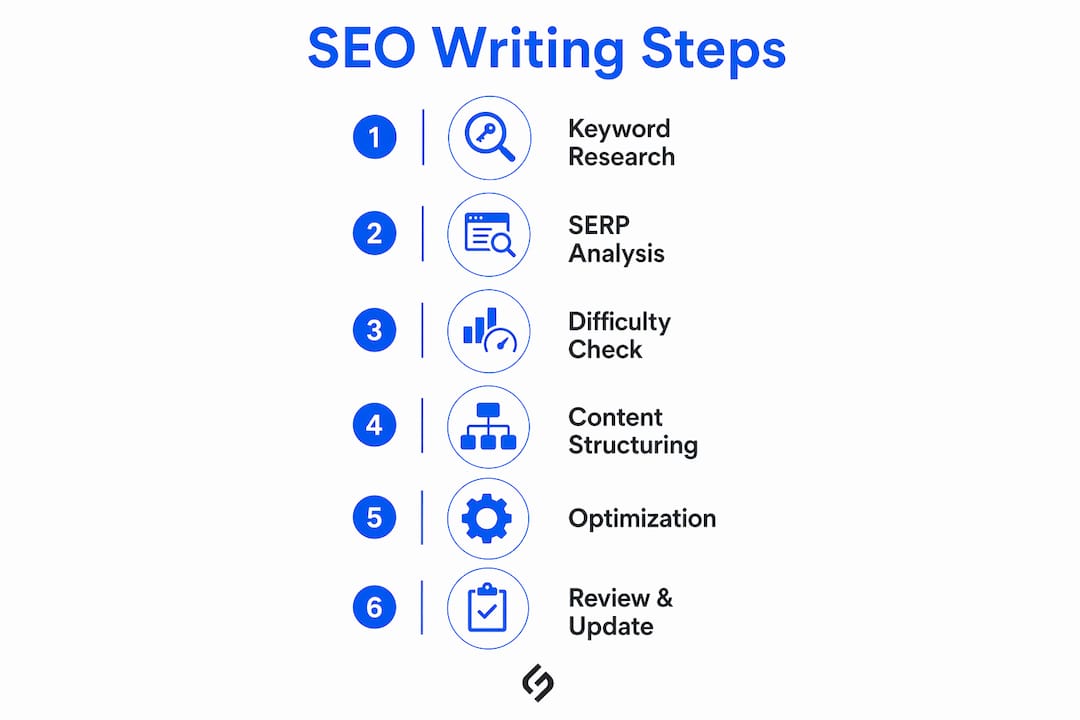
Preparation determines whether your content ranks or disappears on page four. Skipping this phase is the most common reason well-written articles fail to gain traction.
Step 1: Choose your keywords strategically
Select one primary keyword and 3–5 related secondary keywords before writing a single sentence. The primary keyword acts as your editorial brief. Every heading, paragraph, and example should connect back to it. Secondary keywords fill in the semantic gaps that modern algorithms expect to see around a topic.
Step 2: Analyze the top SERP results
Search your primary keyword and study the top 10 results. Note whether Google surfaces blog posts, comparison pages, listicles, or product pages. That format is your template. If all top results are 1,500-word how-to guides, a 400-word overview will not compete regardless of quality.
Step 3: Assess keyword difficulty and search volume
Use keyword research tools to evaluate difficulty scores and monthly search volume before committing to a topic. A keyword with high volume and low competition is the ideal entry point for newer sites. Established sites can target higher-difficulty terms by building topic clusters first.
Step 4: Plan your content structure
Map out your H1, H2s, and H3s before writing. Decide which sections will use lists, tables, or narrative paragraphs. This prevents structural problems mid-draft and ensures your content covers the topic completely.
| Preparation step | Why it matters |
|---|---|
| Primary keyword selection | Focuses every content decision on one clear target |
| SERP format analysis | Reveals what Google already rewards for the query |
| Keyword difficulty check | Prevents wasting effort on unwinnable terms |
| Content structure mapping | Reduces rewrites and gaps in topic coverage |
What are the best practices to write SEO content that ranks?
The best SEO content writing starts with the reader, not the algorithm. Write for readers first, then place keywords strategically to satisfy SEO requirements naturally. Content that reads like a keyword list earns neither trust nor rankings.
Place keywords where they signal relevance
Keyword placement in the H1, first 100 words, meta description, and at least one H2 is the minimum required to signal content relevance to search engines. Place keywords in these locations first, then let them appear naturally in the body. Forcing exact-match phrases into every paragraph triggers keyword stuffing penalties.
Structure content for readability and extraction
Clear, well-structured headings and concise paragraphs enhance both readability and SEO. Break content into sections with descriptive H2 and H3 headings. Keep paragraphs to 3–5 sentences. Short blocks help readers scan and help AI engines extract precise answers.
Write answers in 75–150-word blocks for easy AI extraction and featured snippet optimization. This is the structural habit that separates GEO-ready content from content that only satisfies traditional crawlers.
Apply semantic SEO principles
Semantic SEO focuses on related concepts and entities rather than exact keyword matches. A thorough article on “how to write SEO content” should naturally include terms like search intent, meta descriptions, schema markup, and E-E-A-T. These related terms tell algorithms that your page covers the full topic, not just a narrow slice of it.
Demonstrate E-E-A-T throughout
E-E-A-T trust signals are essential for SEO success and require visible author credentials and reputable citations. Add an author bio with relevant credentials. Cite primary research and link to reputable non-competitive sources. These signals build the trust that Google’s quality raters measure directly.
- Include a named author with a short bio and relevant credentials
- Cite statistics from recognized industry sources
- Link to authoritative external references (government sites, academic research, major publications)
- Update content regularly to reflect current data
Pro Tip: Write a direct definition or answer in the first sentence of every major section. AI citation systems pull from the opening lines of sections far more often than from mid-paragraph text.
How to optimize SEO content with technical and on-page elements
Technical optimization makes well-written content discoverable. Even the best article fails to rank if crawlers cannot read it or if page speed drives readers away before they finish the introduction. Hosting quality directly affects SEO performance, making server reliability a foundational concern before any on-page work begins.
On-page technical checklist
- Write a compelling meta description (150–160 characters) that includes the primary keyword and a clear reason to click. Meta descriptions do not directly affect rankings, but they drive click-through rates, which do.
- Keep URLs short and descriptive. Short URLs with keywords improve crawlability and click-through rates. Use hyphens between words and remove stop words like “a,” “the,” and “of.”
- Add alt text to every image. Describe the image accurately and include the primary keyword where it fits naturally. Alt text serves both accessibility and image search indexing.
- Implement schema markup. Article, FAQ, and Author schema markup significantly increases the chance of your content being cited by AI engines and appearing in featured snippets. Schema tells AI models exactly what your content is about and who wrote it.
- Build internal links strategically. Link to related articles on your site using descriptive anchor text. Internal links distribute authority and help search engines understand your site’s topic structure. For example, a page on SEO content writing naturally connects to a broader guide on enterprise SEO concepts.
| On-page element | Impact on SEO |
|---|---|
| Meta description | Improves click-through rate from search results |
| Short, keyword-rich URL | Aids crawlability and user trust |
| Image alt text | Supports image search and accessibility compliance |
| Schema markup | Enables featured snippet and AI citation eligibility |
| Internal linking | Distributes page authority and clarifies topic relationships |
How to review, troubleshoot, and improve your SEO content
Publishing is not the finish line. SEO content requires ongoing review to maintain and improve rankings over time.
Common mistakes that kill rankings:
- Keyword stuffing: forcing exact-match phrases into every sentence reduces readability and triggers algorithmic penalties
- Thin content: pages under 600 words rarely satisfy informational search intent
- Ignoring search intent: writing a product page when the query demands a how-to guide
- Missing E-E-A-T signals: no author bio, no citations, no external links to credible sources
- Slow page load times: website performance directly affects both user engagement and search rankings
Refreshing content with updated data and timestamps signals content freshness to search engines. A page updated in the current year consistently outperforms an identical page last touched three years ago. Set a calendar reminder to review high-value pages every six months.
Use Google Search Console to identify pages with declining impressions or click-through rates. These are your priority refresh targets. Look for queries where your page ranks in positions 5–15. A targeted content update, adding a new section or fresher data, often moves those pages into the top three.
Adding FAQs based on actual user questions increases relevance and improves chances of featured snippet inclusion. Pull questions directly from Google’s “People Also Ask” boxes and from Search Console query data. Answer each question in 2–3 sentences using plain language.
Pro Tip: When refreshing old content, add a visible “Last updated” date near the top of the page. Readers and search engines both treat visible timestamps as a trust signal.
Key takeaways
Effective SEO content writing requires matching search intent, demonstrating E-E-A-T, and structuring every page for both human readers and AI extraction systems.
| Point | Details |
|---|---|
| Start with keyword research | Select one primary keyword and 3–5 secondary keywords before writing anything. |
| Match search intent | Study the top 10 SERP results to identify the content format Google rewards. |
| Structure for AI extraction | Write answers in 75–150-word blocks to improve featured snippet and AI citation eligibility. |
| Apply E-E-A-T signals | Include author credentials, credible citations, and reputable external links on every page. |
| Refresh content regularly | Update pages with new data and timestamps every six months to maintain rankings. |
What I’ve learned from writing SEO content for both humans and AI
The biggest mistake I see content creators make is treating SEO as a checklist to complete after writing. Keyword placement, schema markup, and meta descriptions matter. But they are finishing touches, not the foundation.
The content that consistently earns citations from AI engines and holds top positions in traditional search shares one quality: it answers a specific question completely, in plain language, within the first few sentences of each section. That is not an accident of style. It is a deliberate structural choice that requires planning before the first word goes on the page.
The shift toward GEO has made this even more critical. AI systems do not read your entire article before deciding whether to cite it. They extract the most direct, self-contained answer block they can find. If your best insight is buried in paragraph seven, it will not get cited. Write as if the reader might only read one paragraph, and make that paragraph worth their time.
The other underrated factor is trust. E-E-A-T is not just a Google framework. It reflects how real readers evaluate credibility. A named author with verifiable credentials, a citation from a recognized source, and a link to a government or academic reference all tell the reader: this page was written by someone who knows what they are talking about. That trust converts readers into customers far more reliably than any keyword density formula.
My honest advice: write the clearest, most direct answer you can. Then apply the technical layer. That order produces better content and better rankings than any other approach I have tested.
Solution4guru’s resources for SEO and digital growth
Strong SEO content does not exist in isolation. It works best when the underlying website is fast, well-structured, and built with search visibility in mind.

Solution4guru’s digital marketing resources cover the full spectrum from content strategy to technical site performance, giving content creators and business owners a practical foundation for growth. The platform’s web development basics guide is particularly useful for marketers who want to understand how site architecture affects content discoverability. For businesses ready to connect SEO content strategy to measurable outcomes, Solution4guru offers tailored consulting and free initial consultations to identify the highest-impact opportunities.
FAQ
SEO content writing is the practice of creating text that ranks in search engines by matching search intent, using targeted keywords, and demonstrating E-E-A-T signals. It serves both human readers and AI indexing systems simultaneously.
Select one primary keyword based on search volume and relevance, then add 3–5 secondary keywords that cover related subtopics. Analyze the top SERP results to confirm the content format Google rewards for that query.
E-E-A-T stands for Experience, Expertise, Authoritativeness, and Trustworthiness. Google uses these signals to assess content quality, so pages with named authors, credible citations, and reputable external links consistently outperform anonymous, uncited content.
Review high-value pages every six months and refresh them with updated data, new statistics, and a visible timestamp. Regular updates signal content freshness to search engines and help maintain or improve rankings over time.
Schema markup is structured data code added to a page’s HTML that tells search engines and AI systems what the content is about. Article, FAQ, and Author schema increase eligibility for featured snippets and AI citations, making it a high-value addition for any SEO content strategy.