
Improving Online Presence for Small Business Owners

TL;DR:
- Improving online presence involves managing your digital identity for better visibility and trust. Regular audits, consistent data, schema markup, and authentic engagement help build a durable reputation. Structured routines and infrastructure work ensure long-term success and accurate AI-driven search results.
Improving online presence is the process of intentionally managing and enhancing your digital identity to increase visibility, credibility, and customer engagement. For small and medium-sized businesses, this means controlling what appears when customers search for you, ensuring your information is accurate across every platform, and building a consistent brand that earns trust over time. The industry term for this discipline is digital footprint management, and it covers everything from your website and social profiles to directory listings and AI-generated search results. Done well, it turns your digital identity into a reliable sales asset.
What does improving online presence actually require?
Improving online presence starts with understanding what your digital footprint actually looks like right now. Most business owners assume their information is consistent and current. The reality is that outdated phone numbers, mismatched addresses, and stale social profiles quietly erode customer trust every day. A structured audit process is the fastest way to find and fix those gaps.
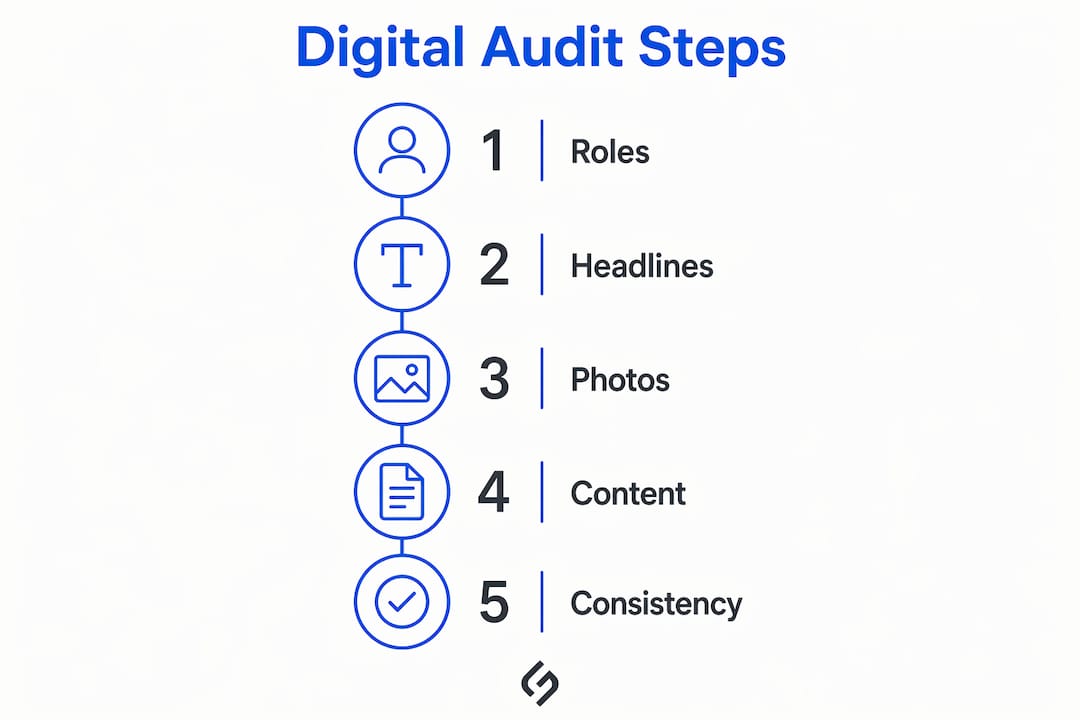
The five-layer digital footprint audit scores five core areas on a 0–5 scale: roles and titles, profile headlines, photos, contact information, and content freshness. Each layer gets a score, and the total adds up to a maximum of 25 points. A score below 15 signals a risk zone where brand reputation is actively at stake. That threshold is a concrete benchmark, not a vague warning.
Businesses should run this audit quarterly to catch drift before it compounds. A quarterly cadence keeps each layer current without requiring a full-time effort. The scoring system also creates accountability: when a team member owns a specific layer, problems get fixed instead of ignored.
Pro Tip: Set a recurring calendar reminder for the first week of each quarter. Assign one team member to each audit layer so no single person carries the full workload.
The table below shows how the five-layer scoring system works in practice.
| Audit Layer | What to Check | Score Range |
|---|---|---|
| Roles and titles | Accurate job titles across LinkedIn, Google, directories | 0–5 |
| Profile headlines | Consistent, keyword-relevant descriptions | 0–5 |
| Photos | Current, professional images on all platforms | 0–5 |
| Contact information | Matching phone, address, email everywhere | 0–5 |
| Content freshness | Recent posts, updated bios, current offers | 0–5 |
How to build digital architecture before you post anything
Digital architecture is the foundation that makes every piece of content work harder. It includes your brand voice, content pillars, and visual identity. Without it, posting frequently just creates noise. Building digital architecture first leads to visibility that outlasts any single viral moment.

Content pillars are the three to five core topics your business speaks about with authority. A local accounting firm might own topics like tax planning, small business compliance, and cash flow management. Every post, article, or video connects back to one of those pillars. This creates a recognizable pattern that audiences and search engines both reward.
Visual identity consistency matters just as much as the words. Your logo, color palette, and photo style should look identical on your website, Google Business Profile, LinkedIn, and any directory where you appear. Inconsistency signals to both humans and AI systems that your brand is fragmented or unmanaged.
“Your digital footprint is not what you post. It is what remains when the noise fades. Build architecture first, and your presence compounds over time instead of resetting with every trend.”
- Clear bio: Write one authoritative bio and use it everywhere, word for word.
- Consistent visual identity: Use the same logo, colors, and photo style across all platforms.
- Aligned content themes: Every post should connect to one of your defined content pillars.
- Owned assets first: Owning primary content assets produces better search and AI rankings than social activity alone.
- Unique positioning: Identify the one thing your business does that no competitor in your market does the same way, then make it the center of your messaging.
Understanding business process digitalization helps connect your internal workflows to the external digital identity you are building.
Why does entity consistency matter for online visibility?
Entity consistency is the practice of keeping your business Name, Address, and Phone number, known as NAP, identical across every online directory, social platform, and website listing. AI assistants and search engines cross-reference NAP data to verify that a business is legitimate. NAP consistency is the most overlooked technical requirement for online presence, yet it directly affects whether your business appears in local search results and AI-generated answers.
Schema markup is the technical layer that makes entity consistency machine-readable. Adding structured data to your website tells AI assistants exactly who you are, what you do, and where you operate. Personal websites with structured data schema dominate AI assistant results because they give these systems verified, organized information to cite. HTTPS on your domain is a prerequisite. Schema markup is the next step.
Pro Tip: Use Google’s Rich Results Test tool to verify that your schema markup is correctly implemented before publishing any changes to your site.
Common technical mistakes that hurt visibility include:
- Mismatched NAP data: A different phone number on Yelp versus Google Business Profile confuses AI indexing.
- Missing schema markup: Without structured data, AI systems rely on guesswork to describe your business.
- No HTTPS: An unsecured domain reduces trust signals for both users and search algorithms.
- Duplicate listings: Multiple unmanaged directory entries split authority and create conflicting information.
The table below shows which schema types matter most for SME visibility.
| Schema Type | Purpose | Priority |
|---|---|---|
| LocalBusiness | Confirms location, hours, and contact data | High |
| Person | Identifies key team members for AI biographical answers | High |
| Product or Service | Describes offerings for rich search results | Medium |
| FAQPage | Feeds structured answers directly into AI results | Medium |
Understanding SEO fundamentals gives business owners the context to implement these technical elements without relying entirely on outside help.
How do you maintain and grow your digital presence over time?
Active management separates businesses that grow their digital reputation from those that stagnate. The work is not dramatic. It is consistent and scheduled. Regular content updates, deleting outdated posts, and monthly monitoring of AI-generated brand references form the core maintenance routine.
- Audit social profiles monthly. Check that bios, contact details, and pinned posts reflect your current offer. Remove anything that no longer represents your brand accurately.
- Archive or delete off-brand content. Old, off-brand social media posts resurface in AI-generated answers and can damage brand perception. Tools like Tweet Delete automate removal of dated posts at scale.
- Run monthly AI spot checks. Search your business name in Google and in AI assistants like ChatGPT or Perplexity. Note what they say. If the information is wrong or outdated, trace it back to the source and correct it.
- Engage authentically with your audience. Consistent, authentic engagement builds long-term digital reputation more effectively than posting frequency alone. Respond to comments, answer questions, and acknowledge reviews within 24 hours.
- Refresh website content quarterly. Update service pages, team bios, and case studies to reflect current capabilities. Search engines treat fresh content as a relevance signal.
Pro Tip: Create a simple spreadsheet that tracks your monthly AI spot check results. Over three months, you will see patterns that reveal which platforms are feeding AI assistants the most information about your business.
Integrating CRM and SEO efforts creates a feedback loop where customer data informs content decisions, which in turn improves search visibility. For business owners who want to go further, optimizing your digital workflow setup can free up the time needed to maintain these routines consistently.
Building authority online requires genuine insight over volume. One well-researched article that answers a real customer question outperforms ten generic social posts every time.
Key Takeaways
A strong digital presence requires quarterly audits, consistent NAP data, structured schema markup, and authentic engagement to build lasting credibility with both customers and AI systems.
| Point | Details |
|---|---|
| Run quarterly audits | Score five digital layers on a 0–5 scale; a total below 15 signals active brand risk. |
| Build architecture first | Define content pillars and visual identity before increasing posting frequency. |
| Maintain NAP consistency | Identical name, address, and phone data across all directories improves AI indexing accuracy. |
| Implement schema markup | Structured data on your website gives AI assistants verified information to cite about your business. |
| Engage authentically | Responding to comments and reviews builds long-term reputation more than post volume alone. |
What I have learned about sustainable online presence
Most business owners treat their online presence like a campaign. They push hard for a few weeks, see some results, then let everything drift. Six months later, they are back at zero, wondering why nothing stuck. The businesses I have seen build durable digital reputations do the opposite. They treat it like bookkeeping: boring, scheduled, and non-negotiable.
The quarterly audit methodology changed how I think about this entirely. Before I encountered the five-layer scoring system, I assumed that posting regularly was enough. It is not. A score below 15 out of 25 means your digital identity is actively working against you, even if your content is good. Fixing the infrastructure first, NAP data, schema markup, and profile consistency, is the unglamorous work that makes everything else pay off.
The part that surprises most business owners is how much AI assistants now shape brand perception. When a potential customer asks ChatGPT or Perplexity about your business, those systems pull from whatever structured data they can find. If your website lacks schema markup and your directory listings conflict with each other, the AI constructs an answer from fragments. That answer may be wrong, and you will never know unless you check.
Online presence is a long-term investment, not a sprint. The businesses that win are the ones that show up consistently, fix problems as they find them, and treat their digital identity with the same discipline they apply to their finances.
How Solution For Guru helps you build a stronger digital presence
Small and medium-sized businesses rarely lack the motivation to improve their online presence. They lack the time and technical knowledge to do it systematically. Solution4guru addresses both.
Solution For Guru’s services cover the full range of what this article describes: web development fundamentals that create owned digital assets, SEO implementation including schema markup and NAP auditing, and digital marketing strategies that align with your content pillars. The team works with SME owners to build digital architecture before recommending any content or advertising spend. For businesses ready to grow their online sales and visibility, Solution4guru offers a free consultation to assess your current digital footprint and identify the highest-priority fixes.
FAQ
A digital footprint audit is a structured review of your online presence scored across five layers: roles, headlines, photos, contact information, and content freshness. A total score below 15 out of 25 indicates active brand reputation risk.
Business owners should audit and update social profiles monthly and run a full five-layer digital audit quarterly. Monthly AI spot checks on Google and AI assistants catch harmful or outdated content before it spreads.
NAP stands for Name, Address, and Phone number. Keeping this data identical across all directories and platforms is the most overlooked technical requirement for local search visibility and accurate AI-generated results.
Yes. AI assistants prioritize websites with verified domain ownership and structured data when constructing answers. Without schema markup, AI systems piece together information from unverified sources, which produces inaccurate descriptions.
Quality consistently outperforms frequency. Posting with genuine insight sustains digital presence longer than high-volume, low-value content. One authoritative post that answers a real customer question builds more credibility than ten generic updates