Why Brand Identity Matters for Your Business Growth

TL;DR:
- Brand identity is a strategic combination of visual, verbal, and emotional elements that build trust through consistency. It enhances market positioning, allows for premium pricing, and fosters customer loyalty, especially during downturns. Small businesses can create a strong identity by defining their purpose, maintaining visual consistency, and regularly auditing their brand touchpoints.
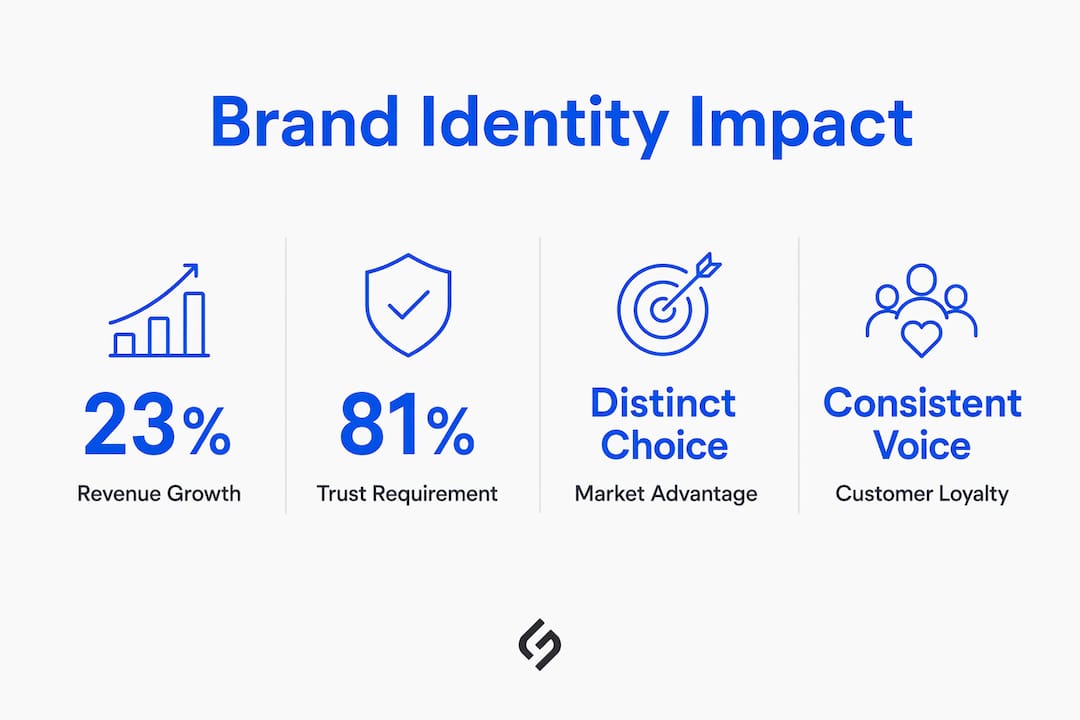
Brand identity is defined as the strategic combination of visual, verbal, and emotional elements a business controls to present itself consistently and build customer trust. This is distinct from brand image, which is how customers perceive you, and from branding, which is the process of creating that identity. Understanding why brand identity matters gives small and medium-sized business owners a direct path to stronger customer relationships and measurable revenue growth. Research shows that consistent brand presentation increases business revenue by an average of 23%. That single figure makes brand identity one of the highest-return investments a business owner can make.
Why brand identity matters for customer trust
Trust is the single most powerful driver of purchase decisions. 81% of consumers require brand trust before committing to a purchase. That means four out of five potential customers are evaluating your credibility before they ever click “buy.”
Brand identity builds that trust through consistency. When your logo, tone of voice, color palette, and messaging align across every customer touchpoint, you signal reliability. A business that looks and sounds the same on its website, social media, and email newsletters feels stable and professional. Customers interpret that consistency as a sign that the business is organized and dependable.
The specific elements that influence trust most directly include:
- Logo design: A clean, recognizable logo signals professionalism and makes your business easier to recall.
- Tone of voice: Whether formal or conversational, a consistent voice tells customers what to expect from every interaction.
- Color palette: Colors trigger emotional associations. Blue communicates reliability; orange signals energy and approachability.
- Messaging consistency: Repeating the same core value proposition across channels reinforces what your business stands for.
Pro Tip: Create a one-page brand style guide that documents your logo usage, approved colors, fonts, and tone of voice. Share it with every team member and vendor who produces content for your business. Consistency breaks down the moment different people make different design decisions.
How does brand identity affect market presence and competitive advantage?
A strong brand identity does more than build trust. It positions your business as a distinct choice in a crowded market. Companies with strong brand identities can command higher prices and maintain customer loyalty even during market downturns. That pricing power comes from perceived value, not just product quality.
Brand identity also acts as a filter. A well-defined identity attracts the customers who are the right fit for your business and naturally repels those who are not. That alignment reduces wasted marketing spend and increases conversion rates. When your brand clearly communicates who it serves and why, the right audience self-selects.
Four competitive advantages a strong brand identity delivers:
- Premium pricing defensibility. Customers pay more for brands they trust and recognize. A clear identity justifies higher prices without requiring constant discounting.
- Employee alignment. When your team understands the brand’s values and voice, they deliver a more consistent customer experience without constant supervision.
- Faster customer decisions. Familiar brands reduce the cognitive effort required to make a purchase. Recognition accelerates the buying process.
- Resilience during downturns. Loyal customers built through consistent brand identity are less likely to switch to a lower-cost alternative when budgets tighten.
What visual and emotional design elements strengthen brand identity?
Visual elements are the first layer of brand identity that customers process. Logo simplicity, color, and typography significantly affect consumer cognition, attitudes, and purchase intentions. A cluttered logo is harder to recall. An inconsistent font choice signals a lack of attention to detail. These are not aesthetic preferences. They are business decisions with measurable consequences.

Emotional design adds a second, deeper layer. Emotional design enhances consumers’ sense of brand identity, promoting purchase intention and loyalty through positive emotional experiences. A brand that makes customers feel understood, valued, or inspired creates an attachment that purely functional messaging cannot replicate. This is why cinematic storytelling has become a recognized tool for building that emotional connection at scale.
Cultural context shapes how visual elements land with different audiences. Color meanings differ across countries and must be chosen carefully for any business operating in multiple markets. White signals purity in Western markets but mourning in several East Asian cultures. Red communicates luck in China but danger in many Western contexts.
| Visual element | Primary marketing effect | Common mistake |
|---|---|---|
| Logo simplicity | Improves recall and recognition | Overcomplicating with too many details |
| Color palette | Triggers emotional associations | Using too many colors inconsistently |
| Typography | Communicates brand personality | Mixing incompatible font styles |
| Imagery style | Sets tone and audience expectations | Using generic stock photos |
| Tone of voice | Builds familiarity and trust | Shifting register across channels |
Pro Tip: Test your visual identity with a five-second exposure test. Show your logo and homepage to someone unfamiliar with your business for five seconds, then ask what they remember and what they think your business does. If the answers are vague, your visual identity needs more clarity.
Practical steps for small businesses to build a strong brand identity
Small businesses can build a strong brand identity without large budgets. A well-defined personality and consistent voice outperform inconsistent larger competitors. The advantage of being small is that you can move faster and stay more coherent than a large organization managing dozens of stakeholders.
The process starts with strategy, not design. Before choosing colors or fonts, define your business’s purpose, core values, and market positioning. Ask: who is the ideal customer, what problem does this business solve, and what makes this business different from every alternative? The answers to those questions drive every design and messaging decision that follows.
Key steps for building and maintaining brand identity:
- Define your positioning statement. Write one sentence that captures who you serve, what you offer, and why you are different. Use it as the filter for every brand decision.
- Choose distinct visual elements. Select a color palette of two to three colors, one primary font, and a logo that works in black and white as well as color.
- Document everything in a brand guide. A simple document covering logo usage, colors, fonts, and tone of voice prevents inconsistency as your team grows.
- Apply identity consistently across all digital platforms. Your website, social profiles, email templates, and online presence should all look and sound like the same business.
- Avoid imitation. Copying a competitor’s visual style creates confusion and positions your business as a follower, not a leader.
- Audit your brand touchpoints quarterly. Check every customer-facing asset for consistency. Outdated logos, off-brand colors, or inconsistent messaging erode trust over time.
Consistent brand identity across fragmented platforms is the most common failure point for growing businesses. As you add new channels, the risk of dilution increases. A quarterly audit catches drift before it becomes a credibility problem.
Understanding digital marketing for startups also helps small business owners see how brand identity and marketing strategy connect. Your identity is the foundation. Your marketing channels are the delivery mechanism.
Key Takeaways
A strong brand identity directly increases revenue, builds customer trust, and creates a competitive advantage that pricing alone cannot replicate.
| Point | Details |
|---|---|
| Revenue impact | Consistent brand presentation increases revenue by an average of 23%. |
| Trust as a purchase driver | 81% of consumers require brand trust before making a purchase decision. |
| Visual elements matter | Logo, color, and typography directly affect consumer cognition and purchase intent. |
| Small businesses can compete | Clarity and consistency outperform budget when building brand identity. |
| Consistency across platforms | Fragmented brand presentation dilutes recognition and erodes customer trust. |
Brand identity in 2026: what I’ve learned from watching businesses get it wrong
The businesses I see struggling most with brand identity share one trait. They treat it as a design project rather than a business strategy. They spend money on a logo, pick some colors, and call it done. Then they wonder why customers do not recognize them or why their marketing feels like it is not working.
The market in 2026 has made this mistake more costly than ever. AI-generated content proliferation increases the competitive advantage for brands with a distinct, authentic human identity. When every competitor can produce polished content at scale, the businesses that stand out are the ones with a voice and personality that feels genuinely human and specific. Generic is now invisible.
The small businesses I have seen succeed are the ones that committed to a clear point of view and held it consistently across every channel. They did not try to appeal to everyone. They built something specific, and the right customers found them. That specificity is not a limitation. It is the strategy. Authenticity, applied consistently, is the most defensible competitive advantage available to a small business owner right now. Ingredient transparency in product-based businesses is one concrete example of how that authenticity translates directly into consumer trust and brand loyalty.
How Solution For guru supports your brand identity goals
Building a brand identity that holds together across your website, digital marketing, and customer experience requires more than good intentions. It requires the right technical foundation.
Solution4guru works with small and medium-sized businesses to build that foundation. From web development basics that ensure your site reflects your brand accurately, to UX design best practices that align every user interaction with your brand’s values, the team at Solution4guru connects strategy with execution. A brand identity that exists only in a style guide does not generate revenue. One that is built into every digital touchpoint does. Reach out to Solution4guru for a free consultation and see how your current digital presence measures up against your brand goals.
FAQ
Brand identity is the system of visual, verbal, and emotional elements a business controls to present itself consistently. It includes the logo, color palette, typography, tone of voice, and core messaging.
Brand identity matters because it builds the trust that drives purchase decisions. 81% of consumers require brand trust before buying, and consistent identity is the primary mechanism for building that trust.
Consistent brand presentation across all marketing channels increases business revenue by an average of 23%. That uplift comes from stronger recognition, higher trust, and improved customer loyalty.
Brand identity is what a business intentionally projects through its visual and verbal elements. Brand image is how customers actually perceive the business. The goal is to align the two as closely as possible.
Small businesses build strong brand identity by prioritizing clarity and consistency over production value. A defined positioning statement, a simple visual system, and a documented brand guide cost very little and outperform inconsistent larger competitors.