How Secure Is Square for Payment Processing?
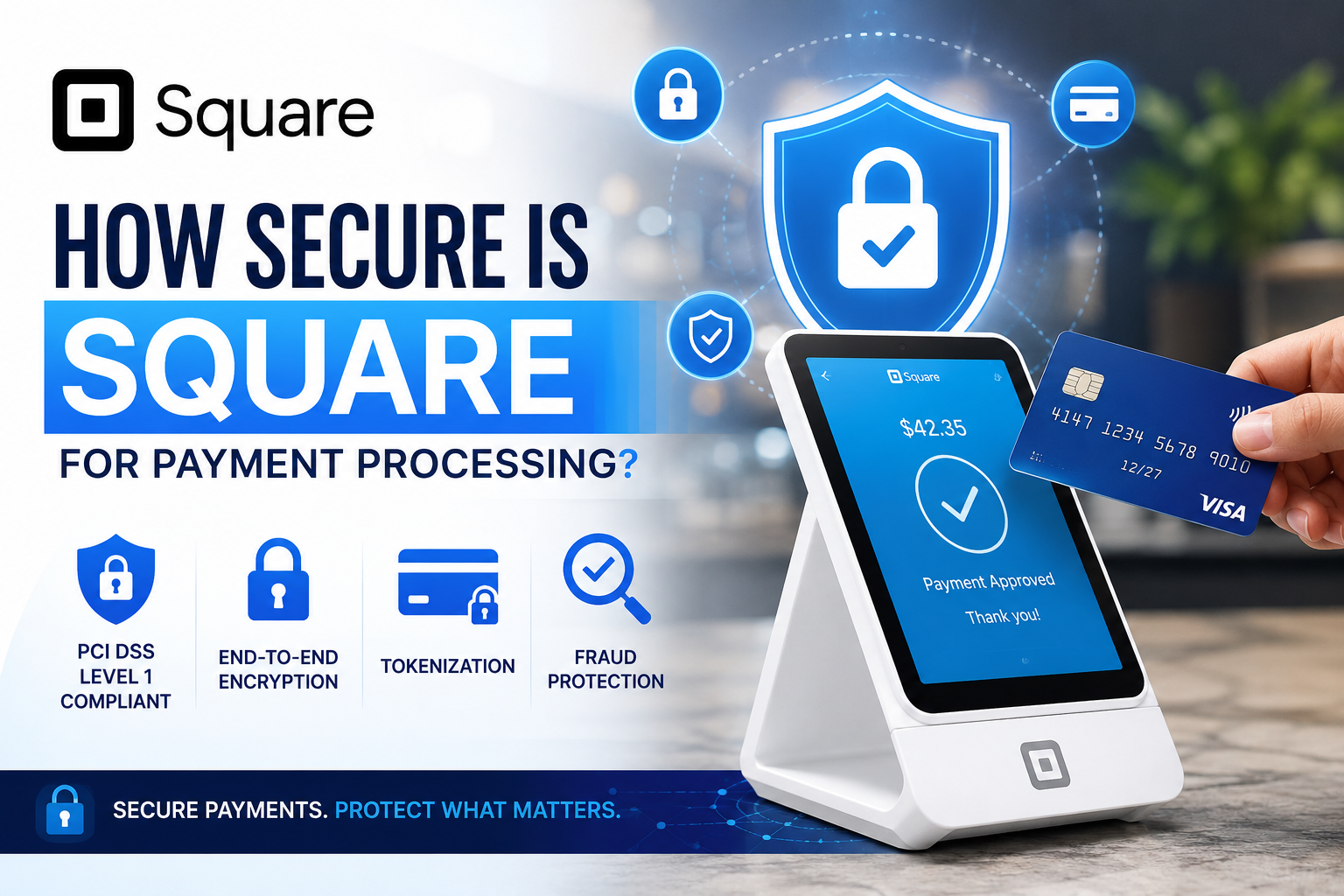
Handing over a customer’s card details, even for a few seconds, carries real risk if the underlying payment system is weak. Business owners know this, which is why security questions come up almost as often as pricing questions when evaluating a payment processor. Square has built its reputation partly on ease of use, but the platform’s security architecture deserves just as much attention, since it directly determines whether a business can trust the system with sensitive financial data. This article breaks down exactly how Square protects transactions, what compliance standards it follows, and what business owners should still do on their end to keep their accounts safe.
Security in payment processing is not a single feature; it is a layered system involving encryption, compliance, monitoring, and access control working together. Consequently, judging whether a platform is “secure” means looking at each of these layers individually rather than accepting a one-word answer. The sections below walk through exactly how Square approaches each layer, so a business owner can make an informed decision rather than a guess.
Additionally, security expectations have risen sharply as more transactions move online and customers become more aware of data breaches reported in the news. A single compromised transaction can damage a business’s reputation far beyond the financial cost of the breach itself. Therefore, business owners increasingly treat payment security as a core factor in choosing a processor, not a secondary consideration handled only after price and convenience. This shift in expectations is exactly why a detailed look at Square’s security architecture matters so much right now.
Table Of Contents
Quick Summary
Before going through the full breakdown, here is a fast overview of what this article covers:
- Encryption — Square encrypts transaction data at the moment of swipe, dip, or tap, before it ever leaves the device.
- Tokenization — sensitive card data gets replaced with irreversible tokens once it reaches Square’s servers.
- Compliance certifications — Square maintains PCI DSS Level 1, SOC 1 and 2, and ISO 27001 certifications.
- Fraud monitoring — automated, real-time monitoring flags suspicious transactions across every channel.
- Account protections — two-step verification and granular staff permissions limit unauthorized access.
- Dispute handling — Square acts as the merchant of record and helps manage chargebacks on a business’s behalf.
- Shared responsibility — Square secures the infrastructure, but business owners still need strong passwords, staff training, and careful data handling.
What Is Square and How Does It Relate to Payment Security?

Square is a payment processing and point-of-sale platform that lets businesses accept card payments in-store, online, and on the go, all through one merchant account. Because Square sits between a customer’s card and a business’s bank account, it becomes responsible for protecting every piece of data that passes through that connection, from the initial swipe to the final settlement.
This is precisely why Square’s security practices matter so much to this topic. A payment platform that processes transactions quickly but handles data carelessly would expose businesses to fraud, fines, and reputational damage. Square, therefore, built its entire infrastructure around minimizing that exposure: encrypting data immediately, avoiding storage of raw card numbers, and taking on much of the compliance burden that would otherwise fall on individual merchants. Understanding these mechanisms is essential before trusting any payment processor with real customer transactions, and it explains why Square’s approach to security sits at the center of this article.
How Does Square Encrypt Payment Data?
Encryption forms the first line of defense in any payment system, and Square applies it from the earliest possible point in a transaction.
What Happens the Moment a Card Is Swiped, Dipped, or Tapped?
Square encrypts card data inside the reader itself, at the exact moment a customer swipes, dips, or taps their card. Because encryption happens on the hardware before the data ever reaches a phone, tablet, or computer, unencrypted card numbers never touch the device running the Square app. Therefore, even if a device were compromised, an attacker would not find usable card data sitting on it.
How Does Encryption Work for Online and Manually Entered Transactions?
For online orders, invoices, and manually keyed-in payments, Square applies the same encryption principle as soon as the customer submits their payment details through a secure, Square-hosted page. This means a business never directly handles raw card numbers on its own servers, which significantly reduces the business’s own compliance burden and shrinks the attack surface a hacker could target.
Why Does End-to-End Encryption Matter for Businesses?
Without end-to-end encryption, sensitive card data could sit unprotected at multiple points along its journey, creating opportunities for interception. Square’s approach closes those gaps by ensuring data stays encrypted from the point of capture until it reaches Square’s secure servers, which is a standard now expected from any reputable payment processor.
How Does Tokenization Protect Customer Card Data?
Beyond encryption, Square uses tokenization to further limit what happens to sensitive data once it arrives on its servers.
What Is Tokenization and How Does Square Use It?
Tokenization replaces a customer’s actual card number with a randomly generated stand-in value, known as a token, that cannot be mathematically reversed into the original number. Square stores this token instead of the real card number, so even if an attacker somehow accessed the stored data, they could not use it without access to Square’s systems that translate the token.
How Does Tokenization Support Recurring Payments?
Businesses that bill customers on a recurring basis, such as subscription services or membership-based gyms, need a way to charge a saved card without storing the actual card number themselves. Tokenization solves this problem directly: Square keeps the token on file, charges it on schedule, and the business never needs to see or store the real card details at all.
What Compliance Standards Does Square Maintain?
Compliance certifications allow business owners to verify that independent standards support a payment processor’s security claims rather than marketing language alone.
What Is PCI DSS and Why Does It Matter?
PCI DSS, or the Payment Card Industry Data Security Standard, is a set of requirements that any business handling card data must follow. Square’s card-processing systems meet PCI DSS Level 1, the highest tier of certification, which requires rigorous annual audits, vulnerability scanning, and strict controls over the handling of cardholder data. Because Square acts as the merchant of record and absorbs most of this compliance responsibility, individual businesses using Square typically do not need to independently validate their own PCI compliance for transactions processed through the platform.
What Other Certifications Does Square Hold?
In addition to PCI DSS, Square maintains SOC 1 and SOC 2 compliance along with ISO 27001 certification. SOC reports verify that Square’s internal controls around financial reporting and data security meet independent auditing standards, while ISO 27001 certification confirms that Square follows a globally recognized framework for managing information security risks. Together, these certifications give business owners a way to confirm that Square’s security claims hold up under third-party scrutiny rather than relying on self-reported assurances alone.
How Does Square Handle Data Privacy Regulations?
Square also aligns its practices with data privacy regulations such as the California Consumer Privacy Act and, for businesses operating internationally, the General Data Protection Regulation in Europe. As a result, businesses using Square gain confidence that Square manages customer data in accordance with recognized legal frameworks rather than relying solely on internal company policies.
How Does Square Detect and Prevent Fraud?
Encryption and compliance protect data in transit and storage, but fraud prevention requires a different, more active layer of defense.
How Does Real-Time Transaction Monitoring Work?
Square continuously monitors transactions as they happen, watching for patterns that resemble known fraud tactics, such as unusual purchase amounts, rapid repeated charges, or transactions originating from flagged locations. When Square’s systems detect a suspicious pattern, they can flag or hold a transaction for review before it completes, which helps prevent fraudulent charges from slipping through unnoticed.
How Does Square Use Automated Risk Analysis?
Square applies automated risk-scoring models to transactions across its entire network, drawing on patterns observed from millions of transactions processed daily. Because this analysis happens at scale, Square can often catch emerging fraud patterns faster than an individual business monitoring its own transactions manually ever could.
What Happens When a Chargeback or Dispute Occurs?
When a customer disputes a charge, Square acts as the merchant of record and helps manage the process on the business’s behalf. The business supplies supporting documentation, such as receipts or delivery confirmation, and Square uses that information to challenge the dispute with the card network. Consequently, business owners are not left to negotiate directly with banks on their own, which simplifies an otherwise stressful process.
How Does Square Protect Merchant Accounts From Unauthorized Access?
Protecting the transaction itself is only part of the picture; protecting the merchant account that manages those transactions matters just as much.
How Does Two-Step Verification Add a Layer of Protection?
Square supports two-step verification, which requires a second form of confirmation, such as a code sent to a mobile device, before allowing access to a merchant account. This extra step makes it significantly harder for an attacker to gain access even if they somehow obtain a business owner’s password.
How Do Employee Permissions Limit Internal Risk?
Not every security risk comes from outside a business. Square lets owners assign granular permissions to staff members, controlling exactly which actions each employee can take, such as processing refunds, viewing sales reports, or accessing customer payment details. Therefore, a business can limit internal exposure by giving employees only the access they genuinely need to do their jobs.
How Are Devices Secured Against Tampering?
Square’s hardware ships secure by default, without requiring business owners to configure encryption settings manually. Additionally, Square designs its systems so that no unencrypted payment data ever reaches the device running the Square app, which reduces the risk that a lost or stolen device could expose sensitive information.
What Security Layers Does Square Use Across the Payment Process?
The table below summarizes how each security layer applies across the stages of a typical transaction.
| Security Layer | What It Protects | When It Applies |
|---|---|---|
| Point-of-capture encryption | Card data at the moment of swipe, dip, or tap | Instantly, before data leaves the device |
| Tokenization | Stored card data on Square’s servers | After the transaction reaches Square’s systems |
| PCI DSS Level 1 compliance | Overall handling of cardholder data | Continuously, verified through annual audits |
| SOC 1/2 and ISO 27001 | Internal security controls and risk management | Ongoing, verified by independent auditors |
| Real-time fraud monitoring | Suspicious or fraudulent transactions | During every transaction, in real time |
| Two-step verification | Merchant account login access | Every time an account is accessed from a new device |
| Employee permissions | Internal misuse of account access | Continuously, based on assigned roles |
Because these layers work together rather than in isolation, a weakness in one area does not automatically expose the entire system. This layered design is one of the main reasons Square continues to be trusted by a wide range of businesses handling sensitive customer payment data every day.
How Does Square Secure Its Physical Hardware and Devices?
Software encryption matters little if the physical device processing a payment can be tampered with, so Square applies additional protections at the hardware level.
How Does Square Prevent Tampering With Card Readers?
Square designs its card readers so that any physical tampering attempt is likely to disable the device entirely rather than expose usable data. Because the encryption happens inside a sealed component of the reader itself, an attacker attempting to intercept data by opening or modifying the hardware would typically destroy its ability to function, rather than gain access to unprotected card numbers.
Why Does Square Prohibit Storing Card Data on Client Devices?
Square prohibits the storage of card numbers, magnetic stripe data, and security codes directly on the phones, tablets, or computers running its app. Consequently, even a lost or stolen device running the Square app would not contain a local cache of sensitive payment information for a thief to extract.
How Are Square’s In-House Applications Tested for Security Flaws?
Applications developed internally by Square go through structured quality testing and security review before release, and web development follows widely recognized secure coding guidelines, such as those published by the Open Web Application Security Project. Therefore, security considerations get built into Square’s software from the development stage rather than added afterward as a patch.
How Does Square Handle Security for Offline Transactions?
Not every payment happens with a stable internet connection, and this scenario introduces its own unique security considerations.
What Happens When a Transaction Is Processed Without Internet Access?
When Square processes a payment offline, such as at an outdoor market or a location with unreliable connectivity, it still encrypts the transaction data on the device before temporarily storing it. Once connectivity returns, Square transmits and processes the encrypted data through its normal secure channels, meaning the offline gap does not create an unprotected window for sensitive data to sit in.
Why Does This Matter for Mobile and Event-Based Businesses?
Vendors who travel between markets, pop-up events, or job sites often cannot guarantee a stable connection at every location. Because Square maintains the same encryption standards whether a transaction processes instantly or after a delay, these businesses do not need to choose between mobility and security.
How Does Square’s Security Approach Compare Across the Industry?
Payment security is often measured against recognized industry benchmarks, and Square’s certifications place it alongside other major, well-established processors.
How Does Square’s PCI Level Compare to Smaller Processors?
Achieving PCI DSS Level 1, the strictest tier of compliance, typically requires far more rigorous auditing than the lower compliance levels that smaller or newer payment processors sometimes rely on. Because Square processes an extremely high volume of transactions, it must comply with this top-level standard. As a result, businesses of any size that use Square gain access to enterprise-grade security controls without having to process the same transaction volume themselves.
What Role Does Transparency Play in Building Trust?
Square publishes documentation covering its compliance certifications and security practices through its own trust center, rather than requiring businesses to take security claims on faith. This kind of transparency allows business owners, and their own customers, to independently verify what protections are actually in place instead of relying solely on marketing claims.
What Security Responsibilities Still Belong to the Business Owner?
Even with a strong platform behind them, business owners still carry some responsibility for keeping their own accounts and practices secure.
How Important Are Strong Passwords and Account Hygiene?
A secure payment platform cannot fully protect an account if the business owner reuses weak passwords across multiple services. Consequently, business owners should use unique, strong passwords for their Square account and enable two-step verification rather than relying on Square’s backend security alone.
Why Does Staff Training Matter for Payment Security?
Employees who handle Square hardware and software need basic training on recognizing suspicious behavior, such as customers attempting unusually large transactions or requesting manual card entry without a clear reason. Because staff interact directly with customers and hardware, their awareness adds a practical layer of protection that technology alone cannot fully replace.
How Should Businesses Handle Customer Data Beyond Square?
Businesses that export reports, store customer contact details, or integrate Square with other software need to apply similar care to that data outside of Square’s own systems. Otherwise, even a fully secure payment platform cannot prevent a data leak that happens through an unrelated, poorly protected tool.
How Does Square’s Security Compare to Traditional Merchant Accounts?
Traditional merchant account providers often require businesses to independently validate their own PCI compliance, which can involve lengthy questionnaires, vulnerability scans, and ongoing fees. Square instead absorbs much of this responsibility as the merchant of record, meaning businesses using Square generally do not need to complete separate compliance validation for transactions processed through the platform. Additionally, because Square controls both the hardware and software involved in a transaction, it can enforce consistent security standards across its entire ecosystem, whereas traditional setups that combine equipment and software from different vendors sometimes create inconsistent security practices between components.
Conclusion
Security in payment processing depends on far more than a single feature, and Square addresses this reality with a layered approach that spans encryption, tokenization, independent compliance certifications, real-time fraud monitoring, and account-level protections. Because Square encrypts data at the point of capture, replaces sensitive card numbers with tokens, and maintains PCI DSS Level 1, SOC, and ISO 27001 certifications, businesses gain a level of protection that would be costly and complex to build independently. That said, security remains a shared responsibility, and business owners still need to practice good account hygiene and train their staff appropriately. Altogether, Square offers a payment processing environment built with security as a foundational design choice rather than an afterthought, which explains why so many businesses continue to trust it with their day-to-day transactions.
Frequently Asked Questions
No. Because Square acts as the merchant of record and maintains PCI DSS Level 1 certification, most businesses using Square for the full storage, processing, and transmission of card data do not need to separately validate their own PCI compliance.
Square does not store the actual card number. Instead, it uses tokenization to replace the card number with a secure token, which the business can charge again for recurring payments without ever handling the real card details.
Business owners should enable two-step verification, review staff permission settings, and contact Square support immediately if they notice suspicious transactions or unauthorized account access, since Square’s fraud monitoring and dispute support teams can help investigate and resolve the issue.
What Are the Benefits of Partnering With Solution for Guru?

Choosing a secure payment platform like Square handles one critical piece of protecting a business, but true end-to-end security depends on how that platform gets integrated into the rest of a business’s website and systems. Solution for Guru specializes in exactly this kind of integration work, helping businesses connect payment tools such as Square to a properly secured, professionally built website rather than a loosely configured template.
The team’s cybersecurity and data protection services extend security considerations beyond the payment processor itself, covering the surrounding website, hosting environment, and any connected systems that might otherwise become a weak link. Because a payment platform can only secure what happens within its own systems, a business also needs its website, CRM, and integrations protected with the same level of care, which is precisely where Solution for Guru’s broader technical expertise adds value. Their CRM and SaaS integration services also ensure that customer data flowing between Square and other business tools stays protected at every connection point, rather than exposing gaps between systems that were never designed to work together securely.
In addition, Solution for Guru’s tech consulting and strategy services help business owners think through security holistically, rather than treating it as a checkbox handled entirely by the payment processor. From secure custom web development to ongoing monitoring and support, Solution for Guru helps businesses build a complete security posture around their Square setup, not just within it. For any business that wants the confidence of knowing every layer of its online and in-store operations meets a consistent security standard, working with an experienced partner like Solution for Guru turns Square’s strong foundation into an even more resilient, fully protected system.
Recommended:
- Square for Restaurants and Cafes
- How Businesses Use Square to Accept Payments Online and In-Store
- What Is Square Credit Card Processing and How Does It Work?
- Xero for Small Business: Is It the Right Accounting Software for You?
- What is Xero — Overview of the Cloud Accounting Platform’s Features
- How Does FreshBooks Integrate with CRM, Payroll, and Project Management Tools?
- Financial Reporting Architecture in Zoho Books
- Zoho Books Architecture: Cloud Accounting Explained — How Does It All Work?
- FreshBooks for IT Consulting Firms: Managing Projects, Invoices, and Client Billing
- FreshBooks Review: Features, Pricing, Pros, and Cons
- Real-Time Financial Dashboards with Zoho Books
- How Can You Connect Zoho Books with Payment Gateways to Streamline Your Business Finances?