Zoho Books Architecture: Cloud Accounting Explained — How Does It All Work?
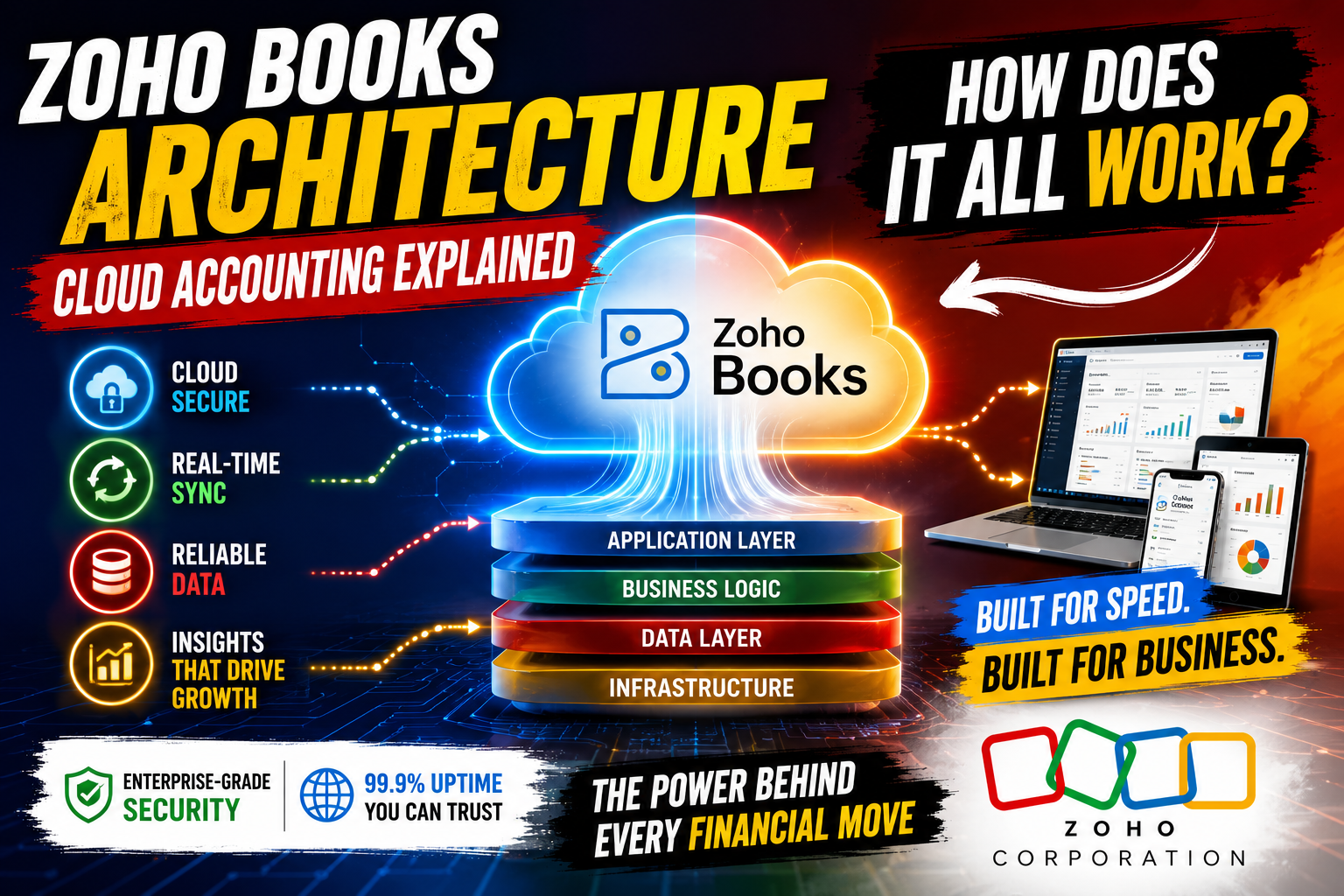
Cloud accounting has transformed how modern businesses manage their finances. Instead of relying on desktop software tied to a single machine, companies now run their books from anywhere, collaborate in real time, and scale without hardware headaches. Zoho Books stands at the forefront of this shift — but what exactly powers it? This article breaks down the cloud architecture behind Zoho Books, explains how each component serves your business, and shows you how partnering with Solution for Guru unlocks the platform’s full potential.
Table of contents
Quick Summary
- Zoho Books is a fully cloud-native accounting platform built on a multi-tier, multi-tenant SaaS architecture.
- Its infrastructure spans secure data centers, RESTful APIs, real-time sync engines, and deep integrations across the Zoho ecosystem.
- Core modules cover invoicing, expense tracking, bank reconciliation, reporting, and tax compliance.
- The platform protects financial data using AES-256 encryption, role-based access control, and SOC 2-aligned security practices.
- Solution for Guru provides expert implementation, custom automation, and ongoing support to maximize your ROI from Zoho Books.
What Is Zoho Books and Why Does Its Architecture Matter?

Zoho Books is a cloud-based accounting solution developed by Zoho Corporation, designed to help small and medium-sized businesses automate financial workflows, stay tax-compliant, and gain real-time visibility into their numbers. Launched as part of the broader Zoho suite of over 55 business applications, Zoho Books goes far beyond basic bookkeeping. It handles invoicing, purchase orders, bank feeds, multi-currency transactions, project billing, and powerful reporting — all from a single browser tab or mobile app.
Understanding the architecture behind Zoho Books matters for several practical reasons. First, it helps businesses assess reliability: will the platform stay available when they need it? Second, it informs integration decisions: how smoothly does Zoho Books connect to existing tools? Third, it guides security evaluations: how does the platform safeguard sensitive financial data? Finally, knowing the underlying design helps technical teams, accountants, and decision-makers speak the same language when planning implementations or migrations.
Throughout this article, we explore each architectural layer of Zoho Books — from its cloud infrastructure and data model to its API gateway and compliance engine — and explain what each layer means for your everyday business operations. We also highlight how working with Solution for Guru turns this technical power into measurable business results.
How Does Zoho Books Leverage Cloud Infrastructure?
What Makes Multi-Tenant SaaS Architecture Beneficial for Accounting?
Zoho Books operates on a multi-tenant Software-as-a-Service (SaaS) architecture. In this model, a single application instance serves thousands of businesses simultaneously, with strict logical separation ensuring that your financial data stays completely isolated from other tenants. Each organization gets its own virtual workspace — its own accounts, transactions, users, and reports — while sharing the underlying compute and storage infrastructure with other customers.
This design delivers significant advantages. Because Zoho Corporation manages the infrastructure centrally, businesses never worry about server maintenance, database patches, or backup schedules. Furthermore, multi-tenancy enables Zoho to apply platform-wide updates instantly — when Zoho Books releases a new feature or a security patch, every customer benefits automatically without any manual upgrade process. The result is a continuously improving product that keeps pace with evolving accounting standards and tax regulations around the world.
Where Does Zoho Books Store Your Financial Data?
Zoho operates its own global data centers, strategically distributed across regions including the United States, Europe (Netherlands), Australia, India, Japan, Canada, China, and Saudi Arabia. This geographic distribution serves two critical purposes: data residency compliance and low-latency access. Businesses operating under regulations such as GDPR in Europe or data localization requirements in India can configure Zoho Books to store their data within a specific region.
Within each data center, Zoho runs redundant hardware clusters with automatic failover. If one server node experiences a failure, traffic routes seamlessly to a healthy node — typically in under a second — without any visible disruption to users. Zoho also performs continuous, automated backups with point-in-time recovery capabilities, meaning the platform can restore your financial records to any specific moment if data corruption or accidental deletion occurs.
| Data Center Region | Primary Markets Served | Data Residency Compliance |
|---|---|---|
| United States | North America | CCPA, SOC 2 |
| Europe (Netherlands) | EU, UK | GDPR, ISO 27001 |
| Australia | APAC | Australian Privacy Act |
| India | South Asia | Indian IT Act, MCA |
| Japan | East Asia | APPI compliance |
| Canada | Canadian businesses | PIPEDA |
What Are the Core Modules Inside Zoho Books Architecture?
How Does the Invoicing Engine Work?
At the heart of Zoho Books sits a robust invoicing and billing engine. This module handles the entire order-to-cash cycle: creating estimates, converting them to invoices, tracking payment status, and automatically reconciling received payments against open receivables. Zoho Books supports recurring invoices with configurable billing cycles, automated payment reminders, and client-facing portals where customers can view and pay invoices online.
Technically, the invoicing engine stores each document as a structured JSON record linked to the relevant customer, line items, tax rules, currency, and project — if applicable. When you create an invoice, Zoho Books simultaneously updates your accounts receivable ledger, applies the correct tax rates based on your configured tax profile, and triggers any automation rules you’ve set up, such as sending an email notification or creating a follow-up task. This event-driven architecture ensures that every action produces consistent downstream effects without manual intervention.
How Does Bank Reconciliation Work in the Cloud?
Bank reconciliation traditionally consumed hours of manual effort. Zoho Books eliminates most of that friction through its Bank Feeds feature, which connects directly to thousands of financial institutions via secure Open Banking APIs and data aggregators such as Plaid and Yodlee. Once connected, Zoho Books pulls transaction data from your bank accounts daily — or in near real time for supported institutions — and presents transactions alongside your recorded entries for matching.
The reconciliation engine uses rule-based and machine-learning-assisted matching to automatically pair imported bank transactions with existing invoices, bills, or manual entries. Over time, as you confirm or correct the system’s suggestions, the matching algorithm improves its accuracy for your specific patterns. Unmatched transactions surface in a dedicated review queue, ensuring nothing slips through the cracks. This architecture turns reconciliation from a monthly ordeal into a continuous, low-effort process.
What Role Does the Tax Compliance Engine Play?

Tax compliance represents one of the most complex challenges in accounting software — tax rules differ by country, state, province, and industry, and they change frequently. Zoho Books addresses this through a configurable tax engine that supports GST (Australia, India, Canada), VAT (UK, EU, Middle East), US sales tax, and many other regional frameworks. The engine stores tax rates as objects linked to items, customers, and vendor profiles, applying the correct rate automatically based on transaction context.
For GST-registered businesses in India and Australia, Zoho Books generates compliant returns directly from transaction data — including GSTR-1, GSTR-3B, and BAS filings. In the UK, Zoho Books integrates with HMRC’s Making Tax Digital (MTD) platform, allowing direct submission of VAT returns without leaving the application. This architecture embeds compliance into every transaction rather than treating it as a year-end exercise.
How Does Zoho Books Handle Integrations and APIs?
What Is the Role of the Zoho Books REST API?
Zoho Books exposes a comprehensive RESTful API that allows developers to build custom integrations, automate workflows, and synchronize data with other systems. The API covers virtually every resource in the platform — contacts, invoices, bills, payments, items, journals, reports, and more. Each endpoint follows REST conventions, accepts and returns JSON payloads, and uses OAuth 2.0 for authentication, ensuring that third-party applications access only the data and operations they need.
Developers can use the API to push sales orders from an e-commerce platform into Zoho Books, pull financial reports into a business intelligence dashboard, synchronize inventory levels with a warehouse management system, or automate payroll journal entries from an HR tool. The API rate limits scale with your subscription plan, and Zoho provides official SDKs for popular languages including Java, Python, PHP, Node.js, and C# to accelerate development.
How Does Zoho Books Connect to the Broader Zoho Ecosystem?
One of Zoho Books’ architectural strengths is its native integration with the Zoho suite. Because Zoho CRM, Zoho Inventory, Zoho Expense, Zoho Payroll, Zoho Projects, and dozens of other Zoho apps share a common identity layer (Zoho Accounts) and data platform, they communicate directly without requiring middleware or custom connectors. For example:
- Zoho CRM → Zoho Books: Closing a deal in CRM automatically generates a draft invoice in Zoho Books, populating customer and product details without re-entry.
- Zoho Inventory → Zoho Books: Every inventory movement triggers corresponding journal entries, keeping stock valuations and cost of goods sold perpetually accurate.
- Zoho Expense → Zoho Books: Approved expense reports post directly to the appropriate expense accounts and create reimbursement bills automatically.
- Zoho Payroll → Zoho Books: Payroll runs post salary journal entries, tax withholdings, and employer contributions directly into Zoho Books’ general ledger.
Beyond the Zoho ecosystem, Zoho Books connects to popular third-party platforms through pre-built integrations and the Zapier/Make automation layer, covering tools like Stripe, PayPal, Shopify, Slack, Google Workspace, Office 365, and over 2,000 others.
How Does Zoho Books Protect Your Financial Data?
What Security Layers Does Zoho Books Deploy?
Financial data demands the highest security standards, and Zoho Books implements multiple overlapping protection layers. At the transport layer, all data moving between your browser or app and Zoho’s servers travels over TLS 1.2/1.3 encryption, preventing interception. At rest, Zoho encrypts stored data using AES-256 encryption, the same standard used by banks and government agencies. Encryption keys rotate on a defined schedule and are stored separately from the data they protect.
Access control operates through Role-Based Access Control (RBAC) with granular permission settings. An administrator can configure roles so that, for example, a junior accountant can create and send invoices but cannot modify chart of accounts or access payroll data. Multi-factor authentication (MFA) adds an additional layer of protection to user accounts. In addition, Zoho records all user activity in detailed audit logs. These logs capture who viewed, created, modified, or deleted each record and the exact time of each action. Such records help organizations meet compliance requirements and investigate security incidents when necessary.
| Security Layer | Technology Used | Purpose |
|---|---|---|
| Data in transit | TLS 1.2 / 1.3 | Prevent interception of data between client and server |
| Data at rest | AES-256 encryption | Protect stored financial records from unauthorized access |
| Authentication | OAuth 2.0 + MFA | Verify user and application identity |
| Authorization | RBAC with custom roles | Control which users can access or modify specific data |
| Audit logging | Immutable activity logs | Forensic trail for compliance and incident investigation |
| Infrastructure | SOC 2 Type II certified DCs | Physical and logical security of underlying hardware |
How Does Zoho Books Achieve High Availability?
Zoho Books targets a 99.9% uptime SLA, which translates to less than nine hours of potential downtime per year. The platform achieves this through a combination of redundant server clusters, load balancing, automated health checks, and active-passive failover configurations. Each data center runs with N+1 redundancy for critical components, meaning at least one spare unit is always available to take over if a primary component fails.
Additionally, Zoho’s engineering team runs a continuous deployment pipeline that allows incremental updates and hotfixes without taking the entire platform offline. Blue-green deployment techniques enable the team to roll out new versions to a subset of users first, monitor for issues, and gradually expand the rollout — or roll back instantly if a problem surfaces. From a user perspective, Zoho Books simply improves over time, with new features appearing in the interface without any action on their part.
How Does Zoho Books Support Multi-Currency and Global Operations?
How Does the Multi-Currency Engine Work in Zoho Books?

For businesses that operate internationally, Zoho Books provides a fully integrated multi-currency accounting engine. The platform supports over 170 currencies, pulls live exchange rates from reliable sources (including the European Central Bank and other financial data providers), and stores every foreign-currency transaction in both the original currency and the base currency of the organization.
When exchange rates fluctuate between the time you issue an invoice and when you receive payment, Zoho Books automatically calculates and posts foreign exchange gain/loss entries to keep your books accurate. It also handles currency revaluation at period-end, adjusting the balance sheet values of foreign-currency balances to reflect current rates — a critical requirement for businesses that prepare financial statements under IFRS or GAAP. The architecture separates currency-conversion logic from transaction recording, ensuring that all historical exchange rates are preserved and auditable.
What Reporting Capabilities Does Zoho Books Deliver?
Zoho Books includes over 50 built-in financial reports covering every major reporting need. The platform offers a wide range of financial reports. Standard reports include the Profit & Loss statement, Balance Sheet, Cash Flow Statement, Trial Balance, and General Ledger. Users can also access operational reports that support day-to-day decision-making. These reports cover accounts receivable and payable aging, customer sales, vendor purchases, and item sales performance. Each report generates in seconds regardless of transaction volume, because Zoho’s reporting engine queries pre-aggregated data rather than scanning raw transaction tables.
Beyond standard reports, Zoho Books supports custom report builder functionality where users can define their own filters, groupings, columns, and date ranges. Reports export to PDF, Excel, and CSV formats, and schedule automatically for email delivery to stakeholders. For deeper analytics, Zoho Books integrates with Zoho Analytics, a business intelligence platform that enables cross-application dashboards combining accounting data with CRM metrics, project performance, and inventory trends.
What Makes Zoho Books an Ideal Choice for Growing Businesses?
How Does Zoho Books Scale as a Business Grows?
Scalability is a core design principle of Zoho Books. The platform’s subscription tiers — Free, Standard, Professional, Premium, and Elite — allow businesses to start with basic features and add capabilities as they grow, without migrating to a different system. As transaction volumes increase, Zoho’s infrastructure scales horizontally: additional compute nodes join the cluster to handle the load, while the application tier remains unchanged for the end user.
Moreover, Zoho Books supports multiple organizations under a single login, making it ideal for groups that manage subsidiaries, franchises, or separate legal entities. Each organization maintains its own chart of accounts, currencies, tax settings, and users, while the account owner can switch between them with a single click. Inter-company transactions and consolidation reports help finance teams gain a group-wide view of performance without wrestling with spreadsheets.
| Plan | Users Included | Invoices/Year | Key Features |
|---|---|---|---|
| Free | 1 | 1,000 | Basic invoicing, expenses, bank feeds |
| Standard | 3 | 5,000 | +Recurring invoices, custom fields, budgeting |
| Professional | 5 | 10,000 | +Retainers, purchase orders, multi-currency |
| Premium | 10 | 25,000 | +Custom domain, advanced analytics, vendor portal |
| Elite | 15 | 100,000 | +Advanced inventory, unlimited custom reports |
How Does Zoho Books Support Mobile and Remote Work?
The mobile-first architecture of Zoho Books delivers a full-featured experience across iOS and Android devices. The mobile apps offer comprehensive accounting capabilities rather than serving as simple companion tools. Users can create invoices while away from the office and capture receipts using their device’s camera. The apps also support receipt categorization, purchase order approvals, and dashboard reviews. Additionally, users can log time against projects and access important business information from anywhere. Changes sync immediately to the cloud, so desktop and mobile views always reflect the same current state.
Offline functionality, while limited by the nature of cloud accounting, allows Zoho Books to queue actions taken without connectivity and sync them once a connection restores. This architecture makes Zoho Books practical for field salespeople, traveling executives, and business owners who need to stay on top of their finances without being desk-bound.
What Conclusions Can We Draw About Zoho Books Cloud Architecture?
Zoho Books represents a mature, enterprise-grade cloud accounting platform built on architectural principles that prioritize availability, security, scalability, and integration. Its multi-tenant SaaS model delivers continuous improvements without disruption. Its distributed global data centers ensure compliance with data residency regulations across dozens of markets. Also, its event-driven transaction engine keeps every ledger entry, tax calculation, and bank reconciliation in sync in real time.
Furthermore, Zoho Books does not exist in isolation — it operates as a deeply integrated node within the broader Zoho ecosystem and connects to the wider business technology landscape through a comprehensive REST API. This architectural openness makes Zoho Books an accounting hub rather than a siloed tool, capable of serving as the financial backbone for businesses of every size and complexity.
Importantly, technology architecture is only as valuable as its implementation. The richness of Zoho Books’ feature set means that organizations who invest in expert configuration, thoughtful workflow design, and proper training realize dramatically more value than those who rely on default settings and self-discovery. That is precisely why partnering with Solution for Guru makes a measurable difference. Their combination of Zoho platform expertise, accounting domain knowledge, and technical integration skills gives businesses the confidence that their Zoho Books deployment will perform as expected from day one — and continue improving as the business grows.
In summary, Zoho Books delivers cloud accounting built for the modern world: secure, scalable, globally compliant, and deeply connected. With the right implementation partner, it becomes not just an accounting tool but a strategic financial intelligence platform that drives better decisions and supports sustainable growth.
Frequently Asked Questions
Zoho Books protects data through multiple security layers including AES-256 encryption at rest, TLS 1.3 in transit, multi-factor authentication, and role-based access controls. Zoho’s infrastructure holds SOC 2 Type II certification, and data centers comply with regional regulations such as GDPR in Europe, CCPA in California, and the Australian Privacy Act. For regulated industries like financial services and healthcare, Zoho Books’ granular RBAC and immutable audit logs provide the transparency and control that compliance frameworks require. Additionally, Zoho Books supports regional data residency, allowing businesses to ensure their financial data stays within specific geographic boundaries as required by their regulators.
Compared to competitors such as QuickBooks Online and Xero, Zoho Books offers a distinctive architectural advantage: deep native integration with a comprehensive suite of over 55 business applications. While QuickBooks Online and Xero both provide strong core accounting and open APIs, they rely heavily on third-party app marketplaces to extend functionality. Zoho Books, by contrast, connects natively to CRM, inventory, payroll, expense management, projects, and analytics within a single platform and identity layer. This reduces data duplication, eliminates integration maintenance overhead, and provides a unified view of business performance. Zoho Books also tends to offer more aggressive pricing, particularly for mid-market businesses that need advanced features like multi-currency, custom reporting, and workflow automation.
Why Should You Work with Solution for Guru to Implement Zoho Books?
How Does Solution for Guru Add Value Beyond the Standard Zoho Books Setup?
Deploying Zoho Books effectively involves far more than creating an account and entering opening balances. The platform’s depth — spanning chart-of-accounts design, tax configuration, workflow automation, custom reports, API integrations, and user training — means that the difference between a basic setup and an optimized one can translate to hundreds of hours of saved effort per year. Solution for Guru specializes in bridging exactly that gap.
Solution for Guru is an authorized Zoho partner with deep expertise in accounting workflows, business process automation, and the broader Zoho ecosystem. Their consultants work alongside your finance team to understand your specific processes before designing a Zoho Books configuration that fits your business — not a generic template. The result is a system where automation handles the routine, exceptions surface clearly, and your team focuses on decisions rather than data entry.
What Specific Services Does Solution for Guru Provide for Zoho Books?
Here is what businesses gain when they partner with Solution for Guru:
- Needs Assessment & Gap Analysis: Solution for Guru begins with a thorough review of your current accounting processes, identifying inefficiencies, compliance risks, and integration opportunities before configuring a single setting.
- Chart of Accounts Design: A well-structured chart of accounts forms the foundation of meaningful reporting. Solution for Guru designs account hierarchies that align with your industry, reporting requirements, and management information needs.
- Workflow Automation: Using Zoho Books‘ built-in automation rules and Zoho Flow, Solution for Guru builds approval workflows, automated reminders, escalation triggers, and cross-system notifications that keep your financial operations running smoothly without manual handoffs.
- Custom Integrations: If your business uses systems outside the Zoho ecosystem — ERP tools, e-commerce platforms, payment gateways, or legacy databases — Solution for Guru’s developers build and maintain the API connections that keep data flowing accurately between systems.
- Training & Onboarding: Even the best-configured system delivers poor results without user adoption. Solution for Guru provides role-specific training sessions and documentation that help your team become genuinely proficient, not just functional.
- Ongoing Support & Optimization: As your business evolves, your Zoho Books configuration should too. Solution for Guru provides ongoing support, monitors for performance issues, and continuously refines automations and reports to match your changing needs.
Working with Solution for Guru means investing in a long-term partnership, not a one-time installation. Their team stays current with Zoho Books releases, proactively recommending new features that benefit your operations. Businesses that engage Solution for Guru consistently report faster time-to-value, higher user adoption rates, and significantly fewer post-implementation surprises than those who attempt self-service setups. Visit solution4guru.com to learn more about their services.
Recommended:
- FreshBooks for IT Consulting Firms: Managing Projects, Invoices, and Client Billing
- FreshBooks Review: Features, Pricing, Pros, and Cons
- Real-Time Financial Dashboards with Zoho Books
- How Can You Connect Zoho Books with Payment Gateways to Streamline Your Business Finances?
- Financial Data Migration to Zoho Books
- Zoho Books for Finance Teams: Automation and Financial Control
- How Zoho CRM Works: Data Model, Modules, and Relationships