Customer Segmentation: A 2026 Guide for Marketers

What is customer segmentation?
Customer segmentation is the practice of dividing a business’s existing customers into distinct groups based on shared characteristics, so marketing efforts can be tailored to each group rather than broadcast to everyone at once. Those shared characteristics span a wide range: demographics like age and income, behavioral patterns like purchase frequency, psychographic traits like lifestyle preferences, and economic value to the business. The goal is precision. When you know which customers share the same needs and motivations, you can speak directly to those needs instead of sending the same generic message to your entire database.
Customer segmentation enables delivery of tailored products, marketing messages, and improved customer experiences by grouping similar customers. That distinction from a one-size-fits-all approach is what makes segmentation one of the most practical tools in a marketer’s arsenal.
Key attributes that define effective customer segmentation:
- Shared characteristics: Groups are built around measurable traits, whether demographic, behavioral, geographic, psychographic, or value-based.
- First-party data foundation: Segmentation draws on data you already own, including CRM records, purchase history, and web analytics.
- Marketing relevance: Each segment receives messaging and offers matched to its specific profile.
- Ongoing refinement: Segments are not static. They require regular updates as customer behavior and business conditions evolve.
- Business impact: Well-built segments improve retention, conversion rates, ad efficiency, and customer lifetime value.
Table of Contents
- How customer segmentation differs from market segmentation
- The main types of customer segmentation explained
- Why customer segmentation delivers measurable business results
- Customer segmentation in practice: industry examples
- How to build and maintain an effective segmentation strategy
- How to analyze and interpret segmentation data
- How to apply segmentation results to your marketing strategy
- Key Takeaways
- FAQ
How customer segmentation differs from market segmentation
Marketers frequently conflate these two concepts, and the confusion leads to wasted budget. The distinction is straightforward once you understand the data source and the audience each approach targets.
Customer segmentation draws on first-party data and focuses on current customers, whereas market segmentation targets potential customers using third-party data. Put differently, customer segmentation works with people who have already bought from you. Market segmentation works with people who might. The data sources, the marketing objectives, and the messaging strategies differ accordingly.
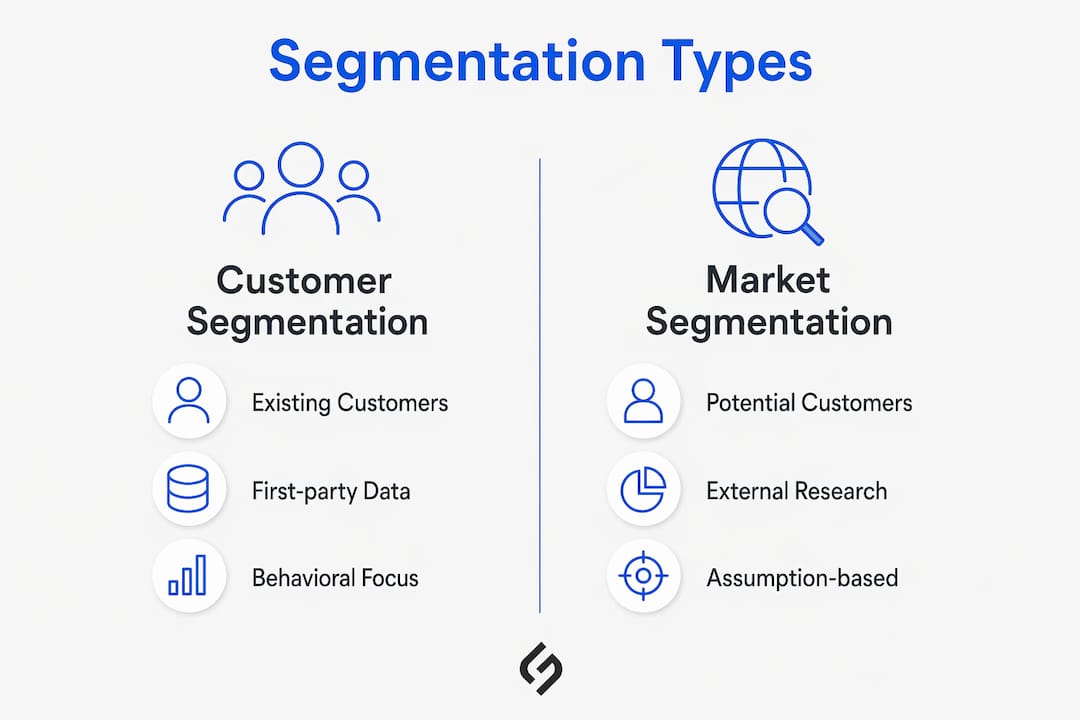
Market segmentation generally relies on external market research and assumptions, while customer segmentation utilizes direct data from CRM systems, purchase history, and customer interactions. Treating these as interchangeable leads to “cold” marketing tactics applied to warm audiences, or vice versa, neither of which performs well.
| Dimension | Customer segmentation | Market segmentation |
|---|---|---|
| Audience | Existing customers | Potential customers |
| Data source | First-party: CRM, purchase history, web analytics | Third-party: market research, surveys, industry data |
| Primary goal | Personalize retention and upsell efforts | Identify new market opportunities |
| Messaging approach | Tailored to known behavior and preferences | Broad profiling based on assumed characteristics |
| Typical use case | Email campaigns, loyalty programs, product recommendations | Market entry strategy, brand awareness campaigns |
For a deeper look at how these distinctions play out across B2B and B2C contexts, the Solution4guru guide on B2B vs B2C marketing covers the practical implications in detail.
The main types of customer segmentation explained
Segmentation types commonly include demographic, geographic, psychographic, behavioral, lifecycle, and value-based categories. Each type answers a different question about who your customers are and what drives their decisions.
Demographic segmentation
Demographic segmentation groups customers by age, gender, income, education, occupation, or family status. A financial services firm might segment by income band to offer different investment products to high-net-worth clients versus entry-level savers. It is the most widely used segmentation type because demographic data is relatively easy to collect and interpret.
Geographic segmentation
Geographic segmentation divides customers by location, whether country, region, city, or even neighborhood. A retail chain might run different promotions in the Northeast versus the Southwest based on seasonal demand patterns. For e-commerce businesses, geographic data also informs shipping strategies and localized content.

Psychographic segmentation
Psychographic segmentation goes deeper than demographics by capturing values, interests, attitudes, and lifestyle choices. A fitness brand might distinguish between customers motivated by competitive performance and those focused on general wellness, then craft separate content strategies for each. This type requires richer data, often gathered through surveys, social listening, or behavioral inference.
Behavioral segmentation
Behavioral segmentation groups customers by how they interact with your brand: purchase frequency, product categories browsed, loyalty program participation, or response to past campaigns. A SaaS company might identify power users who log in daily versus occasional users who need re-engagement, then address each group with a different communication cadence.
Value-based segmentation
Segmenting customers based on economic value helps prioritize marketing to high-value groups and improves return on investment. This approach ranks customers by their actual or projected revenue contribution, often using metrics like average order value or lifetime spend. High-value segments typically receive premium service, exclusive offers, or dedicated account management.
Lifecycle segmentation
Lifecycle segmentation organizes customers by where they are in their relationship with your brand: new buyers, repeat purchasers, at-risk churners, or lapsed customers. A subscription business uses this type to trigger onboarding sequences for new subscribers and win-back campaigns for those who have not renewed.
Why customer segmentation delivers measurable business results
Companies adopting targeted segmentation see better retention, more efficient ad spend, higher conversion rates, and increased customer lifetime value. Those outcomes are not coincidental. They follow directly from the logic of segmentation: when messaging matches the recipient’s actual situation, it performs better.
Personalizing marketing via segmentation avoids irrelevant messaging, building customer trust and improving engagement. Customers who receive offers aligned with their purchase history or stated preferences are more likely to act on those offers and less likely to unsubscribe. The trust built through relevant communication compounds over time.
Customer segmentation supports better resource allocation by focusing marketing efforts on defined groups with tailored messaging and offers. Budget directed at well-defined segments produces a cleaner signal on what works, making it easier to optimize campaigns and justify spend.
Key benefits at a glance:
- Higher conversion rates: Targeted messages convert better than generic broadcasts because they address specific needs.
- Improved customer retention: Segments allow proactive outreach to at-risk customers before they churn.
- Optimized ad spend: Narrower audience definitions reduce wasted impressions on unqualified prospects.
- Increased customer lifetime value: Personalized upsell and cross-sell offers reach the customers most likely to respond.
- Stronger brand trust: Relevant communication signals that the business understands its customers.
- Cleaner performance data: Segment-level reporting reveals which audiences respond to which tactics, accelerating learning.
Statistic callout: Businesses that implement targeted segmentation consistently report gains across retention, conversion, and lifetime value metrics, making it one of the highest-return investments in a digital marketing program.
Customer segmentation in practice: industry examples
Segmentation looks different depending on the industry, the data available, and the business objective. The following examples illustrate how organizations apply segmentation across sectors.
Retail and e-commerce: An online retailer uses behavioral data to identify customers who browse a product category repeatedly but never purchase. That segment receives a targeted discount or a “back in stock” alert, converting browsers into buyers. Separately, the retailer’s highest-spending customers receive early access to new collections, reinforcing loyalty.
Technology and SaaS: A software company segments its user base by feature adoption. Customers who use only basic features receive in-app prompts highlighting advanced capabilities. Power users who have hit plan limits get upgrade offers. Each segment receives a message calibrated to its actual usage pattern, not a generic product newsletter.
Hospitality: A hotel brand segments guests by travel purpose, business versus leisure, and by frequency of stay. Business travelers receive offers for weekday corporate rates and airport transfer packages. Leisure guests get weekend getaway promotions and family activity bundles. The same property, two very different conversations.
Financial services: A bank segments customers by life stage. Young professionals in their late twenties receive messaging about first-time homebuyer programs and investment accounts. Customers approaching retirement age receive information about wealth management and income planning products. Life-stage segmentation keeps the bank relevant at every point in the customer relationship.
Healthcare and wellness: A health insurance provider segments members by engagement level with preventive care programs. Low-engagement members receive outreach about annual checkups and screenings. High-engagement members receive advanced wellness resources and rewards program updates. This approach improves health outcomes and reduces long-term claims costs simultaneously.
For a broader view of how AI tools for customer insights are changing the way businesses build and act on these segments, Solution4guru’s practical guide covers the current state of the technology.
How to build and maintain an effective segmentation strategy
Building a segmentation strategy is a structured process, not a one-time project. The steps below reflect current best practice for organizations starting from scratch or auditing an existing approach.
1. Define your business objective first.
Segmentation without a clear goal produces segments without a clear use. Decide whether you are trying to reduce churn, increase average order value, improve onboarding, or enter a new product category. The objective determines which data matters.
2. Audit your data sources.
Pull together what you have: CRM records, transaction history, web analytics, email engagement data, and customer support logs. Gaps in data reveal where additional collection is needed before segmentation can be meaningful.
3. Choose your segmentation criteria.
Select the type or combination of types (demographic, behavioral, value-based, etc.) that aligns with your objective. A retention campaign calls for lifecycle and behavioral data. A product launch calls for demographic and psychographic data.

4. Build your initial segments.
Starting with 3–5 prioritized segments based on value or behavior is advised to avoid over-segmentation, which can lead to ineffective marketing and audience fragmentation. Resist the temptation to create a segment for every possible customer variation.
5. Validate segment viability.
Each segment should be measurable, accessible, substantial enough to act on, and distinct from other segments. A segment of two hundred customers may not justify a dedicated campaign unless those customers represent a disproportionate share of revenue.
6. Develop tailored messaging and offers.
Write creative and select channels based on what each segment’s data tells you. A segment of high-frequency mobile purchasers warrants a push notification strategy. A segment of high-value but infrequent buyers warrants a personalized email sequence.
7. Execute, measure, and iterate.
Track segment-level performance separately from overall campaign metrics. Conversion rates, open rates, and revenue per segment tell you whether the segmentation model is working or needs adjustment.
Common pitfalls to avoid:
- Over-segmentation: Too many narrow segments dilute budget and reduce statistical reliability. Start broad, then refine.
- Static segments: Customer behavior changes. A segment built on last year’s purchase data may no longer reflect current reality.
- Data silos: Segmentation built on email data alone misses behavioral signals from your website, app, or support channels.
- Ignoring segment size: A segment too small to reach statistical significance cannot produce reliable performance data.
Pro Tip: Use RFM analysis (Recency, Frequency, Monetary value) as a starting framework for behavioral segmentation. It is one of the most reliable methods for identifying your highest-value customers and those at risk of churning, and most CRM platforms support it natively.
How to analyze and interpret segmentation data
Raw segments are only as useful as the analysis applied to them. Once segments are defined and campaigns are running, the analytical work begins.
Start by establishing baseline metrics for each segment before any campaign launches. Conversion rate, average order value, email open rate, and churn rate per segment give you a benchmark against which to measure change. Without a baseline, you cannot attribute performance shifts to the segmentation model itself.
Look for patterns within segments, not just between them. A behavioral segment of “high-frequency buyers” might contain two distinct sub-patterns: customers who buy the same product repeatedly and customers who buy across multiple categories. Those sub-patterns suggest different upsell opportunities and warrant different messaging, even within the same parent segment.
Pay attention to segment migration. Customers move between segments as their behavior changes. A new buyer who makes three purchases in sixty days has migrated into a repeat-buyer segment. Tracking that migration rate tells you how effectively your onboarding and early retention efforts are working. CRM platforms with personalized customer journey capabilities can automate this tracking and trigger the appropriate next communication.
Finally, run A/B tests within segments, not just across your full list. Testing two subject lines against your entire database tells you what works on average. Testing within a specific segment tells you what works for that audience, which is a far more useful signal for refining your approach.
How to apply segmentation results to your marketing strategy
Segmentation data becomes valuable only when it drives concrete decisions across your marketing channels. The translation from insight to execution follows a consistent pattern regardless of industry or channel.
Email marketing: Map each segment to a distinct email sequence with subject lines, content, and calls to action calibrated to that group’s profile. A lifecycle segment of at-risk churners receives a re-engagement sequence with a time-limited offer. A high-value segment receives early access announcements and premium content. Segment-specific sequences consistently outperform batch-and-blast campaigns on open rates and revenue per email.
Paid advertising: Use segment data to build audience lists for paid search and social campaigns. Behavioral segments translate directly into custom audiences on platforms like Meta Ads Manager and Google Ads. Value-based segments inform bid strategy: higher bids for audiences that historically convert at higher order values.
Website personalization: Serve different homepage banners, product recommendations, and promotional offers based on the visitor’s segment. A returning high-value customer sees a loyalty reward prompt. A first-time visitor from a specific geographic region sees localized content. This kind of conversion rate optimization at the segment level produces measurable lifts in on-site engagement.
Product development: Segment data reveals which customer groups are underserved by your current offering. A psychographic segment with strong interest in sustainability signals a product line extension opportunity. A geographic segment with high cart abandonment rates signals a pricing or shipping friction point that product and operations teams can address.
The role of data in marketing strategy extends well beyond segmentation alone, but segmentation is typically where the most immediate and measurable gains appear. Applying segment insights consistently across channels compounds their effect over time.
Key Takeaways
Customer segmentation delivers its strongest results when segments are built on first-party data, kept to a manageable number, and updated regularly as customer behavior evolves.
| Point | Details |
|---|---|
| Core definition | Customer segmentation groups existing customers by shared traits to enable targeted, relevant marketing. |
| Data foundation | Segmentation relies on first-party data: CRM records, purchase history, and behavioral analytics. |
| Optimal segment count | Starting with 3–5 high-level segments prevents over-segmentation and audience fragmentation. |
| Key segmentation types | Demographic, geographic, psychographic, behavioral, lifecycle, and value-based are the primary categories. |
| Ongoing maintenance | Segments must be updated regularly using methods like RFM analysis to stay accurate and actionable. |
FAQ
Customer segmentation is the process of dividing a business’s existing customers into groups based on shared characteristics such as demographics, behavior, or economic value, so marketing and product efforts can be tailored to each group’s specific needs.
The four most widely used types are demographic (age, income, gender), geographic (location), psychographic (values, lifestyle, interests), and behavioral (purchase frequency, product usage, engagement). Value-based and lifecycle segmentation are also common additions.
The core steps are: define your business objective, audit available data, select segmentation criteria, build an initial set of 3–5 segments, validate each segment’s size and distinctness, develop tailored messaging, then execute campaigns and measure performance at the segment level.
Customer segments refer to the distinct groups that result from the segmentation process. Each segment represents a subset of customers who share enough common traits that a single, targeted marketing approach can address their needs more effectively than a general campaign would.
Customer segmentation focuses on existing customers using first-party data from CRM and purchase records. Market segmentation targets potential customers using third-party research and external market data, with the goal of identifying new audiences rather than serving current ones.