Agile Methodology Explained: A Complete 2026 Guide

What is Agile methodology and why does it matter?
Agile methodology is an iterative, values-driven approach to project and software management that prioritizes delivering working results frequently, adapting to change, and keeping customers at the center of every decision. The term itself was coined in 2001 when 17 software practitioners published the Agile Manifesto, a document that set out four core values and twelve guiding principles to reshape how software gets built.
At its foundation, Agile is not a single process or tool. As Microsoft Learn describes it, Agile is a mindset that drives an approach to software development, not something you simply “do.” Teams that adopt this mindset break work into short cycles, gather feedback continuously, and adjust course based on what they learn. The result is software and products that stay aligned with real user needs rather than drifting toward a specification written months earlier.
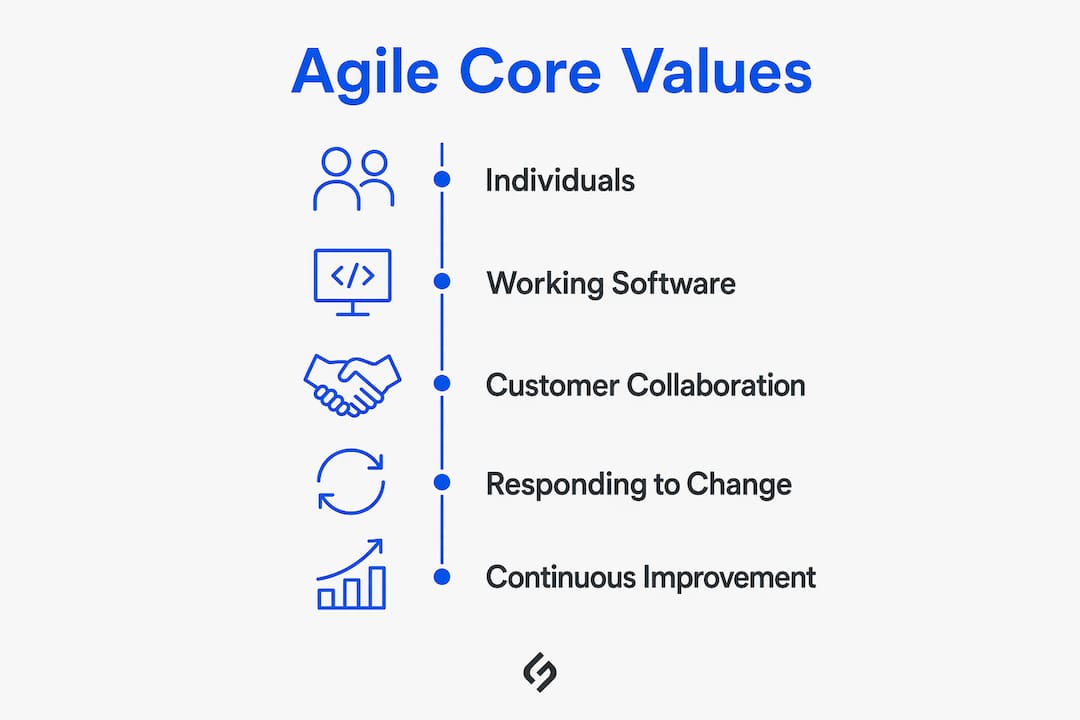
The four core values of Agile, as stated in the Agile Manifesto, are:
- Individuals and interactions over processes and tools
- Working software over comprehensive documentation
- Customer collaboration over contract negotiation
- Responding to change over following a plan
Each value acknowledges that the item on the right has worth. The point is that the item on the left matters more when the two come into conflict.
Table of Contents
- The four core values and twelve principles that drive Agile
- Which Agile frameworks should your team know?
- What benefits does Agile deliver for teams and organizations?
- Expert insights on Agile implementation: misconceptions and best practices
- How Agile roles and responsibilities work in practice
- Agile ceremonies and artifacts: what they are and why they matter
- How does Agile compare to traditional Waterfall project management?
- How do Agile teams measure success?
- How do teams actually implement Agile in practice?
- Key Takeaways
- FAQ
The four core values and twelve principles that drive Agile
Understanding Agile means understanding why its values exist, not just what they say. The four values emerged from years of frustration with heavyweight, document-driven processes that delivered software late, over budget, and misaligned with what customers actually needed. The Agile Alliance describes Agile as the ability to create and respond to change in an uncertain environment. That framing explains why flexibility and collaboration rank above rigid planning.
This principle is one of the most misunderstood in practice. Teams often interpret Agile as license to build more features faster. The manifesto pushes in the opposite direction: do less, but do it well.
The twelve Agile principles, drawn directly from agilemanifesto.org, group naturally into five themes:
Customer focus
- Satisfy the customer through early and continuous delivery of valuable software.
- Welcome changing requirements, even late in development.
- Deliver working software frequently, preferring shorter timescales.
Collaboration and communication
- Business people and developers must work together daily throughout the project.
- The most efficient method of conveying information within a team is face-to-face conversation.
Team empowerment
- Build projects around motivated individuals and trust them to get the job done.
- The best architectures and designs emerge from self-organizing teams.
Technical excellence
- Continuous attention to technical excellence and good design enhances agility.
- Working software is the primary measure of progress.
Continuous improvement
- Agile processes promote sustainable development at a constant pace.
- At regular intervals, the team reflects on how to become more effective and adjusts accordingly.
- Simplicity is essential.
These principles are not a checklist. They describe a way of thinking about work, and Coursera’s analysis of Agile principles notes they center on customer satisfaction, adaptability, collaboration, simplicity, technical excellence, and continuous improvement.
Which Agile frameworks should your team know?
Agile is not one single method. It is a family of approaches built around shared values, and choosing the right framework depends on team size, project type, and organizational context. Here are the major ones worth understanding.
Scrum
Scrum is the most widely adopted Agile framework, and the one most teams encounter first. It organizes work into fixed-length iterations called sprints, typically lasting one to four weeks. Each sprint begins with planning, proceeds through daily standups, and ends with a review and retrospective. Scrum defines three core roles: the Product Owner, the Scrum Master, and the Development Team. Work items live in a prioritized Product Backlog, and the team pulls a subset into each sprint.
Key Scrum characteristics:
- Fixed-length sprints with a defined goal
- Daily standup meetings for synchronization
- Sprint Review to demonstrate working software to stakeholders
- Sprint Retrospective for process improvement
- Transparent backlog visible to the whole team
Kanban
Kanban uses a visual workflow board and limits work-in-progress to reduce bottlenecks. Unlike Scrum, Kanban has no sprints or fixed iterations. Work flows continuously from a backlog through stages such as “In Progress” and “Review” to “Done.” Teams set explicit limits on how many items can occupy each column at once, which surfaces bottlenecks quickly. Kanban works especially well for maintenance teams, support queues, and operational workflows where demand arrives unpredictably.
Extreme Programming (XP)
Extreme Programming focuses on technical excellence as the foundation of agility. Its defining practices include test-driven development (TDD), pair programming, continuous integration, and frequent small releases. XP is particularly effective for teams building complex software where code quality directly affects the ability to change direction quickly. The discipline it demands is higher than Scrum, but the payoff in code maintainability is substantial.
SAFe (Scaled Agile Framework)
SAFe scales Agile for enterprises by coordinating multiple teams through program increments and Agile Release Trains (ARTs). A program increment typically spans 8–12 weeks and aligns dozens of teams around shared objectives. SAFe introduces additional roles such as Release Train Engineer and Product Management, and it adds governance layers that satisfy the compliance needs of large organizations. Critics argue it reintroduces bureaucracy; proponents point to its ability to align strategy with execution across hundreds of people.
LeSS (Large-Scale Scrum)
LeSS takes the opposite philosophy from SAFe. Rather than adding structure, it applies standard Scrum to multiple teams working on a single product, with minimal additional roles or processes. One Product Owner manages a single Product Backlog shared across all teams. LeSS works best when an organization is willing to restructure teams around the product rather than around functional departments.
Other frameworks worth knowing
- Crystal: A family of methods that scales practices based on team size and project criticality, emphasizing communication over process.
- Feature-Driven Development (FDD): Organizes work around a feature list, with short design and build iterations per feature. Common in larger teams that need structured planning.
- Scrumban: A hybrid that blends Scrum’s structure with Kanban’s flow-based approach, useful for teams transitioning between the two or managing mixed workloads.
Hybrid Agile approaches that blend practices from multiple frameworks often deliver the best fit, adapting to team size, project needs, and governance constraints.
What benefits does Agile deliver for teams and organizations?
Agile’s practical advantages are well-documented across software and non-software contexts. Iterative delivery and continuous customer feedback improve product quality and reduce late-stage overruns compared to traditional waterfall methods. That alone explains why Agile adoption has spread well beyond software into marketing, product design, and operations.
The core benefits include:
- Faster time to market: Short delivery cycles mean working features reach users in weeks, not months, allowing organizations to respond to competitive pressure quickly.
- Reduced risk: Frequent releases surface problems early, when they are cheap to fix, rather than at a final delivery date when rework is expensive.
- Higher product quality: Continuous testing and feedback loops catch defects within the same iteration they are introduced, rather than in a separate testing phase weeks later.
- Stronger stakeholder engagement: Regular sprint reviews keep customers and business stakeholders involved throughout development, reducing the chance of a costly misalignment at the end.
- Team autonomy and motivation: Self-organizing teams with clear goals tend to take ownership of their work, which correlates with higher engagement and lower turnover.
- Adaptability to change: Because planning is continuous rather than front-loaded, teams can incorporate new information without derailing the entire project.
One benefit that often goes unnoticed is the compounding effect of retrospectives. Teams that consistently act on retrospective findings improve their velocity and quality over time, not just their process satisfaction. The gains are incremental per sprint but substantial over a year.
Expert insights on Agile implementation: misconceptions and best practices
The most persistent misconception about Agile is that adopting it means following a specific process. Agile is a mindset that guides how work is done, not a fixed procedure. No two teams implement it exactly the same way, and that variability is intentional, not a flaw. Teams that treat Scrum ceremonies as bureaucratic checkboxes without understanding the underlying values tend to get the ceremony without the benefit.
A second common mistake is treating Agile as an excuse to skip planning. Microsoft Learn addresses this directly: Agile requires continual planning throughout the project, not the absence of planning. The difference is that planning happens in short cycles with real data, rather than in one exhaustive phase before any work begins.
Common pitfalls to avoid:
- Running daily standups as status reports rather than synchronization meetings. Standups misused as status updates reduce team openness and erode the meeting’s value.
- Holding retrospectives without producing concrete, assignable improvement actions. Retrospectives are most effective when they generate specific actions with owners and deadlines, not just a list of complaints.
- Neglecting technical practices in favor of process ceremonies. Technical excellence is essential to avoid technical debt that slows future development.
- Scaling Agile by adding process rather than by improving team capability.
Best practices from experienced practitioners:
- Start with one framework, learn it deeply, then adapt. Teams that jump between frameworks before mastering any of them rarely capture the full benefit.
- Involve the Product Owner in daily work, not just sprint reviews. Proximity to the team accelerates decision-making.
- Protect the team’s capacity for technical improvement work in every sprint. Deferring it consistently creates debt that compounds.
- Use retrospective findings as a backlog item with the same priority discipline applied to product features.
Pro Tip: Assign every retrospective action item an owner and a due date before the meeting ends. An improvement without an owner is just a wish.
A practical illustration: a mid-size software team running sprints of fixed short duration adopted the practice of reserving a portion of each sprint’s capacity for addressing technical debt. Within three sprints, their defect rate dropped measurably and their sprint velocity stabilized. The investment in quality paid back faster than the team expected, which is consistent with what Agile principles advise about the long-term value of technical excellence.
How Agile roles and responsibilities work in practice
Agile teams are deliberately small and cross-functional. Rather than organizing by specialty (all developers in one group, all testers in another), Agile teams bring together everyone needed to deliver a working product increment. Three roles appear in virtually every Agile context, most visibly in Scrum.
Product Owner
The Product Owner represents the customer and business stakeholders. This person owns the Product Backlog, prioritizes work based on business value, and makes final decisions about what gets built and in what order. A strong Product Owner is available to the team daily, not just at sprint boundaries. When Product Owners are absent or disengaged, teams build features without clear direction, which is one of the most common causes of wasted sprint capacity.

Scrum Master
The Scrum Master is not a project manager in the traditional sense. This role focuses on removing obstacles that slow the team, facilitating Agile ceremonies, and coaching the team and organization on Agile practices. A Scrum Master who turns into a task-assigner or status-collector undermines the self-organizing principle that Agile depends on.
Development Team
The Development Team is a cross-functional group, typically three to nine people, responsible for delivering a potentially shippable product increment at the end of each sprint. Members include developers, testers, designers, and anyone else whose skills the product requires. The team collectively owns the work; there are no sub-teams or hierarchies within it.
In frameworks beyond Scrum, roles shift. Kanban teams have no formal roles beyond team member and, optionally, a service delivery manager. SAFe introduces Release Train Engineers, System Architects, and Business Owners at the program level. The principle across all frameworks remains the same: roles exist to serve the work, not to create reporting structures.
Agile ceremonies and artifacts: what they are and why they matter
Agile ceremonies are structured events that create regular opportunities for planning, synchronization, inspection, and adaptation. Artifacts are the documents and tools that make work visible and shared.
Core ceremonies
Sprint Planning opens each sprint. The team reviews the top items in the Product Backlog, discusses what can be completed in the sprint, and commits to a sprint goal. Good sprint planning produces a clear, achievable goal and a shared understanding of the work, not just a list of tasks.

Daily Standup is a 15-minute synchronization meeting held each working day. Each team member addresses what they completed yesterday, what they plan to do today, and whether anything is blocking their progress. The meeting is for the team, not for management reporting.
Sprint Review closes the sprint with a demonstration of completed work to stakeholders. Feedback gathered here feeds directly into the Product Backlog, keeping the product aligned with real user needs. This is where customers see working software, not slides or status reports.
Sprint Retrospective follows the review. The team reflects on its process, identifies what worked and what did not, and commits to specific improvements for the next sprint. For retrospectives to be effective, every improvement action needs a named owner and a deadline before the meeting ends.
Core artifacts
Product Backlog: A prioritized list of all desired features, fixes, and improvements for the product. The Product Owner owns it and keeps it ordered by value.
Sprint Backlog: The subset of Product Backlog items the team commits to completing in the current sprint, along with the plan for delivering them.
Increment: The sum of all completed Product Backlog items at the end of a sprint. It must be in a usable, potentially shippable state regardless of whether the team actually releases it.
Teams using Zoho Projects for Agile development can manage backlogs, track sprint progress, and visualize workflows in one place, which reduces the coordination overhead that often slows distributed teams.
How does Agile compare to traditional Waterfall project management?
Waterfall and Agile represent fundamentally different philosophies about how projects should be managed, not just different schedules or tools.
Waterfall is a sequential, phase-gated model. Requirements are gathered fully upfront, then design happens, then development, then testing, then deployment. Each phase must be complete before the next begins. This works well when requirements are stable, well-understood, and unlikely to change, such as in construction or manufacturing. In software, those conditions rarely hold.
Agile treats requirements as emergent. Rather than specifying everything upfront, teams deliver working software in short cycles and refine requirements based on what they learn. Testing happens within each iteration, not in a separate phase at the end.
| Dimension | Agile | Waterfall |
|---|---|---|
| Planning | Continuous, iterative | Front-loaded, comprehensive |
| Requirements | Emergent, evolving | Fixed upfront |
| Delivery | Frequent increments | Single final release |
| Testing | Integrated into each cycle | Separate phase after build |
| Change handling | Welcomed and expected | Costly and disruptive |
| Customer involvement | Continuous throughout | Primarily at start and end |
| Risk profile | Risks surface early | Risks surface late |
The practical implication is that Waterfall projects often discover major problems at the testing phase, when fixing them is expensive. Agile projects surface problems within days or weeks of introducing them. Neither model is universally superior. Waterfall remains appropriate for projects with fixed regulatory requirements, fixed-price contracts with fully specified scope, or physical deliverables where iteration is impractical. Agile fits projects where user needs are uncertain, technology is evolving, or speed to market matters more than exhaustive upfront specification.
Many organizations now use hybrid approaches, applying Waterfall-style governance at the program level while running Agile delivery at the team level.
How do Agile teams measure success?
Agile metrics focus on outcomes and flow rather than activity. The goal is to understand whether the team is delivering value effectively, not just whether people are busy.
Velocity measures how much work a Scrum team completes per sprint, expressed in story points or similar units. Velocity is useful for forecasting future sprint capacity but should never be used to compare teams or pressure individuals. Teams game velocity when it becomes a performance metric.
Cycle Time tracks how long a work item takes from the moment work begins to the moment it is delivered. Shorter cycle times indicate a smoother workflow with fewer bottlenecks. Kanban teams rely on cycle time more than velocity.
Lead Time measures the total time from when a request enters the backlog to when it is delivered. Lead time captures queue wait time as well as active work time, making it a useful indicator of overall responsiveness.
Sprint Burndown shows how much work remains in the current sprint over time. A healthy burndown trends steadily downward. A flat line mid-sprint signals that the team is blocked or that work was underestimated.
Defect Rate and Escaped Defects track how many bugs are found during development versus how many reach production. A rising escaped defect rate often signals that the team is cutting corners on testing under schedule pressure.
Customer Satisfaction is measured through Net Promoter Score (NPS), user feedback sessions, or sprint review feedback. Working software is the primary measure of progress per the Agile Manifesto, and customer satisfaction is the clearest signal that the software is actually working for its users.
Teams building high-performing engineering practices typically combine velocity and cycle time with deployment frequency and change failure rate, borrowing from the DORA metrics framework to get a complete picture of delivery health.
How do teams actually implement Agile in practice?
Starting Agile is straightforward. Sustaining it takes deliberate effort. Most teams begin with Scrum because its structure provides clear guardrails while the team builds new habits.
Step 1: Build the right team.
Cross-functional, co-located or well-connected remote teams work best. A team that must wait on external specialists for every decision cannot self-organize effectively. For distributed teams, remote collaboration tools that support real-time communication and shared visibility are not optional.
Step 2: Create and prioritize the Product Backlog.
The Product Owner writes user stories that describe features from the user’s perspective, estimates their relative size with the team, and orders them by value. Planning Poker is a common estimation technique that encourages shared understanding of what “done” means for each item.
Step 3: Run the first sprint.
Keep the first sprint short, two weeks at most, and choose work the team is confident it can complete. Early success builds momentum and gives the team a concrete experience of the Agile cycle before they try to optimize it.
Step 4: Hold ceremonies with discipline.
Run standups at the same time every day. Keep them to 15 minutes. End every retrospective with assigned actions. Treat the sprint review as a real demonstration to real stakeholders, not an internal status meeting.
Step 5: Inspect and adapt continuously.
After three or four sprints, the team has enough data to make meaningful process improvements. Velocity stabilizes, bottlenecks become visible, and the retrospective becomes a genuine improvement engine rather than a formality.
Step 6: Scale thoughtfully.
If the product grows beyond what one team can handle, resist the urge to simply add people to the existing team. Consider splitting into feature teams with a shared backlog, or adopting a scaling framework like LeSS or SAFe based on organizational complexity.
AI-assisted project management tools are increasingly used by Agile teams to automate backlog grooming, flag at-risk sprint items, and surface patterns in retrospective data that human facilitators might miss.
Agile implementation is not a one-time event. Teams that treat it as a destination rather than a continuous practice tend to drift back toward old habits within a few months. The discipline of the ceremonies, the honesty of the retrospective, and the commitment to technical excellence are what separate teams that genuinely benefit from Agile from those that simply use its vocabulary.
Key Takeaways
Agile methodology delivers its greatest value when teams treat it as a mindset grounded in the Agile Manifesto’s four values and twelve principles, not as a process to be followed mechanically.
| Point | Details |
|---|---|
| Agile is a mindset, not a process | No two teams implement Agile identically; the values and principles guide decisions, not a fixed procedure. |
| Four core values drive everything | Individuals over processes, working software over documentation, customer collaboration over contracts, and change over rigid plans. |
| Framework choice depends on context | Scrum suits iterative product work; Kanban fits continuous flow; SAFe and LeSS address enterprise scale. |
| Retrospectives require concrete actions | Every improvement identified in a retrospective needs a named owner and a deadline to produce real change. |
| Technical excellence sustains agility | Neglecting code quality creates technical debt that slows every future sprint and erodes the team’s ability to adapt. |
FAQ
Agile is an approach to project and software management that delivers work in short cycles, gathers feedback continuously, and adapts plans based on what the team learns. It prioritizes collaboration and working results over rigid upfront planning.
The four core values, as stated in the Agile Manifesto, are: individuals and interactions over processes and tools; working software over comprehensive documentation; customer collaboration over contract negotiation; and responding to change over following a plan.
Agile centers on iterative delivery, continuous customer collaboration, self-organizing teams, technical excellence, and continuous improvement. These concepts work together to keep projects adaptive and focused on delivering real value.
The four most widely used Agile frameworks are Scrum, Kanban, Extreme Programming (XP), and SAFe. Scrum is the most common starting point; Kanban suits flow-based work; XP emphasizes technical practices; and SAFe coordinates Agile across large enterprises.
Recommended
- Using Zoho Projects for Agile Development – Solution for Guru
- Cloud Solutions for Business: Your 2026 SME Guide – Solution for Guru
- CI/CD, Automation, and Beyond: Core DevOps Practices You Should Implement Today – Solution for Guru
- How Do You Create a Comprehensive Project Management Plan That Ensures Success? – Solution for Guru