Define Your Target Audience and Waste Less Ad Spend

TL;DR:
- Defining a target audience involves identifying the specific group most likely to buy and creating measurable segments for targeted marketing. A precise audience focus improves ROI by increasing conversion rates and reducing wasted ad spend through targeted messaging and channel selection. Validating audience hypotheses with data and research ensures efficient campaigns and continuous improvement.
Defining your target audience is the process of naming the specific group most likely to buy from you and selecting the measurable segments you will reach first. The immediate output is a one-sentence audience definition plus one or two personas you can plug directly into ad targeting, content briefs, and channel strategy. Without that definition, every campaign dollar is a guess.
Quick-start checklist:
- Identify the single primary benefit your product or service delivers
- Pull your top 20% of customers by revenue or engagement from your CRM or analytics platform
- Pick one channel to run a small test on within the next seven days
Table of Contents
- How do you define a target audience, and how is it different from a target market?
- Why a precise audience definition improves ROI and reduces wasted spend
- What dimensions should you use to classify your audience?
- A step-by-step process to identify and prioritize your audience
- How do you build buyer personas, and what do they look like?
- Which tools and KPIs help you validate your audience?
- Key Takeaways
- What most teams get wrong when defining their audience
- Solution4guru helps you move from audience hypothesis to validated segments
- Useful sources and tools for further research
- FAQ
How do you define a target audience, and how is it different from a target market?
A target audience is a specific subset of a broader target market. The target market is the full universe of people who could conceivably buy from you. The target audience is the narrower group you are actively messaging right now, defined by enough shared characteristics that a single ad, email, or landing page will resonate with all of them.
The practical difference matters most at execution time. A target market informs product decisions and pricing. A target audience determines who sees the ad, what the headline says, and which channel you use to reach them.
Market vs. audience in practice: A fitness equipment brand’s target market might be “adults aged 25–55 who exercise regularly.” Its target audience for a specific campaign might be “women aged 30–45 in suburban U.S. markets who follow strength-training content on social media and have searched for home gym equipment in the past 90 days.” One is a strategic category; the other is a testable, addressable segment.
The distinction prevents a common planning error: writing a campaign brief at market level and then wondering why the creative feels generic. Audience-level thinking forces specificity before a single dollar is spent.
Why a precise audience definition improves ROI and reduces wasted spend
Vague targeting is expensive. When messaging tries to speak to everyone, it resonates with no one, and poor targeting wastes ad spend while reducing campaign effectiveness. A tight audience definition changes three things at once: the creative brief becomes specific enough to write, the channel selection becomes obvious, and the measurement framework has a clear baseline to beat.
The direct marketing outcomes of a well-defined audience include:
- Higher conversion rates because the message matches the reader’s actual situation
- Lower cost per acquisition (CPA) from reduced impression waste on low-fit prospects
- Clearer creative briefs that give copywriters and designers a real person to write for
- Faster channel decisions because the audience’s media habits point directly to where they spend time
- More useful measurement because you are comparing like-for-like cohorts rather than an undifferentiated mass
Audience-focused marketing also shortens the feedback loop. When you know exactly who you are testing, a small paid-media pilot or email segment test produces signal you can act on within days rather than weeks.
The cost of skipping this step: Research from Marketing Evolution confirms that targeting mistakes reduce campaign effectiveness and inflate cost per result. The fix is not a bigger budget — it is a more specific audience definition before the campaign launches.
What dimensions should you use to classify your audience?
The American Marketing Association identifies six practical dimensions for audience classification. Each one adds a layer of specificity and, when combined, produces segments precise enough to test.
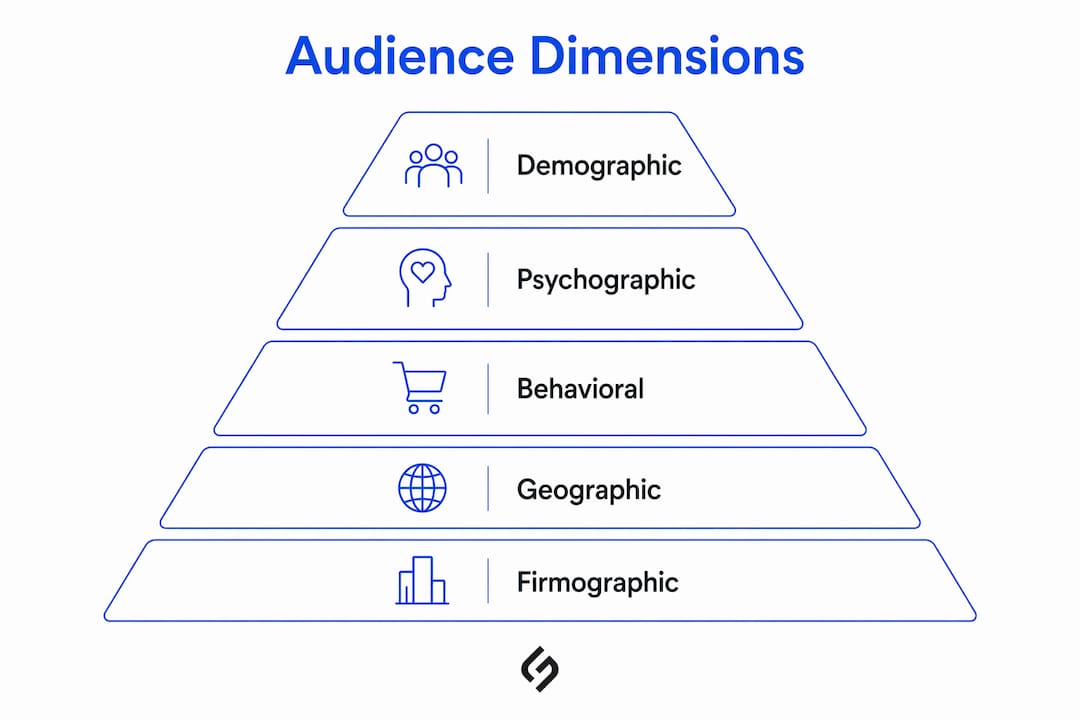
| Dimension | Key signals to measure | Quick messaging example |
|---|---|---|
| Demographic | Age, income, gender, education, occupation | A retirement planning ad targets adults aged 55–65 with household income above $100K |
| Psychographic | Values, motivations, lifestyle, personality | A sustainable apparel brand targets eco-conscious buyers who prioritize ethical sourcing |
| Geographic | Region, city size, climate, urban/rural | A snow-removal service focuses on homeowners in the Upper Midwest and New England |
| Behavioral | Purchase frequency, product usage, brand loyalty | A SaaS tool retargets users who logged in fewer than three times in 30 days |
| Purchase intent | Active search behavior, comparison shopping, recent category engagement | A car dealership targets users who visited review sites in the past two weeks |
| Subculture/Lifestyle | Community membership, hobbies, media consumption | A gaming peripheral brand targets competitive esports players who stream on Twitch |
Demographics are the easiest to measure, but they rarely explain why someone buys. Psychographics — motivations, pain points, and values — are what make messaging build loyalty rather than just generate one-time clicks. The most actionable segments combine at least two dimensions: a demographic filter narrows the pool, and a behavioral or intent signal confirms readiness to buy.
For a deeper look at how to layer these signals into segments, Solution4guru’s customer segmentation guide covers when to combine demographic and behavioral data for maximum precision.
A step-by-step process to identify and prioritize your audience
This sequence moves from product-fit analysis to a testable audience hypothesis. Follow it in order; skipping steps two or three is the most common reason teams end up with personas that feel accurate but do not convert.
Map product benefits to customer problems. List every concrete outcome your product delivers, then write the specific problem each outcome solves. This produces a raw list of potential audience types defined by need, not by assumption.
Analyze first-party customer data. Pull your top 20% of customers by revenue, retention, or engagement. Look for shared characteristics: job title, company size, purchase trigger, geographic cluster, or usage pattern. First-party data is more accurate than any purchased list because it reflects real behavior with your product. AI-assisted analysis tools can accelerate this step significantly — see Solution4guru’s AI for customer insights guide for practical SMB-scale approaches.
Run lightweight market research. Customer interviews (even five to eight conversations) surface motivations that data alone cannot show. Supplement with social listening on Reddit, LinkedIn, or niche forums, and review your existing survey or NPS data. DHL’s small-business guidance recommends combining interviews, data review, and analytics tools as the core research stack.
Scan competitors for underserved segments. Review competitor messaging, ad copy, and content to identify the audiences they are not speaking to. Look for communication gaps rather than copying their positioning verbatim. A competitor communications scan often reveals adjacent segments you can test rapidly with a low-cost pilot. The AMA confirms this approach as a reliable method for finding underserved adjacent segments.
Build prioritized segments and select 1–2 for testing. Score each candidate segment on three criteria: size (is it large enough to matter?), accessibility (can you reach them through available channels?), and fit (does your product solve their primary problem better than alternatives?). Pick the top one or two.
Launch readiness checklist:
- Audience definition written as a single sentence with a named KPI hypothesis
- First-party data pull completed and top-20% customer profile documented
- At least one research method completed (interviews, survey, or social listening)
- Competitor gap identified and documented
- Test channel selected and budget allocated
- Measurement baseline established before the test launches
How do you build buyer personas, and what do they look like?
A persona is a named, composite profile of a real audience segment. It is not a fictional character — it is a synthesis of patterns found in actual customer data and research. The goal is a profile specific enough that a copywriter can write to it without asking follow-up questions.

Persona template
| Field | What to fill in |
|---|---|
| Name & role | A first name and job title or life stage (e.g., “Marcus, VP of Operations”) |
| Demographic | Age range, income band, location, education level |
| Primary goal | The one outcome they are trying to achieve |
| Primary pain point | The specific friction blocking that outcome |
| Preferred channels | Where they consume information (LinkedIn, email, YouTube, etc.) |
| Key objections | The top 1–2 reasons they might not buy |
| 1-line value proposition | “For [persona], [product] delivers [outcome] by [mechanism].” |
Three short persona examples
B2C persona — “Priya, 34, suburban homeowner”
Priya manages a household budget carefully and researches purchases extensively before buying. Her primary goal is finding home services that show up reliably and communicate proactively. Her main objection is price transparency. Messaging that leads with a fixed-price guarantee and same-day confirmation converts better than messaging that leads with brand history.
B2B persona — “Marcus, VP of Operations at a 50-person logistics firm”
Marcus evaluates software on implementation time and integration with existing tools, not on feature lists. His primary pain point is that new platforms disrupt his team’s workflow during onboarding. For B2B vs. B2C segmentation, the decision trigger is a peer referral or a case study from a comparable company — not a cold outreach email.
Niche/subculture persona — “Jordan, competitive home barista”
Jordan spends time in specialty coffee forums, follows roasters on Instagram, and buys equipment based on community reputation rather than retail availability. Channel: niche newsletters and YouTube reviews. Messaging that uses technical terminology correctly earns trust; generic “great coffee at home” copy signals the brand does not understand the community.
Anti-personas: who not to target
Explicitly documenting who you will not target is as valuable as defining who you will. An anti-persona might be a customer segment that generates high support volume, low lifetime value, or frequent refund requests. Removing them from paid-media targeting rules reduces wasted spend and keeps your conversion data clean. Document one or two anti-personas alongside each primary persona.
Which tools and KPIs help you validate your audience?
Defining an audience is a hypothesis. Validation is the test that confirms or refutes it. The following tools and methods are practical for U.S.-based teams at SMB scale.

| Tool / Method | Primary metric it informs | Best use case |
|---|---|---|
| Google Analytics 4 (GA4) | Conversion rate by audience segment, session quality | Validate which demographic/behavioral cohort converts on-site |
| Meta Ads Manager | CPA, frequency, relevance score | Small-budget paid-media pilots to test audience response |
| Email platform analytics (Mailchimp, Klaviyo, HubSpot) | Open rate, click-to-open rate, conversion rate by segment | Email segment tests to compare two audience definitions head-to-head |
| CRM reporting (Salesforce, HubSpot CRM) | LTV-to-CPA ratio, retention by cohort | Identify which acquired segments have the highest long-term value |
| Social platform analytics (LinkedIn, Instagram Insights) | Engagement rate, follower demographics | Confirm whether organic content reaches the intended audience |
| Customer interviews | Qualitative: motivation, objection, language | Validate psychographic assumptions before scaling paid spend |
KPI checklist for early-stage audience tests:
- Acquisition CPA vs. baseline
- Conversion rate (landing page or product page)
- LTV-to-CPA ratio after 60 days
- Engagement rate (for content-led channels)
- Sample size: aim for at least 100 conversions per variant before drawing conclusions
Audience definitions should be reviewed at least once per year and immediately after any major market disruption, product change, or significant shift in campaign performance.
Pro Tip: Before running a paid test, send a five-question survey to your existing email list asking respondents to describe their primary challenge in their own words. The language patterns that emerge are more reliable than any demographic filter — and they cost nothing to collect.
Key Takeaways
Defining your target audience with first-party data, psychographic depth, and a testable one-sentence hypothesis produces better campaign results than any amount of creative polish applied to a vague segment.
| Point | Details |
|---|---|
| Start with first-party data | Pull your top 20% of customers by revenue or engagement before building any persona. |
| Combine dimensions | Demographics alone are insufficient; add behavioral or intent signals to form a testable segment. |
| Write a one-sentence definition | Every audience hypothesis should name the segment, the problem, and the expected KPI outcome. |
| Validate before scaling | Run a small-budget pilot or email segment test and require at least 100 conversions before drawing conclusions. |
| Review annually | Revisit audience definitions at least once per year or after any major market or product shift. |
| Solution4guru’s approach | Solution4guru offers persona workshops, analytics setup, and test planning to help teams move from hypothesis to validated audience faster. |
What most teams get wrong when defining their audience
The most consistent mistake is conflating audience definition with demographic profiling. Teams spend hours debating whether their customer is 28 or 35, male or female, and then write a campaign brief that could apply to either. Demographics narrow the pool; they do not explain the decision. The teams that produce the most useful personas are the ones that spend the most time on the psychographic layer — specifically, the primary fear or frustration that makes a person search for a solution in the first place.
A second pattern worth naming: teams treat the first audience definition as permanent. They run one campaign, see mediocre results, and conclude the product does not have market fit. The more accurate diagnosis is usually that the audience hypothesis was wrong, not the product. Audience definition is an iterative process, not a one-time deliverable.
One anonymized example from agency work illustrates the point. A B2B software client had defined their audience as “IT managers at mid-size companies.” After reviewing first-party CRM data, the actual pattern was “operations managers at companies undergoing a compliance audit who needed a solution within 90 days.” The same product, a completely different audience definition. Switching the paid-media targeting to that intent-and-timing signal cut CPA by roughly half within two months.
The question of when to bring in outside help is straightforward. If your team lacks the analytics infrastructure to pull cohort-level data, if you are entering a new market segment with no existing customers to analyze, or if internal capacity is genuinely limited, an external agency or consultant accelerates the process significantly. The value is not the framework — most frameworks are publicly available. The value is the speed and the pattern recognition that comes from having run the process across multiple industries.
Solution For guru helps you move from audience hypothesis to validated segments
Audience definition is where most digital marketing projects stall. The research is clear on what to do; the gap is execution capacity and analytics infrastructure. Solution4guru works with small businesses, startups, and growth-stage teams to close that gap through persona workshops, first-party data analysis, test planning, and GA4 or CRM analytics setup.
The agency’s digital marketing for startups service covers the full sequence: from initial audience research and persona development through channel selection and paid-media pilot design. Deliverables for an audience-definition engagement typically include a documented audience definition, two to three validated personas with anti-persona notes, a channel recommendation, and a 30-day test plan with KPI baselines. For teams that need a broader view of how audience data connects to web performance and conversion, the Solution4guru homepage is the starting point for a free consultation.
Useful sources and tools for further research
The following resources are authoritative starting points for U.S.-based marketers who want to go deeper on audience research and validation.
American Marketing Association — Target Audience Guide — The AMA’s practical breakdown of audience dimensions and competitor-gap analysis; reliable as a methodology reference.
Salesforce — Target Audience Definition — Covers the market-vs.-audience distinction and persona field guidance; useful for CRM-integrated teams.
Adobe Express — 5 Steps to Identify Your Target Audience — Concise five-step sequence with emphasis on psychographics and testing; good for teams building their first process.
Forbes Communications Council — How to Identify Your Target Audience — Practitioner-level guidance on first-party data prioritization and annual review cadence.
DHL Small Business — 7 Steps to Define Your Target Audience — Practical research methods including interviews, competitor analysis, and analytics tools; written for SMB scale.
Marketing Evolution — Target Audience Essentials — Covers the cost of poor targeting and the role of intent-based segmentation in reducing wasted spend.
Harvard Business School Online — Why Target Audience Matters — Academic grounding for the ROI case; useful for stakeholder presentations.
Pew Research Center — Americans and Privacy — U.S.-specific data on consumer attitudes toward data collection; relevant context for first-party data strategy.
Solution4guru — Customer Segmentation Guide — Covers psychographic segmentation and when to combine demographic and behavioral signals for SMB campaigns.
Solution4guru — Role of Data in Marketing — Practical guidance on building a data-informed marketing strategy, including audience validation frameworks.
On data and privacy: U.S. marketers building first-party data programs should stay current with state-level privacy regulations (California’s CPRA, for example) and platform data policies. Pew Research Center’s ongoing consumer privacy research is a useful benchmark for understanding how your audience perceives data collection.
FAQ
A target audience is the specific group of people most likely to buy your product, defined by shared demographic, behavioral, or psychographic characteristics that make a single message relevant to all of them.
What are the four main types of target audiences?
The most commonly used classification dimensions are demographic (age, income, occupation), psychographic (values, motivations, lifestyle), behavioral (purchase frequency, product usage), and intent-based (active search behavior, comparison shopping). Geographic segmentation is a fifth dimension frequently added for location-dependent products or services.
Classification starts with demographic filters to narrow the pool, then adds psychographic or behavioral signals to explain the buying decision. A complete audience description names the segment, the primary problem they are solving, and the channel where they are most reachable.
Audience definitions should be reviewed at least once per year and immediately after any major market disruption, product change, or significant drop in campaign performance, per guidance from Forbes Communications Council.
A target audience is a segment-level definition used for campaign targeting and channel selection. A buyer persona is a named, composite profile of a representative individual within that segment, used to guide creative, messaging, and content strategy.
Recommended
- How to Increase Website Conversions: 2026 Guide – Solution for Guru
- Customer Segmentation: A 2026 Guide for Marketers – Solution for Guru
- Lead Nurturing Techniques That Convert Prospects in 2026 – Solution for Guru
- Email Marketing Essentials: Grow Your Business with Effective Campaigns – Solution for Guru