How to Set Business Goals: A Practical SMB Guide

TL;DR:
- Setting 3 to 5 outcome-based business goals aligned with KPIs and broken into 90-day milestones enhances execution. Regular weekly updates and clear ownership ensure progress and accountability, reducing the risk of missed targets. Using frameworks like SMART and OKRs helps structure ambitions and maintain strategic focus across functions.
Set 3–5 outcome-based goals, align each to one KPI, and break them into 90-day milestones — that is the core of how to set business goals that actually get executed. Before the end of this week, take three concrete steps:
- Pick your top 3 strategic priorities for the next quarter.
- Assign one measurable KPI to each priority.
- Schedule a 90-day planning session with your leadership team or key stakeholders.
Three quick examples of what this looks like in practice:
- Revenue: “Increase monthly recurring revenue significantly by the end of September.”
- Marketing: “Generate a strong flow of qualified leads each month through paid search by the end of the quarter.”
- Operations: “Reduce order fulfillment time substantially by the end of August.”
Each example names a starting point, a target, and a deadline. That structure is not accidental — it is the foundation of every section that follows.
Table of Contents
- Why business goals matter more than most SMBs realize
- Which goal-setting framework should you use?
- How to set business goals in five phases
- SMART goal templates and examples across business functions
- How do you prioritize goals without overloading your team?
- How to cascade goals and make them part of daily work
- Selecting KPIs and building a reporting rhythm
- Common goal-setting mistakes and how to fix them fast
- What tools and templates should you use?
- When should you hire external help for goal setting?
- Key Takeaways
- The part of goal setting most guides skip
- How Solution4guru helps you move from goal setting to execution
- Useful sources and further reading
- FAQ
Why business goals matter more than most SMBs realize
A business goal is an outcome-focused, time-bound target that connects daily work to your company’s mission and strategy. It answers the question: “Where do we need to be, and by when?” That is different from an objective, which describes the specific steps and measures used to reach the goal. A task, by contrast, is a discrete action — “redesign the homepage” — with no inherent outcome attached.

The distinction matters because confusing tasks with outcomes is one of the most common reasons SMBs miss their targets. “Redesign the homepage” is a task. “Increase homepage conversion rate by Q3” is a goal.
Three core benefits make clear goal-setting worth the effort for small and medium-sized businesses specifically. First, goals force prioritization: when resources are limited, a written goal list makes it obvious what to fund and what to defer. Second, they create alignment — every team member can see how their work connects to a shared outcome. Third, they generate measurable progress data, which makes course-correction possible before a problem becomes a crisis. According to an Economist study cited by Harvard Business School, 90% of senior executives at large companies admitted failing to reach all their strategic goals because of poor implementation. For SMBs with fewer resources to absorb missed targets, that execution gap is even more costly.
A balanced scorecard — combining financial, customer, internal-process, and learning-and-growth perspectives — helps protect against the trap of optimizing one dimension while degrading another. Many businesses hit a revenue target while quietly eroding customer satisfaction or team capacity. Tracking all four dimensions keeps the business healthy across the board.
Which goal-setting framework should you use?
Two frameworks dominate practical business goal planning: SMART and OKRs. Both are useful; neither is universally superior. The choice depends on what you are trying to accomplish and over what timeframe.
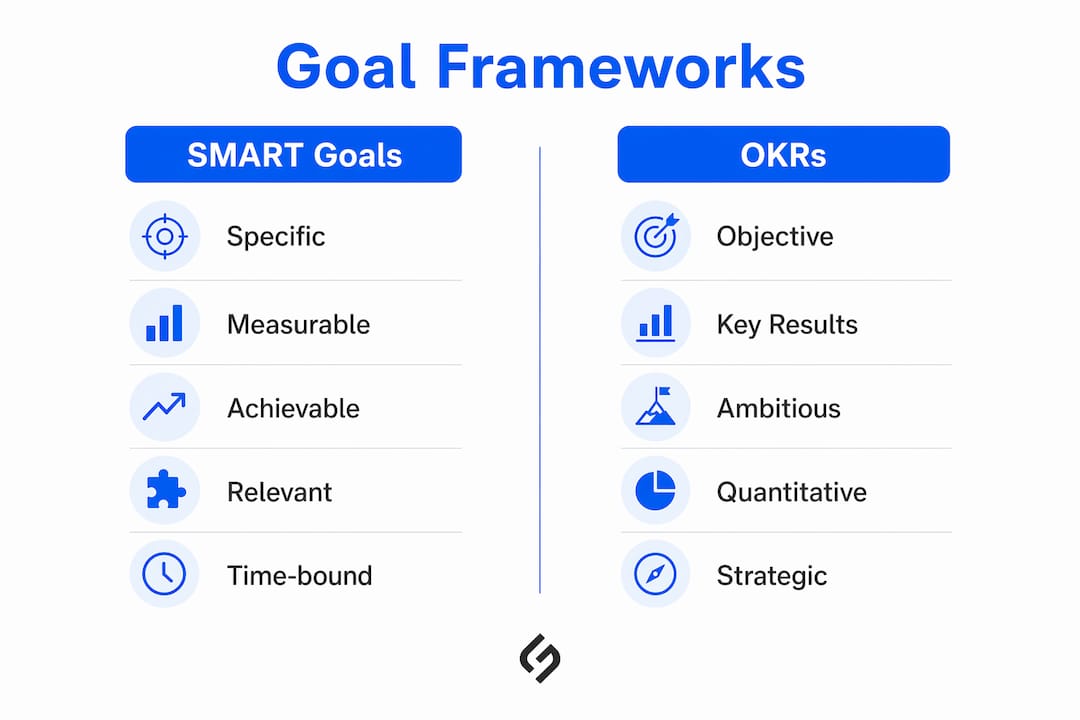
SMART stands for Specific, Measurable, Achievable, Relevant, and Time-bound. The SMART framework structures ambitions into trackable outcomes by forcing specificity at the point of writing. A goal that passes all five criteria is almost always executable — you know what success looks like, how to measure it, and when it is due.
OKRs (Objectives and Key Results) pair an ambitious, qualitative objective with two to four quantitative key results. OKRs are designed for stretch: the objective is aspirational, and hitting 70% of a key result is considered a success. They work best for cross-functional alignment and annual strategic direction.
| Dimension | SMART Goals | OKRs |
|---|---|---|
| Purpose | Tactical execution with guaranteed outcomes | Strategic stretch and cross-functional alignment |
| Cadence | 30-day, 90-day cycles | Quarterly or annual |
| Best fit | Department-level targets, operational goals | Company-wide priorities, product or growth bets |
| Example phrasing | “Reduce order fulfillment time substantially by the end of August.” | “Objective: Become the fastest-responding team in our market. KR1: Resolve the majority of tickets quickly by Q3” |
Pro Tip: Use OKRs for your one or two annual strategic priorities and SMART goals for the 90-day tactical objectives that ladder up to them. This gives you both the ambition of a stretch target and the precision of a measurable plan.
How to set business goals in five phases
This process can run as a half-day leadership workshop or spread across a planning week. Each phase has a specific output so the team leaves with a working document, not just a conversation.
Assess current state. Collect 3–5 data points that describe where the business stands today: revenue trend, customer retention rate, operational throughput, team capacity, and one market signal (competitive shift, demand change, or regulatory update). This baseline prevents goal-setting from becoming wishful thinking. For teams managing technology-related objectives, linking department-specific IT goals to broader business priorities is a useful starting point — the ITSM strategy framework from Solution4guru covers this well.
Define outcome-based targets. Write each goal as an outcome, not a task. The test: does the goal describe a result the business will be in, or an activity the team will perform? “Launch a new campaign” fails the test. “Increase qualified leads by 20% through a new campaign by Q4” passes it. Every goal should follow the “From X to Y by When” structure.
Prioritize using impact vs. effort. Score each candidate goal on two dimensions: expected business impact (high/medium/low) and execution effort (high/medium/low). High-impact, low-effort goals go first. High-impact, high-effort goals require a resource plan before committing. Limit the shortlist to 3–5 goals per cycle — when everything is a priority, nothing is.
Establish KPIs and a reporting cadence. For each goal, choose one leading measure (an activity that predicts the outcome) and one lagging measure (the outcome itself). Combining lead and lag measures increases the likelihood of hitting objectives because you can intervene before the lagging number goes wrong. Set a weekly check-in and a monthly review as the minimum cadence.
SMART goal templates and examples across business functions
The SMART writing pattern follows a simple structure: “[Action verb] [specific metric] from [baseline] to [target] by [date].” The key conversion move is replacing task language with outcome language. “Train the sales team” becomes “Increase average deal size from $3,200 to $4,000 by December 31 through targeted sales coaching.”
Here are 12 ready-to-use examples organized by function:
Revenue
- Grow monthly recurring revenue from $42,000 to $50,000 by September 30.
- Increase average order value from $85 to $110 by Q4 through upsell prompts at checkout.
- Close 8 new enterprise accounts (minimum $15,000 ARR each) by year-end.
Marketing
- Generate 150 qualified leads per month via paid search by the end of Q3.
- Reduce customer acquisition cost from $220 to $160 by December 31.
- Grow the email subscriber list from 4,200 to 7,000 by October 31. Avoiding common digital marketing pitfalls during this process keeps measurement clean from the start.
Product / Operations
- Reduce order fulfillment time substantially by the end of August.
- Decrease software bug backlog from 120 open items to fewer than 30 by Q3.
- Launch two new product features with a Net Promoter Score above 40 by year-end.
HR / People
- Reduce voluntary employee turnover from 18% to 12% by December 31.
- Complete skills assessments for 100% of the engineering team by July 15.
- Fill all three open senior roles within 60 days of posting, at or below a $4,500 cost-per-hire.
For 30-day goals, compress the baseline-to-target gap and focus on one leading activity. For annual goals, set quarterly checkpoints so the team can recalibrate without waiting until December to discover a miss.
How do you prioritize goals without overloading your team?
The shortlist rule is simple: no more than 3–5 goals per planning cycle. Research consistently shows that teams working toward fewer, well-defined goals outperform those juggling many simultaneous targets. The reason is cognitive and operational — every additional goal splits attention, dilutes resources, and increases coordination overhead.

A practical prioritization matrix scores each candidate goal on two axes:
| Goal | Impact (H/M/L) | Effort (H/M/L) | Priority |
|---|---|---|---|
| Grow MRR to $50K | H | M | Act now |
| Launch new product line | H | H | Plan with resources |
| Redesign internal reporting | M | L | Quick win |
| Enter new geographic market | H | H | Defer or pilot |
| Improve onboarding NPS | M | M | Next cycle |
Score each goal before the planning session ends. Goals in the “Act now” quadrant go on the active list. Everything else gets deferred, deprioritized, or broken into a smaller pilot.
Three red flags signal goal overload in an organization:
- More than five active KPIs per team with no clear hierarchy.
- Goals without a named single owner (shared ownership usually means no ownership).
- No lead measures — only lagging outcomes tracked after the fact.
When these appear, the fix is to cut the list, assign one owner per goal, and add at least one leading indicator to each remaining target.
How to cascade goals and make them part of daily work
A company-level goal only drives results when it splits into team goals and individual milestones. This cascade is what connects the boardroom to the daily standup. A revenue goal of “grow MRR by 20%” becomes a sales team goal of “close 8 new accounts,” which becomes an individual rep goal of “conduct 15 discovery calls per week.” Each level is specific, owned, and traceable back to the company objective.
Cascading objectives with visible scoreboards and regular accountability meetings is the mechanism that keeps goals alive between planning sessions. Without it, goals become static documents reviewed once a quarter and forgotten in between.
Meeting integration checklist:
- Weekly stand-up (15 minutes): Each owner reports one number — the lead measure for their goal. No narrative, just the metric and a flag if it is off track.
- Monthly review (60 minutes): Review lagging KPIs, assess milestone completion, and decide whether any goal needs adjustment.
- One-on-one check-ins: Managers discuss individual milestone progress and remove blockers before they compound.
A scoreboard should show three things: the goal, the current number, and the target. Nothing else. Cluttered scoreboards with ten metrics create the same problem as too many goals — no one knows what to act on. A single shared document or a lightweight dashboard visible to the whole team is enough for most SMBs.
Selecting KPIs and building a reporting rhythm
The most common KPI mistake is tracking outputs instead of outcomes. Page views, emails sent, and meetings booked are outputs. Revenue generated, customer retention rate, and net new qualified leads are outcomes. Choose KPIs that indicate whether the goal is being achieved, not just whether the team is busy.
Leading vs. lagging measures:
- Leading (predictive): Weekly discovery calls booked, new content pieces published, outbound sequences launched. These are controllable and tell you whether you are on track before the final number lands.
- Lagging (outcome): Monthly revenue, customer churn rate, net promoter score. These confirm whether the goal was hit, but too late to course-correct within the cycle.
For tracking KPIs effectively, pair one leading measure with one lagging measure per goal. That combination gives you both early warning and final confirmation.
Reporting template (weekly):
| Goal | Lead Measure (this week) | Lag Measure (MTD) | Status |
|---|---|---|---|
| Grow MRR to $50K | 12 discovery calls | $44,200 MRR | On track |
| Reduce fulfillment to 2 days | 3 process changes tested | 3.1 days avg | At risk |
Timeline guidance:
- 30-day goals: Operational fixes, quick wins, pilot tests. Review weekly.
- 90-day goals: Tactical growth targets, campaign performance, hiring milestones. Review monthly with weekly lead-measure check-ins.
- Annual goals: Strategic direction, market expansion, major product launches. Review quarterly with monthly KPI updates.
Common goal-setting mistakes and how to fix them fast
Most goal failures trace back to a handful of recurring errors. Each one has a direct corrective action:
- Vague goals (“improve customer experience”): Rewrite using “From X to Y by When” — “Increase CSAT score by December 31.”
- Tasks masquerading as goals (“launch a new website”): Add the outcome — “Increase website conversion rate from 1.8% to 3.2% by Q4 through a redesigned homepage.”
- Too many goals at once: Cut the list to 3–5 per cycle. Every goal above five reduces the probability of hitting any of them.
- No single owner: Assign one name per goal. “The team” owns nothing; a named person owns everything.
- Missing lead measures: Add one predictive indicator per goal so the team can course-correct before the lagging number goes wrong.
- Goals disconnected from strategy: Every goal should trace back to a company-level priority. If it does not, defer it.
Pro Tip: Before finalizing any goal, run it through this test: “If we hit this number, will it meaningfully move the business forward?” If the answer is uncertain, the goal is probably a task in disguise or a vanity metric.
Avoiding common digital marketing measurement mistakes is especially relevant for marketing goals, where proxy metrics like impressions and clicks often crowd out the outcome metrics that actually matter.
What tools and templates should you use?
The right tool depends on your team size and goal complexity. Most SMBs do not need specialized software to start — they need a consistent format and a shared location.
Tool categories and what each solves:
- Shared documents (Google Docs, Notion): Goal definitions, owner assignments, and milestone tracking for teams of 2–15. Low overhead, easy to update, visible to everyone.
- Lightweight project boards (Trello, Asana, Monday.com): Task-level tracking within a goal’s milestone plan. Useful when a goal has multiple contributors and sequential steps.
- Dashboards (Google Looker Studio, Databox): Automated KPI visualization pulling from existing data sources. Best when lead and lag measures already live in a CRM or analytics platform.
- OKR software (Lattice, Perdoo, Weekdone): Purpose-built for cascading OKRs across teams, tracking key results, and running check-in workflows. Worth the investment when you have more than three teams running parallel goal cycles.
Keep it simple until complexity demands otherwise. A well-maintained spreadsheet with goal definitions, owners, KPIs, and weekly status columns outperforms an underused OKR platform every time. Upgrade to dedicated software when cross-team alignment and integrated KPI tracking become the bottleneck, not before. For SMBs working through digital transformation challenges, aligning technology tool choices with goal-tracking needs early prevents costly platform switches later.
When should you hire external help for goal setting?
Three signals indicate it is time to bring in an outside consultant or agency:
- The leadership team has set goals for two or more consecutive cycles and missed them without a clear diagnosis of why.
- There is no internal capacity to run a structured planning process — the team is fully consumed by day-to-day operations.
- Goals need to cascade across three or more functions with no existing alignment mechanism.
Agency brief template (copy and adapt):
- Objectives: Define 3–5 company-level goals for the next 12 months and cascade them to team level.
- Deliverables: Goal workshop facilitation, KPI dashboard setup, 90-day execution roadmap.
- Timeline: 4–6 weeks from kickoff to first scoreboard live.
- KPIs: Goal clarity score (team survey), milestone completion rate at 30 days, lead measure tracking adoption.
- Team involvement: Two half-day sessions with leadership; one follow-up with department heads.
Selection checklist when evaluating consultants or agencies:
- Demonstrated experience with SMBs of similar size and industry.
- Transparent pricing with a defined scope (avoid open-ended retainers for a first engagement).
- References from clients who ran goal cycles, not just strategy decks.
- Willingness to run a pilot engagement before a full commitment.
- A case-study skeleton they can share: what the client’s starting state was, what goals were set, and what results were measured at 90 days.
Key Takeaways
Effective business goal planning requires outcome-based targets, a shortlist of 3–5 priorities per cycle, a single named owner per goal, and a weekly check-in cadence to keep execution on track.
| Point | Details |
|---|---|
| Use the SMART structure | Write every goal as “From X to Y by When” to make targets specific, measurable, and time-bound. |
| Limit to 3–5 goals per cycle | Fewer goals drive better execution; more than five splits focus and reduces the probability of hitting any. |
| Pair lead and lag measures | One predictive indicator plus one outcome KPI per goal gives early warning and final confirmation. |
| Cascade with a named owner | Every goal needs one accountable person and visible milestones at the team level to move from plan to action. |
| Solution4guru as your next step | Solution4guru offers goal workshops, KPI dashboard setup, and 90-day execution roadmaps for SMBs ready to operationalize their strategy. |
The part of goal setting most guides skip
Most goal-setting content treats the planning session as the hard part. It is not. The hard part is the six weeks after the session, when daily urgency competes with quarterly priorities and the scoreboard stops getting updated.
The conventional advice — “set SMART goals and review them monthly” — is technically correct and practically insufficient. A monthly review cadence is too slow to catch a goal drifting off track. By the time the monthly meeting arrives, a team can be three weeks behind with no early warning. Weekly lead-measure check-ins, even a 10-minute async update in a shared document, change this dynamic entirely. They create a rhythm where problems surface when they are still fixable.
There is also a structural mistake that even experienced operators make: setting goals at the company level and stopping there. A company goal with no team-level cascade is a wish, not a plan. The cascade is not administrative overhead — it is the mechanism that converts strategy into daily behavior. When a sales rep knows that their 15 discovery calls per week directly feeds the company’s MRR target, the goal becomes personal. That connection is what drives consistent execution, not motivational language in a planning deck.
One more observation worth stating plainly: goals should be stable enough to guide decisions but flexible enough to survive contact with reality. Strategic objectives can hold for 12 months. Tactical goals should be reviewed and adjusted at 90 days without apology. Treating a 90-day goal as immutable when the market has shifted is not discipline — it is rigidity. Build the review cadence into the plan from day one so adjustment feels like good management, not failure.
How Solution For guru helps you move from goal setting to execution
Setting goals is the starting point. Turning them into a running system — with dashboards, accountability rhythms, and technology aligned to your priorities — is where most SMBs need support.
Solution4guru works with small and medium-sized businesses to design and run that system. An engagement typically follows five steps: a current-state audit, a goal-setting workshop with leadership, a 90-day execution roadmap with milestones and owners, a pilot sprint to validate the plan, and scoreboard setup so progress is visible to the whole team. The result is not a strategy deck — it is a live operating system your team uses every week.
For businesses focused on revenue growth or digital marketing goals, Solution4guru brings both the strategic framework and the technical execution capability to make those goals measurable from day one. Book a free consultation at solution4guru.com to discuss your next planning cycle and what a 90-day roadmap would look like for your business.
FAQ
SMART goals are targets that are Specific, Measurable, Achievable, Relevant, and Time-bound. The framework converts vague ambitions into trackable outcomes — for example, “increase monthly revenue from $42,000 to $50,000 by September 30” rather than “grow revenue.”
Most teams work best with 3–5 goals per planning cycle. Fewer goals concentrate resources and attention, which consistently produces better execution outcomes than spreading effort across many simultaneous targets.
A business goal describes the broad outcome the company wants to reach — “become the leading provider in our region.” A business objective is the specific, measurable step that gets you there — “grow regional revenue by 15% by year-end.”
SMART is a framework, not a list of five goals. The five criteria are: Specific (clear and precise), Measurable (trackable with a number or benchmark), Achievable (realistic given available resources), Relevant (connected to company strategy), and Time-bound (with a defined deadline).
Weekly check-ins on lead measures and monthly reviews of lagging KPIs are the recommended minimum cadence. This rhythm surfaces problems early enough to course-correct within the planning cycle rather than discovering a miss at the end of the quarter.