Business Continuity Planning: A Manager’s Quick-Start Guide

TL;DR:
- Business continuity planning involves documenting how organizations sustain critical operations during disruptions by assigning clear ownership and focusing on people, processes, premises, and providers. Regular testing, proper governance, and tiered recovery objectives are essential for operational resilience, not just compliance. Planning is an ongoing management discipline requiring continuous updates, stakeholder involvement, and practical drills to remain effective.
Business continuity planning (BCP) is the process of documenting how your organization will keep critical operations running during and after a significant disruption. The single most practical first step: appoint a named plan owner this week and schedule a one-page business impact snapshot within 30 days.
A well-built BCP covers people, processes, premises, and providers — the four dimensions most organizations overlook when they focus only on IT recovery. It integrates with but is broader than disaster recovery planning, which addresses technical restoration of systems and data. Think of DR as a chapter inside your BCP, not a substitute for it.
Table of Contents
- What does business continuity planning actually cover?
- What are the core components of a business continuity plan?
- How do you build a business continuity plan in five steps?
- How do RTO and RPO shape your recovery design and cost?
- How should you test your business continuity plan?
- Who owns the plan, and how should governance work?
- How long does it take to build a plan, and what does it cost?
- Where can you find official US templates and training resources?
- What expert recommendations and common mistakes should you know?
- Key Takeaways
- Why most BCPs fail before the first real incident
- FAQ
- Authoritative sources and further reading
What does business continuity planning actually cover?
Business continuity is an organizational capability, not a single document. It spans every function that must keep operating when a hurricane, cyberattack, supplier failure, or pandemic disrupts normal conditions.
Who needs a formal plan?
- Any organization subject to federal or state regulatory requirements (financial institutions, healthcare providers, critical infrastructure operators)
- Businesses with revenue-generating processes that cannot tolerate more than a few hours of downtime
- Companies with complex supplier chains or single points of failure in staffing or technology
- Organizations that have experienced a disruptive incident and lacked a coordinated response
Smaller businesses can start with a lightweight, two-to-three-page plan covering their top five critical functions. Enterprises typically need a tiered program with documented playbooks per business unit. The FDIC’s BCP guidance notes that many organizations confuse DR and BCP, focusing only on IT recovery and leaving people, premises, communications, and supply chain continuity completely unaddressed.
Tangible benefits of having a plan:
- Reduced downtime and faster return to normal operations
- Reputational protection with customers, partners, and regulators
- Regulatory readiness (SOC 2, HIPAA, FFIEC, and similar frameworks all reference continuity requirements)
- Lower insurance premiums in some coverage categories
- Clearer decision-making authority during a crisis, which reduces costly improvisation
What are the core components of a business continuity plan?
IBM’s research on business continuity identifies four consistently effective elements: risk assessment, business impact analysis, recovery strategies, and validation through testing and maintenance. Governance and communications round out the canonical list.
- Risk assessment — Identify threats (natural disasters, cyber incidents, utility failures, key-person loss) and evaluate their likelihood and potential impact on operations.
- Business impact analysis (BIA) — Map critical business functions, quantify the financial and operational cost of disruption over time, and set Recovery Time Objectives (RTO) and Recovery Point Objectives (RPO) for each function.
- Recovery strategies — Define how each critical function will be restored: alternate work sites, manual workarounds, backup suppliers, data replication, and staffing contingencies.
- Roles and responsibilities — Assign a named owner to every recovery action. Unowned tasks do not get executed under stress.
- Communications plan — Document how you will notify employees, customers, regulators, and the media during an incident, including backup communication channels.
- Testing and maintenance — Schedule structured exercises and a documented review cadence so the plan stays current as systems, suppliers, and staff change.
These components map directly to common regulatory frameworks. NIST SP 800-34 Rev. 1 defines a BCP as “the documentation of a predetermined set of instructions or procedures that describe how an organization’s mission/business processes will be sustained during and after a significant disruption.”
Pro Tip: Keep each component to one or two pages of actionable content. A 200-page BCP that no one reads is operationally worthless. Prioritize role-based action cards over narrative prose.
How do you build a business continuity plan in five steps?
The sequence below follows the business continuity planning lifecycle recommended by the Canadian Centre for Cyber Security and aligns with Ready.gov’s US-focused guidance.
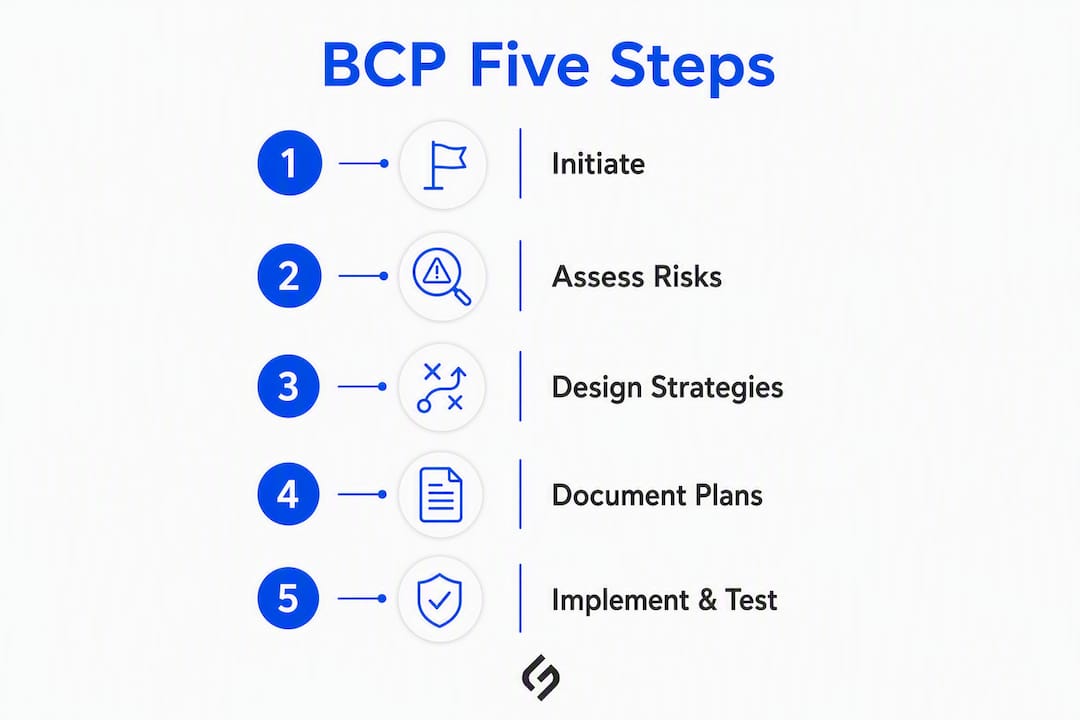
Step 1: Initiate
Secure executive sponsorship, define the scope (which business units and functions are in scope), and conduct an initial inventory of critical processes, systems, staff, and suppliers. Assign a BCP program owner with authority to convene stakeholders.
Step 2: Conduct the BIA and risk assessment
Prioritize services by criticality and set tiered RTO and RPO targets for each. A Tier 1 payment processing function might require a short RTO; a Tier 3 internal reporting function might tolerate a much longer RTO. The BIA output drives every downstream decision about recovery architecture and cost.

Step 3: Design recovery strategies
For each critical function, document the recovery approach across four dimensions: people (cross-training, remote work, contractor surge), premises (alternate sites, work-from-home protocols), processes (manual workarounds, priority sequencing), and providers (backup suppliers, contract clauses). Cloud-based recovery options have significantly reduced the cost of warm and hot standby architectures for mid-market organizations.
Step 4: Document playbooks and communications
Write role-based action cards, not narrative paragraphs. Each card should state: who does what, by when, using which tool or backup channel. Google Cloud’s DR guidance recommends making technical recovery steps precise, for example specifying the exact script path and flags rather than writing “restore the database.” Vague instructions cause costly errors under pressure.

Step 5: Implement, train, and schedule continuous review
Distribute the plan, run an initial tabletop exercise within 60 days of completion, and set a formal review cadence (at minimum annually, and after any significant system change or real incident). Integrate change management so updates happen automatically when suppliers, systems, or staff change.
Quick-start checklist:
- [ ] Named BCP owner appointed
- [ ] Scope defined (functions in/out)
- [ ] Critical functions inventoried
- [ ] BIA completed with RTO/RPO per function
- [ ] Recovery strategies documented
- [ ] Role-based action cards written
- [ ] Contact lists verified
- [ ] First tabletop exercise scheduled
Pro Tip: For your first exercise, scope it to a single scenario — a ransomware attack or a primary-site power failure — rather than a full-scale multi-threat simulation. A focused, 90-minute tabletop with the right people produces more actionable findings than a sprawling all-day event.
How do RTO and RPO shape your recovery design and cost?
RTO and RPO are the two primary quantitative metrics that drive every technical and financial decision in a continuity program.
Recovery Time Objective (RTO) is the maximum acceptable duration of downtime for a given function or system before the business suffers unacceptable harm. An RTO of four hours means the function must be restored within four hours of a disruption.
Recovery Point Objective (RPO) is the maximum acceptable amount of data loss measured in time. An RPO of one hour means you can tolerate losing up to one hour of transactions or data, which in turn dictates backup frequency and replication architecture.
These two metrics map directly to recovery architecture patterns. Google Cloud’s DR planning guide describes three standard patterns: cold standby (lowest cost, longest recovery), warm standby (moderate cost, hours-range recovery), and hot standby or active-active (highest cost, near-zero downtime). Modern DR programs often express RTO/RPO targets as Service Level Objectives (SLOs) and embed them in vendor SLAs.
The cost-to-target relationship is steep. Reducing RTO targets significantly increases infrastructure and licensing costs, depending on data volume and system complexity. That trade-off must be grounded in the BIA’s financial impact figures, not in IT preference.
| Tier | RTO Target | RPO Target | Typical Architecture |
|---|---|---|---|
| Tier 1 (Mission-critical) | Short RTO target | Minimal data loss RPO | Hot standby / active-active, synchronous replication |
| Tier 2 (Business-critical) | Moderate RTO target | Moderate RPO target | Warm standby, asynchronous replication |
| Tier 3 (Important) | Longer RTO target | Longer RPO target | Cold standby, daily backup restore |
Pro Tip: Uniform RTOs across all services are one of the most common and costly planning errors. Tier your services by BIA output, then validate each tier’s target with a timed simulation before committing to the architecture.
How should you test your business continuity plan?
Ready.gov’s guidance is direct: testing is the activity that separates resilient organizations from those that only think they are resilient. Realistic simulations consistently surface outdated contact lists, unmapped dependencies, and recovery steps that work in theory but fail under time pressure.
Exercise types and when to use them:
- Tabletop exercise — Discussion-based walkthrough of a scenario with key stakeholders. Low cost, high value for identifying gaps in decision-making and communications. Run at least annually.
- Functional test — Activates specific recovery procedures (e.g., failing over a single application to a backup environment) without a full production cutover. Good for validating technical playbooks.
- Full failover / DR rehearsal — Complete cutover to the alternate environment under timed conditions. Validates end-to-end recovery against RTO/RPO targets. Run at least once per year for Tier 1 systems.
- Live continuity drill — Simulates a real incident (e.g., primary office inaccessible) and requires staff to operate from alternate locations using backup tools and communication channels.
| Exercise Type | Participants | Frequency | Key Success Criteria |
|---|---|---|---|
| Tabletop | Leadership, BCP owner, BU leads | Annually (minimum) | Decision gaps identified, action items logged |
| Functional test | IT, operations, BCP owner | Semi-annually | Recovery procedures execute without errors |
| Full failover | IT, operations, senior leadership | Annually | RTO/RPO targets met under timed conditions |
| Live continuity drill | All staff in scope | Annually | Staff reach alternate site/tools within target time |
Realistic validation means testing contact lists by actually calling them, verifying that backup communication channels (Signal, satellite phone, out-of-band email) work, and confirming that supplier escalation paths are current. The most common surprises found in exercises: a key vendor contact left the company six months ago, the backup data restore takes three times longer than estimated, and staff do not know where the plan is stored.
Pro Tip: Design at least one exercise to stress your communications chain specifically. Simulate a scenario where your primary email system is unavailable and your primary office is inaccessible simultaneously. Most plans have never been tested under that condition.
Who owns the plan, and how should governance work?
A BCP without clear ownership is a document, not a capability. Governance defines who has authority to act, who declares an incident, and who communicates externally when normal channels are disrupted. Treating BCP as a management system rather than a static compliance document is what converts planning into operational resilience.
Governance tiers:
- Board / executive leadership — Sets risk appetite, approves the BCP program budget, and receives annual program status reports. The Board’s involvement signals organizational commitment and is increasingly expected by regulators and auditors.
- BCP program owner — Manages the overall program, coordinates exercises, owns the master plan document, and reports to executive leadership. This role typically sits in risk management, operations, or IT.
- Business unit continuity owners — Responsible for their unit’s recovery procedures, staff training, and participation in exercises. They are the primary point of contact during an incident for their function.
- Technical leads — Own IT recovery playbooks, system failover procedures, and data restoration processes.
| Role | Declares Incident | Authorizes Failover | Communicates Externally |
|---|---|---|---|
| CEO / COO | Yes | Yes | Yes |
| BCP Program Owner | Yes (operational) | With IT lead | Internal only |
| BU Continuity Owner | For their function | No | No |
| IT Technical Lead | For IT systems | Yes (technical) | No |
Authority checklist for emergency decisions:
- Who can authorize unplanned spending above a defined threshold during an incident?
- Who can declare a work-from-home mandate for the entire organization?
- Who approves external communications to customers and regulators?
- Who has authority to invoke a supplier’s DR clause?
- Who can activate the alternate site and commit to the associated costs?
Minimal delegation rules: every authority above should have a named primary and at least one named backup. If the primary is unavailable during an incident, the backup must have pre-authorized standing to act, not just a phone number.
How long does it take to build a plan, and what does it cost?
Timeline and cost depend heavily on organizational size, complexity, and the depth of the program. A typical timeline involves phases such as a quick-start snapshot focusing on top critical functions, building a minimum viable plan with tiered recovery targets and documented strategies, and then scaling to a comprehensive enterprise program with full documentation and governance.
Primary cost drivers:
- People hours — BIA interviews, strategy workshops, playbook writing, and exercise facilitation are the largest cost for most organizations, often 60–70% of total program cost.
- Alternate workspace — Dedicated recovery sites or hot-desk agreements at co-working facilities carry ongoing subscription costs.
- Backup and replication infrastructure — Cloud-based Disaster Recovery as a Service (DRaaS) options have reduced capital expenditure, but recurring costs scale with data volume and RTO targets.
- Vendor DR services — Contracts with managed service providers for failover support, crisis communications platforms, or emergency staffing.
- Testing exercises — Functional tests and full failover rehearsals require staff time, potential infrastructure spin-up costs, and sometimes external facilitation.
To control cost on an MVP plan, scope the BIA to your top five revenue-generating or operationally critical functions only. Avoid the temptation to document everything at once. A focused plan that is actually tested beats a comprehensive plan that sits on a shelf.
Enterprise IT resilience programs increasingly integrate BCP cost planning with cloud architecture decisions, using DRaaS to replace capital-intensive on-premises recovery infrastructure.
Where can you find official US templates and training resources?
The US government provides several high-quality, free resources specifically for business continuity planning. Start with these before purchasing commercial toolkits.
- Ready.gov Business Continuity Planning — The primary federal resource for US businesses. Includes step-by-step guidance, training videos, exercise planners, and downloadable templates. Start here for any US organization building its first plan.
- Ready.gov IT Disaster Recovery Plan — Companion resource covering data backup strategy, IT DRP development, and integration with the broader BCP. Particularly useful for the technical recovery sections of your plan.
- FEMA Business Continuity and Cybersecurity Tips — FEMA’s guidance integrates cybersecurity best practices with continuity planning, reflecting the reality that cyber incidents are now among the most common triggers for BCP activation.
- NIST SP 800-34 Rev. 1 — The authoritative federal standard for contingency planning for federal information systems. Widely referenced by private-sector organizations as a framework baseline, particularly those in regulated industries.
- DHS / CISA — The Department of Homeland Security and its Cybersecurity and Infrastructure Security Agency (CISA) publish sector-specific continuity guidance for critical infrastructure operators.
For most US organizations, the Ready.gov starter pack and FEMA templates are sufficient to build an MVP plan. NIST SP 800-34 is most valuable when you need to align with federal contract requirements or regulated-industry audit expectations. Government templates are free to use without attribution requirements for internal planning purposes.
What expert recommendations and common mistakes should you know?
The practitioners who build durable continuity programs share a consistent pattern: they treat BCP as an operational management system, not a compliance document. That shift in framing changes everything about how the program is resourced, tested, and maintained.
Expert recommendations:
- Involve the Board in setting risk appetite. The BCP program owner cannot make meaningful RTO/RPO trade-off decisions without knowing how much downtime the organization is willing to accept and at what financial threshold.
- Integrate BCP with your broader risk management strategy and enterprise risk register. Continuity risks that are not on the enterprise risk register tend not to get funded.
- Assign business unit ownership, not just IT ownership. Cultural resistance and the “checklist mentality” are the largest barriers to durable programs. Embedding continuity tasks into daily workflows, rather than treating them as annual compliance events, is what makes plans operationally real.
- Use process digitalization to map and document critical workflows before a disruption forces you to reconstruct them from memory.
Common mistakes that sink plans:
- Outdated contact lists — The single most common failure found in exercises. Contact lists must be verified quarterly, not annually.
- One-size-fits-all RTOs — Applying the same recovery target to every system ignores the BIA’s output and drives unnecessary cost or leaves critical gaps.
- Treating the plan as a compliance document — A plan written to satisfy an auditor and never tested is not a plan. It is a liability.
- Insufficient supplier mapping — Most organizations cannot name their Tier 2 and Tier 3 suppliers for critical inputs. A supplier failure two levels up the chain can be just as disruptive as a direct supplier failure.
- No pre-authorized spending authority — During an incident, waiting for a procurement approval cycle to hire emergency contractors or activate a backup site costs hours the organization cannot afford.
Pro Tip: After every exercise and every real incident, run a structured after-action review within 48 hours. Capture what worked, what did not, and what specific plan updates are required. Assign each update to a named owner with a deadline. Plans that are not updated after exercises decay faster than plans that are never tested.
Key Takeaways
Effective business continuity planning requires tiered recovery objectives, named ownership at every level, and regular testing — without all three, a plan is documentation, not operational resilience.
| Point | Details |
|---|---|
| Appoint an owner first | Every BCP must have a named program owner with authority to convene stakeholders and drive exercises. |
| Tier your RTO and RPO targets | Mission-critical functions need very short RTOs; less critical functions can tolerate longer recovery windows. |
| Test at least annually | Tabletop exercises and functional tests consistently surface outdated contacts and unmapped dependencies. |
| Start with a focused MVP plan | Scope your first BIA to the top five critical functions to control cost and build momentum. |
| Integrate with enterprise risk management | BCP risks not on the enterprise risk register tend not to get funded or maintained. |
Why most BCPs fail before the first real incident
The gap between a documented plan and an operational one is almost always cultural, not technical. Organizations that produce durable continuity programs share three observable traits: executive sponsorship that goes beyond signing a policy, business unit ownership that makes continuity tasks part of normal operations, and a testing cadence that treats exercises as learning events rather than audit checkboxes.
What actually works is assigning a business unit continuity owner in every department and giving that person a specific, funded responsibility: run one exercise per year, verify contact lists quarterly, and update the recovery playbook when systems or suppliers change. That structure distributes the program across the organization instead of concentrating it in a single risk or IT team that lacks the authority to drive change in other functions.
The organizations that struggle are those that build a plan once, file it, and revisit it only when a regulator asks. By the time a real incident occurs, the contact lists are stale, the alternate site agreement has lapsed, and the staff who wrote the original playbooks have left. BCP is not a project with a completion date. It is a management discipline with a maintenance schedule.
For teams building or rebuilding their digital infrastructure as part of a continuity strategy, Solution4guru’s digital transformation services can help map critical processes, design recovery-ready architectures, and integrate continuity requirements into your technology roadmap.

FAQ
Business continuity planning is the process of documenting how an organization will sustain critical operations during and after a significant disruption. Per NIST SP 800-34, a BCP is “the documentation of a predetermined set of instructions or procedures that describe how an organization’s mission/business processes will be sustained during and after a significant disruption.”
The five core components are: risk assessment, business impact analysis (BIA), recovery strategies, a communications plan, and a testing and maintenance program. Governance and role assignments are typically documented alongside these components.
The five steps are: (1) initiate with executive sponsorship and scope definition, (2) conduct a BIA and risk assessment to set RTO/RPO targets, (3) design recovery strategies for people, premises, processes, and providers, (4) document role-based playbooks and communications procedures, and (5) implement, train, and schedule continuous review and testing.
The 4 P’s are people, processes, premises, and providers. They represent the four dimensions every continuity plan must address to avoid the common mistake of focusing only on IT recovery while leaving staffing, facilities, and supply chain continuity unplanned.
Most frameworks recommend at minimum an annual tabletop exercise and an annual functional or full failover test for Tier 1 systems. Contact lists should be verified at least quarterly, and the plan should be reviewed and updated after any significant system change, supplier change, or real incident.
Recommended
- Cloud Solutions for Business: Your 2026 SME Guide – Solution for Guru
- Claims Management in Commercial Auto Insurance: A Step-by-Step Guide – Solution for Guru
- How Do You Create a Comprehensive Project Management Plan That Ensures Success? – Solution for Guru
- Understanding Business Process Streamlining for Success – Solution for Guru