Are Chatbots Effective for Business Leaders in 2026?

Yes, chatbots are effective for improving customer experience and operational efficiency, provided they are scoped correctly, grounded in real enterprise data, and monitored continuously. Zendesk’s 2026 CX Trends Report finds that a large majority of customer experience leaders believe intelligent AI agents will transform CX within a few years. Meanwhile, G2’s analysis of 2,950+ verified AI chatbot reviews shows that vendors using advanced agent-like architectures report production failure rates as low as 1%, though inaccuracy and hallucinations remain the top buyer complaint across the broader market.
The practical recommendation: sponsor a scoped pilot on one high-volume, low-risk workflow before committing to enterprise-wide deployment, as explained in detail in this AI-Powered Chatbot for Smarter Customer Support guide.
- Verdict: Chatbots deliver measurable value in repetitive, data-rich customer interactions.
- Proof point 1: a large portion of CX leaders see intelligent AI agents as central to near-term CX transformation.
- Proof point 2: Production failure rates reach as low as 1% when orchestration, grounding, and monitoring are built in.
- Caveat: Inaccuracy and hallucinations remain the leading complaint in verified user reviews, making engineering quality the decisive variable.
Pro Tip: Before approving any chatbot budget, ask the vendor to show you their task completion rate and escalation latency from a live deployment, not a demo environment.
Table of Contents
- Are chatbots effective for customer experience and efficiency?
- Where do chatbots fall short, and how do you reduce the risk?
- Which use cases and industries get the most reliable value from chatbots?
- How do you design a chatbot that actually works?
- How do you measure chatbot performance and estimate ROI?
- How do you run a safe, measurable chatbot pilot?
- What does the research say about chatbot effectiveness?
- What should decision-makers do next?
- Key Takeaways
- The gap between chatbot hype and what actually moves the needle
- How Solution4guru helps you move from pilot to production
- Useful sources
- FAQ
Are chatbots effective for customer experience and efficiency?
Chatbots deliver their strongest results when they act as a conversational layer over existing enterprise systems, connecting users to CRM records, ticketing platforms, and ERP data without requiring manual lookups. IBM’s enterprise chatbot research describes this integration function as the primary driver of operational efficiency: fewer handoffs, faster resolution, and consistent answers at scale.

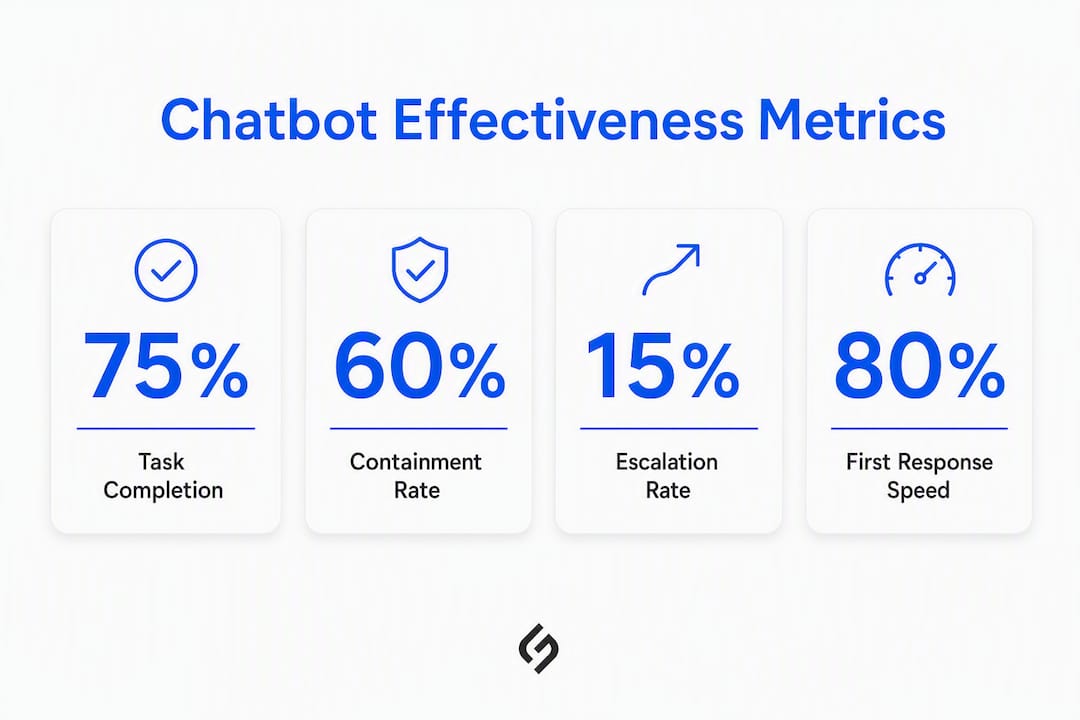
The business outcomes map directly to KPIs most executives already track. Faster first response, higher containment rates, and reduced average handle time are all achievable when the bot is scoped to tasks it can reliably complete. G2 verified reviewers cite time savings and increased efficiency as their top reason for satisfaction, with 21.7% of reviewers naming it explicitly.
What separates high-performing deployments from frustrating ones is not the underlying model. It is the engineering layer: multi-step orchestration, responses grounded in company data, versioned prompts, and a monitoring pipeline that tracks task completion rather than conversation volume. Businesses that skip this layer tend to see the failure modes described in the next section.
Where do chatbots fall short, and how do you reduce the risk?
The gap between vendor promises and user experience is real. Even as vendors report 1% production failure rates for advanced architectures, inaccuracy and hallucinations remain the most frequently cited complaint in verified buyer reviews. That gap exists because most organizations deploy without the engineering controls that make low failure rates possible.
The primary failure modes to plan for:
- Inaccuracy and hallucination: The model generates plausible but wrong answers, particularly when it lacks access to current, grounded company data.
- Escalation failures: The bot does not recognize when a conversation exceeds its competence and fails to hand off to a human agent in time, creating customer frustration.
- Trust erosion: Research on consumer trust in chatbots identifies two distinct dimensions: affective trust (social and emotional cues) and cognitive trust (technical reliability and accuracy). A bot that feels friendly but gives wrong answers destroys cognitive trust quickly, and recovery is slow.
- Poor backend integration: A chatbot without live access to order management, ticketing, or CRM data cannot resolve most real customer problems.
- Privacy and compliance exposure: Any bot that handles personal data creates a regulatory surface that must be scoped and audited before launch.
Pro Tip: Build escalation triggers before you build conversation flows. Define the exact conditions (topic type, confidence threshold, sentiment signal) that route a user to a human agent, and test those triggers in your pilot dataset before going live.
A poor bot experience does not just fail to help. It actively damages the brand. Customers who cannot get a resolution and cannot reach a human agent churn at higher rates than customers who never encountered the bot at all. Budget for mitigation from day one, not as an afterthought.
Which use cases and industries get the most reliable value from chatbots?
The decision rule is straightforward: match chatbots to tasks that are high-volume, low-risk, and repeatable. The more a task relies on retrieving structured data or following a defined decision tree, the better a chatbot performs.
Strong-fit use cases:
- Order status and shipment tracking
- Password reset and account authentication
- FAQ and policy lookups
- Appointment scheduling and rescheduling
- Basic billing inquiries and payment confirmations
- Internal IT helpdesk for common employee requests
Industries where chatbots consistently deliver:
- Retail and e-commerce: Order tracking, return initiation, and product availability queries are high-volume and structured. Chatbots handle these at scale without degrading CSAT.
- Travel and hospitality: Booking confirmations, itinerary changes, and loyalty program queries fit the repeatable-task profile well.
- Logistics and supply chain: Shipment status, delivery window updates, and carrier handoff notifications are data-retrieval tasks that chatbots handle reliably.
- Banking (simple operations): Balance inquiries, transaction history, and branch locator functions are low-risk and high-volume.
Where to be cautious:
- Clinical health decisions: A systematic review published in JMIR found that CBT-oriented psychological chatbots show only moderate effect sizes for depressive symptoms, with low evidence certainty and high variability across trials. Clinical mental health support requires human oversight.
- Complex legal or financial advice: High-stakes, nuanced decisions carry liability that no current chatbot architecture handles reliably.
- Emotionally sensitive customer situations: Complaints involving loss, grief, or significant financial harm require human empathy that chatbots cannot replicate.
How do you design a chatbot that actually works?
Design quality determines whether a chatbot resolves problems or creates them. The Wharton Blueprint for Effective AI Chatbots and practitioner data consistently point to the same principles.
Step-by-step design checklist:
- Scope narrowly first. Define three to five tasks the bot must complete reliably. Resist the urge to cover every use case in version one.
- Ground responses in live enterprise data. Connect the bot to your CRM, knowledge base, and ticketing system so answers reflect current information, not training data.
- Use versioned prompts. Treat prompt templates as code: version them, test changes, and roll back when performance drops.
- Build escalation logic before conversation flows. Define triggers for human handoff and test them against a representative sample of real conversations.
- Set user expectations explicitly. Tell users they are talking to a bot, what it can help with, and how to reach a human agent. Transparency builds the cognitive trust that drives sustained adoption.
- Instrument everything. Log task completion, escalation rate, and user drop-off at each conversation step from day one.
UX and trust-building requirements:
- Disclose bot identity at the start of every conversation.
- Provide a visible, one-click path to a human agent at every step.
- Write error-handling scripts for the top ten failure scenarios before launch.
- Avoid superficial persona features that prioritize friendliness over accuracy. Research confirms that information quality and problem-solving capability drive customer satisfaction far more than humanlike cues.
Pro Tip: Measure task completion rate, not conversation length or user satisfaction scores alone. A user who says “fine” and abandons the task has not been served. Completion is the only metric that proves the bot worked.
How do you measure chatbot performance and estimate ROI?
Measurement starts before launch. Establish baseline values for every KPI the chatbot is expected to move, then track the delta after deployment.
| KPI | What It Measures | Reporting Cadence |
|---|---|---|
| Task completion rate | Percentage of conversations where the user’s goal was fully resolved | Weekly |
| Deflection rate | Conversations resolved without human agent involvement | Weekly |
| Average handle time (AHT) | Time per interaction, bot vs. human | Weekly |
| CSAT / NPS | Customer satisfaction after bot interaction | Weekly |
| Escalation rate | Percentage of conversations handed to a human | Daily |
| First contact resolution (FCR) | Issues resolved in a single interaction | Monthly |
| Conversion lift | Revenue or sign-up rate for commerce flows | Monthly |
ROI calculation approach:
- Map AHT reduction to agent hours saved per month.
- Multiply saved hours by fully loaded agent cost to get a dollar value.
- Add conversion lift revenue for commerce use cases.
- Subtract implementation, licensing, and ongoing maintenance costs.
- Divide net benefit by total cost for a straightforward ROI ratio.
Realistic timelines: most pilots reach stable metric readings within 60–90 days. Scale decisions should wait for at least 90 days of monitored data. Practitioner experience consistently shows that unmonitored bots degrade over time as product data, policies, and customer language evolve. Build a monthly review cycle into the operating model from the start.
Pro Tip: Track escalation rate daily during the first 30 days. A rising escalation rate is the earliest signal that the bot’s knowledge base or grounding data needs updating, well before CSAT scores reflect the problem.
How do you run a safe, measurable chatbot pilot?
A well-structured pilot reduces risk and generates the evidence an executive sponsor needs to approve scale investment.
Pilot phases:
- Define scope and success criteria. Choose one use case. Set specific targets: for example, a 20% deflection rate, CSAT at or above the current human-agent baseline, and escalation latency under three minutes.
- Select your dataset and integration points. Identify the data sources the bot needs to access and confirm API availability before building flows.
- Build minimal conversation flows. Cover the top five to eight intents for the chosen use case. Do not build for edge cases in the first version.
- Run a closed pilot. Limit the audience to a defined user segment or a single channel. Monitor every conversation.
- Collect and review metrics. At 30 days, review task completion, escalation rate, and CSAT. Identify the top three failure patterns.
- Iterate. Update grounding data, refine prompts, and adjust escalation triggers based on findings. Run a second 30-day cycle.
- Plan scale. If success criteria are met, document the operating model and prepare the integration and governance plan for broader rollout.
Go/no-go checklist before scaling:
- Task completion rate meets or exceeds the pilot target.
- Escalation rate is stable or declining.
- CSAT is at or above the human-agent baseline.
- Escalation latency is within the defined threshold.
- Data privacy and compliance review is complete.
- Monitoring and alerting infrastructure is in place.
Pro Tip: Assign one named operations owner to the chatbot from day one of the pilot. Bots without a clear owner degrade silently. That person reviews conversation logs weekly and owns the update cycle.
What does the research say about chatbot effectiveness?
The evidence base is growing, but it is not uniform. The strongest findings come from enterprise deployments in structured, data-rich environments. Results in open-ended or clinical contexts are more mixed.
Key research findings:
- Zendesk’s 2026 CX Trends Report reports that a large portion of CX leaders see intelligent AI agents as central to near-term CX transformation.
- G2’s analysis of 2,950+ verified reviews shows 21.7% of satisfied users cite time savings and efficiency as their primary benefit, while inaccuracy and hallucinations remain the top complaint overall.
- IBM’s enterprise research identifies CRM and ERP integration as the primary mechanism for operational efficiency gains.
- A JMIR systematic review of CBT-oriented psychological chatbots finds moderate short-term effects for depression but low evidence certainty and high variability across trials.
- Research published in Humanities and Social Sciences Communications frames consumer trust as a dual construct: affective (emotional) and cognitive (reliability-based), with responsiveness and accuracy as the primary trust drivers.
| Evidence Domain | Strength of Finding | Key Caveat |
|---|---|---|
| Enterprise operational efficiency | Strong | Requires deep system integration |
| Customer-facing CX (retail/travel) | Strong | Scoped to repeatable tasks |
| Clinical mental health support | Moderate, low certainty | High variability across trials |
| Complex advisory or legal tasks | Weak | Not recommended for current deployment |
Where uncertainty remains: long-term trust maintenance, performance across diverse user populations, and the compounding effects of hallucination in high-stakes domains all need more longitudinal study. The Wharton Blueprint for Effective AI Chatbots offers one of the more rigorous practitioner frameworks for evaluating these trade-offs in enterprise settings.
What should decision-makers do next?
Chatbots are effective for business when scoped to high-volume, repeatable tasks and supported by the engineering and monitoring infrastructure that makes low failure rates achievable.
Three prioritized next actions:
- Sponsor a scoped pilot. Choose one use case, set measurable success criteria, and commit to a 60–90 day evaluation window before any scale decision.
- Assign a data and operations owner. This person owns grounding data quality, prompt versioning, and the weekly conversation review cycle.
- Define KPIs and escalation rules before building. Task completion rate, deflection rate, and escalation latency must be instrumented from day one.
When to pause or stop investment: If task completion rate remains below target after two full iteration cycles, or if CSAT drops below the human-agent baseline and does not recover within 60 days, pause and reassess the use case scope before continuing.
Key Takeaways
Chatbots are effective for business when scoped to repeatable tasks, grounded in live enterprise data, and supported by continuous monitoring and iteration.
| Point | Details |
|---|---|
| Effectiveness is conditional | Chatbots work best on high-volume, low-risk, repeatable tasks with strong backend data integration. |
| Engineering quality is decisive | Vendors report 1% production failure rates only when orchestration, grounding, and monitoring are built in. |
| Trust requires accuracy first | Research shows information quality and problem-solving ability drive satisfaction more than humanlike persona features. |
| Measure task completion, not volume | Track completion rate, deflection rate, and escalation latency from day one to get a true performance signal. |
| Solution4guru supports the full pilot cycle | Solution4guru’s AI integration and UX design services cover assessment, integration, and measurement for chatbot pilots. |
The gap between chatbot hype and what actually moves the needle
The conversation around chatbot effectiveness tends to collapse into two camps: enthusiasts citing transformation statistics and skeptics citing hallucination horror stories. Both camps are selecting their evidence. The more useful question is not whether chatbots work, but under what conditions they work, and whether your organization has the operational discipline to create those conditions.
The 86% of CX leaders who expect AI agents to transform customer experience are not wrong. But transformation does not happen because a bot is deployed. It happens because someone owns the grounding data, someone reviews the conversation logs every week, and someone has the authority to pull the bot offline when it starts generating wrong answers at scale. That operational model is what most organizations underestimate, and it is where most pilots quietly fail.
The research on trust is particularly instructive here. Affective trust (the feeling that the bot is friendly and responsive) is easy to engineer. Cognitive trust (the belief that the bot is accurate and reliable) takes months of consistent performance to build and can be destroyed in a single bad interaction. Organizations that invest heavily in persona design and conversational tone before they have solved grounding and accuracy are building on a foundation that will not hold.
The practical implication: treat your first chatbot deployment as an infrastructure project, not a product launch. The conversation design matters, but the data pipeline, the monitoring instrumentation, and the escalation logic matter more. Get those right first, and the CX outcomes follow.
How Solution For guru helps you move from pilot to production
Deploying a chatbot that actually performs requires more than selecting a platform. It requires a clear assessment of your existing data infrastructure, a UX design process that prioritizes accuracy over aesthetics, and a measurement framework that tells you whether the bot is working before you scale it.
Solution4guru’s AI integration and UX design services cover the full pilot cycle: scoping the use case, connecting the bot to your CRM and backend systems, designing conversation flows grounded in your actual data, and instrumenting the KPIs that matter. The result is a deployment built for measurable outcomes, not a demo that degrades in production. Decision-makers who want a structured evaluation before committing to a platform can request a consultation to map their use case against a realistic pilot framework.
Useful sources
The following sources support the core claims in this article on chatbot effectiveness, limitations, and design best practices.
- AI Chatbot Capabilities & Limitations: What 2000+ G2 Users Say: Verified buyer review analysis covering production failure rates, top satisfaction drivers, and the most common complaints including inaccuracy and hallucinations.
- What is a chatbot — benefits of chatbots | Zendesk: Source for the 86% CX leader statistic from the 2026 CX Trends Report; covers strategic expectations for AI agents.
- Enterprise Chatbots: Benefits and Use Cases | IBM: IBM’s practitioner framework for enterprise chatbot integration with CRM, ERP, and ticketing systems.
- The Wharton Blueprint for Effective AI Chatbots: Rigorous practitioner and academic framework for evaluating and designing effective AI chatbot deployments.
- Efficacy, user engagement, and acceptability of CBT-oriented psychological chatbots (JMIR): Systematic review and meta-analysis of chatbot efficacy in mental health contexts; supports caution around clinical use cases.
- Investigating the impact of chatbot interactivity on consumer behavior | Humanities and Social Sciences Communications: Research framing consumer trust as affective and cognitive dimensions; informs design and trust-building guidance.
- Chatbot information quality and its effects on satisfaction (ScienceDirect): Finds that information quality and problem-solving capability outperform superficial humanlike cues as satisfaction drivers.
- 20 benefits of chatbots for businesses and customers in 2026 | The Noupe Blog: Practitioner synthesis of deployment patterns, including the importance of continuous monitoring and iteration.
- Can Artificial Intelligence Chatbots Improve Mental Health?: A Scoping Review (PubMed): Scoping review of AI chatbot use in mental healthcare, covering efficacy, advantages, and limitations.
The strongest evidence for enterprise operational efficiency comes from IBM and G2. The strongest caution for clinical and high-stakes use cases comes from the JMIR and PubMed reviews. The Wharton Blueprint and Zendesk report together provide the strategic framing most relevant to executive decision-making.
FAQ
Yes, for high-volume, repeatable tasks such as order tracking, FAQ responses, and appointment scheduling. Chatbot effectiveness drops significantly in emotionally complex or high-stakes interactions that require human judgment.
The primary KPIs are task completion rate, deflection rate, average handle time, CSAT, escalation rate, and first contact resolution. Track escalation rate daily during the first 30 days as an early warning signal.
Most pilots reach stable, reliable metric readings within 60–90 days. Scale decisions should wait for at least 90 days of monitored data and two full iteration cycles.
Yes. Travel, logistics, hospitality, and banking (for simple operations) all show strong results. Clinical health and complex legal advisory contexts carry higher risk and require human oversight regardless of chatbot quality.
Solution4guru provides AI integration, UX design, and measurement services that cover the full pilot cycle, from use case scoping and backend integration to KPI instrumentation and iteration planning.
Recommended
- Pipedrive Web Chat and LeadBooster: Generate More Leads from Your Website – Solution for Guru
- Lead Nurturing Techniques That Convert Prospects in 2026 – Solution for Guru
- Improving Communication in Teams: Strategies for 2026 – Solution for Guru
- Digital Solutions for SMEs: Your 2026 Action Playbook – Solution for Guru