How to Create Buyer Personas: A Step-by-Step SMB Guide

A buyer persona is a semi-fictional profile of your ideal customer built from real data — CRM records, customer interviews, behavioral analytics, and support tickets. The four steps to build one are: research (mine your first-party data), segment (decide which customer types to profile), build (draft persona one-pagers), and activate (integrate personas into campaigns, sales decks, and product decisions).
Here is what you can do in the first 48 hours:
- Pull your last 20–30 closed-won deals from your CRM and note job title, company size, and deal source.
- Identify two or three recurring customer types from that list.
- Schedule your first three buyer interviews with recent customers.
- Pick a one-page persona template (a Google Doc or PDF works fine) and assign an owner.
Templates and a full interview script appear in the sections below. The step-by-step workflow starts in Section 4.
Key Takeaways
Data-first buyer personas built from CRM records and JTBD interviews consistently outperform personas built from internal assumptions, because they capture the real trigger that drives purchase decisions.
| Point | Details |
|---|---|
| Start with CRM data | Pull closed-won records before any interviews to identify real customer clusters. |
| Interview 8–12 buyers per segment | This sample size reaches qualitative saturation and surfaces true triggers and objections. |
| Focus on JTBD, not demographics | A JTBD headline is directly usable in copy; a demographic descriptor is not. |
| Keep persona one-pagers to one page | Include a verbatim quote; supporting evidence belongs in a linked appendix. |
| Solution4guru persona sprint | Solution4guru delivers managed persona research, one-pagers, and activation playbooks for SMBs. |
Table of Contents
- What a buyer persona is — and how it differs from a target market
- Why buyer personas produce better marketing, product, and sales results
- How to create buyer personas: a practical step-by-step workflow
- Persona templates and examples you can copy today
- Common persona mistakes and the practices that fix them
- Which tools and data sources speed up persona work
- How to validate personas and measure their business impact
- A lean 4-week persona sprint you can run right now
- Why JTBD-first personas tend to be the most useful
- How Solution4guru helps SMBs build personas they can actually use
- Sources
- FAQ
What a buyer persona is — and how it differs from a target market
A buyer persona is a research-backed, semi-fictional profile that represents a specific type of customer. It captures not just who someone is, but why they buy: their goals, frustrations, decision triggers, and the alternatives they considered before choosing you. Personas go beyond demographics to capture psychographics, motivations, and jobs-to-be-done (JTBD) — the underlying progress a customer is trying to make in their work or life.
A target market is broader. It defines the universe of potential buyers by segment (industry, geography, company size, age range). A persona lives inside that universe and tells you how to speak to a specific type of buyer within it.
The practical difference: your target market tells you who to reach. Your persona tells you what to say, where to say it, and when.
Negative personas (sometimes called anti-personas) are equally useful. They describe the customer types that look like a fit but consistently churn, demand excessive support, or never convert. Building one or two negative personas alongside your primary profiles helps you avoid wasting ad spend on audiences that will never generate returns.
| Dimension | Buyer Persona | Target Market |
|---|---|---|
| Purpose | Guide messaging, content, and sales conversations | Define the addressable market |
| Granularity | Individual-level: role, goals, triggers, objections | Segment-level: industry, size, geography |
| Data sources | Interviews, CRM, support tickets, behavioral data | Market research, census data, industry reports |
| Outputs | One-page profile, verbatim quotes, JTBD statements | Segment definitions, TAM/SAM estimates |
| How to use | Inform copy, channel selection, sales enablement | Prioritize markets, allocate budget |
For a deeper look at how to define your target audience before building personas, Solution4guru’s segmentation guide covers the full process.
Why buyer personas produce better marketing, product, and sales results
Personas work because they shift teams from assumptions to evidence. Generic copy written for “business decision-makers” rarely does.
For marketing, personas sharpen channel selection and message framing. A persona that reveals your buyer reads industry newsletters and trusts peer recommendations tells you to invest in content syndication and case studies, not display ads.
For product teams, personas surface the exact friction points that cause drop-off. If your persona’s primary JTBD is “reduce the time my team spends on manual reporting,” every feature that does not serve that job is a lower priority.
For sales, personas accelerate deal cycles. Reps who understand a persona’s typical objections, veto roles, and buying triggers close deals faster because they can address resistance before it surfaces. Personas matter most during three moments: a new go-to-market launch, a repositioning effort, and any expansion into a new customer segment.
How to create buyer personas: a practical step-by-step workflow
Step 1: Mine your first-party data
Before any interviews, extract what your existing data already tells you. Start with closed-won CRM records and product analytics signals — they reveal real purchase patterns, not hypothetical ones.
Fields to pull from your CRM:
- Job title, seniority, and department of the primary contact
- Company size, industry, and revenue band
- Deal source (how they found you)
- Sales cycle length and number of stakeholders involved
- Closed-won reason and closed-lost reason
From your analytics stack, look at:
- Top landing pages by conversion rate (not just traffic)
- Content pieces that appear in the paths of converted users
- Search queries driving qualified sessions
- Support ticket categories and frequency
From your support and success teams, pull the five most common questions asked before purchase and the five most common complaints after onboarding. These two lists often reveal the real JTBD and the biggest purchase barriers.
Step 2: Decide how many segments to profile
Most SMBs start with two or three personas. More than four creates coordination overhead that outweighs the benefit. Use your CRM data to identify natural clusters: recurring job titles, consistent deal sizes, or shared industries. Each cluster that generates meaningfully different revenue, has different objections, or requires a different message is a candidate for its own persona.
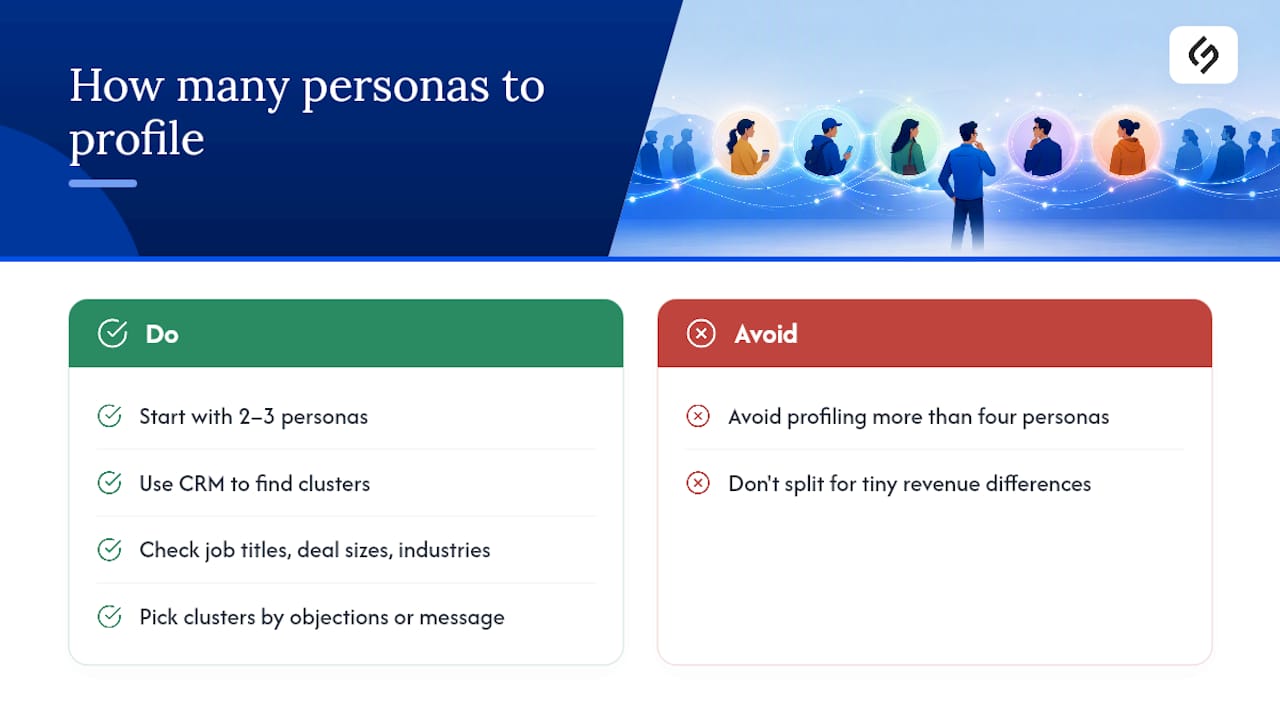
For customer segmentation methods that go beyond basic demographics, including behavioral and psychographic clustering, Solution4guru’s segmentation guide provides practical frameworks.
Step 3: Run buyer interviews (JTBD focus, 8–12 per segment)
Interviews are where the real insight lives. Experts recommend 8–12 interviews per customer segment to gather high-quality qualitative data focused on what the buyer tried to accomplish, the trigger for their search, and the barriers they encountered. Start with recent closed-won customers — they remember the decision clearly and can articulate what actually drove the purchase.

Recruiting interviewees: Email recent customers directly. Avoid recruiting from your NPS detractors for the first round; their feedback is valuable but belongs in a separate session.
Consent and recording: Always ask permission before recording. Tools like Otter.ai or Rev produce transcripts that make synthesis faster. Store recordings and transcripts in a shared folder with restricted access.
Sample interview script:
- “Walk me through what was happening in your work or business right before you started looking for a solution like ours.” (Trigger event)
- “What had you already tried, and why did those options fall short?” (Alternatives considered)
- “Who else was involved in the decision, and what did they care most about?” (Buying committee)
- “What almost stopped you from moving forward with us?” (Purchase barriers)
- “How did you find us — what channel or source led you here?” (Discovery path)
- “If you had to describe the single biggest outcome you were hoping for, what would it be?” (JTBD statement)
Pro Tip: Saturation — the point at which new interviews stop producing new themes — typically arrives between interview 8 and 12. If interviews 9, 10, and 11 are repeating the same triggers and objections you heard in interviews 1 through 7, you have enough data. Stop there and move to synthesis rather than collecting more for the sake of completeness.
Step 4: Synthesize and draft persona one-pagers
After interviews, group your notes and transcripts by theme. Look for patterns in trigger events, alternatives tried, objections raised, and channels used. Each pattern that appears in at least three interviews is worth including in the persona.
A persona one-pager should include:
- Core identity: Name (fictional), job title, company type, seniority
- Primary JTBD: One sentence describing the progress they are trying to make
- Top goals: Two or three specific outcomes they are measured on
- Key pain points: The friction they experience before finding your solution
- Buying committee role: Champion, economic buyer, technical evaluator, or blocker
- Channel preferences: Where they consume content and how they prefer to be reached
- Top objections: The two or three reasons they hesitate to buy
- Verbatim quote: One real sentence from an interview that captures their mindset
Keep persona documents to one page and include a verbatim customer quote. A single real quote improves rep recognition and asset usage far more than a paragraph of synthesized description.
Data sources checklist:
- CRM closed-won records
- Sales call recordings
- Customer interviews (transcribed)
- Support ticket logs
- Google Analytics or equivalent behavioral data
- Ad platform audience insights
- Product usage data (if applicable)
- Social listening signals
Tag each data point in your synthesis document with its source (interview, CRM, analytics) so the persona is auditable and credible to skeptics on your team.
Persona templates and examples you can copy today
How to use the template
Fill the “Core Identity” and “Primary JTBD” fields first — these two elements drive every downstream decision. Store the completed persona in a shared Google Doc or Notion page accessible to marketing, sales, and product. Offer it in PDF for print distribution and as a CSV of persona fields for CRM import.
Keep the one-pager to a single page. Supporting evidence (interview transcripts, data queries, raw quotes) belongs in an appendix or linked document, not on the face of the persona itself. Adobe’s guidance on persona structure reinforces this: keep the operational document concise and evidence-based, with demographics, role, motivations, pain points, and one verbatim quote.
B2B persona example: “Operations Marcus”
Headline: VP of Operations, 150-person manufacturing firm, primary economic buyer
Primary JTBD: Reduce manual procurement reporting time so his team can focus on supplier negotiations.
Key pain points: Disconnected spreadsheets across three departments; no real-time visibility into spend.
Buying committee role: Economic buyer; technical sign-off from IT Director required.
Channel preferences: LinkedIn, industry newsletters, peer referrals from his CFO network.
Top objections: “We’ve tried tools like this before and they required too much IT lift.” / “I need to see ROI within 90 days or the CFO won’t approve renewal.”
B2C persona example: “Freelance Sofia”
Headline: Independent graphic designer, 28–35, sole proprietor, urban market
Primary JTBD: Find reliable project management software that does not require a learning curve so she can onboard clients faster.
Top goals: Reduce client onboarding time; get paid faster with automated invoicing.
Key pain points: Current tools are built for agencies, not solo operators; pricing tiers force her to pay for features she will never use.
Buying committee role: Sole decision-maker; no approval chain.
Channel preferences: Instagram, YouTube tutorials, Reddit communities, word-of-mouth from designer peers.
Top objections: “I’ve signed up for free trials and then forgotten to cancel.” / “I don’t want to migrate all my existing client data.”
For a complementary perspective on what a customer persona is and how practitioners apply them, Reddog Consulting Group’s guide offers useful tactical examples.
Common persona mistakes and the practices that fix them
Mistakes that undermine persona quality
- Relying on demographics alone. Age, gender, and job title describe who someone is, not why they buy. A 45-year-old VP of Marketing and a 45-year-old VP of Sales may share every demographic but have entirely different triggers and objections.
- Building too many personas. Four or more personas at launch spreads activation effort too thin. Start with two or three, validate them, then expand.
- Using internal assumptions instead of customer data. Personas built from what your team thinks customers want consistently miss the real purchase trigger.
- Treating personas as a one-time deliverable. A persona document that sits in a shared drive and is never updated becomes fiction within 12 months.
- Siloing personas in marketing. When sales and product teams never see the persona, the investment in building it produces no downstream benefit.
Best practices that make personas operational
- Start with closed-won CRM data before any interviews to identify real patterns, not hypothetical ones.
- Focus interviews on the switch event — the moment the buyer decided the status quo was no longer acceptable. That moment contains the real trigger.
- Include a verbatim quote on every persona one-pager. It makes the profile feel human and helps reps internalize the buyer’s mindset.
- Assign a persona owner — one person responsible for keeping each persona current and distributing updates.
- Review personas every six months or after any significant market shift (a new competitor, a pricing change, a product pivot).
- Add persona fields to your CRM so reps can tag deals by persona type and you can track which personas convert at the highest rate.
Statistic callout: Experts recommend 8–12 interviews per segment to reach qualitative saturation — the point at which new interviews stop producing new themes. Fewer than eight interviews per segment risks missing a critical objection or trigger that only surfaces with repeated exposure.
Which tools and data sources speed up persona work
Lightweight SMB tool stack
- Survey tool: Typeform or Google Forms for pre-interview screeners and post-purchase surveys. Keep surveys under five questions for higher completion rates.
- Interview transcription: Otter.ai or Rev for automatic transcripts. Both integrate with Zoom and Google Meet.
- Synthesis and storage: Notion or Airtable for organizing quotes, themes, and persona drafts in one place.
- Persona visualization: Figma or Canva for producing shareable one-pagers that look professional without a design team.
For teams using AI to accelerate the synthesis step, AI and analytics can generate detailed persona drafts, but human validation with recent buyers remains non-negotiable. Use AI to detect patterns across transcripts and draft initial persona language, then validate every claim against your interview notes before publishing the persona internally.
Solution4guru’s guide on AI for customer insights covers practical AI applications for SMBs, including responsible use in persona generation.
Pro Tip: Progressive profiling — collecting one or two additional data points per customer interaction rather than asking everything at once — builds richer persona data over time without survey fatigue. A five-question onboarding survey followed by a two-question check-in at 30 days produces more honest answers than a single 15-question form.
How to validate personas and measure their business impact
Personas are hypotheses until data confirms them. Validation requires deliberate experiments and consistent measurement.
Validation experiments
- Landing page A/B test: Create two versions of a landing page — one written for a specific persona (using their language, JTBD, and top objection) and one generic version. Run both with equal traffic for two to four weeks and compare conversion rates.
- Email segmentation test: Segment your list by persona type (using CRM tags) and send persona-specific subject lines and body copy. Compare open rates, click-through rates, and downstream conversions against your baseline.
- Sales feedback loop: After every closed-won and closed-lost deal, ask the rep: “Did the persona profile match what you saw in this buyer?” Track discrepancies and update the persona when patterns emerge.
KPIs to track
- Click-through rate (CTR): Persona-targeted ads and emails should outperform generic versions.
- Conversion rate (CVR): Landing pages and lead forms aligned to a persona’s JTBD should convert at a higher rate.
- MQL-to-SQL conversion rate: If personas are accurate, marketing-qualified leads should pass sales qualification at a higher rate.
- Average deal size: Personas that map to your highest-value customer types should correlate with larger deals.
- Sales cycle length: Reps using persona-informed talk tracks should close deals faster than those using generic scripts.
- Lead quality score: Track how often CRM-tagged persona leads reach closed-won vs. churning early.
Validate persona effectiveness with A/B tests comparing persona-targeted messaging against generic messaging, and track conversion, lead quality, and average deal size as outcome metrics. For guidance on connecting persona data to broader digital marketing ROI, Solution4guru’s measurement guide covers the full attribution framework.
A lean 4-week persona sprint you can run right now
This sprint is designed for a two-to-three person SMB team. It produces two or three validated persona one-pagers, an interview library, and an activation playbook in 20 working days.
Week-by-week checklist
1: Data audit and recruitment
- Pull closed-won CRM records (last 12 months, minimum 30 deals).
- Identify two or three recurring customer clusters by job title, industry, and deal size.
- Export support ticket categories and top five pre-purchase questions.
- Send interview recruitment emails to 20–25 recent customers (targeting 8–12 acceptances per segment).
2: Interviews
- Conduct 8–12 interviews per segment using the JTBD script above.
- Record and transcribe every session.
- Tag each transcript by theme: trigger event, alternatives tried, objections, buying committee, discovery channel.
3: Synthesis and drafting
- Group themes across transcripts and identify the three to five patterns per segment.
- Draft persona one-pagers (one per segment) using the template structure above.
- Select one verbatim quote per persona from the interview library.
- Share drafts with sales and product leads for a 48-hour review.
4: Activation
- Add persona fields to CRM records and tag existing deals.
- Brief the sales team on persona triggers, objections, and buying committee roles.
- Update one active campaign per persona with persona-specific copy and creative.
- Schedule a six-month persona review date.
Deliverables at sprint end
- Two or three persona one-pagers (PDF and Google Doc)
- Interview library (transcripts, tagged by theme, stored in Notion or Airtable)
- Role-buying-trigger map for B2B personas (role, stage, trigger, message, channel, offer)
- Activation playbook (CRM fields, campaign briefs, sales talk tracks)
Roles and responsibilities
- Persona owner (marketing lead): Recruits interviewees, runs synthesis, drafts one-pagers, manages the review cadence.
- Interview lead (marketing or sales): Conducts interviews, manages recordings and transcripts.
- Sales input (one rep or manager): Reviews drafts for accuracy against real deal experience, flags missing objections.
- Product input (optional): Validates JTBD statements against feature usage data.
Why JTBD-first personas tend to be the most useful
Most persona worksheets start with demographics: age, title, income, location. The problem is that demographics describe a buyer but do not explain a purchase. Two buyers with identical demographic profiles can have completely different triggers — and completely different responses to the same message.
Jobs-to-be-done interviews flip the sequence. Instead of asking “who is this person?” you ask “what were they trying to accomplish, and what made them decide to act now?” That question surfaces the switch event: the specific moment when the status quo became unacceptable. The switch event is almost always more actionable than any demographic data point.
A JTBD headline for a persona sounds like this: “Help me reduce the time my team spends on manual reporting so I can redirect that capacity to higher-value analysis.” That sentence can be turned directly into ad copy, an email subject line, or a landing page headline. A demographic descriptor like “VP of Operations, 40–50, mid-market manufacturing” cannot.
For complex B2B deals, pair JTBD insights with a buying-committee map. Identify each role in the purchase decision (champion, economic buyer, technical evaluator, legal/procurement), their individual JTBD, and their most likely objection. The result is a role-buying-trigger map that gives sales reps a specific message for every stakeholder they encounter, not just a single persona profile for the primary contact.
How Solution For guru helps SMBs build personas they can actually use
Building personas from scratch takes time most SMB teams do not have. Recruiting interviewees, running synthesis, drafting one-pagers, and wiring persona fields into a CRM is a four-week project when done well — and a six-month delay when it keeps getting deprioritized.
Solution4guru works with SMBs and early-stage product teams to deliver the full persona sprint as a managed engagement: interview recruitment and facilitation, transcript synthesis, persona one-pagers, a role-buying-trigger map for B2B clients, and an activation playbook your team can use immediately. The deliverables integrate directly with your existing CRM and campaign tooling. For teams that also need persona-driven UX design and digital marketing strategy, Solution4guru’s end-to-end service covers both the research and the activation. Book a free consultation at Solution4guru to discuss your segment priorities and get a timeline estimate for your first persona sprint.
Sources
- Buyer Persona: How to Create One (Template)
- What Is a Buyer Persona? Types, How to Create, and Examples | Salesforce
- Buyer Personas: The Complete Guide For Today’s Marketers
- Create engaging and comprehensive buyer personas. | Adobe
- How to Build B2B Buyer Personas | Abmatic AI
FAQ
Start by mining your CRM for closed-won patterns, then identify two or three customer segments, run 8–12 JTBD-focused interviews per segment, and synthesize the findings into a one-page profile that includes the buyer’s goals, pain points, objections, and one verbatim quote.
Definitions vary across frameworks, but a common breakdown covers the economic buyer (controls budget), the champion (drives internal adoption), the technical evaluator (assesses fit and risk), and the end user (operates the product daily). In B2C contexts, personas are typically segmented by behavioral and psychographic profile rather than buying-committee role.
“Operations Marcus” is a VP of Operations at a 150-person manufacturing firm whose primary job-to-be-done is reducing manual procurement reporting time. His top objection is that previous tools required too much IT involvement, and he needs to show ROI within 90 days. His channel preference is LinkedIn and peer referrals from his CFO network.
Two or three personas is the right starting point for most SMBs. More than four creates activation overhead that outweighs the benefit; fewer than two often means important customer differences are being collapsed into a single profile that fits no one precisely.
Review personas every six months under normal conditions, and immediately after any significant market shift — a new competitor entering the market, a pricing change, or a major product update. Assign one owner per persona to manage the review cadence and distribute updates to sales and marketing.