
Social Media Plans: How to Build One That Drives Revenue

A social media plan is a written operating document. It states which business goals social media serves, which audiences and platforms matter, what content will be published and by whom, and how results will be measured and reported. A plan that stops at a posting calendar is a schedule. A plan that connects goals, content, compliance and data is a management tool.
This guide walks through the structure of an effective plan for small and mid-sized businesses, including the parts that most templates skip: financial accountability, CRM data, and US disclosure rules.
TL;DR
- A working social media plan has six parts: goals and KPIs, audience, platform selection, content themes, a workflow with owners, and a measurement routine.
- Plan topics and content buckets, not individual posts. A bucket structure reduces decision fatigue and shows which themes resonate.
- Separate vanity metrics from business metrics. Reach alone rarely satisfies a finance team, so connect social activity to CRM records.
- In the US, brand and influencer posts must disclose material connections clearly. Platform labels alone may not be enough.
- Treat the plan as a living document and review it monthly and quarterly.
Table of Contents
- What a social media plan must contain
- Step 1: Align goals with business objectives
- Step 2: Define the audience
- Step 3: Audit what exists and choose platforms
- Step 4: Build content around buckets and the customer journey
- Step 5: Set a workflow and calendar
- Step 6: Build compliance into the plan
- Step 7: Measure with data that finance and IT can trust
- Our perspective: plan for the system behind the posts
- Where Solution4guru fits
- Common mistakes in social media plans
- FAQ
- Sources
What a social media plan must contain
Top-ranking guides agree on the core sequence: set goals, define the audience, audit current channels, choose platforms, plan content, and measure. That sequence is sound. The difference between a plan that is used and one that is archived lies in how specific each part is.
The American Marketing Association describes a social media strategy as a blueprint for turning online activity into business impact, not simply a plan for posting. That framing is useful. Each section below should answer one question: what business result does this decision support?
| Plan component | Question it answers | Example output |
|---|---|---|
| Goals and KPIs | What must change for the business? | Qualified leads from social per quarter |
| Audience | Who needs to be reached and why? | Two or three defined buyer profiles |
| Platform selection | Where does that audience research and decide? | Two primary channels, one secondary |
| Content buckets | What will be said, repeatedly and consistently? | Four to five themed categories |
| Workflow | Who drafts, approves, publishes and replies? | Named owners and turnaround times |
| Measurement | How will results be judged and reported? | Monthly dashboard tied to CRM |
Step 1: Align goals with business objectives
Start with the business objective, then derive the social goal. A company that needs more sales-qualified leads should not set a goal of “increase followers.” It should set a goal such as a target number of qualified leads attributed to social channels in a defined period.
Two practical rules keep goals honest:
- Limit the plan to two or three goals. More goals dilute content and reporting.
- Assign each goal a primary KPI and a supporting KPI. For lead generation, the primary KPI may be leads created in the CRM from social sources, and the supporting KPI may be click-through rate on links.
Research on metrics supports a balanced approach. A 2024 systematic review of SME social media measurement, covering 138 papers, associates detailed engagement metrics with a 25% increase in customer retention and a focus on brand awareness metrics with a 30% improvement in customer acquisition. Different metrics serve different goals, so choose them to match the objective rather than reporting everything.
Avoid the vanity-metric trap
Marketing managers are often pressed to show immediate financial returns from social media. Management accounting research published in Review of Managerial Science points out that this pressure can be misleading and can push teams toward superficial measures such as reach, instead of balanced KPIs that reflect the interactive, long-term nature of social platforms.
The practical answer is to agree on KPIs with finance before the plan launches. Reach and engagement remain useful as leading indicators. Leads, pipeline and retention are the numbers leadership will ask about.
Step 2: Define the audience
A useful audience definition describes a decision, not just a demographic. For a B2B service firm, the audience may be an operations director comparing vendors, a founder choosing a CRM, or a marketing manager replacing an agency. For each profile, record:
- The job title and the business problem they are trying to solve
- Where they look for information before contacting a vendor
- The objections that slow a purchase
- The content formats they actually use: short video, long posts, carousels, webinars
Sales and customer service teams are the best source for this information. Ask them for the ten questions prospects raise most often. Those questions become the raw material for content.
Step 3: Audit what exists and choose platforms
Before adding channels, audit the current ones. For each account, record posting frequency, top-performing posts by business outcome, response times, and whether profile information is accurate and consistent. Review two or three direct competitors the same way, noting which formats they publish and how audiences respond.
Choose fewer platforms and run them well
Platform selection should follow audience behavior. DataReportal’s Digital 2025 report found that Instagram, Facebook and TikTok are the leading platforms for brand research, used for researching products or services by 62.3%, 52.5% and 51.5% of their respective active adult users. The same analysis notes that marketers should monitor reported declines in Instagram business account engagement.
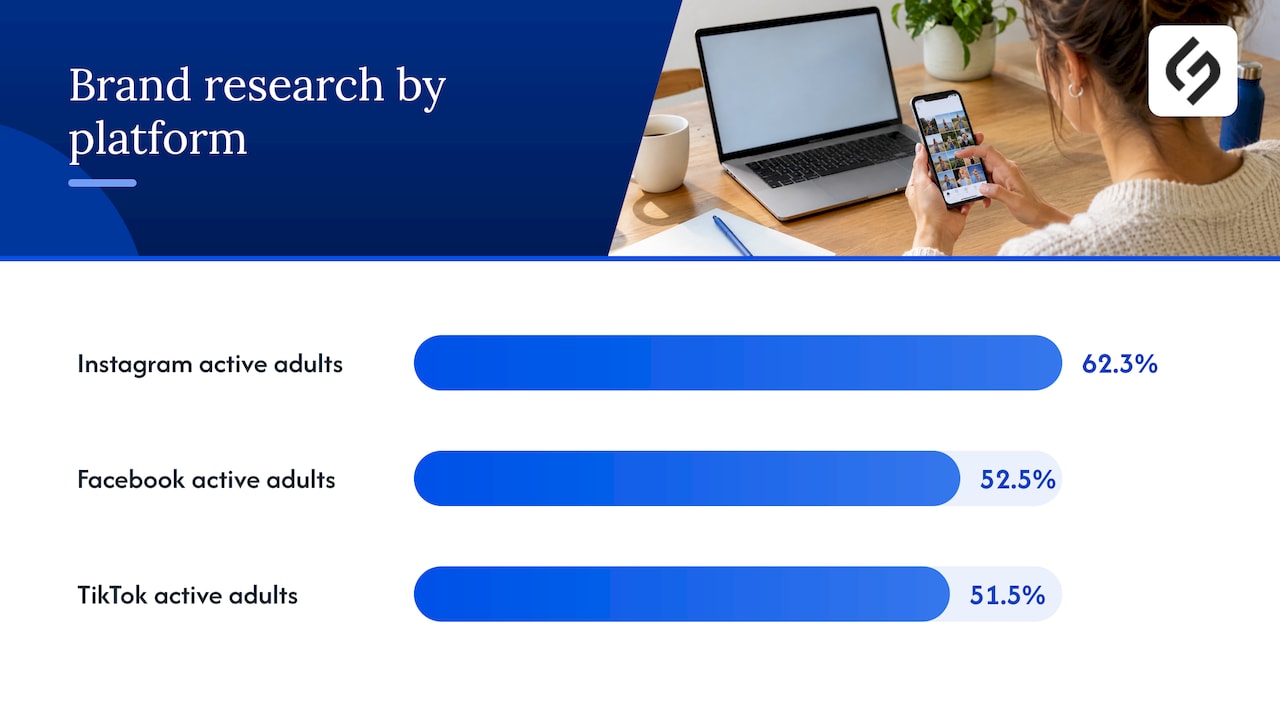
Those figures describe consumer behavior across many markets, and a B2B firm should validate them against its own buyers. LinkedIn, YouTube and industry communities may matter more for professional services. A sensible default is two primary platforms and one experimental channel. DataReportal’s own commentary on top social platforms advises marketers to stop chasing every new platform, since users of newer platforms can generally be reached on established ones.
Step 4: Build content around buckets and the customer journey
A content plan answers what will be published and why. Two frameworks make that manageable.
Content buckets
Practitioners recommend planning topics rather than individual posts, so that one idea can be adapted for the website, email and social channels. Content buckets are themed categories assigned to particular days or weeks, for example a weekly tip, a behind-the-scenes look, a customer story, or an industry update. The AMA guidance notes that this structure reduces decision fatigue, keeps feeds varied and makes it easier to see which themes resonate and which lose the audience.
A starter set of buckets for a B2B company:
- Education: how-to posts and explainers that answer common prospect questions.
- Proof: case studies, testimonials and results, with permission from clients.
- Perspective: commentary on industry changes and regulations.
- People and process: the team, the method, how projects run.
- Offers and next steps: a clear invitation to talk, book a consultation or download a resource.
Feel, Think, Do
The same AMA source describes the Feel-Think-Do framework for mapping content to the customer journey. “Feel” content motivates and builds interest. “Think” content supplies statistics, reviews and facts that support evaluation. “Do” content carries a clear call to action. Practitioners warn that relying too heavily on “Do” content, without nurturing the first two stages, tends to produce weak engagement and low conversion.
A quick audit: count the last 20 posts and label each Feel, Think or Do. If more than a third are “Do” posts, the feed is asking for decisions before it has earned attention.
Consider audience-created content
Research published in 2025 in Systems indicates that directed consumer-generated content can outperform brand-created advertisements on conversion rates and return on ad spend. The same research cautions that marketers often struggle to attribute revenue directly to such efforts. For a B2B firm, the equivalent is client stories, reviews and employee voices, planned deliberately and measured through the CRM.
Step 5: Set a workflow and calendar
A calendar is the schedule. The workflow is the system that makes the schedule achievable. Define:
- Owners: who drafts, who approves, who publishes, who responds to comments and messages.
- Turnaround times: for example, drafts due a set number of days before publication.
- Escalation: who handles complaints, legal questions or a public mistake.
- Tools: a shared, cloud-based document or board so that every department sees the same plan. AMA guidance names Google Sheets and Notion as examples of tools that support cross-functional alignment.
A nonprofit’s published social media playbook lists reasons for a content plan that apply to any organization: it keeps staff informed about what is coming, makes delegation easier and removes the guesswork about what to post and when.
A sample monthly rhythm
| Week | Focus bucket | Funnel stage | Output |
|---|---|---|---|
| 1 | Education | Think | Explainer post plus short video |
| 2 | Proof | Think | Client story with measurable result |
| 3 | People and process | Feel | Team or project walkthrough |
| 4 | Offers and next steps | Do | Consultation invitation and resource link |
Adjust frequency to the capacity of the team. Consistency over several months matters more than a burst of daily posting that cannot be sustained.
Step 6: Build compliance into the plan
Compliance belongs in the plan itself, not in a late review. In the US, the Federal Trade Commission’s Endorsement Guides apply to brands, influencers and employees who promote products when a material connection exists, such as payment, free products or a business relationship.
The FTC states in its guidance on common questions that responsibility for clear and conspicuous disclosure rests with the influencer and the brand, not the platform. Built-in labels such as “sponsored” may not always be enough on every device or interface. The practical steps:
- Place disclosures such as #ad or “Paid” where they cannot be missed, for example above the “more” cut-off on mobile, not at the end of a long caption or inside a string of hashtags.
- Brief every influencer or partner in writing on disclosure expectations.
- Review published posts, not only drafts.
The FTC has also sent letters to more than 90 influencers and marketers reminding them of disclosure duties, which shows the agency monitors this area. Businesses with legal exposure, such as regulated industries including insurance and financial services, should have counsel review their social media policy and approval process.
Step 7: Measure with data that finance and IT can trust
Measurement is where most plans fail. Reports are assembled manually from platform dashboards, no one can connect them to revenue, and the numbers lose credibility.
The Springer research cited above argues that social media performance measurement works best as a cross-functional effort, with IT and technology leaders involved in KPI selection so that data integration, such as connecting CRM data with social attribution, is prioritized over fragmented manual tracking.
A practical measurement stack has three layers:
- Platform metrics: reach, engagement rate, video completion, link clicks. These guide content decisions.
- Website and campaign metrics: tagged links, landing page conversions, form submissions.
- CRM metrics: leads, opportunities, pipeline and closed revenue by original source.
The third layer is what turns a social media plan into a business case. Organizations that publish social feeds in other environments, for example schools displaying social content on digital screens, face the same underlying question: how does engagement data flow into the systems that run the organization? Our own guide to integrating a CRM with your website and SEO covers the lead-source tracking that makes the third layer work.
Reporting cadence
- Weekly: check scheduled content, replies and anomalies. Fifteen minutes.
- Monthly: compare KPIs with targets, review which buckets performed, adjust the next month.
- Quarterly: revisit goals, platform mix and budget with marketing, sales and finance together.
Our perspective: plan for the system behind the posts
We see the same pattern in many small and mid-sized businesses. The content is reasonable, the posting is regular, and the plan still disappoints leadership because no one can say which conversations began on social media. The cause is rarely creativity. It is usually disconnected systems: a social scheduler in one place, a website with untagged forms in another, and a CRM that records every lead as “direct” or “other.”
Our approach is strategy first. We start from the business model and the sales workflow, then decide which social goals are measurable and what data must flow where. That often means tying forms, campaigns and lead sources into the CRM, and automating the handoff so a social lead reaches the right salesperson quickly. Our article on automation examples for SMBs shows what lead routing looks like in practice.
We also advise treating the plan as a living document. Platforms change, audiences shift and the first quarter of data will contradict at least one assumption. A plan that is reviewed and revised is worth more than a perfect plan written once.
Where Solution For guru fits
Businesses that have a plan but lack the systems to execute and measure it can work with us on the technical and strategic layers: CRM and SaaS integrations, marketing automation, HubSpot implementation and management, SEO and digital marketing, and tech consulting. Each engagement is tailored to the client’s workflows rather than built from a template. See the full list on our services page, or start with a free consultation through our main site.
If the question is whether to bring in outside help for content itself, our guide to vetting social content agencies lays out the decision criteria.
Common mistakes in social media plans
- Starting with tactics. Choosing platforms and formats before goals leads to activity without direction.
- No owner for replies. Unanswered comments and messages undermine the content that earned them.
- Repetition without variety. Content fatigue sets in when feeds recycle one message. Buckets prevent this.
- Skipping disclosure rules. Treating compliance as an afterthought creates avoidable regulatory risk.
- Reporting reach only. Leadership will eventually ask about revenue.
- Never revising. An annual plan that is not reviewed quarterly is out of date by midyear.
FAQ
A plan should be as long as the team needs to execute it, and often fits in a few pages plus a calendar. Include goals, audience, platforms, content buckets, workflow, compliance rules and a reporting schedule. Keep it in a shared, editable document so that it stays current.
There is no universal number. The right frequency is the highest one the team can sustain with consistent quality. Start with a modest weekly rhythm across two platforms, review performance by content bucket after a month, and increase only where results justify it.
The strategy sets direction: goals, audience, positioning and the role social plays in the business. The plan turns that direction into execution: calendar, owners, formats, budget and measurement. In practice the terms overlap, and a good document contains both.
Yes, in the US the Endorsement Guides apply whenever a material connection exists between a brand and someone promoting its product, regardless of company size. Disclosures must be clear and conspicuous, and the FTC says responsibility rests with the brand and the influencer, not the platform. Businesses in regulated sectors should have counsel review their policy.
Track lead source from first click through to closed deal. Use tagged links, forms that pass campaign data into the CRM, and reports that show pipeline by original source. Attribution will rarely be perfect, so agree with finance in advance on what evidence counts.
Sources
- 8 Steps to Build a Successful Social Media Strategy, American Marketing Association
- Tracking and Measuring Social Media Activity: Key Metrics for SME Strategic Success, SSRN
- Social media marketing and performance measurement, Review of Managerial Science
- Digital 2025: the state of social media in 2025, DataReportal
- Digital 2025: top social platforms in 2025, DataReportal
- Directed consumer-generated content research, Systems (MDPI)
- Social Media Playbook, YMCA of San Diego County
- FTC’s Endorsement Guides: What People Are Asking
- FTC Staff Reminds Influencers and Brands to Clearly Disclose Relationship