
Digital Customer Experience Agency: How to Choose One

A digital customer experience agency advises on, builds and continuously improves the websites, platforms and journeys that customers use to deal with a business. The best ones start by diagnosing journeys and outcomes, not by proposing a redesign. This guide explains what such an agency does, when hiring one makes sense, what the contract should contain and how to compare proposals on criteria that matter.
TL;DR
- A digital CX agency covers three phases: advisory, implementation and continuous optimization. Gartner’s 2025 research on digital experience services evaluates providers on exactly those phases, which makes them a practical buying framework.
- Hire an agency when customer journeys cross several systems or teams and internal staff lack the research, design, integration, analytics or change-management capacity to fix them.
- Insist on a journey and outcome diagnosis before any website or CRM build is scoped.
- Put accessibility (WCAG 2.2), data access, code and design ownership, support terms and a measurement plan in the statement of work.
- Public price lists are unreliable benchmarks. A scoped discovery proposal is the more defensible starting point.
Table of Contents
- What a digital customer experience agency actually does
- When hiring an agency makes sense
- The process a credible agency follows
- Measurement: define success before building
- Accessibility belongs in the statement of work
- What to require in the contract
- Comparing proposals: criteria that matter
- What it costs, and why published prices mislead
- Perspective: why we start with the workflow, not the template
- How Solution4Guru can help
- A short checklist before signing
- FAQ
- Sources
What a digital customer experience agency actually does
Customer experience (CX) is the sum of what a person perceives across every interaction with an organization. The U.S. government’s Digital.gov introduction to customer experience uses a similar definition, and it is a useful reminder that CX is broader than a website. A digital CX agency concentrates on the part of that experience delivered through screens and connected systems: the website, the web application, the customer portal, the checkout, the CRM-driven emails and the data that links them.
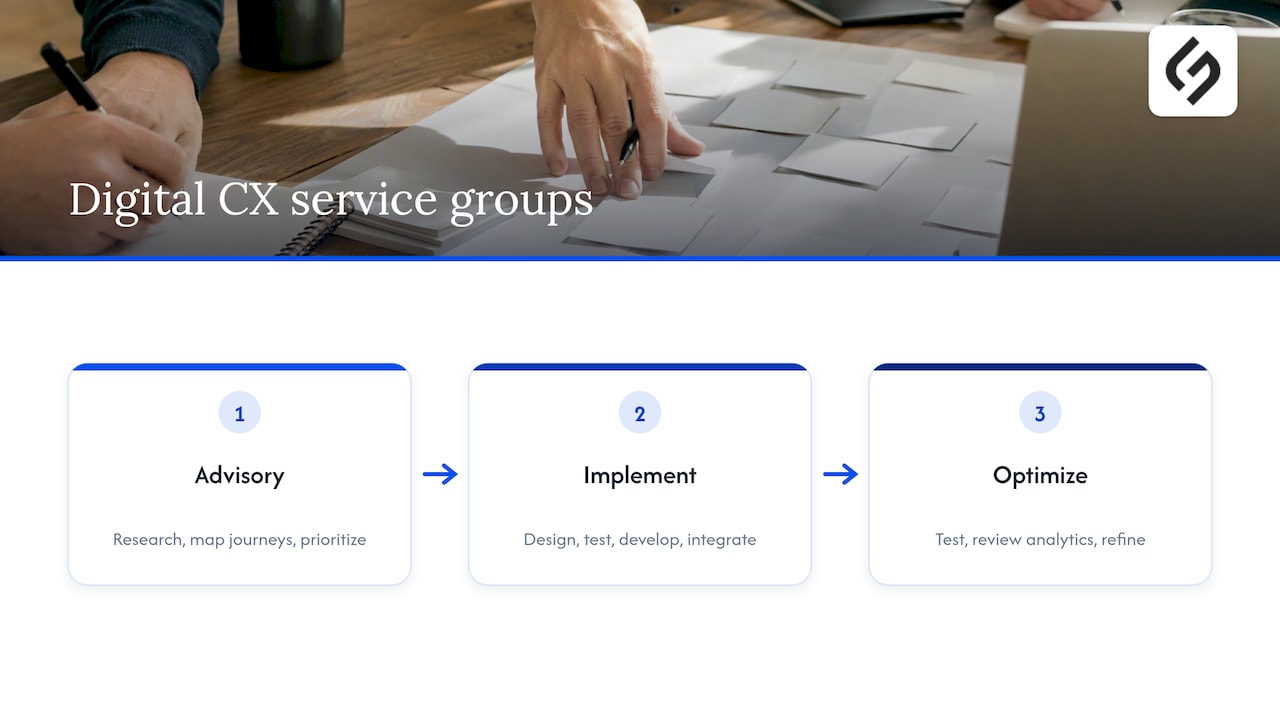
In practice, the work falls into three groups.
Advisory. Research, journey mapping, measurement design, experience strategy and prioritization. This is where the agency decides what should be fixed first and how success will be judged.
Implementation. Information architecture, UI/UX design, prototyping, usability testing, development, and integration with the CRM, marketing automation, commerce and analytics platforms already in use.
Continuous optimization. Testing, analytics review, content and SEO refinement, security upkeep and iterative improvements after launch. A launch is a milestone, not the finish line.
The label varies. Providers describe themselves as CX agencies, digital experience (DX) agencies, UX and conversion optimization firms, or digital transformation consultancies. The label matters less than whether the three phases are genuinely covered and whether they connect to each other.
When hiring an agency makes sense
Not every business needs an outside partner. A single product page with a high bounce rate can often be handled by a capable in-house marketer. An agency becomes the better option under conditions like these:
- Journeys cross systems or teams. A customer who sees an ad, books a demo, receives a proposal, signs and then uses a portal touches marketing, sales, finance and support. No single team owns that path.
- The skills are missing in-house. Research, service design, integration engineering, analytics and accessibility testing rarely sit in one small team.
- Past redesigns did not move the numbers. A visually polished site can still underperform. Forrester’s journey-value research explains that every journey can create or destroy value for both the customer and the firm, so the work should be judged on both sides.
- Leadership needs an objective baseline. Agencies bring outside benchmarks and a neutral view of internal disagreements.
The opposite signal is equally clear. If the request is simply a new website with no defined outcome, a CX agency is probably not the right brief yet. The first deliverable should be a clearer problem statement.
The process a credible agency follows
A sound engagement tends to follow a sequence like the one below. Names differ between firms, but the logic is consistent, and it matches the stepwise approach described in Gartner’s strategic sourcing guide for digital experience services.
- Discovery and baseline measurement. Current conversion rates, task completion, support volumes, revenue per journey, and the systems and data involved.
- Journey research and prioritization. Interviews, analytics review and session evidence, then a ranking of journeys by value and need for intervention.
- Service blueprint and technical audit. What happens behind the screen: handoffs, tools, data flows, and the technical debt that limits improvement.
- Experience strategy and information architecture. The target journeys, content structure and navigation model.
- Prototype and usability testing. Real users attempt real tasks before a line of production code is written.
- Implementation and integrations. Front end, back end, CRM, commerce and analytics connections.
- Analytics, accessibility, security and quality assurance. Verified throughout delivery, not appended at the end.
- Launch. Staged where the risk justifies it.
- Continuous optimization. A backlog of tested improvements tied to the agreed measures.
A proposal that jumps from step 1 straight to step 6 is a build shop with a CX label.
Treat CX as a portfolio of journeys
The most useful reframing for a buyer is that CX is a portfolio of journeys, not one redesign. For each priority journey, the agency should be able to document the customer outcome, the business value, known friction points, the owner, data dependencies and a backlog of interventions. Forrester advises prioritizing journeys by value and intervention need rather than by whichever internal stakeholder pushes hardest, and that advice saves many projects from becoming a political exercise.
Measurement: define success before building
Metrics only matter when they change decisions. Forrester’s guidance on measuring CX performance and proving ROI points to embedding CX metrics in organizational decision-making and connecting them to business results. For a buyer, the practical implication is to have the agency document six things for each metric before implementation starts:
| Element | Question to answer | Example |
|---|---|---|
| Baseline | Where are we today? | Quote-request completion rate over the last 90 days |
| Target | What change counts as success? | A stated improvement agreed with the sponsor |
| Owner | Who is accountable? | Head of demand generation |
| Data source | Where does the number come from? | Analytics platform plus CRM |
| Review cadence | How often is it examined? | Monthly review |
| Decision rule | What happens if the target is missed? | Reprioritize the backlog or stop the change |
The examples are illustrative. The point is that each row has a name next to it before work begins. An agency that cannot fill in this table for a pilot journey will struggle to prove value later.
Accessibility belongs in the statement of work
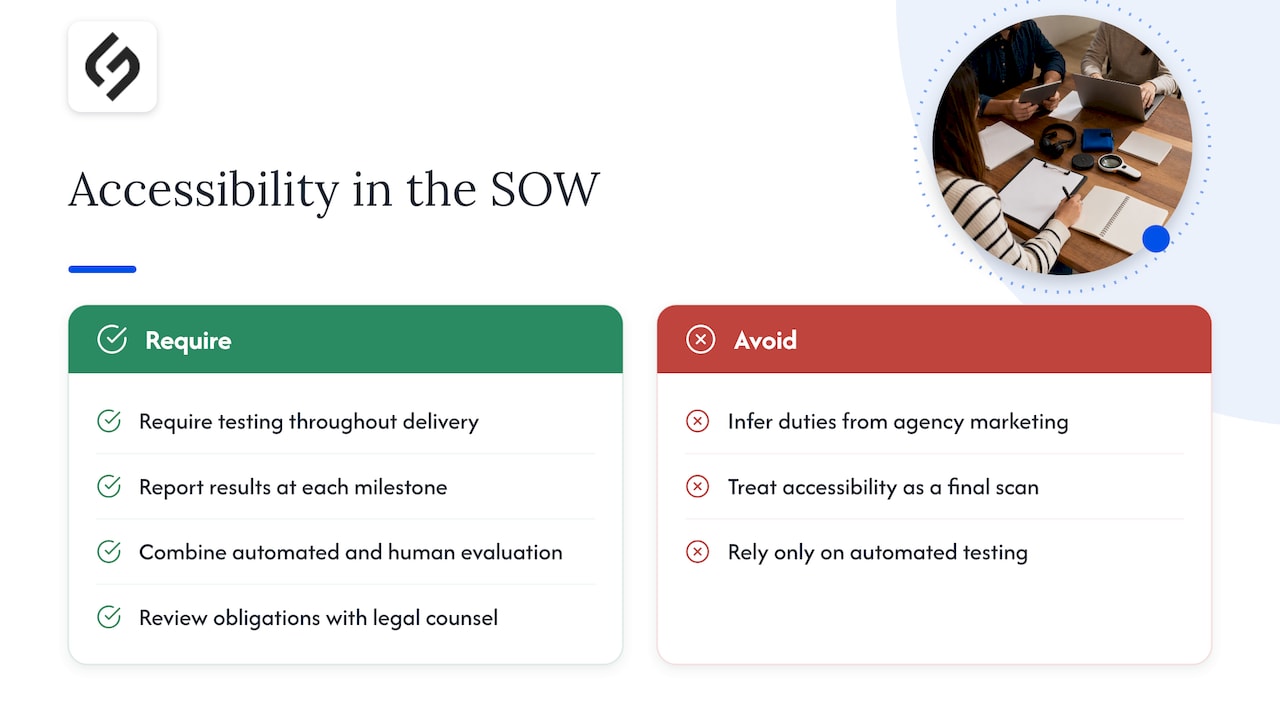
Accessibility is a quality attribute of customer experience, and for U.S. businesses it also carries legal exposure. The W3C recommends WCAG 2.2, organized around four principles: perceivable, operable, understandable and robust. WCAG 2.2 was published as a W3C Recommendation on 5 October 2023 and adds nine success criteria over WCAG 2.1.
Two cautions apply. First, W3C does not make regulations, so which standard a particular organization must meet depends on its jurisdiction and sector. Obligations should be reviewed by qualified legal counsel, not inferred from an agency’s marketing. Second, accessibility is not a final automated scan. The W3C describes WCAG 2.2 as testable through a combination of automated testing and human evaluation, and it applies to dynamic content, mobile, apps, software and documents. The statement of work should therefore require keyboard, screen-reader, focus, authentication, form, mobile and content testing throughout delivery, with results reported at each milestone.
For a phase-by-phase view of how SEO and WCAG 2.2 checks fit into a redesign, the audit-driven website redesign checklist walks through the sequence.
What to require in the contract
Procurement language is where many CX engagements are won or lost. The statement of work should name:
- Outcomes. The journeys in scope and the measures that define success.
- Milestones and deliverables. Research reports, blueprints, prototypes, test results and launch criteria, each with acceptance conditions.
- Client responsibilities. Access to stakeholders, data, systems and approvals, with response times. Delays on the client side are a common cause of overruns.
- Data access. Direct access to analytics, CRM and testing tools, not only screenshots in a monthly deck.
- Ownership. Who owns the code, designs, research and configurations on completion or termination.
- Support terms. Warranty period, response times and what happens to the optimization backlog after launch.
- Security and privacy. How customer data is handled in development, testing and integrations.
- Accessibility. The target conformance level and the testing method.
Federal buyers face the same questions. The U.S. CX Office publishes a CX services evaluation and buying guide that addresses what to do in-house versus outsource, what skills to seek and where to start. It is written for agencies, but the questions transfer well to private-sector buyers.
Comparing proposals: criteria that matter
Agencies of very different shapes answer the same search. A buyer will typically meet four types: large consultancies, platform-aligned implementation partners, design-led boutiques and tech-led digital agencies. None is universally better. Compare them on the following:
| Criterion | What good looks like | Warning sign |
|---|---|---|
| Starting point | Diagnosis of journeys and outcomes | A fixed website or CRM build proposed in the first meeting |
| Coverage | Research, design, integration and optimization under one accountable team | Strong visuals but no integration or analytics capability |
| Fit to your stack | Experience with the CRM, commerce and marketing tools you already use | Template-driven builds that ignore existing workflows |
| Measurement | Baselines, targets and review cadence defined up front | Vanity metrics such as page views alone |
| Accessibility and security | Built into each phase, tested by people and tools | A one-off scan before launch |
| Post-launch | A defined optimization retainer or backlog | Handover with no support plan |
| Transparency | Clear scope, assumptions and client responsibilities | A single lump sum with vague deliverables |
References deserve a direct question: what changed for the customer and for the business, and how was it measured? A portfolio of attractive screens answers neither.
What it costs, and why published prices mislead
Public agency price lists are not a reliable universal benchmark. Scope varies materially with the number of journeys, markets, platforms and integrations, the depth of research, compliance needs and the level of ongoing optimization. Two proposals with the same headline number can contain very different work.
A more defensible method is to commission a paid or free discovery phase, receive a written proposal with assumptions, and then compare scopes line by line. Ask each agency to price three things separately: diagnosis and strategy, implementation, and the first six to twelve months of optimization. Separate pricing makes it clear what is being bought and allows a phased commitment.
Perspective: why we start with the workflow, not the template
We build and integrate digital systems for small and mid-sized businesses and enterprises, and the pattern we see most often is simple. A company buys a platform or a redesign, and the customer experience barely changes, because the underlying workflow was never examined. The CRM holds one version of the customer, the website another, and support a third.
For that reason our projects are tailored to the client’s business model and workflows rather than assembled from templates, and the implementation is designed around specific goals. A CRM connected properly to the website and SEO turns anonymous visits into traceable leads, which is often a larger CX gain than a new homepage. The same logic applies to strategy: our view on why many programs stall is set out in the piece on digital transformation consulting.
We also hold that setup is the beginning. Ongoing optimization, measured against agreed baselines, is where an experience actually improves. Buyers should ask every agency, including us, to show how that second phase works.
How Solution For Guru can help
Solution4Guru is a digital agency covering custom web development, UI/UX design, SEO and digital marketing, e-commerce development, CRM and SaaS integrations, AI and automation, cybersecurity and data protection, and tech consulting and strategy. For teams running HubSpot, the services include implementation, integration, administration and ongoing management, data migration, process automation and Marketing Hub custom development. Prices are not published, because scope drives cost, so engagements begin with a conversation about goals and journeys.
Explore the full list of services or start from the Solution4Guru home page to request a consultation.
A short checklist before signing
- Has the agency diagnosed at least one priority journey, with evidence, before proposing a solution?
- Is each metric tied to a baseline, target, owner, data source, review cadence and decision rule?
- Does the statement of work cover accessibility testing by people and tools, and has counsel reviewed any legal obligations?
- Are code, design and data ownership written down?
- Is there a priced optimization plan for the months after launch?
- Do references describe customer and business outcomes, not only deliverables?
An agency that answers all six clearly is likely to manage the harder parts of the engagement well.
FAQ
The terms overlap heavily. CX agencies often emphasize research, journey design and measurement, while digital experience agencies tend to emphasize platforms, UX and implementation. Evaluate the actual services and process rather than the label.
It depends on the number of journeys, integrations and testing rounds. Discovery and prioritization are usually shorter than implementation, and optimization continues after launch. Ask each agency for a phased timeline with milestones and client responsibilities instead of one end date.
Both. The agency should build and test against a standard such as WCAG 2.2 using automated tools and human evaluation. Which obligations apply to a given business is a legal question, so qualified counsel should review it.
Yes, when journeys cross systems, such as a website, a CRM and a support tool, and in-house skills are limited. A narrowly scoped first phase, such as one priority journey, keeps the commitment proportionate while producing measurable evidence.
Sources
- Gartner Magic Quadrant for Digital Experience Services
- Gartner Digital Experience Services Strategic Sourcing Guide
- Forrester: Optimize Journey Value For Customers And The Business
- Forrester: How To Measure Customer Experience Performance And Prove ROI
- W3C: WCAG 2 Overview
- W3C: WCAG 2.2 Recommendation announcement
- W3C: Web Content Accessibility Guidelines 2.2
- Digital.gov: An introduction to customer experience
- U.S. CX Office: Customer Experience Services Evaluation and Buying Guide