Business Automation Workflows: Ops Leads Can Govern the First 90 Days

A business automation workflow is a defined sequence of tasks that software runs with little or no manual effort, from trigger to outcome. Done well, it cuts repetitive work, shortens cycle times, and improves accuracy. This guide gives you a governance-first path to build one that lasts, from process selection through rollout.
TL;DR:
- Use process mining to reveal frequency and complexity, simulate cost and time effects, then score candidates for impact, stability, compliance risk, and automation ease.
- Automate stable processes with clear rules first, such as invoice capture or lead routing; fix messy processes before encoding them.
- Use federated governance with central standards and local execution, shared intake, versioned changes, role based access, audit logs, and separate build and approval responsibilities.
- Capture a baseline before launch and track operational measures, including cycle time and error rate, alongside business outcomes such as cost per transaction and hours saved.
- Use built in triggers for simple tasks, RPA for legacy systems, and workflow engines for approvals; keep human checkpoints wherever errors carry high costs.
Table of Contents
- Where does automation fit in the process management lifecycle?
- How do you design and implement an automated workflow step by step?
- What governance keeps automation from becoming fragile?
- Which technology and integration patterns should you choose?
- How do you measure success and keep improving?
- What quick wins fit a practical roadmap?
- Why people and governance beat tooling alone
- How we help you put this blueprint into practice
- FAQ
- Sources
Where does automation fit in the process management lifecycle?
Automation works best as one stage inside a larger discipline, not as a standalone project. The business process management lifecycle runs through planning and strategy, as-is analysis, to-be design and modeling, implementation, measurement and control, and optimization. Technology supports monitoring, testing, and continuous improvement at every stage.
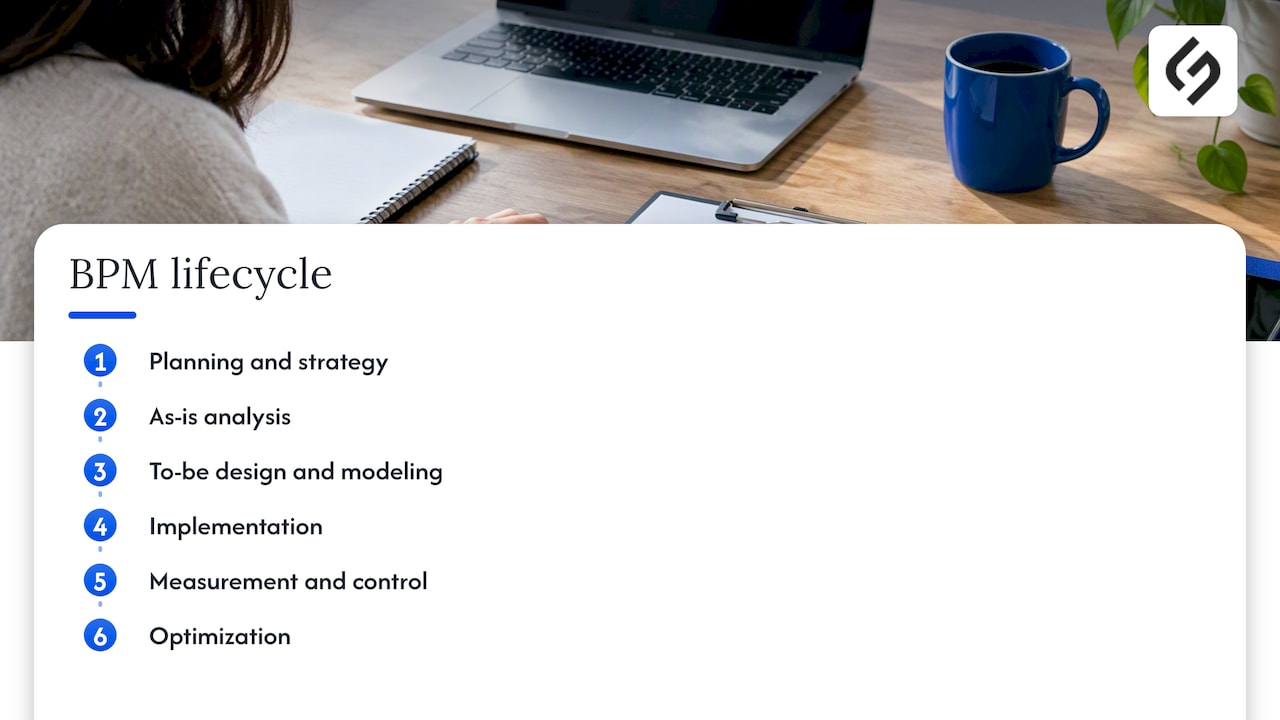
The technologies complement each other. BPM designs the process. Robotic process automation (RPA) and workflow tools operationalize parts of it. AI agents are an evolving capability that handles work rules alone cannot.
Maturity is cyclical. A systematic review of RPA in process management describes it as strategic alignment, operational execution, and continuous improvement, and notes that scaling without that feedback loop produces fragile, short-lived gains. Treat every automation as a living asset, not a finished project.
How do you design and implement an automated workflow step by step?
Move in a fixed order: goals, data, priorities, design, pilot, scale. Skipping ahead to tooling is the most common reason automation stalls.
- Start with strategic goals. Name the business outcome (faster collections, shorter onboarding), then map your process portfolio against it.
- Discover with data, not opinions. Process mining uncovers hidden complexity and frequency, removes subjectivity from candidate selection, and lets you simulate impacts such as cost and time savings before you build.
- Score your candidates. Rate each process on frequency, business impact, stability, compliance risk, and ease of automation. Pick the highest scorers.
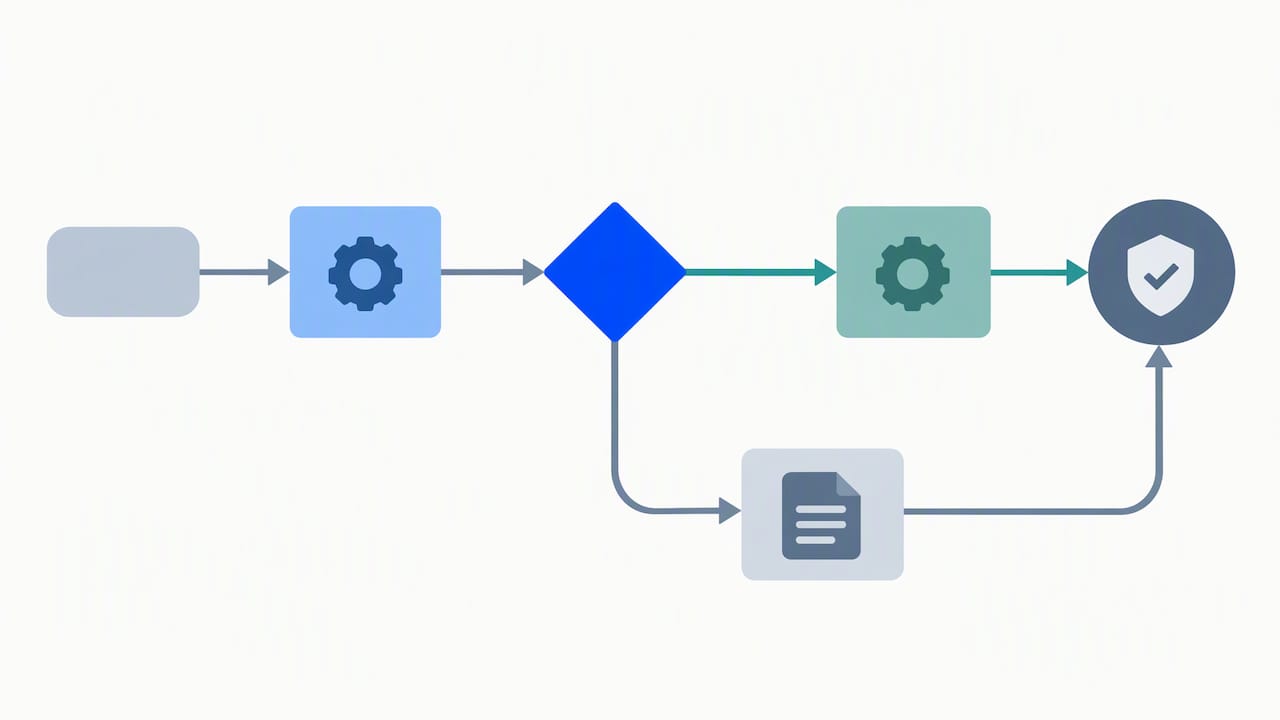
- Model the to-be process. A simple BPMN diagram or swimlane chart is enough. Mark every point where a person approves, corrects, or handles an exception.
- Pilot small, then scale. Run one process end to end, instrument monitoring from day one, compare results to your baseline, and only then expand the pipeline.
Pro Tip: Automate a stable process before a messy one. Automating chaos only produces faster chaos, so fix the process, then encode it.
For a broader practitioner view on frameworks and return on investment, this business process automation guide is useful background reading.
What governance keeps automation from becoming fragile?
Governance is what separates automation that lasts from a pile of scripts nobody owns. Federated governance, meaning central standards with distributed execution, consistently outperforms purely centralized or decentralized models in mid-to-large organizations. A Center of Excellence (CoE) sets the rules, and local teams build within them.
A working CoE usually covers these responsibilities:
- Owns standards, templates, and a shared component library
- Runs a single intake process so every request is scored the same way
- Controls changes through versioning, testing, and approval before release
- Enforces role-based access control and separation of duties, so no one person can build and approve the same automation
- Requires logging and audit trails for every automated action
People matter as much as controls. The same RPA review stresses protecting workforce autonomy, setting transparent human-agent collaboration protocols early, and planning communication and training to avoid resistance and workaround behavior. Involve the employees who run the process today before you design its replacement.
Pro Tip: Publish a one-page rule for who may override an automation and how that override is logged. It removes most arguments before they start.
Which technology and integration patterns should you choose?
Match the tool category to the work, not the other way around. Start by naming the use case, then pick the lightest option that handles it.
- Platform triggers: built-in rules inside your CRM or finance tool, best for simple, single-system tasks
- RPA: software robots that operate user interfaces, suited to legacy systems without APIs
- Workflow engines and BPM suites: orchestration of multi-step, multi-team processes with approvals
- iPaaS: API-based integration that connects applications and moves data between them
- AI and agentic automation: handling of semi-structured work such as emails, documents, and classification
Integration patterns matter too. API-first connections are sturdier than screen scraping. Event-driven designs react as things happen instead of polling. Orchestration should always include a fallback path, and human-in-the-loop checkpoints belong wherever errors are costly.
Judge options on maintainability, observability, compliance fit, and total cost of ownership. A technology-selection framework presented at AMCIS 2025 notes that adoption stays low partly because of initiative complexity and the sheer variety of technologies, which is why a structured selection approach pays off.
How do you measure success and keep improving?
Track two layers of metrics and review them on a fixed schedule. Operational KPIs show whether the automation runs well: cycle time, throughput, error rate, and bot utilization. Business KPIs show whether it matters: cost per transaction, customer response time, and FTE-equivalent hours saved.
Capture a baseline before you launch, otherwise every improvement is a guess.
Process mining removes subjectivity from candidate selection and helps set realistic expectations by simulating impacts like cost and time savings. Use the same data after launch to spot drift and re-prioritize.
Dashboards fed by process data reveal when a workflow degrades, for example when exceptions climb after a policy change. That signal triggers optimization, and the lessons feed your next round of scoring. Measurement is the loop that closes the lifecycle, not a report you file.
What quick wins fit a practical roadmap?
Start with low-risk, high-frequency work where rules are clear: invoice capture, lead routing, simple approvals, and scheduled reporting. Our small business workflow automation article shows what short-term wins look like in practice, and our piece on Zapier workflow examples covers entry-level patterns with governance tips.
A realistic plan moves through these phases:
- Discovery: map candidate processes, gather data, and score them.
- Pilot: build one workflow with logging and a human checkpoint.
- Measurement: compare against your baseline and fix exceptions.
- Refinement and scaling: document standards and queue the next candidates.
Keep process ownership and business rules in-house. Bring in an implementation partner when you need integration engineering, CRM configuration, or capacity you cannot spare. Case evidence supports this balance: an RPA case study found that projects need multi-stakeholder governance, iterative testing, and integration with other applications to remove fragile spreadsheets and manual workarounds.
Why people and governance beat tooling alone
Our view is simple: the tool is rarely the reason automation succeeds or fails. Teams that start with governance and people build workflows that survive staff changes and policy updates, while teams that start with software accumulate brittle automations nobody trusts. Objective selection through process mining also keeps expectations honest, because it shows what a process really looks like before you promise savings.
Agentic AI is the area to watch with care. Practitioners expect gains in efficiency and compliance, but they recommend defining goals, setting legal and ethical guardrails, agreeing on human-agent collaboration, and always providing safe fallbacks.
— Vadim
How we help you put this blueprint into practice
We turn the steps above into working workflows for teams that want a partner on the build. Solution4guru works with you across the full engagement, from first scoping call to ongoing tuning. Our services cover:
- Process discovery and prioritization
- Integration and engineering across your existing systems
- HubSpot and CRM automation, including process automation with HubSpot
- Custom workflow development
- Ongoing optimization and administration
A typical engagement moves from scoping to a pilot, then to measurement, then to scale. Book a free consultation through our main site and we will help you map automation candidates.
FAQ
What is a business automation workflow?
It is a set of tasks that software carries out automatically, triggered by an event and ending in a defined outcome. People step in only for approvals and exceptions. The result is less repetitive work and fewer manual errors.
How do I choose which process to automate first?
Score candidates on frequency, business impact, stability, compliance risk, and ease of automation. Use data from process mining where possible, since it replaces opinion with measured frequency and complexity.
Do I need a Center of Excellence to start?
Not on day one, but you need its functions: shared standards, one intake process, and change control. Federated governance pairs central rules with local execution and tends to scale best as automation grows.
Is AI-driven automation safe to use in business processes?
It can be, with guardrails. Practitioners recommend defined goals, legal and ethical limits, human-agent collaboration rules, and safe fallbacks before agents touch critical decisions.
Sources
- Robotic Process Automation in Business Process Management: A Systematic Literature Review and an Integrated Framework
- Agentic Business Process Management: Practitioner Perspectives on Agent Governance in Business Processes
- Innovation Insight: Process Mining Helps Overcome Major Automation Challenges