Common Progressive Commercial Policy Mistakes Small Businesses Make
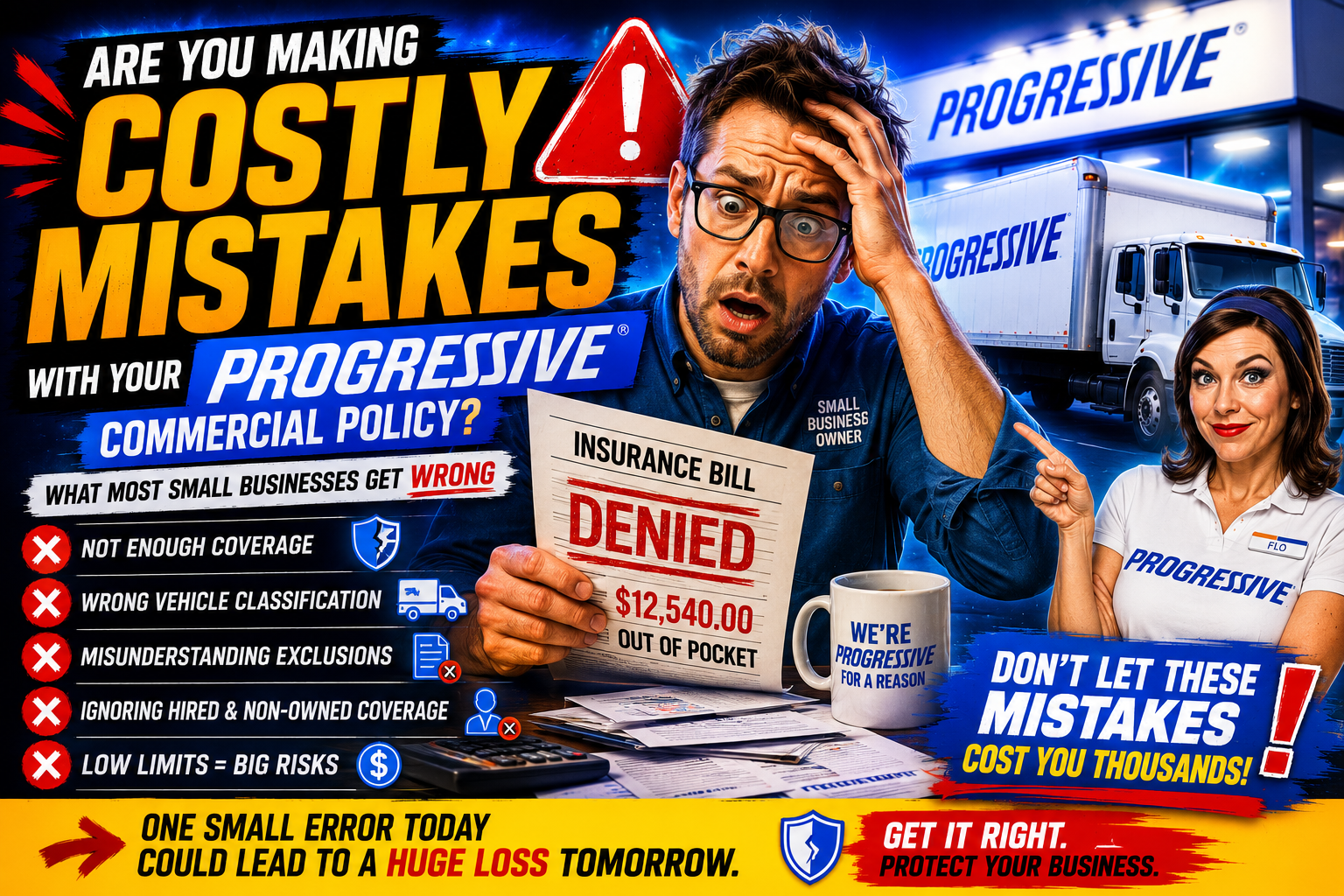
Running a small business means managing a relentless list of responsibilities — payroll, operations, customer service, compliance, and growth strategy all compete for your attention every single day. Insurance, as a result, often ends up treated as an afterthought: something you buy once and rarely revisit until a claim forces your hand. That reactive approach, however, exposes your business to financial risks that a well-structured commercial insurance policy could have prevented. This article identifies the most common mistakes small business owners make with their Progressive commercial insurance policies and, more importantly, explains how to avoid each one.
Table of contents
What Will You Find in This Article?
This article walks you through the most frequent and costly commercial policy mistakes that small businesses make, with a specific focus on policies offered through Progressive. You will learn how to choose the right coverage types, set appropriate limits, avoid dangerous gaps, and keep your policy aligned with your business as it grows. You will also find a practical overview table, answers to the most common questions business owners ask, and guidance on how partnering with Solution4Guru can help you navigate commercial insurance decisions with confidence.
What Is Progressive Commercial Insurance and Why Does It Matter for Small Businesses?

Progressive is one of the largest and most recognized insurance providers in the United States, serving millions of personal and commercial policyholders nationwide. Through its dedicated commercial division — Progressive offers a wide range of commercial auto insurance products specifically designed for small and medium-sized businesses. These include coverage for business-owned vehicles, contractor fleets, food trucks, delivery drivers, rideshare companies, and many other commercial operations that depend on vehicles to generate revenue.
How Is Progressive Commercial Insurance Directly Related to Small Business Policy Mistakes?
Progressive Commercial stands out in the US auto insurance market because it specifically targets small business owners who use vehicles as part of their daily operations. Consequently, the policy decisions small business owners make — or fail to make — within a Progressive Commercial policy directly determine how well protected their business assets, employees, and revenue streams are.
The mistakes covered in this article directly reflect real-world scenarios that Progressive’s commercial policyholders encounter: underinsuring business vehicles, failing to list all drivers, skipping hired and non-owned auto coverage, and neglecting to update policies as the business grows. Understanding these mistakes in the context of Progressive’s specific commercial offerings helps small business owners take targeted corrective action rather than relying on generic advice.
What Are the Most Common Progressive Commercial Policy Mistakes Small Businesses Make?

Small business owners consistently repeat a recognizable set of insurance mistakes — not because they are careless, but because commercial policy decisions are genuinely complex. The following sections break down each mistake, explain why it happens, and offer concrete steps to correct it.
Mistake #1: Are You Confusing Personal Auto Insurance With Commercial Coverage?
This is, without question, the single most common and most dangerous mistake small business owners make. Many entrepreneurs assume their personal auto insurance policy covers their vehicle when they use it for business purposes — delivering products, driving to client sites, or transporting equipment. That assumption, unfortunately, is almost always wrong.
Personal auto insurance policies explicitly exclude commercial use. If you get into an accident while driving for business purposes and you only hold a personal policy, your insurer will likely deny the claim entirely. Progressive specifically requires commercial auto policies for vehicles used in business operations, and their underwriters evaluate each risk based on business use patterns, not personal driving habits.
The business vehicle use test: Ask yourself these questions to determine whether you need commercial coverage:
- Do you use your vehicle to visit clients, job sites, or business locations?
- Do you transport tools, equipment, products, or business materials in your vehicle?
- Do employees drive the vehicle, even occasionally?
- Do you use the vehicle to make deliveries or provide a service for pay?
If you answer yes to any of these questions, a personal policy leaves you dangerously exposed. Progressive Commercial offers tailored commercial auto policies that cover exactly these use cases — and getting the classification right from the start prevents catastrophic claim denials.
Mistake #2: Why Does Underinsuring Your Commercial Vehicles Cost More in the Long Run?
Cost pressure pushes many small business owners to select the minimum required liability limits when setting up their Progressive commercial policy. This decision feels financially responsible at the time, but it creates enormous exposure when an accident causes serious injury or significant property damage.
According to the Insurance Information Institute, the average bodily injury liability claim in the US exceeds $20,000, and multi-vehicle commercial accidents can generate claims in the hundreds of thousands. Minimum liability limits — often set at $25,000 per person and $50,000 per accident — cover only a fraction of these costs. The business owner personally absorbs the remainder, which can result in lawsuits, asset seizures, and business closure.
Recommended coverage benchmarks for small businesses:
| Coverage Type | Minimum Limit | Recommended for Small Business | High-Risk Operations |
| Bodily Injury Liability | $25,000 / $50,000 | $100,000 / $300,000 | $500,000 / $1,000,000 |
| Property Damage Liability | $10,000 | $100,000 | $250,000+ |
| Combined Single Limit | $50,000 | $300,000 | $1,000,000 |
| Uninsured Motorist | State minimum | Equal to liability limits | Equal to liability limits |
| Medical Payments | Optional | $5,000–$10,000 | $25,000+ |
Progressive’s commercial underwriters can help you model the actual risk exposure your business faces based on vehicle type, annual mileage, and cargo type. Importantly, increasing your liability limits typically costs far less than most business owners expect — often a few hundred dollars per year for significantly greater protection.
Mistake #3: Are You Forgetting to List All Drivers on Your Commercial Policy?
Every driver who operates a business vehicle must appear on your commercial auto policy. Nevertheless, small business owners routinely omit occasional drivers — part-time employees, seasonal workers, family members who help out during busy periods — either because they forget or because they assume listed drivers are only those who drive regularly.
Progressive Commercial evaluates driver risk based on motor vehicle records (MVRs). When an unlisted driver causes an accident, Progressive may deny the claim or significantly reduce the payout, citing a material misrepresentation in the policy application. Even if the insurer does pay, the business owner may face policy cancellation or premium increases at renewal.
How to manage drivers correctly:
- Maintain a current list of all employees and family members who drive business vehicles.
- Pull MVRs for every listed driver at policy inception and annually at renewal.
- Immediately add new drivers to the policy before they operate any covered vehicle.
- Report driving record changes — DUIs, suspensions, at-fault accidents — to Progressive promptly.
- Remove drivers who no longer work for the business to keep the policy accurate and the premium competitive.
Progressive also offers a Named Driver Exclusion option for drivers with poor records who you genuinely do not want operating covered vehicles. Using this tool formally protects your policy while creating a clear record that the excluded driver was never authorized.
Mistake #4: What Happens When You Skip Hired and Non-Owned Auto Coverage?
Many small businesses occasionally use vehicles they do not own — rented vans during peak seasons, employee personal vehicles for deliveries, or a leased truck for a one-time project. Standard commercial auto policies cover only vehicles specifically listed on the policy. Therefore, accidents involving unlisted vehicles leave the business entirely unprotected.
Hired Auto Coverage protects your business when you rent or lease a vehicle for business use. Non-Owned Auto Coverage protects your business when an employee uses their personal vehicle on company business and their personal insurance is insufficient to cover the damages. Both coverages are typically available as endorsements on a Progressive Commercial policy at modest additional cost.
Common scenarios where HNOA coverage applies:
- An employee drives their personal car to pick up supplies and rear-ends another vehicle.
- You rent a cargo van for a trade show delivery and a team member scratches another car in the parking lot.
- A contractor uses their own truck on your job site and causes property damage.
- A part-time driver uses a rented vehicle during a surge period and is involved in a collision.
Without Hired and Non-Owned Auto (HNOA) coverage, your business faces direct liability for these incidents. Progressive makes it straightforward to add HNOA as an endorsement, and the additional premium is modest compared to the protection it provides.
Mistake #5: How Does Choosing the Wrong Deductible Damage Your Cash Flow?
Deductible decisions involve a fundamental trade-off: higher deductibles lower your premium, but they also mean you pay more out of pocket when a claim occurs. Small business owners often optimize for the lowest possible premium without honestly assessing whether they could afford the deductible during a cash-flow squeeze.
A business carrying a $5,000 deductible on its commercial auto policy may save $600 per year in premiums. However, if that business experiences two minor claims in the same year — a cracked windshield and a fender bender — it absorbs $10,000 in costs while only saving $600 annually. For a small business operating on thin margins, that math can be catastrophic.
Deductible selection framework:
- Calculate your business’s average monthly cash reserve available for unexpected expenses.
- Set your deductible at no more than the amount you could comfortably pay from operating funds within 30 days.
- Compare the annual premium savings against the realistic probability of a claim — Progressive can provide loss history data for your vehicle class and region.
- Consider separate deductibles for comprehensive (glass, weather, theft) versus collision coverage.
Progressive Commercial allows businesses to select different deductibles for different coverage components, giving you the flexibility to balance cost and risk appropriately across your specific fleet and operations.
Mistake #6: Are You Neglecting to Update Your Policy When Your Business Changes?
A commercial auto policy reflects your business at the moment you purchased it. But businesses change — sometimes rapidly. You add vehicles, hire more drivers, expand into new service areas, change the types of cargo you transport, or shift from local deliveries to interstate operations. Each of these changes alters your risk profile, and failing to update your Progressive policy accordingly can result in denied claims or inadequate payouts.
Furthermore, some changes actually reduce your risk and qualify you for lower premiums — downsizing your fleet, installing telematics devices, or moving to a lower-mileage business model, for instance. Failing to report these positive changes means you overpay for coverage you no longer need.
Trigger events that require immediate policy review:
| Change Event | Why It Matters | Action Required |
| Adding a vehicle to the fleet | Unlisted vehicles carry no coverage | Add vehicle before first use |
| Hiring a new driver | Unlisted drivers create claim risk | Add driver before first drive |
| Changing cargo type | Some cargo requires specialized coverage | Notify Progressive of cargo change |
| Expanding service territory | New regions may carry different risk ratings | Update territory in policy |
| Installing vehicle telematics | Qualifies for usage-based discounts | Report to Progressive for premium review |
| Reducing fleet size | Fewer vehicles lower premium exposure | Remove sold/retired vehicles promptly |
| Adding a trailer | Trailers may require separate coverage | Verify trailer coverage with agent |
| Starting interstate operations | DOT/FMCSA requirements may apply | Review compliance obligations |
Mistake #7: Why Does Ignoring Cargo Coverage Leave Your Business Exposed?
If your business transports goods — whether you run a landscaping company, a food delivery service, a medical supply distributor, or a construction materials hauler — the cargo itself represents significant financial value. Standard commercial auto policies from Progressive cover vehicle damage and liability but do not cover the goods inside the vehicle unless you specifically add cargo coverage.
Consider a small business that transports custom equipment to client sites. If a collision destroys both the vehicle and the equipment inside, the commercial auto policy pays for the vehicle repair but leaves the business absorbing the full cost of replacing the cargo. For high-value goods, that loss can be financially devastating.
Types of cargo coverage to consider:
- Motor Truck Cargo Insurance — covers goods in transit owned by others (for-hire carriers).
- Inland Marine Insurance — covers equipment and materials you own while in transit.
- Refrigeration Breakdown Coverage — critical for food service and perishable goods transporters.
- Specified Perils vs. All-Risk Cargo — broader all-risk coverage costs more but protects against a wider range of incidents.
Progressive works with business owners to identify the right cargo protection based on the specific goods transported, their value, and the transit distances involved. Addressing this gap during policy setup, rather than after a loss, makes all the difference.
Mistake #8: Are You Missing Available Discounts on Your Progressive Commercial Policy?

Progressive Commercial offers a range of discounts that many small business owners never discover simply because they do not ask. Failing to claim applicable discounts means overpaying for the same level of protection — a particularly avoidable form of financial waste.
Common discounts available through Progressive Commercial:
- Pay-in-full discount — paying your annual premium upfront rather than monthly reduces total cost.
- Multi-vehicle discount — insuring two or more commercial vehicles on the same policy generates savings.
- Prior insurance discount — businesses with continuous prior coverage demonstrate lower risk.
- Safety equipment discount — vehicles equipped with anti-theft devices, dashcams, or collision avoidance systems may qualify.
- Telematics/usage-based discount — Progressive’s Snapshot for Business program tracks driving behavior and rewards safe driving patterns with reduced premiums.
- Commercial driver training — employing drivers with formal commercial driving certifications can reduce fleet risk ratings.
Beyond discounts, Progressive also offers a Name Your Price tool for commercial policies that lets business owners set a target premium and then identifies the coverage options that fit that budget. This approach prevents the common mistake of simply accepting the first quote without exploring alternatives.
Mistake #9: What Are the Risks of Not Reading Your Policy Exclusions Carefully?
Insurance policies are legal contracts, and the exclusions section defines the boundaries of your coverage with precision. Yet the vast majority of small business policyholders never read their exclusions in detail. They discover the gaps only when a claim gets denied — exactly the wrong time to learn about them.
Progressive Commercial policies, like all commercial auto policies, contain specific exclusions that vary by endorsement and state. Common exclusions include intentional acts, racing or track events, using a covered vehicle for rideshare without the appropriate endorsement, transporting hazardous materials without a specialized policy, and using a vehicle for purposes not disclosed at application.
Key sections to review in your Progressive Commercial policy:
- Declarations page — confirms the vehicles, drivers, coverage types, and limits actually on the policy.
- Covered auto designation symbols — defines exactly which vehicles trigger coverage (owned, hired, non-owned, etc.).
- Exclusions section — lists all circumstances under which the insurer will not pay a claim.
- Conditions section — outlines your obligations as a policyholder, including claim reporting timelines.
- Endorsements — additional coverages or modifications attached to the base policy; these alter the standard terms.
If any language in your policy is unclear, Progressive‘s commercial agents can walk you through it. Alternatively, an independent insurance advisor or a partner like Solution for Guru can review your policy document and flag coverage gaps before they become claim problems.
Mistake #10: Why Do Small Businesses Fail to Review Their Policy at Renewal?
Auto-renewing a commercial insurance policy without reviewing it is one of the quietest ways a small business erodes its financial protection. Coverage needs change, premiums shift, new endorsements become available, and competing carriers may offer better terms. Nevertheless, most small business owners simply let their Progressive commercial policy roll over without a second look.
At renewal, Progressive recalculates premiums based on updated loss data, regional risk trends, and any changes in your fleet or driver roster. If your business has grown — more vehicles, more drivers, higher cargo values — your coverage limits may no longer match your actual exposure even though the policy still exists.
Annual renewal checklist:
- Verify that all current vehicles appear on the policy with accurate vehicle identification numbers (VINs).
- Confirm that all active drivers are listed and that driver records are current.
- Compare current liability limits against your business’s growth in assets and revenue since the last review.
- Check whether new endorsements now apply to your operations — HNOA, cargo, telematics, etc.
- Request a competitive re-quote if your premium has increased more than 10% without a corresponding change in risk.
- Discuss any new business activities planned for the coming year that might affect coverage needs.
What Should Small Businesses Conclude About Managing Their Progressive Commercial Policy?
The ten mistakes outlined in this article all share a common root cause: treating commercial insurance as a static, set-and-forget expense rather than a dynamic tool that must evolve alongside the business. Small businesses that manage their Progressive commercial policies proactively — reviewing coverage at renewal, adding drivers promptly, selecting appropriate limits, and exploring available endorsements — consistently achieve better financial outcomes when unexpected events occur.
Progressive Commercial Insurance offers small businesses a comprehensive range of commercial auto products that genuinely meet the demands of real-world business operations. From single-vehicle sole proprietors to multi-vehicle fleets, Progressive provides scalable coverage options that grow alongside the business. However, the platform’s flexibility also means that uninformed choices can create significant gaps — exactly the mistakes this article addresses.
Furthermore, the financial stakes of getting commercial insurance wrong extend well beyond a single denied claim. An underinsured business that faces a serious liability lawsuit risks losing vehicles, equipment, savings, and even the business itself. Conversely, a business that carries the right coverage through Progressive Commercial faces those same incidents with confidence, knowing that the financial exposure is contained and manageable.
Therefore, the most important conclusion is this: invest the time to understand your policy, keep it updated as your business changes, and seek expert guidance when coverage decisions become complex. Commercial insurance is not a cost to minimize — it is a risk management tool that protects everything you have built.
Frequently Asked Questions About Progressive Commercial Policy for Small Businesses
Yes — but only if those employees appear as listed drivers on your policy. Progressive evaluates every listed driver’s motor vehicle record (MVR) when calculating your premium and assessing risk. An employee who is not listed on the policy but causes an accident while driving a covered vehicle creates serious complications: Progressive may deny the claim or pay out at a reduced level, citing an inaccurate policy application. Therefore, always add new employees to your commercial policy before they operate any business vehicle, and remove former employees promptly to keep your driver roster current and your premium accurate.
These are two distinct products that serve different purposes. A commercial auto insurance policy — like those offered through Progressive Commercial — covers vehicles used for business operations: accidents, liability, physical damage, and related risks involving your business fleet. A Business Owner’s Policy (BOP), on the other hand, bundles general liability insurance and commercial property insurance into a single package that covers your physical premises, equipment, inventory, and third-party liability for non-auto incidents. Many small businesses need both: a Progressive Commercial auto policy for their vehicles and a BOP for their physical business assets. Progressive offers both product lines, making it practical to consolidate coverage with a single carrier.
At minimum, every small business should conduct a thorough policy review at annual renewal. However, certain trigger events require an immediate mid-term review regardless of where you are in the policy year. These triggers include purchasing or selling a vehicle, hiring or terminating a driver, changing the type of goods you transport, expanding your service territory, taking on a new contract that involves vehicle use, or experiencing a significant change in annual mileage. Progressive allows mid-term policy updates, and making changes promptly — rather than waiting for renewal — ensures you are never operating a business vehicle without appropriate coverage in place.
How Can Solution for Guru Help Your Business Navigate Commercial Insurance Decisions?
Managing commercial insurance — especially policies as customizable as Progressive Commercial — requires expertise that most small business owners do not have time to develop independently. That is precisely where Solution for Guru delivers exceptional value.
What Specific Benefits Does Solution for Guru Offer Small Business Owners?
Expert Policy Analysis: Solution for Guru’s advisors review your existing Progressive Commercial policy in detail, identifying coverage gaps, unnecessary overlaps, and endorsements you may be missing. This analysis gives you a clear, actionable picture of your current protection level.
Needs Assessment and Coverage Mapping: Before recommending any changes, Solution for Guru conducts a structured assessment of your business operations — vehicle types, driver profiles, cargo, service territory, and growth plans. The result is a coverage map that aligns your policy precisely with your real-world risk exposure.
Discount Identification: Solution for Guru actively searches for discounts and premium optimization opportunities within your Progressive Commercial policy. Many small business owners leave significant savings unclaimed simply because they do not know what to ask for.
Renewal Review Management: Rather than letting policies auto-renew without scrutiny, Solution for Guru manages your renewal process proactively. The team reviews your updated business profile, compares renewal terms against market alternatives, and negotiates on your behalf to ensure you receive fair pricing and appropriate coverage.
Claims Guidance and Advocacy: When a claim occurs, Solution for Guru provides guidance on documentation, timelines, and communication with Progressive. This support reduces the stress of the claims process and increases the likelihood of a fair, timely resolution.
Ongoing Policy Maintenance: As your business grows and changes, Solution for Guru ensures your policy keeps pace. The team handles policy updates — new vehicles, new drivers, new endorsements — promptly and accurately, eliminating the risk of operating with outdated coverage.
In short, partnering with Solution for Guru transforms commercial insurance management from a time-consuming, error-prone task into a streamlined, expert-driven process. For small business owners who depend on their vehicles to generate revenue, that level of support is not a luxury — it is a competitive advantage.
Recommended
- Progressive vs biBERK vs NEXT: Which Commercial Auto Insurance Offers Better Value?
- What Does Progressive Commercial Auto Insurance Actually Cover?
- AI in Commercial Auto Insurance: Smarter Risk Assessment
- Understanding biBERK’s Claims Process for Commercial Auto Insurance
- When Is Progressive More Expensive Than Regional Commercial Auto Insurers?
- Top Progressive Discounts Small Business Owners Should Know About
- 24/7 Policy Management: How Progressive Supports Busy Business Owners
- Is biBERK a Good Choice for Small Business Owners?
- Checklist: Documents Needed for Commercial Auto Insurance
- How Food Truck Owners Can Benefit from Commercial Auto Insurance
- Commercial vs. Personal Auto Insurance: What’s the Difference?
- biBERK vs Progressive Commercial Auto Insurance: Which Is Better?
- Digital Transformation in Commercial Auto Insurance: What’s Next for Businesses?
- Insurance Needs for Contractors with Company Vehicles: What Do You Really Need?
- Commercial Auto Insurance for Delivery Businesses: Why biBERK Is a Strong Option
- What It’s Like to Work in Commercial Auto Insurance (And How to Start)