
Lead Nurturing Techniques That Convert Prospects in 2026

TL;DR:
- Effective lead nurturing combines multi-channel outreach with behavioral segmentation and stage-specific content to build trust and accelerate conversions. It requires patience, speed, and persistence, focusing on delivering new value at each contact and measuring impact through holdout groups and pipeline growth. Building a connected technology infrastructure and adapting sequences to prospect behavior enhances program effectiveness.
Lead nurturing techniques are defined as multi-touch, multi-channel sequences that deliver targeted content to prospects at each stage of the buying process to build trust and accelerate conversion. Most marketing professionals treat nurturing as a single email drip. The reality is that effective programs combine email, LinkedIn, personalized video, and direct calls into coordinated sequences timed to prospect behavior. Done correctly, these campaigns do not just warm leads. They create the conditions that make a buying decision feel natural.
What are the most effective lead nurturing techniques in 2026?
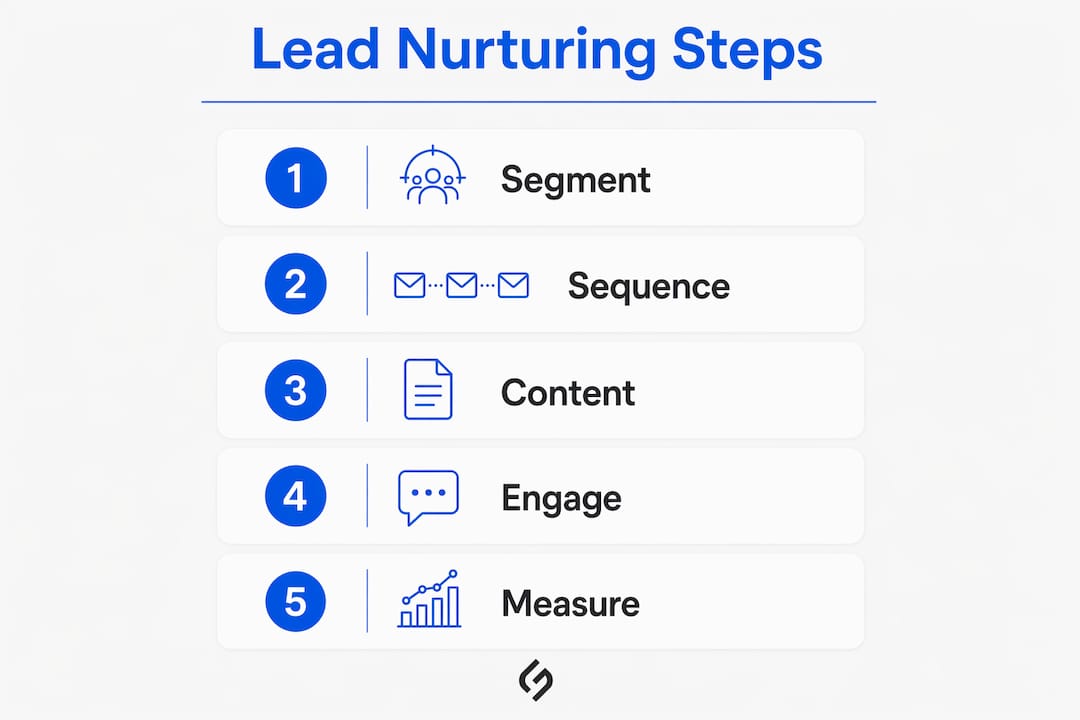
The most effective approach combines multi-channel sequencing with behavioral segmentation and stage-matched content. Each element reinforces the others. Remove one, and the whole program loses precision.
Multi-channel sequencing
Multi-channel approaches combining email, LinkedIn, personalized video, and phone calls achieve higher conversion rates than single-channel programs. Layered touchpoints create familiarity and credibility that overcome prospect skepticism. A prospect who sees your name in their LinkedIn feed, inbox, and voicemail on the same day is far more likely to respond than one who receives only an email.

Behavioral segmentation
Segmentation based on buyer stage, engagement signals, and firmographic data is the foundation of relevant outreach. A prospect who downloaded a pricing guide signals different intent than one who read a blog post. Treating both with identical messaging wastes budget and erodes trust.
Stage-matched content mapping
Content must match the buyer’s journey stage to be effective. Awareness-stage prospects need problem framing and educational resources. Consideration-stage prospects need ROI comparisons and differentiation. Decision-stage prospects need proof of results, implementation details, and risk reduction. Sending a pricing sheet to an awareness-stage lead is one of the fastest ways to lose them permanently.
AI and automation in nurturing workflows
AI-driven tools for segment discovery and creative variant testing accelerate the identification of high-signal nurturing sequences without sacrificing buyer understanding. Automation handles the scheduling and delivery. Human judgment still determines which message earns the right to be sent. For financial service marketers, digital lead nurturing with AI has become a primary growth driver in 2026.
- Multi-channel sequencing: Combine email, LinkedIn, video, and calls into one coordinated program.
- Behavioral segmentation: Trigger sequences based on what a prospect actually does, not just who they are.
- Stage-matched content: Map every asset to awareness, consideration, or decision before publishing.
- AI-assisted personalization: Use automation to personalize at scale while preserving message quality.
- Account-level view: Treat the buying committee as the unit of engagement, not individual contacts.
Pro Tip: Before building any nurture sequence, map your existing content assets to each buyer stage. Gaps in your content library will become gaps in your conversion rate.
How to design and execute a high-impact follow-up cadence
A high-impact cadence starts with speed and sustains itself through consistent value delivery. The structure matters as much as the message.
Make first contact within one hour. Contacting leads within one hour increases lead qualification nearly 7 times compared to waiting 24 hours. Speed signals professionalism and catches prospects while their interest is highest.
Plan for 8–12 touches over 21–45 days. Follow-up cadences typically involve 6–12 touchpoints spread across three to six weeks. This range gives enough time to build familiarity without dragging into irrelevance.
Front-load early touches. Touches 1–3 should happen in the first week. Touches 4–7 spread across the next two weeks. Beyond that, space contacts 5–10 days apart. Front-loading captures peak interest. Wider spacing later prevents fatigue.
Deliver new value at every touch. Every follow-up must introduce new value to avoid being perceived as spam. Rotate between case studies, data points, industry insights, and direct questions. Repeating the same ask in different words is not nurturing. It is noise.
Apply structured cadence frameworks. The 3-3-3 framework spaces three touches in week one, three in week two, and three across the final three weeks. The 2-2-2 framework compresses this for shorter sales cycles. Both frameworks force discipline around spacing and value variety.
Use the “breakup” email at touch seven. Breakup emails at around the 7th touch can re-open 30–40% of dead deals. Ask directly whether you should close their file. This respectful exit often prompts a response from prospects who had simply gone quiet.
Treat the buying committee as one unit. New leads from the same account should continue where the previous engagement left off. Sending an introductory email to a second contact at an account that already received a proposal wastes credibility.
Pro Tip:
Build a “value bank” before launching any cadence. List 10 distinct value points you can deploy across touches. If you cannot fill the list, your cadence is not ready.
Research confirms that 60% of prospects say no four times before eventually agreeing to a conversation. This means most sales teams quit two to three touches before the prospect was ready to engage. Persistence, paired with genuine value, is the differentiator.
What are common mistakes in lead nurturing campaigns?
The most damaging mistakes in lead nurturing are structural, not tactical. They reflect a misunderstanding of what prospects actually need.
Repeating the same message. Repetition without new value reduces trust and damages brand reputation. Each touch must educate or inspire. Sending the same pitch five times signals that you have nothing new to offer.
Pushing decision-stage content too early. Aligning content strictly with the buyer stage prevents premature pushes that alienate prospects. A prospect still defining their problem does not want a demo request. They want clarity.
Ignoring engagement signals. Managing pacing dynamically according to prospect engagement signals builds better relationships than rigid calendar schedules. If a prospect opens three emails in two days, accelerate the sequence. If they go silent, pause and reassess.
Treating all contacts at an account as independent leads. An account-level engagement view allows marketing teams to synchronize messaging to buying committees, reducing redundant outreach. Sending conflicting messages to different stakeholders at the same company is a credibility problem.
Scaling touches before trimming low-fit accounts. A healthy nurture program balances activity and audience quality by removing low-fit accounts before scaling. Nurturing a prospect who will never buy wastes resources and distorts performance data.
Measuring only vanity metrics. Open rates are unreliable in 2026 due to privacy protections in major email clients. Measuring only opens and clicks tells you almost nothing about pipeline impact.
How can you measure and optimize lead nurturing performance?
Accurate measurement separates programs that generate pipeline from programs that generate reports. The standard approach relies on holdout groups and pipeline attribution.
Using holdout groups
Running holdout groups of 10–20% excluded from nurturing is the most reliable method to measure incremental impact. Compare pipeline creation rates between nurtured and non-nurtured segments. The difference is your true lift. Without a holdout group, you cannot distinguish nurture impact from organic demand.
Tracking the right metrics
The metrics that matter are opportunity creation rate, sourced pipeline value, and incremental lift over the holdout group. Engagement metrics like click rates serve as directional signals, not proof of ROI. Aggregate engagement at the account level rather than the individual contact level for a more accurate picture of buying committee interest.
Iterating based on data and sales feedback
Sales teams see what marketing cannot. A weekly feedback loop between sales and marketing surfaces which messages resonate, which objections appear most often, and which content actually moves conversations forward. This feedback directly informs the next iteration of the nurture sequence. For a deeper look at measuring marketing ROI, Solution4guru’s resource library covers attribution models in practical detail.
Pro Tip: Tag every creative variant in your marketing automation platform before launch. Without tagging, you cannot isolate which message drove which outcome. Retroactive tagging is unreliable.
The role of data in marketing extends beyond reporting. It determines which segments receive which sequences and when those sequences should pause or accelerate.
Key Takeaways
Effective lead nurturing requires multi-channel sequencing, stage-matched content, and holdout-group measurement to generate pipeline that can be proven, not just claimed.
| Point | Details |
|---|---|
| Speed drives qualification | Contact new leads within one hour to increase qualification rates nearly 7 times. |
| Cadence length and structure | Plan 8–12 touches over 21–45 days, front-loading early contacts and spacing later ones. |
| Value at every touch | Each message must introduce a new data point, case study, or question to avoid being perceived as spam. |
| Stage-matched content | Map every asset to awareness, consideration, or decision stage before including it in a sequence. |
| Measure with holdout groups | Exclude 10–20% of prospects from nurturing to isolate true incremental pipeline impact. |
What I have learned from years of watching nurture programs succeed and fail
The most common failure mode I see is impatience dressed up as process. Marketing teams build a six-touch email sequence, run it for three weeks, see modest results, and conclude that nurturing does not work. What they actually proved is that six generic emails over three weeks do not work.
The programs that consistently generate pipeline share three traits. They treat the buying committee as a unit, not a list of individuals. They pause when prospects go quiet rather than escalating volume. And they measure against a holdout group rather than against last quarter’s open rates.
The breakup email is the tactic I recommend most often to teams that are skeptical about nurturing. Sending a respectful, direct message asking whether you should close a prospect’s file feels counterintuitive. The response rate proves otherwise. Prospects who had simply deprioritized the conversation often re-engage when given a clear exit. It respects their time and restores your credibility.
The other insight that changes how teams operate is the account-level view. When a new contact at an existing account enters a nurture sequence, they should not receive an introductory message. They should receive context that reflects where the account already is in the conversation. This requires your CRM and marketing automation to share data cleanly. Most teams have not built that connection yet, and it shows in their results.
Patience is not passive. It means designing sequences that adapt to behavior, not sequences that fire on a fixed schedule regardless of what the prospect does. The teams that master this distinction consistently outperform those that do not.
How Solution For guru helps you build nurture programs that perform
Building an effective nurture program requires more than a good email sequence. It requires a technology foundation that connects your CRM, website, and marketing automation into one coherent system.
Solution4guru works with marketing professionals and business owners to design and implement the technical infrastructure that makes personalized, behavior-driven nurturing possible. From CRM and SEO integration to AI-assisted outreach workflows, the team builds systems that capture the right signals and deliver the right messages at the right time. For business owners who want to understand how digital marketing fits into a broader growth strategy, the digital marketing for startups resource is a practical starting point. Schedule a free consultation to see how Solution4guru can help you turn your nurture program into a measurable pipeline asset.
FAQ
Lead nurturing is the process of delivering targeted, timed content to prospects across multiple channels to build trust and move them toward a purchase decision. Programs that nurture leads consistently generate more qualified pipeline than those that rely on single-touch outreach.
An effective cadence typically involves 8–12 touches over 21–45 days, with early contacts front-loaded in the first week and later contacts spaced 5–10 days apart.
Content matched to the buyer’s journey stage performs best. Awareness-stage prospects respond to problem-framing content, consideration-stage prospects need ROI evidence, and decision-stage prospects need implementation details and proof of results.
Run a holdout group of 10–20% of prospects excluded from nurturing, then compare opportunity creation rates between nurtured and non-nurtured segments. The difference in pipeline sourced is your incremental lift.
Pause a sequence when a prospect goes silent for an extended period and adjust based on engagement signals. Send a direct breakup email around the seventh touch asking whether you should close their file. This approach re-engages a significant share of prospects who had simply deprioritized the conversation.
Recommended
- How Does Creatio Improve Lead Management and Conversion Rates? – Solution for Guru
- Email Marketing Essentials: Grow Your Business with Effective Campaigns – Solution for Guru
- CRM, Website and SEO Integration: Best Practices for Lead Generation – Solution for Guru
- How to Boost Online Sales: Strategies for 2025 Success – Solution for Guru