Inbound Lead Generation Strategy: A B2B Framework

An inbound lead generation strategy is a system for attracting prospects who are already looking for answers, capturing their contact details in exchange for something useful, and qualifying them before sales follows up. Prospects come to the business through search, content and conversations, instead of the business interrupting them. This guide sets out the stages, the tactics, the metrics and the operating rules that make the system produce revenue rather than traffic.
TL;DR
- An inbound lead is a prospect who initiates contact after finding the company through content, search, social media, events or referrals.
- A working strategy has four moving parts: attract, capture, nurture and qualify. A gap in any one of them stalls the pipeline.
- Choose two or three tactics tied to your buyers’ questions, then add channels only when the first ones are measurable.
- Track MQL and SQL rates, deal velocity and sourced pipeline by channel, not raw visits or form fills.
- Agree on lead definitions and response times between marketing and sales before scaling content.
Table of Contents
- What an inbound lead generation strategy is
- How inbound leads are generated, step by step
- The funnel stages and lead definitions
- The 4 L’s of lead generation
- Choosing inbound tactics
- Nurturing and qualifying leads
- Measuring and improving results
- Common reasons inbound underperforms
- Our perspective
- Putting the framework into practice with Solution4Guru
- FAQ
- Sources
What an inbound lead generation strategy is
An inbound lead is a potential customer who reaches out to a business independently, typically after finding it through search engines or content, as UpLead’s overview of inbound leads puts it. Salesforce adds that what makes a lead inbound is that the prospect starts the contact, commonly after meeting the company through content, SEO, social media, events, referrals or an article.
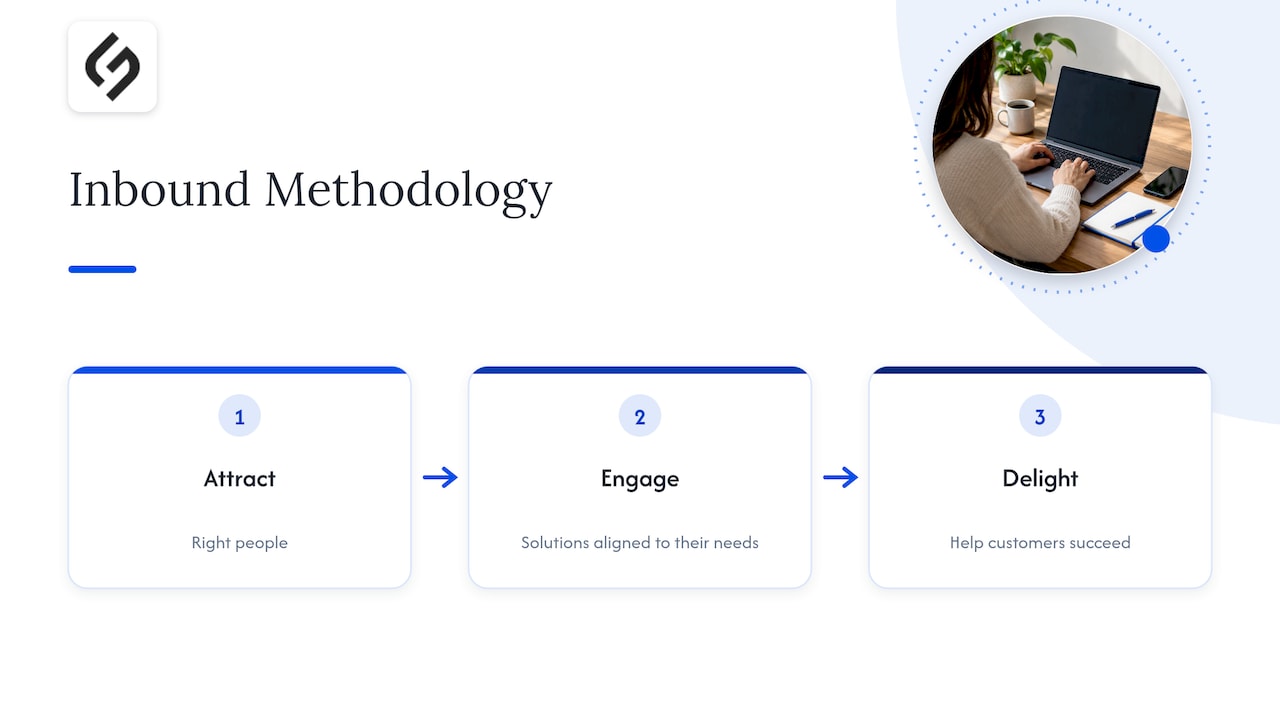
The strategy is the framework around that behavior. HubSpot describes it as a systematic process of attracting, capturing, nurturing and qualifying prospects through non-intrusive value, such as educational content. The same company’s inbound methodology contrasts this with cold calls, display ads and purchased email lists, and organizes the work around three ideas: attract the right people, engage them with solutions aligned to their needs, and delight customers so they succeed.
Oracle frames the appeal from the buyer’s side: inbound gives prospects control over where and when they engage, while the marketer’s job is to be easy to find through search and relevant content.
Inbound versus outbound
Oracle distinguishes two broad approaches. In inbound lead generation, prospects find and approach the company. In outbound, the marketer initiates contact. Most B2B teams run both. The practical difference is where effort sits: outbound spends effort on every conversation, while inbound spends it up front on assets that keep working after they are published.
That is why the question “what are the three approaches of lead generation?” has no single standard answer. Sources usually split the field into inbound and outbound, then add a third category such as referral or partner-driven leads. This article treats inbound as the system and uses the other approaches as supporting channels.
How inbound leads are generated, step by step
The sequence is consistent across vendors. Adobe describes it as creating content relevant to an audience, helping prospects discover it, prompting action with a call to action, collecting contact details in exchange for value, and nurturing the resulting leads with personalized follow-up. In practice, that becomes five working stages.
- Define the buyer. Interview customers and sales staff, then write down the job titles, triggers and objections behind a purchase. A research-based persona process keeps this grounded in evidence rather than assumption.
- Publish content that answers real questions. Educational, search-optimized content is what draws anonymous visitors to the site in the first place.
- Offer a reason to share contact details. Ebooks, webinars, demos, newsletters and tools all work when the value is specific to the reader’s problem.
- Nurture. Follow up with information matched to the person’s interest, not a generic sequence.
- Qualify and hand off. Score fit and intent, then route the lead to sales with context.
HubSpot summarizes the funnel the same way: attract anonymous visitors, convert them through gated offers, nurture, and qualify before handing off to sales.
The funnel stages and lead definitions
A strategy fails quietly when marketing and sales mean different things by “lead.” ZoomInfo’s guide, updated in October 2026, describes an inbound lifecycle of Visitor, Lead, Marketing Qualified Lead, Sales Accepted Lead, Sales Qualified Lead and Customer, with qualification and routing based on fit and intent.
| Stage | What it means | Typical owner |
|---|---|---|
| Visitor | Anonymous person on the site | Marketing |
| Lead | Shared contact details, such as a form fill | Marketing |
| MQL | Has shown interest but is not yet sales-ready | Marketing |
| SAL | Sales has accepted the lead for follow-up | Sales |
| SQL | Ready for direct sales engagement | Sales |
| Customer | Closed deal | Sales, then customer success |
The split between MQLs, who have shown interest but are not yet sales-ready, and SQLs, who are ready for a sales conversation, is the most useful line to draw in writing. Define it with observable criteria: company size, role, pages visited, offer downloaded, a demo request. Then put a response-time agreement in place so accepted leads are contacted quickly.
Salesforce notes that inbound prospects are often better informed because they have already researched their problem, yet they still need timely, personalized nurturing. A prospect who asked for a demo should not wait in the same queue as one who downloaded a checklist.
The 4 L’s of lead generation
The “4 L’s” is a mnemonic, and definitions vary by author. One widely circulated version names Lead Capture, Lead Magnets, Landing Pages and Lead Scoring. It maps cleanly onto the funnel above:
- Lead capture: forms, chat and in-platform lead forms placed where interest peaks. Reduce friction by asking only for what sales needs to qualify.
- Lead magnets: the offer exchanged for contact details. Match it to the stage of the buyer: a benchmark report for early research, a calculator or assessment for evaluation.
- Landing pages: one page per offer, with one action, a clear promise and fast load times.
- Lead scoring: points for fit (industry, size, role) and intent (pricing page visits, repeat sessions, demo requests).
Treat the framework as a checklist for gaps. Many sites have magnets with no scoring, or scoring with no landing pages built for the offers.
Choosing inbound tactics
The top-ranking guides list a dozen or more tactics. Listing is easy; selecting is the strategy. Start from where your buyers ask questions, then match the tactic to the stage.
Content marketing and SEO
Content is the engine, and search is usually the largest source of qualified inbound demand for B2B services. Oracle lists SEO, content syndication, paid search and paid or organic social among the campaigns that convert anonymous visitors into leads. For a deeper treatment of the search side, see how organic search fills a B2B pipeline, and for the editorial side, a content marketing guide for SMBs.
Two technical points matter for lead generation specifically. First, Google recommends good Core Web Vitals for success in Search and for a good user experience, which also supports conversion on landing pages. Second, resist the temptation to produce many near-identical pages targeting slightly different phrases. Google’s spam policies define doorway abuse as pages created to rank for similar queries that lead users to less useful intermediate pages. One strong page per intent beats ten thin ones.
Gated offers, webinars and email
Salesforce lists the common capture offers as newsletters, webinars, virtual events, live chats, whitepapers and ebooks, after which contact details feed personalized communication and targeted promotions. Webinars suit complex, considered purchases because they surface questions in real time. Newsletters suit long sales cycles because they keep the company present between evaluations.
Social media and events
Social channels work best as distribution for content that already earns attention on the site, and as a place for conversations with the right people. HubSpot lists SEO-optimized articles, social media and events as attraction channels. Pick one or two platforms where your buyers are professionally active instead of posting everywhere.
Website experience and personalization
The site is where every channel converges. Clear navigation, accessible design and relevant calls to action determine how many visitors become leads. Accessibility is also a legal and usability matter in the United States; the WCAG 2.2 and ADA guidelines are worth reviewing before a redesign, and a phase-by-phase redesign checklist helps keep SEO equity intact while doing so.
A simple selection rule
| If your buyers… | Lead with |
|---|---|
| Search for solutions by problem | SEO content and comparison pages |
| Need education before evaluating | Webinars, guides, email courses |
| Are active on professional networks | Social distribution plus gated reports |
| Have a long, multi-stakeholder cycle | Newsletters and nurture sequences |
Start with two tactics. Add a third only after the first two have a measured conversion path from visit to SQL.
Nurturing and qualifying leads
Most inbound leads are not ready to buy on the day they convert. Nurturing closes that gap with relevant follow-up: the next useful article, a case study that matches the lead’s industry, an invitation to a webinar. The lead nurturing techniques guide covers sequence design in detail.
Automation makes this scalable. Lead routing, task creation and follow-up reminders are among the first processes worth automating; see these automation examples for SMBs. The value depends on clean data, which is why the connection between CRM, website and SEO matters: if source and behavior data never reach the CRM, scoring and reporting are guesswork.
A practical qualification checklist:
- Fit: does the company match the ideal customer profile by size, industry and geography?
- Role: is the contact a decision maker, influencer or researcher?
- Intent: did the person request a demo or pricing, or only read a blog post?
- Timing: is there a stated project, budget cycle or deadline?
Measuring and improving results
Visits and form fills are activity metrics. HubSpot recommends tracking MQL and SQL rates, deal velocity, and pipeline sourced and influenced by channel, and notes that low SQL rates can signal a need to revisit the service-level agreement and scoring model.
A monthly review can follow a short sequence:
- Compare MQL-to-SQL conversion by channel. A channel with high volume and low conversion is attracting the wrong people.
- Check how long leads wait for first contact. Slow response wastes the intent that inbound creates.
- Review the offers with the most downloads and the fewest sales conversations. Rewrite or retarget them.
- Audit the technical basics: page speed, broken forms, tracking and site health. A website maintenance checklist keeps this routine.
- Update scoring rules with feedback from closed-won and closed-lost deals.
Because results compound slowly, judge each tactic over a full sales cycle, not a few weeks.
Common reasons inbound underperforms
- Content written for search engines, not buyers. Traffic arrives, but nothing in the content connects to a business problem.
- No offer beyond “contact us.” Only the small share of visitors ready to buy converts, and everyone else leaves.
- Disconnected tools. Forms, CRM and email platforms that do not share data leave sales without context.
- Undefined handoff. Marketing counts leads that sales never accepts, and neither side trusts the numbers.
- Too many channels too soon. Effort spreads thin and nothing reaches the volume needed to measure.
Our perspective
We see the same pattern in most inbound programs we review: the content is rarely the weakest link. The weak link is the system around it. A company publishes useful articles, then routes every form fill to a shared inbox, scores nothing, and wonders why sales calls the leads “cold.”
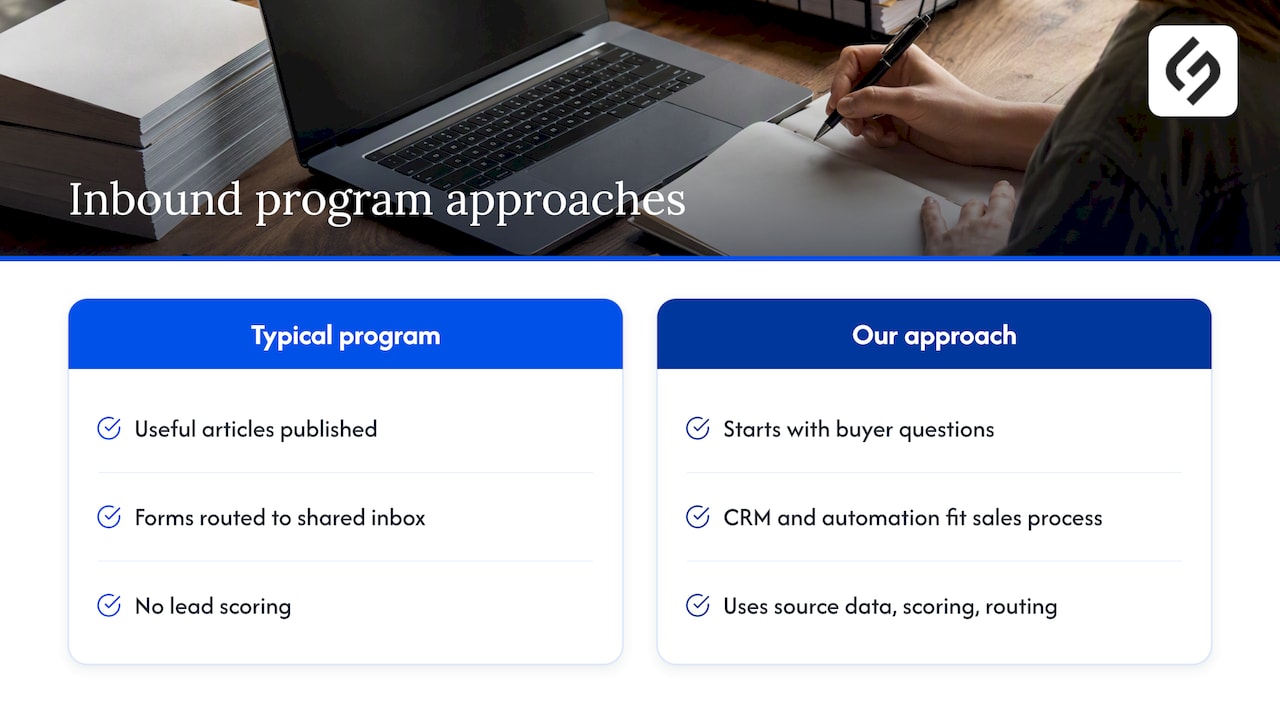
Our approach is strategy first and tool second. We start with the buyer’s questions and the sales process, then design the website, CRM and automation around them, not from a template. That is why our work spans SEO, UX, CRM integration and automation as one connected project rather than separate line items. A form that feeds a properly configured CRM, with source data, scoring and a routing rule, is worth more than three additional blog posts.
We also believe optimization does not end at launch. Scoring models, nurture sequences and landing pages need review against closed deals. Programs that treat setup as the finish line tend to plateau.
— Vadim
Putting the framework into practice with Solution4Guru
Teams that already know their strategy often stall on implementation: a CRM that does not talk to the website, manual lead routing, or landing pages that cannot be changed without a developer. We build and connect these pieces, from custom web development and UI/UX design to SEO, automation and CRM integration. For teams on HubSpot, we also provide implementation, integration, data migration and ongoing administration.
If you want a second opinion on your funnel or a partner to build it, review our services or contact us through the main site for a free consultation. If you are still comparing providers, this guide to choosing a digital marketing IT company lists the questions worth asking.
FAQ
How are inbound leads generated?
Prospects find educational, search-optimized content, visit the website, and share contact details in exchange for something valuable such as an ebook, webinar or demo. The business then nurtures and qualifies them. HubSpot’s guide describes this as the core inbound sequence.
What is the inbound strategy?
It is a methodology of attracting customers with valuable content and experiences instead of pushing messages through cold calls or purchased lists. HubSpot’s inbound model organizes it as attract, engage and delight. In B2B, it usually centers on SEO, content, email and a well-built website.
What are the 4 L’s of lead generation?
There is no universal standard, but one common version lists lead capture, lead magnets, landing pages and lead scoring. Use it as a checklist to find gaps in the funnel. Other authors define the mnemonic differently, so confirm the meaning when comparing guides.
What is the difference between an MQL and an SQL?
An MQL has shown interest but is not yet ready for a sales conversation. An SQL is ready for direct sales engagement, as Cognism explains. Define each with specific fit and intent criteria that marketing and sales both sign off on.
How long does inbound lead generation take to work?
SEO and content programs build gradually, and the timeline depends on competition, site quality and sales cycle length. Judge results over at least one full sales cycle, using pipeline sourced by channel rather than traffic alone.
Sources
- All About Inbound Leads (and How to Generate Them), UpLead
- Lead generation strategies, HubSpot Blog
- What Is Inbound Marketing?, HubSpot
- What is Inbound Sales?, Salesforce
- What is Lead Generation? Guide, Salesforce
- Lead Generation, Oracle
- What is lead generation?, Adobe
- Inbound Lead Generation, ZoomInfo
- What is Inbound Lead Generation?, Cognism
- What are the 4 L’s of Lead Generation?, Cycle of Sales
- Understanding Core Web Vitals, Google Search Central
- Spam Policies for Google Web Search, Google Search Central