Local SEO Optimization: Your 90-Day Playbook for 2026

Local SEO optimization delivers measurable gains in calls, foot traffic, and direction requests from nearby buyers — and the single best first action is to claim, verify, and fully complete your Google Business Profile (GBP) within the next 72 hours. Everything else in this guide builds on that foundation.
Your first 72-hour checklist:
- Claim or verify your Google Business Profile at business.google.com
- Confirm your business name, address, and phone number (NAP) match exactly across your website and every directory
- Select the most accurate primary category and at least two secondary categories
- Upload a minimum of 10 photos (exterior, interior, team, products/services)
- Write a keyword-rich business description (750 characters max) that reads naturally
That five-step sprint alone can move a business into the Local Pack within weeks in low-to-mid competition markets. The rest of this guide covers what to do next, why it works, and how to measure every step.
Key Takeaways
Local SEO optimization requires consistent execution across Google Business Profile, NAP consistency, review acquisition, and structured data — businesses that maintain all four signals simultaneously outperform those that optimize one in isolation.
| Point | Details |
|---|---|
| GBP is the highest-leverage starting point | Claim, verify, and fully complete your Google Business Profile before any other tactic. |
| NAP consistency affects entity trust | Inconsistent name, address, or phone number across directories suppresses local rankings by reducing Google’s confidence in your business data. |
| Review velocity beats review count | A business adding reviews consistently each month signals active engagement and outranks competitors with stale, higher totals. |
| Structured data supports AI citations | LocalBusiness schema with sameAs, geo, and openingHours properties increases visibility in both Google’s Local Pack and AI-generated answers. |
| Solution4guru offers a free local SEO audit | Solution4guru provides GBP optimization, citation cleanup, and location page development for U.S. businesses seeking measurable local visibility gains. |
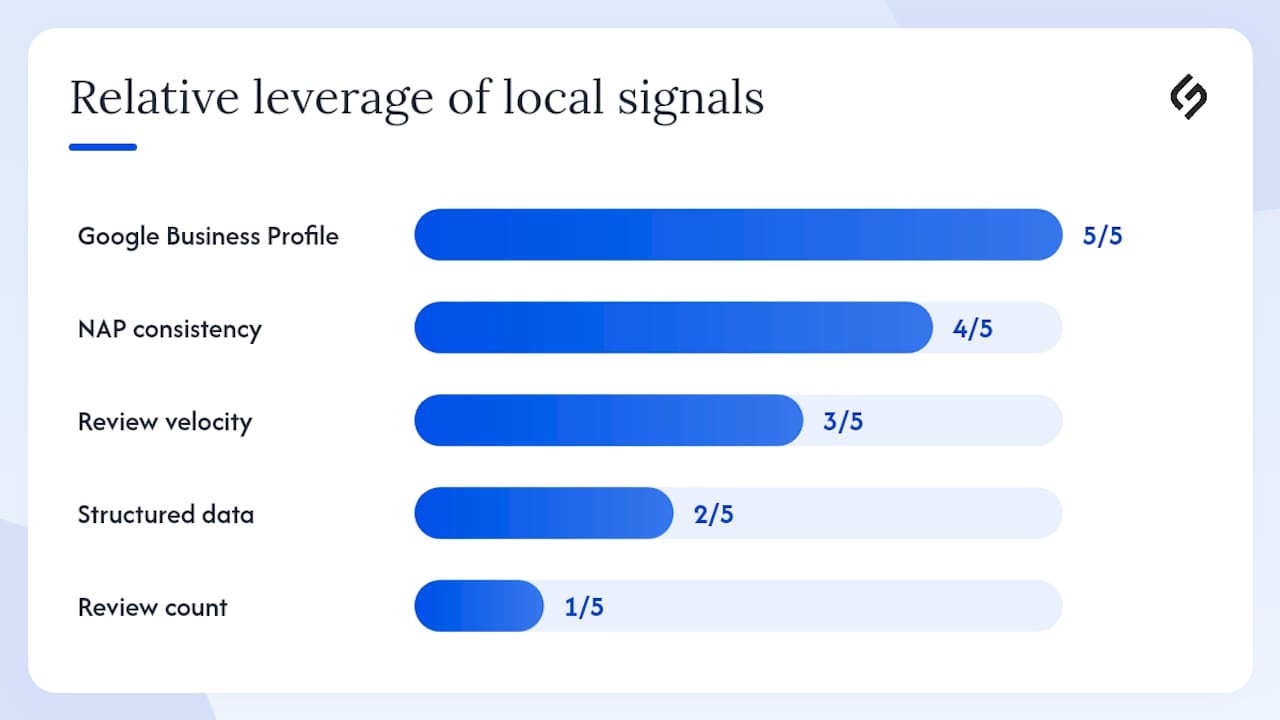
Table of Contents
- What is local SEO and which businesses need it?
- How does local search decide which businesses to show?
- Your local SEO checklist, prioritized by impact
- How to fully optimize your Google Business Profile
- How to get more reviews and use them strategically
- Citations and NAP consistency: how to audit and fix them
- Local link building and content strategy
- Technical local SEO and structured data implementation
- How to measure local SEO performance and the tools to use
- How long does local SEO take and what does it cost?
- Common local SEO mistakes and how to fix them
- Your 90-day local SEO roadmap
- Why mobile performance is non-negotiable for local search
- How local social media signals support your SEO
- How to optimize for voice search in local queries
- Localized paid advertising works best alongside organic SEO
- What actually moves the needle in local SEO
- Solution4guru’s local SEO services: from audit to execution
- Sources
- FAQ
What is local SEO and which businesses need it?
Local SEO is the practice of improving a business’s visibility in geographically relevant search results — specifically Google’s Local Pack (the map + three listings that appear above organic results), Google Maps, and local organic listings. It differs from national SEO in one critical way: proximity is a built-in ranking factor that no amount of content alone can override. A searcher two blocks from your competitor will likely see them first, regardless of your domain authority, unless your relevance and prominence signals are strong enough to compensate.
Search Engine Land’s local SEO guide explains that local ranking is determined by three signals: relevance, distance, and prominence. Distance is fixed; relevance and prominence are what you optimize.
Businesses that should prioritize local search marketing:
- Brick-and-mortar retailers and restaurants — customers search before they visit
- Service-area businesses (plumbers, electricians, landscapers) — they serve a defined geography even without a storefront
- Multi-location brands — each location needs its own GBP and location page
- Professional services (dentists, attorneys, accountants) — high-intent local queries drive appointment bookings
- E-commerce businesses with physical pickup or local delivery — local pages can capture “near me” traffic
The searcher intent behind local queries is almost always transactional or navigational. Someone typing “HVAC repair near me” is not researching — they are ready to call. That urgency is why showing up on Google Maps directly influences revenue, not just traffic.
How does local search decide which businesses to show?
Google’s local algorithm weighs three core signals, and understanding how each one works tells you exactly where to invest effort.
Relevance — How well your business profile and website match the searcher’s query. The primary GBP category is the single most influential relevance signal. A plumber who selects “Plumber” as the primary category and adds “Drain Cleaning Service” and “Water Heater Repair” as secondary categories will rank for a broader set of service queries than one who only lists the primary.
Distance (proximity) — How far your business is from the searcher or the location specified in the query. You cannot move your business, but you can expand your effective radius by building prominence signals strong enough to rank beyond your immediate block.
Prominence — How well-known and trusted your business is, both online and offline. Google measures prominence through review volume and rating, citation consistency, inbound links from local sources, and overall web presence. A business with 200 reviews, consistent NAP across 50 directories, and three local news mentions will outrank a competitor with a perfect GBP but no off-site signals.
On-page local signals also matter: your city and service keywords in title tags, H1s, and meta descriptions tell Google which geographic queries your pages should appear for. Technical signals — mobile performance, page speed, crawlability — determine whether your pages get indexed and served at all.
Pro Tip: In mid-competition markets, review velocity (the rate of new reviews per month) and local backlinks from .edu, .gov, or local news domains tend to outperform raw review count. A business adding a consistent monthly inflow of new reviews tends to outrank competitors with many stale reviews. Consistently adding new reviews will often outrank a competitor sitting on 300 stale reviews with no new activity.
Your local SEO checklist, prioritized by impact
Immediate actions (first 30 days)
- Claim and verify Google Business Profile
- Audit and standardize NAP across website, GBP, and top directories
- Select primary and secondary GBP categories
- Add complete hours, special hours, and service areas
- Upload multiple photos (exterior, interior, team, products/services); add a cover photo and logo
- Write a business description using primary service keywords naturally
- Set up Google Search Console and submit your sitemap
Short-term actions (30–60 days)
- Create individual location pages or service-area pages with unique content
- Ask every recent customer for a Google review (email or SMS request flow)
- Build citations on key national and local directories (Yelp, Bing Places, Apple Maps, BBB, Foursquare)
- Install LocalBusiness schema on location pages (Schema)
- Use Google Keyword Planner or Semrush to identify city-level keyword targets
Ongoing actions (60+ days)
- Respond to every review promptly, ideally within a couple of days
- Publish GBP Posts weekly (offers, events, updates)
- Build local links through sponsorships, partnerships, and local press
- Monitor rankings at the ZIP-code level using Semrush’s Map Rank Tracker or a similar grid tool
- Update schema and content as services or hours change
Pro Tip: Semrush’s local SEO tools include a Listing Management feature that pushes your NAP to dozens of directories simultaneously — a significant time saver for businesses with multiple locations or a messy citation history.
The Backlinko local SEO guide consistently identifies GBP completeness and citation consistency as the two highest-leverage starting points, which aligns with the priority order above.
How to fully optimize your Google Business Profile
A complete GBP is the fastest path to Local Pack visibility. Follow these steps in order.
Claim and verify. Go to business.google.com, search for your business, and claim the listing. Verification options include postcard, phone, email, or video — postcard takes Postcard verification for GBP can take up to two weeks; phone/email verification is instant when available.
Select your primary category carefully. The primary category is the most influential single field in GBP. Choose the category that best describes your core business, not your broadest one. A dental practice should select “Dentist,” not “Health.”
Add secondary categories. Add every relevant secondary category that reflects actual services you offer. Each additional category expands the query set you can rank for.
Write your business description. Use Use a detailed business description within the allowed character limit. Include your primary service, city, and one or two differentiators. Avoid keyword stuffing — Google’s guidelines prohibit promotional language and URLs in this field.
Add services and products. List every service with a name, description, and price (if applicable). This data feeds directly into how Google matches your profile to service-specific queries.
Upload photos systematically. Categories to cover: exterior (multiple angles, day and night), interior, team, products, and work samples. Google’s own guidance confirms that businesses with photos receive more direction requests and website clicks.
Enable and monitor Q&A. Anyone can post a question — and anyone can answer. Seed your own Q&A with the five most common customer questions and answer them yourself. Check weekly for new questions.
Use GBP Posts. Post at least once per week. Post types include Offers, Events, Updates, and Products. Posts expire after seven days (except Events), so a weekly cadence keeps your profile active.
Set attributes accurately. Attributes like “wheelchair accessible,” “women-owned,” “LGBTQ+ friendly,” and accepted payment methods appear in your profile and influence filtered searches.
GBP spam defense:
If a competitor creates a duplicate listing or keyword-stuffs their business name (e.g., “Joe’s Plumbing — Best Plumber in Chicago”), report it through the “Suggest an edit” function or the Google Business Profile Help Community. Google’s guidelines prohibit adding keywords to business names unless they are part of the legal business name.
Weekly maintenance checklist:
- Publish one GBP Post
- Respond to any new reviews
- Check Q&A for unanswered questions
- Verify no unauthorized edits to your profile (categories, address, phone)
How to get more reviews and use them strategically
Reviews influence both ranking (prominence signal) and conversion (click-through rate from the Local Pack). The businesses that win on reviews treat acquisition as a repeatable process, not a one-time ask.
Ethical review request flows:
- Identify the right moment: immediately after a completed service, a positive support interaction, or a repeat purchase.
- Send a short, direct request — email or SMS works best. Example: “Hi [Name], thanks for choosing [Business]. If you have 60 seconds, a Google review helps us a lot: [direct link].”
- Follow up once, 3–5 days later, if no review was left.
- For in-person businesses, a QR code on receipts or at the register pointing directly to the review page removes friction.
Response templates:
- Positive review: “Thank you, [Name]! We’re glad [specific service] met your expectations. We look forward to seeing you again.”
- Neutral (3-star) review: “Thank you for the feedback, [Name]. We’d love to learn more about how we can improve — please reach out to [contact] directly.”
- Negative review: “We’re sorry to hear about your experience, [Name]. This isn’t the standard we hold ourselves to. Please contact [contact] so we can make it right.”
Respond to every review promptly, ideally within a couple of days. Google’s guidance notes that responding to reviews shows you value customer feedback, which contributes to prominence.
Policy pro tip: Never offer incentives (discounts, gifts, cash) in exchange for reviews. Google’s review policies prohibit incentivized reviews, and violations can result in review removal or GBP suspension. Buying reviews from third-party services carries the same risk — and the reputational damage if discovered is permanent.
Review velocity matters as much as total count. A business receiving 10 new reviews per month signals active customer engagement; one sitting on 150 reviews with no new activity in six months signals stagnation to both Google and prospective customers.
Citations and NAP consistency: how to audit and fix them
NAP stands for Name, Address, Phone number. Inconsistent NAP across directories confuses Google’s entity resolution — the process by which Google confirms that the “Joe’s Plumbing” on Yelp is the same business as the one on your website and GBP. Inconsistencies reduce confidence in your data, which suppresses rankings.
Step-by-step citation audit:
- Audit your own website first. Confirm NAP appears in the footer and on the Contact page in identical format.
- Check the four major U.S. data aggregators: Data Axle, Neustar Localeze, Foursquare, and Acxiom. These feed hundreds of downstream directories, so fixing errors here propagates broadly.
- Audit major directories manually: Google Business Profile, Yelp, Bing Places, Apple Maps, Facebook, BBB, and Foursquare.
- Search Google for your business name + city to surface any directory listings you didn’t create.
- Document every inconsistency in a spreadsheet: source, current NAP, correct NAP, status.
NAP formatting rules:
- Use your legal business name — no keyword additions
- Use a local phone number, not an 800 number, when possible
- Format the address consistently (e.g., “Suite” not “Ste.” — pick one and use it everywhere)
- Use the same URL format (with or without trailing slash, www or non-www) across all citations
For scaling citation fixes across dozens of directories, tools like Semrush Listing Management, Yext, or BrightLocal can push updates automatically. For a prioritized list of U.S. citation sources, starting with the highest-authority directories before moving to niche and local sites gives the best return on effort.
Local link building and content strategy
Local links are the off-page prominence signal most businesses neglect. A single link from a local newspaper, a city government page, or a regional chamber of commerce carries more local ranking weight than dozens of generic directory links.
Repeatable link-building tactics:
- Sponsor local events or nonprofits. Most organizations list sponsors on their website with a link. A $200 sponsorship of a local 5K often yields a .org link that lasts for years.
- Local news outreach. Pitch a data-driven story relevant to your industry and your city. A real estate agent who publishes a neighborhood price trend report has a natural hook for local press.
- Partnerships with complementary businesses. A wedding photographer and a florist serve the same customer — a mutual link exchange on resource pages is natural and editorially justified.
- HARO (Help a Reporter Out) and local expert positioning. Responding to journalist queries builds both links and brand authority.
- Event pages. Creating and promoting local events (workshops, open houses, community meetups) generates links from event aggregators and local calendars.
Local content ideas that rank and attract citations:
- City-specific service pages (“Plumbing Services in Austin, TX”) with unique content, not duplicated templates
- Neighborhood guides relevant to your service area
- Pricing pages with local market context
- FAQ pages written to answer the exact questions voice assistants and AI answer engines pull from
For guidance on writing location pages that satisfy both search engines and AI answer engines, this content strategy guide covers the structural requirements in detail.
Content and links compound over time. A city page published today may take three to six months to rank, but once it does, it generates leads passively while you build the next one.
Technical local SEO and structured data implementation
Technical issues are silent ranking killers. A location page that loads in six seconds on mobile, has a duplicate canonical tag, or is blocked by a robots.txt rule will not rank regardless of how good the content is.
Technical checklist for local pages:
- Mobile-friendly layout confirmed in Google Search Console’s Mobile Usability report
- Core Web Vitals passing (LCP under 2.5 seconds, CLS under 0.1, INP under 200ms)
- Each location page has a unique title tag, meta description, and H1
- Canonical tags point to the correct URL — no self-referencing canonicals on paginated content
- Location pages are included in the XML sitemap and submitted via Google Search Console
- No thin or duplicate content across location pages (each page must have unique service descriptions, local details, and photos)
For a deeper technical audit framework, Solution4guru’s technical SEO guide covers crawlability, indexation, and Core Web Vitals diagnostics.
LocalBusiness schema implementation:
Schema defines the structured data properties that tell search engines and AI answer engines exactly what your business is, where it operates, and what it offers. Implement it as JSON-LD in the <head> of each location page.
The most important properties to include:
@type: LocalBusiness (or a more specific subtype like “Plumber,” “Restaurant,” “Dentist”)name,address(PostalAddress with streetAddress, addressLocality, addressRegion, postalCode)telephone,url,openingHoursgeo(latitude/longitude)sameAs(links to your GBP, Yelp, Facebook, and other authoritative profiles)description,priceRange,servesCuisine(for restaurants),hasMap
The sameAs property is particularly important for AI answer engines. Research on schema and AI citations shows that consistent entity signals across structured data and authoritative profiles increase the likelihood of being cited in AI-generated answers. Surferstack’s 2026 local SEO guide reinforces this: structured data, consistent NAP, and deep service pages are the three pillars of AI-era local visibility.
Pro Tip: Name your location page images descriptively: “austin-plumbing-team.jpg” outperforms “IMG_4823.jpg” for both image search and multimodal AI indexing. Add alt text that includes the service and city: “licensed plumber repairing water heater in Austin, TX.”

How to measure local SEO performance and the tools to use
Tracking setup is non-negotiable. Without measurement, you cannot distinguish what is working from what is wasting budget.
Tracking setup steps:
- Connect GBP to your website via the website field and UTM parameters on that URL (e.g.,
?utm_source=google&utm_medium=organic&utm_campaign=gbp) - Verify your site in Google Search Console and submit your sitemap
- Confirm GA4 is firing on all location pages and that goals (form submissions, phone click events) are configured
- Enable call tracking through GBP’s call history feature or a third-party call tracking tool
KPIs to track weekly and monthly:
- GBP calls and direction requests (from GBP Insights)
- Local Pack impressions and clicks (from GBP Performance dashboard)
- Organic sessions to location pages (GA4)
- Keyword rankings at ZIP-code level (Semrush Map Rank Tracker or similar grid tool)
- Review velocity (new reviews per month) and average rating
- Google Search Console impressions and clicks for location-specific queries
| Tool | Primary use case | Cost |
|---|---|---|
| Google Business Profile Insights | Calls, directions, photo views, search queries | Free |
| Google Search Console | Indexing, impressions, clicks for location pages | Free |
| Google Analytics (GA4) | Sessions, conversions, user behavior on location pages | Free |
| Google Keyword Planner | Local keyword volume and bid estimates | Free (Google Ads account required) |
| Semrush Map Rank Tracker | ZIP/grid-level local rank tracking | Paid |
| Ahrefs Site Explorer | Backlink analysis, local link opportunities | Paid |
| BrightLocal / Yext | Citation management, review monitoring, rank tracking | Paid |
How long does local SEO take and what does it cost?
Expectations matter as much as tactics. Businesses that expect overnight results abandon the work before it compounds.
Typical timeline:
- Days to weeks: GBP verification, NAP corrections, and photo uploads produce measurable impressions increases quickly in low-competition markets.
- 1–3 months: Review acquisition, citation building, and on-page fixes begin moving rankings for mid-competition queries.
- Local link building and content publishing start generating consistent results after several months: Local link building and content publishing start generating consistent Local Pack appearances and organic traffic.
- 6–12 months: Authority compounds; the business ranks for a broader set of queries and holds positions more stably.
| Phase | Tasks | Expected impact | Owner |
|---|---|---|---|
| Days 1–30 | GBP setup, NAP audit, photos, review requests | Impressions up, early calls | Business owner |
| Days 31–60 | Location pages, citations, schema, GBP Posts | Rankings improve for core queries | In-house marketer or agency |
| Days 61–90 | Local links, content, review velocity, measurement | Consistent Local Pack visibility | Agency or dedicated marketer |
Cost ranges:
- DIY: $0–$100/month in tools; 10–15 hours/month of owner time
- Freelance: $500–$1,500/month for part-time local SEO support
- Agency: $1,000–$3,000+/month for full-service local SEO management
Variables that change the timeline: market competitiveness (a dentist in Manhattan faces a different challenge than one in a rural county), proximity to the city center, and the starting review baseline. A business with zero reviews needs three to six months of consistent acquisition before reviews become a meaningful ranking signal.
Common local SEO mistakes and how to fix them
Most local SEO failures trace back to a short list of recurring errors.
- Inconsistent NAP. The fix: run a full citation audit (see the Citations section above), document every variation, and correct them starting with the four major data aggregators.
- Wrong or missing GBP categories. The fix: review your primary category against the full GBP category list; add secondary categories for every service you actually offer.
- Thin or duplicate location pages. The fix: each location page needs unique content — local landmarks, team members, service-specific details, and local reviews. Copied templates with only the city name swapped will not rank.
- Ignoring GBP Posts and Q&A. The fix: schedule one post per week and audit Q&A monthly. Unanswered questions look like neglect to prospective customers.
- Buying reviews or incentivizing them. The fix: stop immediately. Google’s review policies are enforced algorithmically and manually. Violations result in review removal, GBP suspension, or a manual action that takes months to resolve.
- No schema markup on location pages. The fix: implement LocalBusiness JSON-LD on every location page. Validate with Google’s Rich Results Test before publishing.
- Not tracking Local Pack impressions separately from organic. The fix: use GBP Insights for Local Pack data and Search Console for organic — they measure different things and require different responses.
For a broader list of technical and on-page errors that suppress rankings, this guide to common SEO mistakes covers the most frequently cited issues with corrective steps.
Your 90-day local SEO roadmap
Days 1–30: Foundation sprint
- Claim and verify Google Business Profile; complete all fields
- Audit NAP across website, GBP, and top 10 directories; correct inconsistencies
- Select and confirm primary and secondary GBP categories
- Upload multiple photos (exterior, interior, team, products/services); write business description
- Set up Google Search Console and GA4; configure call and form conversion events
- Launch review request flow (email or SMS template to recent customers)
- Identify a targeted set of local keywords relevant to your area using Google Keyword Planner or Semrush
Estimated hours: 15–20 hours total. Owner-led for small businesses; in-house marketer for medium businesses.
Days 31–60: Content and citation sprint
- Publish individual location or service-area pages with unique content and LocalBusiness schema
- Build citations on key national and local directories (start with data aggregators, then major platforms)
- Publish GBP Posts weekly; seed Q&A with five common questions
- Begin local link outreach: identify two to three sponsorship or partnership opportunities
- Review Search Console for crawl errors or indexing issues on new pages
Estimated hours: 20–30 hours total. In-house marketer or agency recommended for content production and outreach.
Days 61–90: Scale and measure sprint
- Scale review acquisition; target a consistent monthly velocity
- Publish two to three additional local content pieces (neighborhood guides, FAQ pages, price pages)
- Execute first local link outreach campaign; follow up on sponsorship placements
- Implement structured data for all location pages; validate with Rich Results Test
- Create AI/AEO-optimized FAQ content answering the specific questions voice assistants pull
- Pull first 90-day performance report: GBP calls, direction requests, Local Pack impressions, organic sessions to location pages, review count
Estimated hours: 25–35 hours total. Agency or dedicated marketer for link building and content at scale.
For small businesses managing this independently, this resource on improving online presence offers budget-conscious tactics that pair well with the roadmap above.
Why mobile performance is non-negotiable for local search
Google Search Console data consistently shows that the majority of local searches happen on mobile devices. A searcher looking for “coffee shop near me” at 8:00 AM is on their phone, and if your site takes five seconds to load, they are already on a competitor’s page.
The technical benchmarks that matter most for local mobile performance:
- Largest Contentful Paint (LCP): under 2.5 seconds on mobile
- Cumulative Layout Shift (CLS): under 0.1 (no elements jumping as the page loads)
- Interaction to Next Paint (INP): under 200ms
Beyond speed, mobile UX for local search has specific requirements. Your phone number must be a clickable tel: link. Your address must link to Google Maps. Also, your hours must be visible without scrolling. A local customer on mobile who cannot find your phone number in three seconds will not call — they will find someone who makes it easier.
Website performance optimization covers the technical implementation of Core Web Vitals improvements, including image compression, server response time, and render-blocking resource fixes that directly affect mobile load times.
How local social media signals support your SEO
Social media does not directly influence Google’s local ranking algorithm in the way that citations or backlinks do. What it does influence is the behavior that feeds those signals: review acquisition, local link opportunities, and brand search volume.
A consistent local social presence on Facebook, Instagram, and Nextdoor builds the community trust that converts into Google reviews. When a local customer sees your business active on Nextdoor, they are more likely to search for you by name — and branded search volume is itself a prominence signal.
Practical tactics that connect social activity to local SEO outcomes:
- Post location-tagged content on Instagram and Facebook to reinforce your geographic entity signals
- Use Facebook’s “Check-in” feature and encourage customers to use it — check-ins increase your social proof and local visibility on the platform
- Share GBP Posts to your Facebook page to extend their reach beyond Google
- Engage in Nextdoor’s “Local Business” section to build neighborhood-level trust
- Monitor brand mentions across social platforms; a mention without a link is still a citation signal for AI answer engines
The connection between social engagement and local SEO is indirect but real. Businesses with active local social profiles tend to accumulate reviews faster, earn more local press mentions, and generate more branded searches — all of which feed directly into Google’s prominence calculation.
How to optimize for voice search in local queries
Voice search queries are structurally different from typed queries. A typed search might be “plumber Austin TX”; a voice search is “Who is the best plumber near me?” or “What time does [business name] close?” Optimizing for voice means writing content that answers complete questions in plain language.
The most effective voice search optimization tactics for local businesses:
- Build a dedicated FAQ page that answers the exact questions customers ask verbally. Structure each answer in one to two sentences — the format voice assistants pull from.
- Use conversational language in GBP descriptions and service listings. “We fix burst pipes and water heater failures in Austin, available 24/7” is more voice-search-friendly than “Professional plumbing services.”
- Claim and optimize your GBP completely. Voice assistants pull business hours, phone numbers, and addresses directly from GBP. An incomplete profile means missed voice queries.
- Implement FAQ schema (using
FAQPagemarkup from schema.org) on your FAQ pages to increase the likelihood of appearing in voice and AI-generated answers. - Target “near me” and question-based keywords in your location page content: “best [service] in [city],” “how much does [service] cost in [city],” “is [business name] open on Sunday.”
Voice search and AI answer engines share the same content requirements: clear, direct answers to specific questions, backed by structured data and consistent entity signals. A business that optimizes for voice is simultaneously optimizing for AI citations.
Localized paid advertising works best alongside organic SEO
Paid local advertising and organic local SEO are not competing strategies — they are complementary ones. Paid ads deliver immediate visibility while organic rankings build; organic rankings reduce cost-per-click over time as you capture traffic without paying for it.
Google Local Services Ads (LSAs) are the highest-intent paid format for local businesses. They appear above standard search ads and the Local Pack, carry a “Google Guaranteed” or “Google Screened” badge, and charge per lead rather than per click. For service-area businesses in competitive markets, LSAs often deliver the lowest cost per acquisition of any paid channel.
Google Ads with location targeting allows you to run search campaigns targeting specific ZIP codes, cities, or a radius around your business address. Combining this with local keyword targeting (“emergency plumber Austin”) captures demand that your organic rankings have not yet reached.
Practical integration tactics:
- Use Google Ads search term reports to identify high-converting local queries, then create organic content targeting those exact terms
- Run paid ads on your highest-value service keywords while organic rankings build (typically months 1–3)
- Use remarketing to re-engage website visitors who found you through local search but did not convert
- Allocate paid budget toward seasonal demand spikes that organic rankings cannot respond to quickly enough
The data from paid campaigns also informs organic strategy. A keyword that converts well in paid search is worth prioritizing in your local content calendar. The two channels share the same customer intent — the most efficient local marketers use paid data to sharpen organic targeting and vice versa.
What actually moves the needle in local SEO
The conventional wisdom in local SEO circles tends to focus on GBP completeness as if it were the finish line. It is not. A fully completed GBP is the starting point — the baseline that gets you into contention. What separates businesses that dominate their local market from those that merely appear is the compounding effect of consistent execution across all signals simultaneously.
The businesses that see the most dramatic Local Pack gains in Significant Local Pack gains typically appear within about three months of consistent work. They are almost never the ones with the most sophisticated technical setups. They are the ones that fixed their NAP, asked every customer for a review, and published one genuinely useful local page per week. The fundamentals, executed consistently, outperform clever tactics every time.
There is also a widely underestimated risk in local SEO: the assumption that once you rank, you stay ranked. Local results are highly personalized and proximity-sensitive, as Search Engine Land notes — visibility fluctuates even within the same city depending on the searcher’s exact location, device, and search history. Treating local SEO as a one-time project rather than an ongoing operational function is the most common reason businesses lose rankings they worked months to earn.
The 2026 addition to this picture is AI. Surferstack’s analysis makes the case clearly: businesses that invest in structured data, consistent entity signals, and deep answerable content are positioning themselves not just for Google’s Local Pack but for the AI-generated answers that are increasingly the first thing a searcher sees. The businesses that treat these as separate workstreams will fall behind those that treat them as one.
Solution For guru’s local SEO services: from audit to execution
Knowing the playbook and executing it are two different things. Solution4guru offers local SEO audits, Google Business Profile optimization, citation cleanup, location page development, and schema implementation — the full stack of services this guide covers, delivered by a team that works with business owners and in-house marketers across the United States.
The starting point is a free local SEO audit that identifies your highest-priority gaps: NAP inconsistencies, GBP completeness score, missing schema, and Local Pack ranking baseline. From there, Solution4guru builds a prioritized execution plan matched to your market competitiveness and budget — whether that means a 30-day foundation sprint or a full 90-day managed engagement.
For businesses that need both the technical foundation and the ongoing content and link-building work, Solution4guru’s digital marketing services cover the complete local visibility stack. Book a free consultation at Solution4guru to get your audit started.
Sources
The following resources support implementation, measurement, and policy compliance for local SEO:
- How to improve your local ranking on Google
- What Is Local SEO? Guide to Ranking in Local Search Results
- Schema
- what showing up on Google Maps means for your business
- How to Build a Local SEO Strategy That Works for Both Google and AI Search in 2026 – Surferstack
- Google Keyword Planner
- Google Search Console
FAQ
Local SEO is the process of improving a business’s visibility in geographically relevant search results, including Google’s Local Pack, Google Maps, and local organic listings. It differs from national SEO because proximity is a built-in ranking factor alongside relevance and prominence.
The highest-impact strategy combines a fully optimized Google Business Profile, consistent NAP across all directories, a steady flow of genuine customer reviews, and location-specific pages with LocalBusiness schema. Executing all four consistently over Significant Local Pack gains typically appear within about three months of consistent work produces measurable Local Pack visibility gains.
Quick wins from GBP optimization and NAP corrections can appear within days to weeks in low-competition markets. Sustained Local Pack rankings for competitive queries typically take three to six months of consistent work across reviews, citations, and local content.
Yes. Local search queries carry high transactional intent — searchers are typically ready to call or visit. A business that ranks consistently in the Local Pack captures that demand without paying per click, making local SEO one of the highest-ROI digital marketing investments for small businesses with a defined service area.
It means completing your Google Business Profile, standardizing your NAP across directories, earning consistent customer reviews, publishing location-specific pages with structured data, and building local backlinks — the combination of signals Google uses to determine relevance, distance, and prominence for local queries.