How Secure Is FreshBooks? A Look at Data Protection, Encryption, and Compliance
Handing over invoices, client details, and payment information to a cloud accounting platform requires a genuine level of trust. Because financial data is one of the most attractive targets for attackers, business owners naturally want to know exactly how a provider protects that information before they commit. A breach involving invoicing or payment data does not just cost money to remediate; it can quietly damage client relationships and brand reputation long after the technical issue is resolved. This article takes a close look at how FreshBooks, one of the most widely used cloud accounting platforms for small businesses and freelancers, approaches encryption, data protection, and regulatory compliance. Along the way, it also explains how partnering with Solution for Guru can help businesses configure and use these security tools correctly from the very start.
Table of contents
Quick Summary: How Secure Is FreshBooks?
Before exploring the technical details, here is a quick overview of the security and compliance measures covered in this article:
- Industry-standard encryption protocols protect data both in transit and at rest
- PCI DSS Level 1 compliant partners handle stored cardholder data, with annual third-party audits
- Infrastructure runs on Google Cloud Platform, with redundant, geographically separate datacenters
- Secure development practices follow OWASP guidelines, alongside the principle of least access
- Role-based access controls and multi-factor authentication limit who can view sensitive data
- FreshBooks supports GDPR-related obligations but is not positioned as a HIPAA-compliant platform
Taken together, these measures show that FreshBooks takes financial data protection seriously, though, as with any platform, businesses still play an important role in configuring it securely. The sections below unpack each of these points in more depth.
What Is FreshBooks, and Why Does Its Security Matter?

FreshBooks is a cloud-based accounting and invoicing platform built primarily for small businesses, freelancers, and service-based companies. It handles invoicing, expense tracking, time tracking, and payment collection, which means it routinely stores sensitive information such as client contact details, bank-linked payment records, and business financial history.
Because this data flows through the platform every single day, security is not a peripheral feature; it is central to whether a business can trust the software at all. A single exposed invoice might reveal a client’s contact information, while a compromised payment record could expose far more sensitive financial details. Consequently, understanding exactly how a provider protects this data helps a business owner make an informed decision, rather than simply assuming that any well-known platform is automatically secure.
FreshBooks serves a wide range of users, from solo freelancers and consultants to law firms, real estate agents, health and wellness professionals, and small nonprofit organizations. Each of these use cases involves a slightly different mix of sensitive information, from billable hours and retainer payments to donor records and client communications. Because businesses across many different industries use the platform, FreshBooks must maintain a security posture that meets a wide range of data-sensitivity requirements rather than serving just one narrow use case.
What Security Risks Do Small Businesses Face When Managing Financial Data Online?

Before evaluating any specific platform, it helps to understand the risks that cloud accounting software is generally designed to defend against. Small businesses are frequent targets precisely because they often have fewer dedicated IT resources than larger enterprises.
- Unauthorized access to client and payment data through weak or reused passwords
- Data interception during transmission between a user’s device and the provider’s servers
- Breaches of stored cardholder or banking information
- Phishing attacks that target invoicing and payment workflows specifically
- Non-compliance with regional data protection regulations, leading to legal and financial exposure
Because these risks apply to nearly every cloud-based financial tool, the real question is not whether a platform faces them, but how effectively it addresses them. That is precisely where a closer look at FreshBooks‘ specific safeguards becomes useful.
It is also worth noting that risk exposure often grows alongside business size. A solo freelancer sending a handful of invoices per month faces a very different threat profile than a service business with a dozen employees, multiple payment integrations, and dozens of active clients. As more people gain access to an account and more third-party tools connect to it, the number of potential entry points for an attacker naturally increases. This is exactly why access controls and ongoing account monitoring become more important, not less, as a business scales.
How Does FreshBooks Protect Business and Client Data?
FreshBooks approaches data protection through a combination of encryption, access controls, secure infrastructure, and ongoing auditing. Rather than relying on a single safeguard, the platform layers multiple protections so that a failure in one area does not automatically expose sensitive data elsewhere. The subsections below break down each layer individually.
How Does FreshBooks Encrypt Data in Transit and at Rest?
First, encryption forms the foundation of FreshBooks’ approach to data protection. The platform uses industry-standard encryption protocols, including 256-bit SSL/TLS encryption, to protect information as it travels between a user’s device and FreshBooks’ servers. This matters because attackers can more easily intercept data in transit without proper encryption, especially on public or shared networks, such as when a freelancer sends an invoice from a coffee shop or a co-working space.
In addition to protecting data in transit, FreshBooks also applies encryption to data stored on its servers. Together, these two layers help protect sensitive information, whether users transmit it during an invoice submission or store it between sessions, from unauthorized interception and access.
How Does FreshBooks Secure Payment and Cardholder Data?
Because FreshBooks processes payments directly, cardholder data protection deserves particular attention. The platform maintains PCI DSS Level 1 compliance, the highest tier of the Payment Card Industry Data Security Standard, and undergoes an independent third-party audit of this compliance every year. Where cardholder data storage is required, such as for automatic payments on recurring invoice templates, FreshBooks relies on PCI DSS Level 1 compliant partners who are also independently audited on an annual basis.
Furthermore, FreshBooks only collects cardholder data in the specific areas of the platform that require it, limiting unnecessary exposure elsewhere in the system. Businesses that need formal documentation of this compliance for their own vendor risk assessments can request a PCI attestation of compliance directly from FreshBooks’ security team.
How Does FreshBooks Control Access to Sensitive Information?
Access control is another critical layer of protection. FreshBooks supports role-based permissions, which allow business owners to determine exactly what team members, contractors, or accountants can view or edit within an account. Multi-factor authentication adds a second layer of verification beyond a password alone, significantly reducing the risk of unauthorized access even if someone compromises a user’s login credentials.
Internally, FreshBooks follows the principle of least access by granting employees only the minimum level of system access they need to perform their specific roles. This reduces the potential impact of any single compromised account, since fewer people have broad access to sensitive customer data in the first place. The same principle applies just as well to how a business should configure access for its own team members inside FreshBooks.
How Does FreshBooks Host and Back Up Its Infrastructure?

FreshBooks hosts its application on Google Cloud Platform, which provides a mature, continuously updated infrastructure alongside built-in physical security. The underlying datacenters use biometric access controls, constant surveillance, redundant power feeds, fire suppression systems, and monitored climate control, all measures designed to protect the physical servers that store customer data.
Beyond physical security, FreshBooks also builds redundancy into its data storage strategy. The platform maintains redundant storage and servers so the application stays available even during a hardware failure, and it operates a separate, geographically distinct datacenter that can take over if the primary location becomes unavailable due to a disaster or major disruption. As a result, businesses benefit not only from data protection but also from meaningful uptime resilience.
This kind of infrastructure investment is difficult for most individual businesses to replicate on their own, which is one of the underlying advantages of using a mature cloud accounting platform in the first place. Rather than managing their own backup schedules, physical server security, and disaster recovery planning, businesses effectively inherit these protections simply by using a platform that has already built them in at scale.
How Does FreshBooks Handle Security Vulnerabilities and Audits?
On the development side, FreshBooks engineers follow secure coding practices aligned with OWASP guidelines, which represent widely recognized industry standards for identifying and preventing common application vulnerabilities. This proactive approach helps catch potential weaknesses before they ever reach production systems that handle live customer data.
Should a security or privacy breach still occur despite these safeguards, FreshBooks commits to notifying the relevant authorities and affected customers within the timelines required by applicable data protection law. While no platform can guarantee that a breach will never happen, having a clear, legally aligned notification process in place is an important indicator of a mature security program.
How Does FreshBooks Monitor Accounts for Suspicious Activity?
Beyond preventing vulnerabilities during development, ongoing monitoring plays an important role in catching unusual activity after an account is already in use. FreshBooks continuously updates its authentication mechanisms to address evolving security challenges, and verified login credentials control access to critical account areas instead of static, easily guessed information.
For business owners, this means that unusual login attempts or unauthorized access attempts are less likely to go unnoticed compared to a system with weaker authentication controls. Combined with role-based permissions, this monitoring layer helps ensure that any anomaly is both harder to achieve in the first place and easier to detect if it does occur.
How Does FreshBooks Compare to Other Accounting Platforms on Security?
Security comparisons are most useful when they focus on concrete, verifiable measures rather than marketing language. When evaluated against other popular small-business accounting tools, FreshBooks holds up well on several specific fronts: independently audited PCI DSS Level 1 compliance, redundant geographically separate datacenters, and OWASP-aligned secure development practices. Some competitors offer comparable encryption and authentication measures, but fewer publish the same level of detail about annual third-party audits or physical datacenter safeguards.
That said, no platform in this category, including FreshBooks, is designed to meet HIPAA compliance requirements. Businesses should also avoid assuming a platform meets those requirements simply because a competitor promotes stronger security features. The more useful comparison is not which platform claims to be the most secure in general terms, but which specific compliance standards each platform actually supports, and whether those standards match a business’s regulatory obligations.
Which Compliance Standards Does FreshBooks Follow?
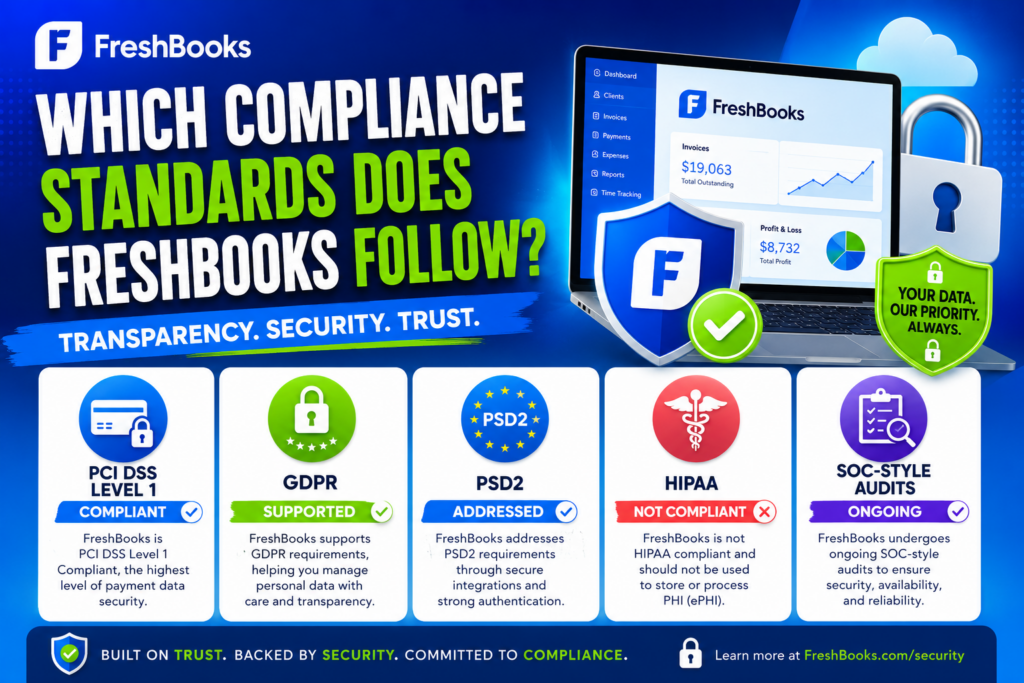
Compliance certifications matter because they demonstrate that a platform’s security claims have been independently verified rather than simply self-reported. Rather than taking a vendor’s word for it, businesses can point to specific, auditable standards when assessing whether a platform meets their regulatory needs. The table below summarizes where FreshBooks currently stands across the most commonly requested standards.
| Standard | Status | What This Means |
|---|---|---|
| PCI DSS Level 1 | Compliant | Highest tier of payment card security; audited annually by an independent third party |
| GDPR | Supported | FreshBooks provides tools and documentation to help EU-related data protection obligations |
| PSD2 | Addressed | Relevant payment services directive requirements are documented for EU customers |
| HIPAA | Not compliant | No Business Associate Agreement is offered; not suitable for storing protected health information |
| SOC-style audits | Ongoing | Independent audits support broader security and reliability claims |
In short, businesses handling standard financial and client data, such as invoices, expenses, and payments, are well covered by FreshBooks‘ existing compliance posture. However, businesses in tightly regulated sectors should always verify that a specific standard applies to their exact use case rather than assuming broad compliance automatically extends to every regulation.
Is FreshBooks HIPAA Compliant?
FreshBooks focuses on general accounting and invoicing rather than healthcare-specific compliance. While the platform offers strong general security, including encryption in transit and account authentication controls, it has not historically offered a Business Associate Agreement, which HIPAA requires for any vendor that handles protected health information. As a result, healthcare providers should avoid entering patient names, service dates, diagnosis codes, or other clinical details into FreshBooks.
That said, healthcare-adjacent businesses, such as wellness professionals or private practices, can still use FreshBooks for general bookkeeping, vendor invoices, and aggregated, de-identified financial records. The key distinction is simple: standard business finances are fine, but protected health information should stay inside a dedicated, HIPAA-compliant system.
Businesses uncertain about where this line falls should apply a conservative rule of thumb: if a piece of information could identify a specific patient and link them to a health condition, treatment, or service date, it does not belong in an invoice, note, or file attachment inside FreshBooks. When in doubt, keeping clinical details entirely separate from the accounting system is far simpler than trying to retroactively scrub sensitive data after the fact.
Is FreshBooks GDPR Compliant?
For businesses operating in or serving the European Union, GDPR compliance is a frequent concern. FreshBooks publishes documentation addressing its approach to GDPR obligations, including how it handles personal data processing, data subject rights, and breach notification timelines. Because GDPR compliance is a shared responsibility between a software provider and the business using it, companies should still configure their own data retention settings, privacy notices, and client consent processes appropriately, rather than assuming the platform alone satisfies every regulatory requirement.
In practice, this shared-responsibility model means businesses should periodically review the client data they collect through FreshBooks, determine whether they still need it, and decide how long they should retain it. Pairing FreshBooks’ underlying technical safeguards with a business’s own clear data governance policy is what actually produces full GDPR alignment, rather than either piece functioning effectively on its own.
What Happens If FreshBooks Experiences a Data Breach?
No security program, no matter how well designed, can offer an absolute guarantee against every possible incident. What matters most is how a provider responds when something does go wrong. According to its published security policies, FreshBooks commits to notifying the necessary authorities and impacted customers within the timelines required by applicable data protection law if a security or privacy breach occurs.
This kind of documented breach notification process matters for two practical reasons. First, it gives businesses confidence that they will not be left in the dark if their data is affected. Second, it helps businesses meet their own downstream notification obligations to clients, since many data protection regulations require companies to inform affected individuals within a specific window after becoming aware of an incident. Because FreshBooks‘ notification commitments are tied to legal timelines rather than vague promises, businesses can factor this directly into their own incident response planning.
What Should Businesses Do to Strengthen Security When Using FreshBooks?
Even the most secure platform depends partly on how it is configured and used day to day. A provider can build airtight infrastructure, but a weak password or an overly broad set of user permissions can still create an unnecessary opening. Consequently, businesses can take several practical steps to get the most out of FreshBooks‘ built-in protections:
- Enable multi-factor authentication on every user account, not just the primary owner login
- Assign role-based permissions carefully, granting team members only the access their role requires
- Avoid storing protected health information or other regulated data types the platform is not designed to handle
- Review connected third-party integrations periodically and remove any that are no longer in active use
- Train staff to recognize phishing attempts that specifically target invoicing and payment workflows
None of these steps are complicated, but they do require deliberate setup. Businesses that treat security configuration as an ongoing responsibility, rather than a one-time task completed during onboarding, consistently reduce their exposure to preventable incidents.
How Secure Is FreshBooks Overall?
Taken as a whole, FreshBooks demonstrates a genuinely layered approach to security, combining strong encryption, PCI DSS Level 1 payment compliance, role-based access controls, resilient cloud infrastructure, and OWASP-aligned development practices. For the vast majority of small businesses and freelancers managing standard invoicing, expenses, and payments, these protections represent a solid, independently audited security foundation.
That said, security is never a one-sided responsibility. Businesses get the most value from FreshBooks when they actively configure multi-factor authentication, apply least-privilege access rules, and avoid using the platform for data types it was never designed to protect, such as protected health information. Understood this way, FreshBooks earns its reputation as a secure, trustworthy platform for everyday financial management, provided businesses do their part to configure it correctly.
Looking ahead, businesses evaluating any cloud accounting platform, FreshBooks included, should treat security as an ongoing conversation rather than a box to check once during onboarding. Regulations evolve, threat patterns shift, and a business’s own data footprint tends to grow over time. Revisiting security settings periodically, alongside a trusted implementation partner where possible, is the most reliable way to keep pace with that change.
Frequently Asked Questions
Only where storage is strictly required, such as for automatic payments on recurring invoice templates. In those cases, FreshBooks relies on PCI DSS Level 1 compliant partners to handle and store that cardholder data, rather than storing it directly on general application servers without additional safeguards. Cardholder data is also collected only in the specific areas of the platform that explicitly require it, which limits how widely that sensitive information travels through the system.
Yes. Businesses that need documentation for their own vendor risk assessments can request a PCI attestation of compliance by contacting FreshBooks’ security team directly. This is a common request during procurement processes, particularly for companies with formal vendor security review requirements, and having this documentation ready in advance can meaningfully speed up an internal approval process.
Generally, yes. Role-based permissions and multi-factor authentication make it possible to extend account access to a larger team without giving every employee full visibility into sensitive financial data. Even so, growing businesses should periodically review who has access to what, since permissions that made sense for a small team can quietly become too broad as headcount increases. Scheduling a recurring access review, for example once per quarter, is a simple habit that keeps this from becoming an overlooked risk.
What Are the Benefits of Partnering With Solution for Guru?
Understanding a platform’s security features is only the first step; configuring them correctly for a specific business is what actually reduces risk. That is where Solution for Guru comes in. As a CRM and software implementation consultancy, Solution for Guru helps businesses set up platforms like FreshBooks with security best practices built in from day one, rather than left as an afterthought.
Specifically, working with Solution for Guru offers several advantages:
- Guided setup of multi-factor authentication and role-based access controls tailored to a business’s team structure
- Expert advice on which data types are appropriate to store in FreshBooks versus dedicated compliance-specific systems
- Integration support for connecting FreshBooks securely with existing CRM, payment, and operations tools
- Ongoing guidance as regulatory requirements, such as GDPR or PCI standards, continue to evolve
In short, pairing FreshBooks with expert guidance from Solution for Guru helps businesses translate a genuinely secure platform into a genuinely secure setup, closing the gap between what a tool is capable of and how it is actually configured in daily use.
Ultimately, no accounting platform, however well engineered, can fully protect a business on its own. Security is a partnership between the software provider and the people configuring and using it every day. Whether a business is setting up FreshBooks for the first time or reviewing an existing account for gaps, Solution for Guru provides the practical, hands-on expertise needed to make sure strong technology is matched by an equally strong configuration.
Recommended:
- FreshBooks ROI: Is the Subscription Cost Worth It?
- FreshBooks Time Tracking: Is It Accurate Enough for Client Billing?
- Zoho Books vs Xero: Cloud Accounting Platforms Compared
- Zoho Books vs QuickBooks: Technical Comparison
- Xero Pricing Plans: Early/Starter, Growing/Standard, Established/Premium
- Overview of the Xero App Marketplace (1,000+ Integrations): What Are the Most Popular Ones?
- FreshBooks vs Xero for Technology Companies: Which One Should You Choose?
- FreshBooks Reporting Features: What Financial Insights Can You Actually Get?
- Xero for Small Business: Is It the Right Accounting Software for You?
- What is Xero — Overview of the Cloud Accounting Platform’s Features
- How Does FreshBooks Integrate with CRM, Payroll, and Project Management Tools?
- Financial Reporting Architecture in Zoho Books
- Zoho Books Architecture: Cloud Accounting Explained — How Does It All Work?
- FreshBooks for IT Consulting Firms: Managing Projects, Invoices, and Client Billing
- FreshBooks Review: Features, Pricing, Pros, and Cons
- Real-Time Financial Dashboards with Zoho Books
- How Can You Connect Zoho Books with Payment Gateways to Streamline Your Business Finances?