Leadership in the Digital Age: What Actually Works Now

Leadership in the digital age means turning people, processes, and technology into value that holds up under constant change, not just adopting new software. Three priorities separate leaders who succeed from those who stall: building digital dexterity across the workforce, adopting adaptive mindsets that replace command-and-control habits, and establishing trustworthy governance for automation before it scales past anyone’s ability to explain it.
This article breaks down each priority into practical moves. You’ll find the skills worth developing, a model for leading distributed teams without adding more meetings, and a 30/60/90 playbook you can start this quarter.
- Build digital dexterity through structured practice, not one-off training
- Shift from authority-based to adaptive, distributed leadership
- Govern automation with transparency and rollback plans before scaling it
Key Takeaways
Digital leadership succeeds when leaders build workforce dexterity, adopt adaptive mindsets, and govern automation with transparency, ownership, and rollback plans working together.
| Point | Details |
|---|---|
| Start with dexterity, not tools | Measure adoption and usage quarterly, since most organizations plateau after initial rollout. |
| Shift to adaptive mindsets | Distribute decisions across producer, investor, connector, and explorer roles instead of centralizing authority. |
| Govern automation deliberately | Require clear ownership, transparency, and a documented rollback plan for every automated system. |
| Run the 30/60/90 sequence | Audit meetings first, then publish decision rights, then build cultural artifacts and post-mortems. |
| Bring in outside support when needed | Solution4guru maps web development, automation governance, and workshops to each playbook step. |
Table of Contents
- Why Digital Dexterity Matters and How to Build It at Scale
- Essential Modern Leadership Skills for the Digital Era
- Adaptive Mindsets Leaders Need for Digital Transformation
- Leading Distributed and Asynchronous Teams Effectively
- How to Keep Automation and AI Trustworthy
- A 30/60/90 Playbook for Digital Leadership This Quarter
- How Solution4guru Turns This Playbook Into Delivered Results
- What Leaders Consistently Get Wrong About Digital Change
- Ready to Turn This Playbook Into a Working System?
- Selected Research and Reports to Read Next
- Sources
- FAQ
Why Digital Dexterity Matters and How to Build It at Scale
Digital dexterity is the combined ability of your people to use technology effectively and adapt as it changes, and most companies have not built it despite years of investment in tools. Leaders who make progress do four things consistently: they reframe technical challenges as business challenges, engage visibly from the top instead of delegating digital work downward, connect people and perspectives across silos, and sustain commitment past the initial rollout phase.
Statistic Callout: Only a minority of organizations report high progress in building a digitally capable workforce, which suggests the gap is rarely about access to tools.
The gap is almost always about practice and reinforcement, not access. You can track whether dexterity is actually improving with a few concrete signals:
- Adoption rates for core platforms after 90 days, not just at launch
- Usage patterns that show tools being used for real decisions, not just logging in
- Skills assessments repeated quarterly rather than once during onboarding
A digital transformation data strategy gives you the baseline to measure any of this honestly.
Essential Modern Leadership Skills for the Digital Era
Three skills separate leaders who thrive from those who merely cope: emotional intelligence, curiosity, and practical tech fluency. None of them require a computer science background.
- Emotional intelligence. Leaders who create psychological safety get more honest signal from their teams about what’s broken. Without it, employees hide failed experiments instead of reporting them, and you lose the early warning signs that matter most.
- Curiosity and learning habits. This matters more than coding ability. Curious leaders sense emerging opportunities and seize them faster, largely because they ask more questions before committing resources.
- Practical tech fluency. You don’t need to write code. You need to know enough to ask your technical teams the right questions: What data feeds this model? What happens when it’s wrong? Who owns the fix?
Developing this is less about study and more about supervised repetition. Coaching and safe experimentation help leaders build the kind of online leadership practice that holds up across both in-person and remote settings.
Pro Tip: Run a “pre-mortem” before any tech rollout: ask your team to list every way it could fail before it launches. You’ll surface the tech-fluency gaps and the trust gaps in the same conversation.
Adaptive Mindsets Leaders Need for Digital Transformation
The old model, where a leader commands and the organization complies, breaks down when technology changes faster than any single person can track. Leaders now need to act as architects and catalysts, designing flexible systems and enabling collective intelligence rather than issuing top-down directives.

Newer leadership frameworks describe four useful mindsets: producer (ships work), investor (allocates resources to bets), connector (links people and ideas across teams), and explorer (tests what’s next). Organizations that build a community of leaders around these roles outperform ones that concentrate authority at the top, largely because decisions get made closer to the information.
Run this quick blind-spot check on your own leadership team:
- Do decisions require your sign-off that a peer team could make faster?
- Are your best ideas coming from the same three people every quarter?
- Would your team recognize a failed experiment as useful, or as a problem to hide?
Leading Distributed and Asynchronous Teams Effectively
Virtual team performance depends on three interlocking factors: communication quality, trust-building, and how well the team manages its technology stack. Effective leaders target the specific factor holding a team back rather than applying generic fixes across the board.
A working leadership operating system rests on four pillars: structured autonomy (clear decision rights so people don’t wait on approval), async communication norms (default to written updates over live meetings), output-based rhythms (measure delivered work, not hours online), and deliberate investment in connection (scheduled, not accidental, relationship building).
- Audit every recurring meeting and cut anything that doesn’t need real-time discussion.
- Document decision rights in writing so people know what they can decide without you.
- Publish a short “how we work” artifact covering response times, tools, and escalation paths.
Pro Tip: Track decision cycle time, how long it takes from a question being raised to a decision being made. Teams that adopt a documented leadership operating system typically see that cycle shrink because fewer decisions wait on a live meeting slot.
For more on structuring this well, see this guide on remote team management.
How to Keep Automation and AI Trustworthy
Trustworthy automation rests on four governance basics: clear ownership of every automated system, transparency about how it makes decisions, a documented rollback plan, and a human-in-the-loop protocol for catching problems early. Skipping any one of these is how automation quietly erodes trust before anyone notices.
Statistic Callout: Deloitte’s research on digital leadership finds that resilience depends on transparency, ownership, and rollback plans working together, not any single safeguard.
Watch these signals continuously rather than at launch:
- Model or process drift over time, not just accuracy at deployment
- Time-to-detect when something goes wrong
- Psychological-safety proxies, like whether staff report anomalies without hesitation
Leaders who show up at post-incident reviews and share what went wrong accelerate cultural learning faster than any policy memo. That visible presence at post-mortems is often what convinces skeptical teams that the organization actually means what it says about safety.
A 30/60/90 Playbook for Digital Leadership This Quarter
You don’t need a multi-year transformation plan to start. A sequenced 90-day push builds momentum and gives you real data before you commit further.
- Days 1 to 30: Audit every recurring meeting and communication channel. Cut low-value synchronous meetings immediately; you’ll likely find more than you expect.
- Days 31 to 60: Publish decision rights in writing and test them on one team. Set async communication norms and measure how team communication shifts.
- Days 61 to 90: Create a written cultural artifact that states your team’s actual values in practice, not aspirational language. Run your first blameless post-mortem and start a leader development sprint focused on the skills above.
| Point | Details |
|---|---|
| Digital dexterity gap | Most organizations still report low progress, so structured practice beats one-off training. |
| Governance basics | Ownership, transparency, and rollback plans must work together, not stand alone. |
| Decision rights first | Publishing decision rights in writing reduces cycle time more than adding meetings does. |
How Solution for guru Turns This Playbook Into Delivered Results
Solution4guru works with businesses as a digital transformation partner, covering web development, AI integration, UX design, and digital strategy, the same categories that show up throughout this playbook. Leaders who want outside support rather than building every capability internally typically bring us in at specific points:
- Modernizing an outdated site or portal to support async-first workflows instead of forcing teams back into live coordination
- Designing automation governance frameworks with clear ownership and rollback paths built in from day one
- Facilitating leadership workshops that translate the mindsets above into team-level habits
Each engagement starts with a scoped assessment, not a generic pitch, so the recommendations map to what your team actually needs.
What Leaders Consistently Get Wrong About Digital Change
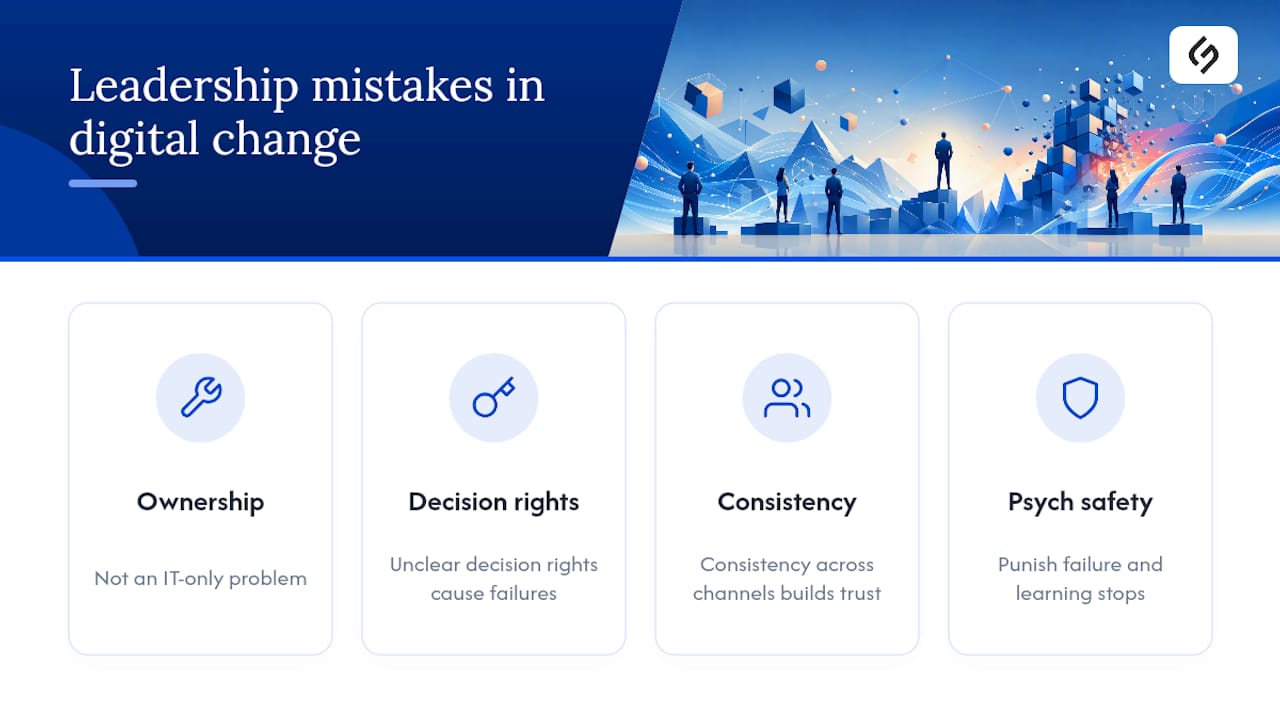
Most leadership failures in this space have nothing to do with the technology itself. They come from treating digital change as an IT problem to hand off rather than a leadership problem to own. A new platform rollout fails just as often from unclear decision rights as from a bad vendor choice, yet leaders rarely audit the former.
The correction that gets overlooked most: consistency across channels matters more than any single flashy initiative when learning how to build trust online. If you say psychological safety matters but punish the first failed experiment you see, your team learns the real rule fast. Visible, repeated behavior, showing up at post-mortems, writing down decision rights, admitting when a rollout stalled, builds more trust than a well-produced town hall ever will.
Ready to Turn This Playbook Into a Working System?
Reading the playbook is the easy part. Sequencing an actual 90 day plan, auditing decision rights, rebuilding a site to support async workflows, or standing up governance for a new automation project, is where most internal teams lose momentum around week three. Solution4guru works alongside leadership teams to close that gap, handling the technical build while you focus on the cultural and mindset shifts this article covers.
Whether you need a full site modernization to support distributed teams or a governance framework for a new AI tool, the starting point is the same. A free consultation covers where your current digital capability stands, which of the steps above matter most for your situation, and a realistic timeline. Start by learning what modern web development actually involves for your business, then book a consultation to scope the specific project.
Selected Research and Reports to Read Next
MIT Sloan on digital dexterity, Deloitte on trustworthy digital leadership, PLOS on virtual teams, Cognizant’s leadership playbook.
Sources
- Why digital dexterity is key to transformation
- Virtual team effectiveness research (2025)
- The Asynchronous Leader’s Playbook for Teams
FAQ
It’s the capacity to convert people, processes, and technology into sustained value, built on digital dexterity, adaptive mindsets, and trustworthy automation governance.
Emotional intelligence, curiosity, and practical tech fluency matter more than coding skills, since they drive faster sensing of opportunities and stronger team trust.
Effective remote leadership relies on structured autonomy, written decision rights, async communication norms, and output-based rhythms rather than more video meetings.
A focused 30/60/90 sequence, starting with a meeting audit and ending with a documented cultural artifact, typically shows measurable shifts in decision speed within one quarter.
Yes. Solution4guru works with leadership teams on the web development, automation governance, and workshop facilitation pieces that turn this playbook into a delivered project.
Recommended
- Understanding Digital Transformation Challenges – Solution for Guru
- What Is Digital Consulting? A Guide for Business Leaders – Solution for Guru
- Digital Transformation Project Plan: A Practical Playbook – Solution for Guru
- Why Digital Transformation Matters: Understanding Its Impact – Solution for Guru