Identity First: How CMOs Choose a Digital Marketing Platform

There is no single universally best digital marketing platform. The right choice depends on an organization’s goals, data maturity, and team capacity. Decision-makers should pick a category first, confirm identity and integration strength, verify orchestration and measurement capability, then select a vendor. Some agencies work alongside teams that want this process tailored to their own architecture rather than a generic rollout.
TL;DR:
- Successful platform selection hinges on the ability to reliably ingest and unify customer data across systems, not just on comparing feature checklists.
- Prioritizing data integration, identity resolution, and clear onboarding processes reduces implementation delays and long-term performance issues.
- For startups, lightweight email automation and cost-effective basic analytics are sufficient, while midmarket and enterprise firms require more robust journey orchestration and security measures.
- Implementation typically involves a four- to eight-week pilot phase focusing on data accuracy, followed by staged rollout and ongoing operational adjustments.
- Vendors should demonstrate failure scenarios live during demos and provide transparent data handling and security practices to diminish future risks.
Table of Contents
- What counts as a digital marketing platform, and how do the categories differ?
- Why data integration and identity matter more than feature checklists
- A practical evaluation framework for shortlisting platforms
- Which stack pattern fits your business size and goal?
- What should a realistic implementation timeline and budget look like?
- How some agencies approach platform selection the way this framework describes: identity and integration strength evaluated before feature comparisons, and implementation scoped in phases rather than as a single handoff. Their services may span custom web development, UI/UX design, SEO and digital marketing, AI and automation solutions, e-commerce development, CRM and SaaS integrations, cybersecurity and data protection, and tech consulting and strategy, with dedicated HubSpot implementation, integration, administration, custom development, process automation, and data migration services.
- What this framework gets right that most buying guides miss
- Start with a consultation built around your data, not a demo
- Sources
- FAQ
What counts as a digital marketing platform, and how do the categories differ?
A digital marketing platform is software that helps a business plan, execute, and measure campaigns across one or more channels. The category spans tools with very different jobs, and confusing them is a common procurement mistake.
The main categories decision-makers compare include:
- Multichannel Marketing Hubs (MMH): Enterprise suites that unify campaign creation, audience activation, and journey orchestration across email, mobile, web, and paid channels.
- Marketing Automation Platforms (MAP): Tools built around lead scoring, nurture sequences, and sales handoff, common in B2B demand generation.
- Email Service Providers (ESP): Platforms focused primarily on email deliverability, list management, and campaign sending.
- Social management platforms: Tools for scheduling, publishing, and monitoring content across social networks.
- SEO and analytics tools: Software that tracks organic visibility, site performance, and campaign attribution.
- Customer Data Platforms (CDP): Systems that unify customer records from multiple sources into a single profile used for activation and personalization.
All-in-one suites reduce vendor management and often simplify reporting, since everything lives in one data model. The tradeoff is flexibility: a single suite rarely excels at every channel equally, and switching costs rise as more workflows depend on it. Best-of-breed stacks let a business pick the strongest tool for each job, but they require stronger integration discipline, since data has to move reliably between systems.
In practice, the category that fits depends on the use case. E-commerce businesses often lean toward MMHs or ESPs with strong behavioral triggers. B2B demand generation teams typically need a MAP connected tightly to a CRM. Retention-focused teams, regardless of industry, usually need a CDP at the center so lifecycle messaging draws from one accurate customer view rather than fragmented exports.
Why data integration and identity matter more than feature checklists
Feature lists are the easiest thing to compare and the least reliable way to predict success. What actually determines whether a platform performs is whether customer data moves cleanly between systems and whether a business can recognize the same person across channels.
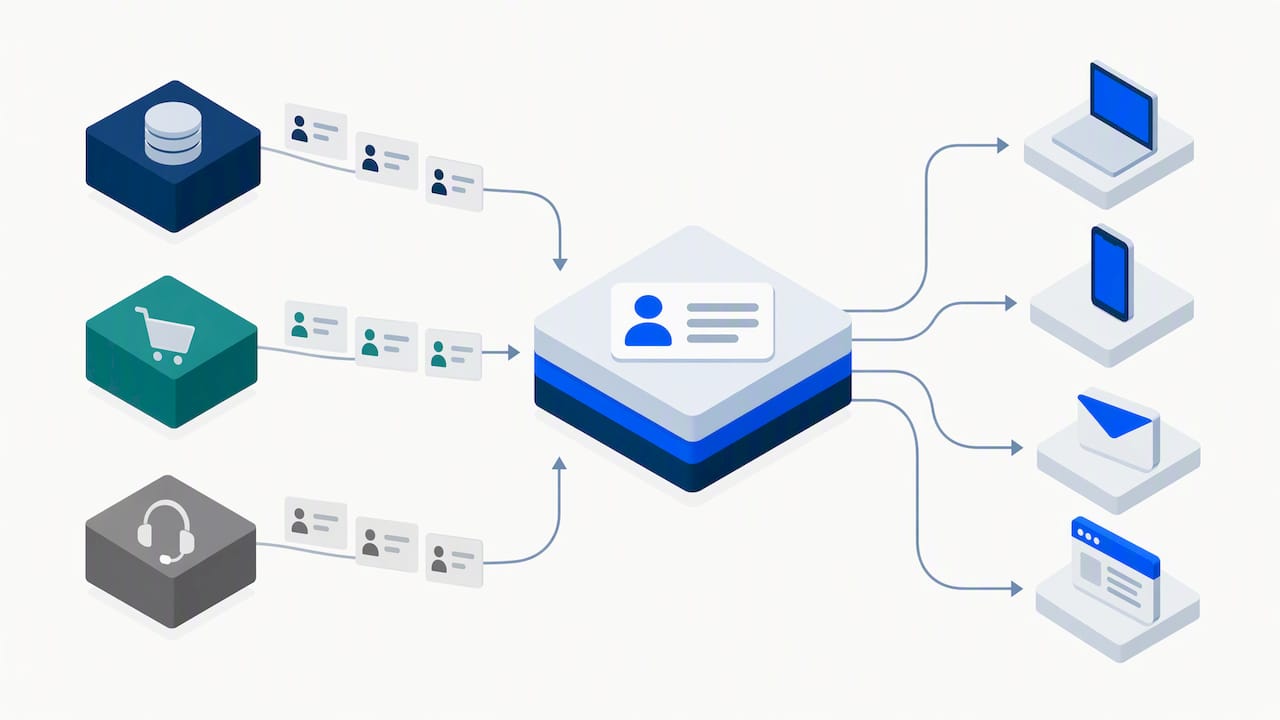
A significant share of organizations cite data integration as their primary martech challenge, according to the 2025 State of Your Stack survey. That figure should reset how buyers prioritize a shortlist: a platform with impressive automation features is a poor investment if it cannot reliably ingest and reconcile customer records from a CRM, e-commerce system, and support desk.
An identity layer, usually a CDP or a warehouse-first architecture, addresses this directly by giving every downstream tool one consistent definition of a customer. Teams that build activation and measurement on top of accurate first-party data avoid the brittle stitching that comes from passing IDs between systems that were never designed to agree with each other, a point echoed in guidance on turning a martech stack into a growth engine. Generative AI features compound this requirement rather than replacing it: A majority of organizations report using generative AI tools within their marketing stack, according to the 2025 State of Your Stack survey, and AI personalization is only as good as the identity data feeding it.
Common integration failures and their mitigations include:
- Event schema mismatches: Different systems log the same action with different field names, which breaks reporting; a documented data contract agreed before implementation prevents this.
- Flaky connectors: Pre-built integrations that silently drop records during high traffic; a monitoring and alerting layer catches gaps before they affect campaigns.
- Duplicate identity records: The same customer appearing as multiple profiles across channels; a deterministic matching rule, not a best-guess algorithm, keeps the record set clean.
Most platform implementations fail for reasons unrelated to the software itself: poor data quality and unreliable integrations undermine even the most capable suite. Establishing a canonical event schema and an identity strategy before evaluating features saves far more time than comparing dashboards.
A practical evaluation framework for shortlisting platforms
Once the category is chosen, the evaluation itself should follow a consistent, weighted checklist rather than a feature-by-feature wish list. The following order reflects what tends to separate platforms that perform from those that stall in year one.
- Data and identity: Can the platform ingest first-party data from existing systems and maintain one accurate customer profile over time?
- Journey orchestration: Does it support conditional, multistep journeys across channels, not just scheduled sends?
- Multichannel execution: Can it execute consistently across the channels the business actually uses today, not a future roadmap?
- Measurement and reporting: Does it support attribution models beyond last-click, and can it export raw data for independent analysis?
- AI and agentic features: Are AI-driven personalization and autonomous optimization explainable, with human oversight built in rather than a black box?
- Security and compliance: Does the platform meet the data protection standards relevant to the business’s industry and region?
- Extensibility: Can the platform connect to future tools through an open API rather than locking data inside a closed ecosystem?
- Cost model: Is pricing based on contacts, sends, or seats, and does it scale predictably as the business grows?
Weighting shifts by company stage. A startup should weight cost model and ease of integration highest, since engineering resources are scarce and the wrong platform is cheap to abandon early. A midmarket company should weight journey orchestration and measurement higher, since campaigns are becoming more complex and attribution gaps start costing real budget. An enterprise should weight security, compliance, and extensibility highest, since the platform will likely need to serve multiple business units and pass procurement and legal review.
During vendor demos, specific questions reveal more than a features comparison ever will: ask how the platform handles a failed data sync, request a sample of its event schema documentation, and ask what happens to historical data if the contract ends. Red flags include vendors who cannot explain their identity resolution logic in plain terms, or who answer security questions by pointing only to a compliance badge rather than describing their actual data-handling practice.
Pro Tip: Ask every shortlisted vendor to demonstrate a failed integration scenario live, not just a successful one. How a platform degrades under failure says more than any feature list.
Gartner’s critical capability frameworks for Multichannel Marketing Hubs and Marketing Automation Platforms are a useful structure to borrow here: effective platforms in these categories are distinguished by unified audience activation, dynamic journey orchestration, and predictive intelligence, not by the size of their channel list.
Which stack pattern fits your business size and goal?
Matching the framework to an actual stack template makes procurement concrete. Three patterns cover most organizations, with variation driven by business goal more than company size alone.
A starter stack suits small businesses and early-stage companies that need consistent email and basic automation without heavy engineering investment: an ESP paired with lightweight automation (welcome flows, abandoned cart triggers) and a simple analytics tool covers most needs. This pattern keeps costs low and setup time short, though it will strain once the business needs cross-channel orchestration or predictive segmentation.
A growth stack fits companies that have outgrown basic automation and are starting to see the cost of fragmented data. This is typically where a CDP enters the picture, consolidating customer records from the website, e-commerce platform, and support tools, while the business begins evaluating MAP or MMH features for more sophisticated journeys. The shift from starter to growth stack is less about adding tools and more about adding the identity layer that makes existing tools more effective.
An enterprise stack generally pairs an enterprise-grade MMH with an enterprise CDP and a dedicated measurement function, often a small analytics team responsible for attribution modeling and incrementality testing rather than relying on any single platform’s native reporting. At this scale, the cost of a measurement gap is large enough to justify the headcount.
Goal-based examples illustrate how these patterns apply in practice:
- E-commerce: Behavioral triggers (cart abandonment, browse abandonment, post-purchase flows) matter more than broad channel coverage, so an ESP or MMH with strong event-based automation is usually the priority.
- B2B demand generation: Lead scoring and CRM synchronization matter most, making a MAP tightly integrated with the sales pipeline the natural fit.
- Retention and loyalty: Consistent identity across purchase history, support interactions, and loyalty program activity is the deciding factor, which is why a CDP-centered stack tends to outperform a channel-first approach here.
What should a realistic implementation timeline and budget look like?
Platform selection is only the first step. Implementation timelines and total cost are where many projects run into trouble, usually because licensing was budgeted but integration work was not.
A typical rollout moves through three phases. A proof-of-concept or pilot phase, often four to eight weeks, tests the platform against a limited use case and real data rather than a demo environment. A pilot iteration phase follows, refining integrations and journeys based on what the pilot revealed, typically another four to six weeks. Full rollout then proceeds in stages by channel or business unit rather than all at once, reducing the risk of a single failure point affecting every campaign simultaneously.
Costs beyond the license fee typically include:
- Integration engineering: Connecting the platform to existing CRM, e-commerce, and support systems reliably, not through a default connector alone.
- Data cleanup: Deduplicating and standardizing existing customer records before they enter the new platform.
- Training: Bringing the marketing team, and often sales, up to speed on new workflows and reporting.
- Change management: Adjusting existing processes so teams actually adopt the new system rather than reverting to old habits.
- Ongoing operations: Continued monitoring, optimization, and troubleshooting after launch, which rarely ends when the pilot does.
Procurement works best when structured in phases rather than a single long-term commitment. Tying contract milestones to measurable pilot acceptance criteria, such as successful data sync rates or campaign send accuracy, protects the business if a vendor underperforms before a full rollout commitment is made.
How some agencies approach platform selection the way this framework describes: identity and integration strength evaluated before feature comparisons, and implementation scoped in phases rather than as a single handoff. Their services may span custom web development, UI/UX design, SEO and digital marketing, AI and automation solutions, e-commerce development, CRM and SaaS integrations, cybersecurity and data protection, and tech consulting and strategy, with dedicated HubSpot implementation, integration, administration, custom development, process automation, and data migration services.
Projects may be built around a client’s existing business model and workflows rather than a standard template, with ongoing optimization continuing after the initial setup phase. That approach mirrors the phased, milestone-based procurement this article recommends: a discovery phase to document the current data architecture, a pilot phase to validate integration reliability before full commitment, and continued administration afterward rather than a one-time deployment.
A platform is only as reliable as the data feeding it, and a vendor relationship is only as useful as the support behind it once the contract is signed.
What this framework gets right that most buying guides miss
Most platform comparisons rank tools by feature count, which rewards the vendors with the longest marketing pages rather than the strongest architecture. The research behind this framework points somewhere else entirely: integration reliability and identity accuracy predict outcomes far better than any individual feature, and the overwhelming majority of organizations are still struggling with exactly that problem.
The conventional advice, pick the platform with the most capabilities, gets the order of operations backward. A business should confirm its data contract and identity strategy before it ever compares dashboards or AI features, because a brilliant automation engine built on fragmented customer records will underperform a modest one built on clean, unified data every time.
If there is one priority worth acting on first, it is this: audit how customer data currently moves between existing systems before adding a new platform on top of it. Most procurement failures trace back to that step being skipped, not to the platform itself being the wrong choice.
— Vadim
Start with a consultation built around your data, not a demo
Choosing a platform is only half the work. Making it perform reliably inside a specific business, with its particular systems, sales process, and customer data, is where most of the value gets won or lost. Solution4Guru works directly with businesses to scope that integration before any license is signed, which means the plan reflects an organization’s actual architecture rather than a vendor’s best-case scenario.
A typical engagement starts with a few concrete steps:
- A discovery call to map existing systems, data sources, and current pain points.
- A technical audit of integration reliability, identity data quality, and reporting gaps.
- A scoped pilot project with clear acceptance criteria before any full rollout commitment.
Readers ready to move forward can review the full range of services, including HubSpot implementation and integration work, or start with a broader look at custom web development, digital marketing, and automation services to find the right starting point for a specific business goal.
Sources
- Gartner — Critical capabilities for marketing platforms (MMH / MAP) 2026
- MarTech — State of Your Stack survey (2025)
FAQ
What is the most effective digital marketing platform?
There is no single most effective platform for every business; effectiveness depends on data integration strength, identity accuracy, and how well the platform fits the specific use case. A platform that excels at B2B lead nurturing may underperform in an e-commerce behavioral-trigger scenario, and vice versa.
Which system is best for digital marketing?
The best system is the one that matches a business’s data maturity and channel mix rather than the one with the longest feature list. Gartner’s critical capability frameworks for marketing hubs and automation platforms are a useful structure for comparing options against actual organizational needs.
Which digital marketing is best?
This depends on the channel and goal rather than a single universal answer: e-commerce businesses often prioritize behavioral email and multichannel execution, while B2B companies prioritize lead scoring and CRM integration. The right mix should be chosen based on where the target audience engages, not a generic ranking.
Which is the best tool for digital marketing?
No single tool serves every function well, which is why most effective stacks combine an email or automation platform with a separate analytics and identity layer. Buying decisions should be mapped to organizational needs, budget, and team size rather than treated as a universal ranking, a point reflected in independent tool roundups as well.
How long does it take to implement a new marketing platform?
A typical rollout moves through a pilot phase of four to eight weeks, followed by iteration and a staged full rollout rather than a single launch date. Businesses that budget only for licensing, without accounting for integration engineering and data cleanup, tend to see timelines extend well beyond this estimate.