Business Transformation: What Leaders Miss in the First 90 Days

Business transformation is a fundamental, organization-wide shift in how a company operates, competes, and creates value, pursued to achieve measurable gains in revenue, cost efficiency, customer experience, and operational agility. It is not a single project or a technology rollout. It spans strategy, structure, process, and culture, and it reshapes how an organization delivers results. The sections that follow explain why companies pursue it, how it unfolds, and how to measure whether it worked.
TL;DR:
- Choose transformation only when a performance gap crosses multiple functions or the operating model cannot deliver target outcomes; otherwise, fix the process or system.
- Distinguish digitization, which converts manual information or steps into digital form, from digital transformation, which changes how the business creates and delivers value.
- Select one to three priority use cases, define success metrics before work begins, and fund each pilot alongside a credible plan to scale proven results.
- Roughly 70% of transformation efforts fail, with leadership and people factors often at the root; pair visible sponsorship with training and sustained funding.
- Review adoption, feature use, training completion, and employee engagement monthly alongside business outcomes, so teams can spot stalled pilots before annual results arrive.
Table of Contents
- Why organizations begin a transformation
- Types of business transformation: a practical taxonomy
- Key drivers and catalysts that force or justify transformation
- How transformations are planned and executed
- Who’s involved: roles, teams, and capabilities
- What makes transformations succeed
- Why many transformations fail
- Measuring impact: KPIs, dashboards, and leading indicators
- Examples that illustrate different transformation types
- How to start: a 90-day roadmap
- A practitioner’s view on what leaders consistently miss
- How we help leaders plan and deliver transformation
- FAQ
- Sources
Why organizations begin a transformation
Most transformation efforts start with a specific business case rather than a vague ambition to “modernize.” Leadership teams typically identify a gap between current performance and what the market now demands, then build a case around closing it through growth, resilience, margin improvement, or a better customer experience.
Several triggers tend to push that case from idea to funded initiative:
- Disruptive entrants change customer expectations faster than legacy operating models can respond.
- New technology (AI, automation, cloud platforms) makes previously uneconomical changes viable.
- Regulatory shifts force changes to data handling, reporting, or product design.
- Sustained cost pressure makes the current cost structure unsustainable relative to competitors.
Not every performance gap calls for transformation. When a problem can be solved by fixing one process or upgrading one system, incremental improvement is the right scope. Transformation becomes the appropriate response when the gap touches multiple functions at once, when the current operating model structurally cannot deliver the target outcome, or when competitors are already capturing share through a materially different approach.
Types of business transformation: a practical taxonomy
Leaders often use “digital transformation” as shorthand for all organizational change, but the distinctions matter when you are deciding where to invest. TechTarget defines business transformation as fundamental changes to operations, strategy, or structure made to improve competitiveness and financial performance, and separates it into several recognizable categories.
- Digitization converts analog information or manual steps into digital form, such as scanning paper records.
- Digital transformation goes further, using technology to change how the business creates and delivers value, not just how it stores data.
- Organizational and structural transformation redesigns reporting lines, decision rights, or team structures.
- Cultural transformation shifts shared behaviors and norms, often paired with structural change since one rarely sticks without the other.
- Business-model transformation changes how a company monetizes its offering, such as moving from one-time product sales to a subscription model, launching a platform that connects third parties, or pursuing a merger that adds a new revenue stream.
The distinction between digitization and digital transformation matters because many initiatives labeled “transformation” are really digitization projects with a narrower payoff. Confusing the two leads to underfunded expectations: a scanning project will not produce the revenue or agility gains that a genuine operating-model change can.
Key drivers and catalysts that force or justify transformation
Transformation drivers split into two categories, and distinguishing them helps leaders build a sharper business case.
External drivers include market disruption from new competitors, shifting customer behavior (particularly expectations set by digital-native companies), new regulation, and technology that makes a new way of operating commercially viable.
Internal drivers are usually less visible from outside the organization but often weigh more heavily on the day-to-day cost of doing business:
- Legacy systems that are expensive to maintain and slow to change.
- Manual processes that inflate operating costs and introduce errors.
- Data silos that block a single view of the customer or the business.
- Talent shortages in the specialized skills a new operating model requires.
The most effective transformation cases translate these drivers into a short list of prioritized use cases rather than a single sweeping mandate. A use case tied to a specific driver, such as reducing cost-to-serve through automation of a manual workflow, is easier to fund, pilot, and measure than an abstract goal like “become more digital.”
How transformations are planned and executed
A repeatable delivery model reduces the risk that a transformation stalls after the initial announcement. Most well-run programs follow a similar sequence, regardless of industry.
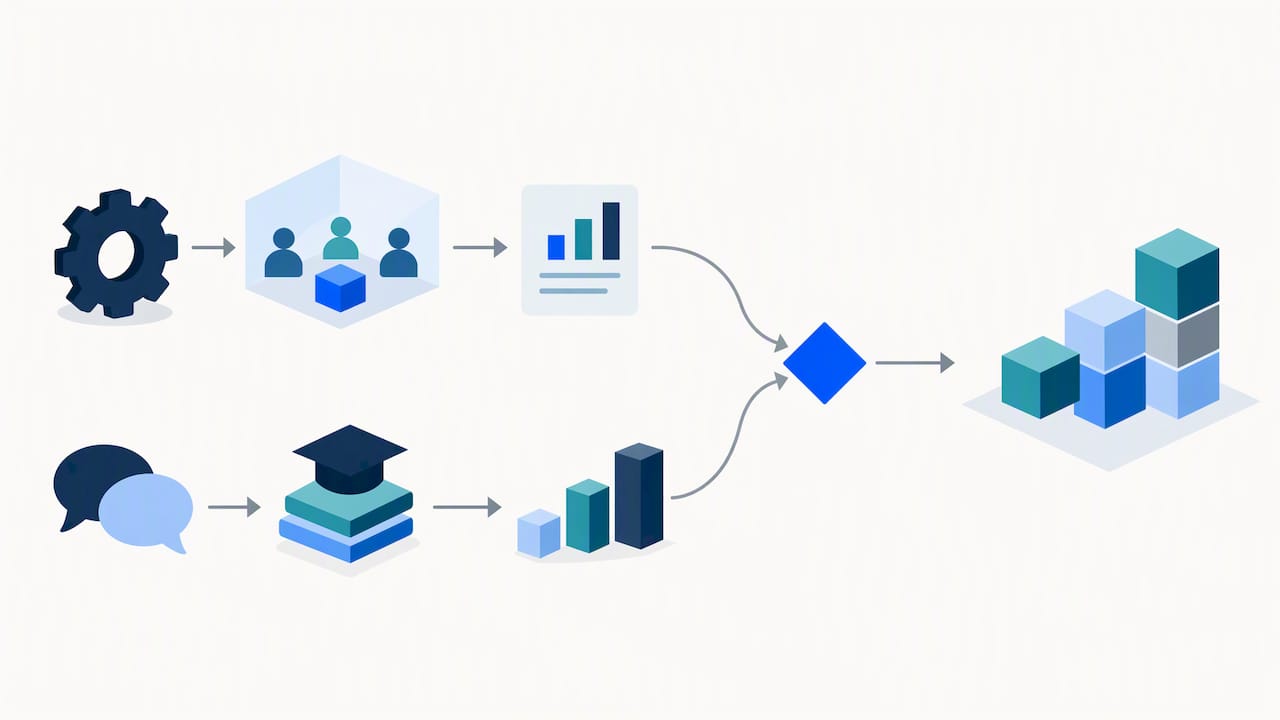
- Diagnose the current state, including process costs, system constraints, and customer pain points.
- Set strategy, translating the diagnosis into a small number of prioritized use cases with clear success metrics.
- Pilot the highest-value, most feasible use cases with a defined scope and timeline.
- Scale what works, extending proven pilots across business units or geographies.
- Sustain the change through updated processes, training, and governance that outlast the original project team.
Governance determines whether this sequence actually happens. A named executive sponsor, a steering committee with cross-functional authority, and a transformation office or PMO to coordinate workstreams are standard features of programs that make it past the pilot stage. Our own Five Phase Digital Transformation Model follows this same diagnose-to-sustain logic, built around prioritized use cases rather than a single large rollout.
Delivery approach matters as much as governance. Agile pilots and data-driven minimum viable products let teams test a value hypothesis with real users before committing full budget, which keeps the organization honest about what is actually working. Change management, including communication plans and capability building for the people whose jobs will change, needs to run in parallel with technical delivery, not after it.
Pro Tip: Fund the first pilot and the scaling plan together; a pilot approved without a path to scale rarely gets a second round of funding.
Who’s involved: roles, teams, and capabilities
Transformation programs fail when responsibility is diffuse. Clear roles make the difference between a program that moves and one that stalls in committee.
- The executive sponsor owns the business case, removes organizational roadblocks, and stays visibly engaged through setbacks, not just at the kickoff.
- The steering committee sets priorities across competing use cases and resolves trade-offs that individual teams cannot.
- A transformation office or PMO coordinates timelines, tracks metrics, and keeps workstreams aligned to the original business case.
- Cross-functional squads, typically drawing from IT, product, HR, operations, and finance, do the actual delivery work, often alongside external partners for specialized skills.
Decision rights need to be explicit from the start. Who approves scope changes, who can reallocate budget between use cases, and who escalates when a pilot’s results are ambiguous are questions worth answering in writing before the first pilot launches, not after a disagreement surfaces.
What makes transformations succeed
Research on transformation outcomes points to a consistent set of success factors, and most of them are organizational rather than technical.
- Define outcomes and metrics tied to the future state, not the legacy operating model.
- Maintain active, visible sponsorship and sustained funding through the full program, not just the pilot phase.
- Invest in people: engagement and upskilling determine whether new processes and tools actually get used.
- Balance quick wins that build momentum with a roadmap that leads to full-scale value capture.
Research shows that roughly 70% of transformation efforts fail, and leadership and people factors are a common root cause, according to Harvard Business Review. That figure reinforces why metrics and sponsorship matter as much as the technology itself: a well-built platform delivered to a workforce that has not been engaged or trained will not move the numbers leadership is tracking.
The World Economic Forum makes a related point: technology investment alone is not enough. Organizations that pair new systems with talent investment, such as adding digital specialists directly into operational teams, are more likely to see the gains scale beyond the pilot.
Why many transformations fail
Understanding failure modes is as useful as studying success factors, since most of the warning signs appear well before results disappoint.
- The false alignment trap: senior teams agree in meetings but disagree materially on priorities and trade-offs once resources are allocated. HBR describes detectable signals including inconsistent decisions, shifting priority lists, and resource allocation that does not match stated priorities.
- Legacy metrics that still reward the old way of working undercut a program even when the new process is objectively better, because teams keep optimizing for the measure that affects their bonus or review.
- Pilot purgatory: a successful small-scale test that never gets a scaling plan or budget, so it sits indefinitely as a “proof of concept.”
- Human signals: falling engagement scores and rising turnover in affected teams often precede a visible drop in program metrics, and are worth tracking as leading indicators in their own right.
Catching these signs early is largely a matter of asking the uncomfortable question in the steering committee: are we measuring what we say we care about, and does the data from the front line match the story told at the top.
Measuring impact: KPIs, dashboards, and leading indicators
Transformation programs need two layers of metrics: outcome KPIs that prove business impact, and leading indicators that reveal whether the program is on track before the outcome numbers arrive.
Outcome-level KPIs typically include revenue change tied to the new model, cost-to-serve, customer satisfaction scores such as NPS or CSAT, and time-to-market for new products or features.
Leading indicators give earlier signal:
- Adoption rate of new tools or processes among target users.
- Feature usage depth, not just whether a tool was logged into once.
- Training completion rates across affected teams.
- Employee engagement scores in units undergoing the most change.
Industry data referenced by the World Economic Forum shows that while most companies have launched digital initiatives, a much smaller share scale those initiatives to capture full value, which is precisely why leading indicators matter: they flag stalled adoption before an entire year’s outcome numbers come in flat. Building a measurement cadence, reviewed monthly by the steering committee rather than once a year, keeps decisions tied to real data instead of anecdote.
Examples that illustrate different transformation types
Two short, contrasting cases make the taxonomy concrete.
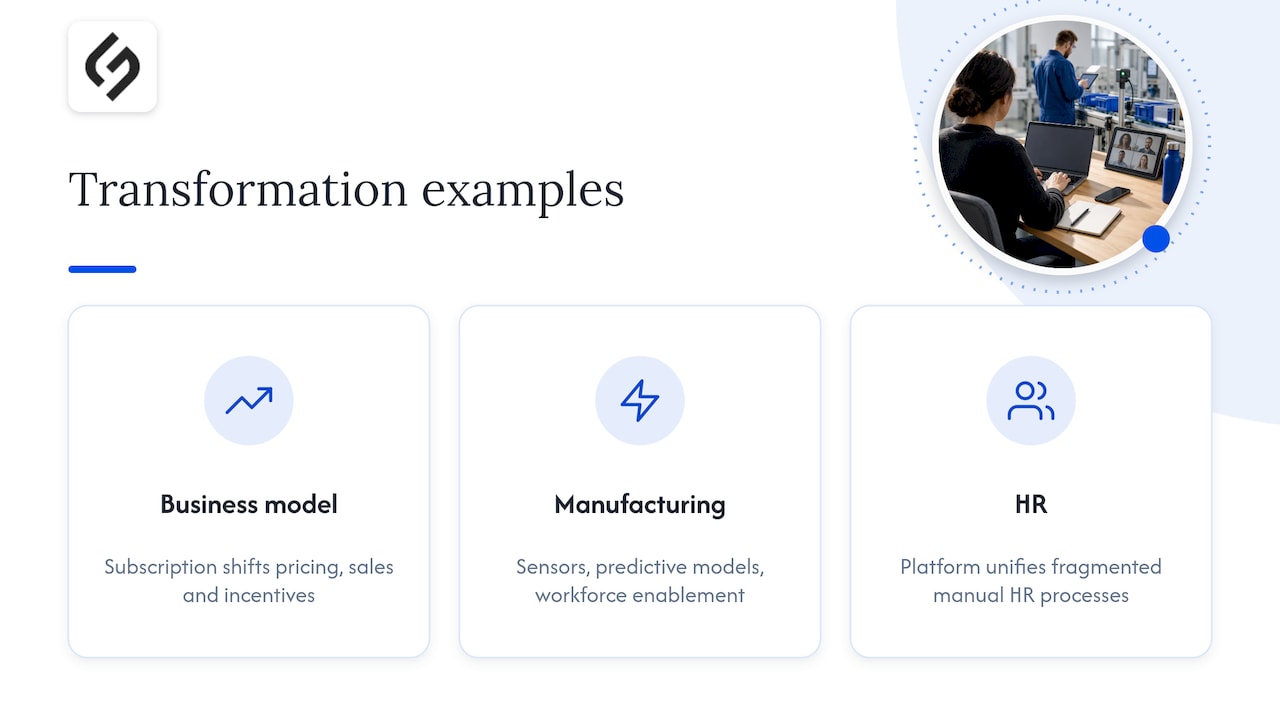
A business-model pivot moves a company from one-time transactions to recurring revenue, for example shifting an on-premise software product to a subscription delivered over the cloud. The transformation here touches pricing, sales incentives, customer success operations, and engineering release cycles all at once, which is why business-model change is usually the most disruptive type on the list even when it does not require new factories or systems.
A digital and operational transformation in manufacturing often centers on “brownfield” sites, meaning existing facilities rather than new builds. The World Economic Forum describes how combining sensors, predictive models, and workforce enablement in these sites can scale into meaningful downtime reduction and productivity gains, but only when the pilot is paired with governance and a clear plan to extend it beyond the first line or plant.
A smaller-scale but still instructive example is a digital HR transformation, where a company replaces fragmented, manual HR processes with an integrated platform, a shift documented in our own case study on HR transformation with HoorayHR.
The lesson across all three: the type of transformation determines which stakeholders feel the most disruption, and planning for that group’s engagement up front avoids the adoption gap that stalls so many programs after a strong pilot.
How to start: a 90-day roadmap
Momentum in the first 90 days sets the tone for the rest of the program, and the steps do not require full budget approval to begin.
- Assess value hypotheses and constraints. Map the gap between current and target performance, and inventory the stakeholders, technology, and data you will need.
- Select one to three priority use cases. Choose based on a combination of business value and feasibility, and define the success metric for each before work begins.
- Run rapid pilots with clear governance. Set a fixed timeline, a named owner, and a learning loop that captures what worked and what did not.
- Plan the scale-up before the pilot ends. Build the case for capability investment and funding around validated results, not projected ones.
A digital transformation consulting partner can shorten this cycle by bringing a tested diagnostic framework and avoiding the common trap of spending the first 90 days debating scope instead of testing it.
Pro Tip: Pick at least one use case that can show a measurable result within 90 days; an early, credible win is often what secures funding for the next phase.
A practitioner’s view on what leaders consistently miss
Our Five Phase Digital Transformation Model exists because the diagnose-to-sustain sequence is simple to describe and hard to execute without structure. We built it around the claim that leaders following a phased, use-case-driven approach can capture a larger share of planned value, and we treat that figure as a planning anchor, not a guarantee: the number only holds when governance and people investment keep pace with the technology.
What we see leaders miss most often is sequencing. They chase a flagship use case for visibility instead of starting with one that balances a quick win against real capability building. The programs that hold up a year later are the ones where the first pilot taught the organization something it reused in the second.
How we help leaders plan and deliver transformation
We work alongside leadership teams on the parts of transformation that technology alone cannot fix: strategy, implementation, and the integration work that connects new systems to existing operations. Our services span custom web development, UI/UX design, SEO and digital marketing, AI and automation, e-commerce, CRM and SaaS integrations, cybersecurity, and tech consulting, built around the specific workflows of the business we are working with rather than a fixed template.
If you are weighing where to start, we offer a free consultation to map your priority use cases and talk through a realistic first 90 days. Get in touch through our services page to see what a tailored roadmap looks like for your business.
FAQ
Business transformation means an organization-wide change in strategy, structure, process, or culture, aimed at improving revenue, cost efficiency, customer experience, and agility. It differs from a routine improvement project because it affects multiple functions at once rather than a single process or system.
The transformation process typically follows five stages: diagnosing the current state, setting strategy around prioritized use cases, piloting the highest-value options, scaling what works, and sustaining the change through updated processes and training. Governance, including an executive sponsor and a transformation office, keeps the process on track between stages.
The main purpose is to close a performance gap that incremental fixes cannot address, usually by targeting growth, lower operating costs, a better customer experience, or faster response to market changes. The specific purpose varies by organization, but it is always tied to a measurable business outcome rather than technology for its own sake.
One common example is shifting from one-time product sales to a subscription or platform-based model, which changes pricing, sales incentives, and how the product is delivered. Another is digitizing operations at an existing manufacturing site, combining sensors and predictive tools with workforce training to improve productivity and reduce downtime.
Sources
- When senior leaders lack people skills, transformations fail – HBR
- Adopting a transformational mindset that goes beyond digital – World Economic Forum