4G vs 5G GPS Trackers: What’s Changing?
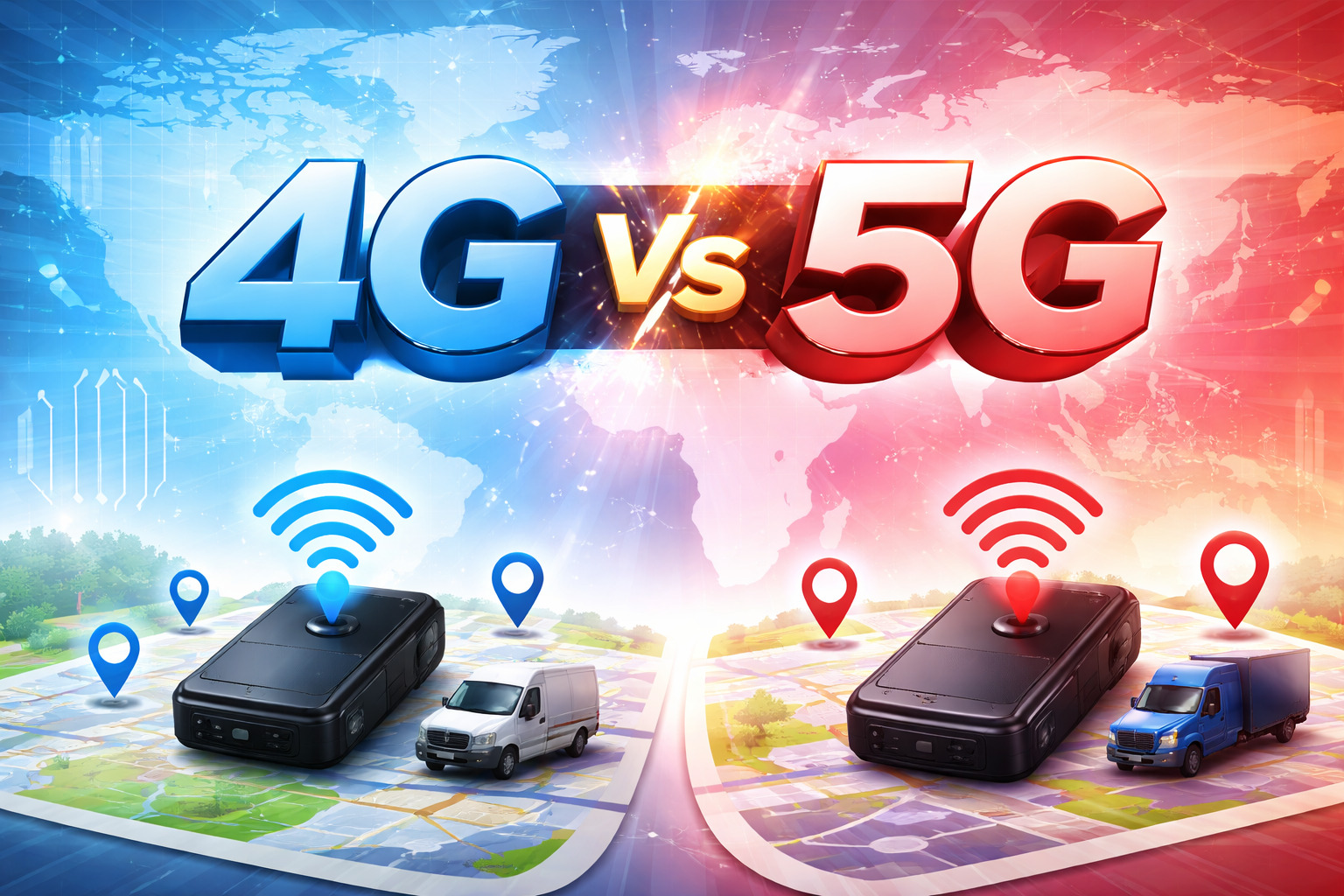
Fleet management professionals and logistics operators know that GPS tracking technology rarely stays still. Over the past decade, 4G LTE networks transformed real-time vehicle monitoring by delivering fast, reliable data at a fraction of the cost of earlier cellular standards. Now, 5G is beginning to reshape what fleet managers expect from their tracking hardware — faster updates, lower latency, and richer data pipelines that open the door to predictive analytics and autonomous vehicle support.
Understanding the difference between 4G and 5G GPS trackers is no longer just a technical curiosity. It directly affects purchasing decisions, integration roadmaps, and the long-term ROI of your fleet technology stack. In this article, we break down exactly what is changing, why it matters, and how leading platforms — Azuga, Verizon Connect, and Motive — are responding to the 5G shift.
Table of contents
Quick Summary
- 4G GPS trackers remain the industry standard in 2024–2025, offering broad coverage and mature software ecosystems.
- 5G GPS trackers deliver ultra-low latency (<10 ms), higher data throughput, and better support for high-density fleets.
- Azuga focuses on driver safety scoring and compliance analytics, adapting its hardware line as 5G coverage expands.
- Verizon Connect leverages Verizon’s own 5G Ultra Wideband network to offer early real-world 5G fleet tracking advantages.
- Motive (formerly KeepTruckin) integrates AI-powered dashcams and ELD compliance with progressive 5G hardware upgrades.
- The right platform depends on fleet size, existing infrastructure, and how quickly 5G reaches your operational routes.
How Do 4G and 5G GPS Trackers Actually Differ?
What Makes 4G LTE GPS Tracking So Reliable Today?
4G LTE GPS trackers send location and telematics data through a cellular modem that connects to the nearest tower on the LTE network. In practical terms, this means a typical update interval of 30–60 seconds, with premium devices pushing updates every 10 seconds. Latency sits in the 30–70 millisecond range — more than adequate for route replay, geofencing alerts, and end-of-day reporting.
Because 4G networks now cover over 99% of the US population and vast portions of Europe and Asia-Pacific, 4G trackers offer something 5G currently cannot: near-universal reach. Furthermore, 4G hardware costs have dropped significantly. OBD-II plug-in trackers, for example, now retail for as little as $20–$60, making fleet-wide deployment economically viable for small and mid-sized operators.
The main technical ceiling of 4G arises in high-density environments. When dozens of vehicles concentrate in a logistics depot, stadium area, or urban freight hub, 4G spectrum congestion can degrade location accuracy and delay alerts. This is precisely the gap that 5G is designed to close.
What New Capabilities Does 5G Bring to GPS Fleet Tracking?
5G’s most significant contribution to GPS tracking is not raw speed — it is the combination of ultra-low latency and massive device density support. Sub-10 ms latency enables near-instantaneous geofence triggers, which matters for automated gate entry at warehouses or precise stop-detection in last-mile delivery. Additionally, 5G’s millimeter-wave spectrum can serve up to one million devices per square kilometer, eliminating the congestion issues that occasionally plague 4G in dense urban environments.
Beyond connectivity, 5G hardware opens the pipeline for richer sensor payloads. Traditional GPS trackers transmit location, speed, and basic diagnostic codes. 5G-enabled devices can simultaneously stream high-definition dashcam footage, real-time brake/acceleration telemetry, cargo temperature data, and AI-based driver behavior scores — all without sacrificing location update frequency.
Consequently, fleet managers can shift from reactive “where is my truck?” monitoring to proactive, data-driven fleet intelligence. However, this potential remains theoretical in many regions where 5G coverage outside urban centers is still limited.
| Feature | 4G LTE GPS Tracker | 5G GPS Tracker |
|---|---|---|
| Typical Latency | 30–70 ms | 1–10 ms |
| Location Update Frequency | Every 10–60 seconds | Every 1–5 seconds |
| Network Coverage (Global) | Very broad (99%+ urban/suburban) | Growing, mainly urban 2024–2025 |
| Device Density Support | ~100K devices/km² | ~1M devices/km² |
| Data Throughput | 10–100 Mbps | 100 Mbps – 10 Gbps |
| Hardware Cost (Entry Level) | $20–$80 | $80–$200+ |
| AI/Video Streaming Support | Limited | Full HD + real-time |
| Battery Life (Plug-free units) | Longer | Shorter (higher power draw) |
| Rural Route Reliability | High | Variable (coverage gaps) |
| Ideal Use Case | Standard fleet monitoring, compliance | AI fleets, autonomous vehicles, dense urban logistics |
Which Industries Are Driving the Move Toward 5G Fleet Tracking?

Why Is Last-Mile Delivery Leading the 5G Adoption Curve?
Last-mile delivery operations concentrate large numbers of vehicles in small geographic areas — precisely the scenario where 5G’s density advantages shine. E-commerce growth has placed enormous pressure on urban logistics providers to reduce delivery windows, improve stop accuracy, and automate customer communication. 5G GPS trackers can trigger automated delivery notifications with sub-second precision, enable dynamic route adjustments based on live traffic feeds, and stream proof-of-delivery photos instantly — all tasks that strain 4G connections under congestion.
As a result, large courier networks and grocery delivery fleets are among the earliest enterprise adopters of 5G-capable devices. Notably, platforms like Verizon Connect hold a structural advantage here: as a Verizon subsidiary, Verizon Connect customers gain early access to 5G Ultra Wideband networks rolled out across major metropolitan areas, giving enterprise clients a concrete 5G performance uplift before the technology achieves wide rural coverage.
How Is the Long-Haul Trucking Sector Responding to 5G?
Long-haul trucking presents a very different picture. Interstate routes frequently pass through areas with limited 5G coverage, meaning 5G-only devices would risk connectivity gaps for hours at a time. Therefore, most serious fleet management vendors — including Motive — currently deploy dual-mode hardware that falls back to 4G LTE when 5G signals are unavailable.
This hybrid approach lets long-haul operators benefit from 5G’s richer data streams at origin yards, major highway interchanges, and urban delivery points while maintaining consistent tracking on open roads. For Motive specifically, this matters because its customer base of over 120,000 fleets spans everything from small owner-operators to large enterprise carriers — a diversity that demands broad coverage reliability above cutting-edge connectivity.
Additionally, ELD (Electronic Logging Device) compliance requirements set by the FMCSA demand uninterrupted data logging. Any connectivity gaps that cause logging failures create regulatory risk. Consequently, 4G remains the backbone of long-haul compliance monitoring for the foreseeable future.
What About Construction and Field Service Fleets?
Construction fleets and field service operations — the sweet spot for Azuga — often work in suburban or semi-rural environments where 5G penetration is moderate at best. For these fleets, the immediate priority is asset tracking reliability, driver safety scoring, and IFTA/fuel reporting accuracy. Azuga’s platform excels at combining GPS-based location data with OBD-II vehicle health diagnostics, which 4G handles efficiently.
Nevertheless, Azuga is actively evolving its hardware roadmap. As 5G small cells spread into suburban corridors, Azuga’s connected vehicle intelligence layer — which already uses machine learning for predictive maintenance alerts — will increasingly benefit from 5G’s capacity to carry richer sensor data streams in real time.
How Do Azuga, Verizon Connect, and Motive Compare on 4G and 5G Tracking?
All three platforms represent the upper tier of commercial fleet management software. However, they differ meaningfully in their approach to the 4G-to-5G transition, hardware ecosystems, and target customer segments. The comparison table below captures the most important dimensions for procurement teams evaluating these solutions.
| Category |  |  |  |
|---|---|---|---|
| Current Network Support | 4G LTE (5G roadmap) | 4G LTE + 5G Ultra Wideband | 4G LTE + dual-mode 5G |
| Hardware Type | OBD-II plug-in, hardwired | OBD-II, hardwired, asset trackers | OBD-II, ELD, AI dashcam, asset tags |
| GPS Update Frequency | Every 30 sec (customizable) | Every 30 sec – real-time | Every 1 min (ELD) / real-time (AI cam) |
| AI & Video Streaming | ◐ Limited dashcam integrations | ✓ Integrated dashcam + AI coaching | ✓ AI dashcam (front + road-facing) |
| ELD / HOS Compliance | ✓ FMCSA-registered ELD | ✓ FMCSA-registered ELD | ✓ FMCSA-registered ELD |
| Driver Safety Scoring | ✓ Core feature + gamification | ✓ Integrated coaching alerts | ✓ AI-powered event detection |
| 5G Network Advantage | ◐ Planned future upgrade path | ✓ Direct Verizon 5G UW access | ◐ Dual-mode (4G fallback) |
| Asset Tracking (Non-Vehicle) | ◐ Limited | ✓ Comprehensive | ✓ Cargo, trailers, equipment |
| Fuel Management | ✓ IFTA + fuel card integration | ✓ Fuel analytics | ✓ Fuel card + MPG analytics |
| API / Integrations | ◐ Standard API | ✓ Extensive (Salesforce, SAP, etc.) | ✓ Open API, 100+ integrations |
| Best For | SMBs, field service, construction | Enterprise, dense urban fleets | Long-haul trucking, mixed fleets |
| Contract Flexibility | Month-to-month available | Typically annual contracts | Flexible, per-vehicle pricing |
Legend: ✓ Full support | ◐ Partial / in progress | ✗ Not available
What Are the Real-World Benefits of Upgrading to 5G GPS Tracking?

Does Faster Data Actually Reduce Fleet Operating Costs?
The business case for 5G fleet tracking rests on four concrete cost levers. First, higher-frequency location updates reduce idle time by enabling dispatchers to redirect vehicles more precisely, trimming empty miles. Second, real-time AI event detection — made practical by 5G’s bandwidth — allows immediate coaching interventions after harsh braking or acceleration events, reducing fuel waste and accident frequency. Industry research from the American Transportation Research Institute (ATRI) consistently shows that every mile-per-hour of average speed reduction through smoother driving yields measurable fuel savings per vehicle annually.
Third, 5G’s bandwidth enables continuous streaming of HD dashcam footage to the cloud. This eliminates the current workflow where fleet managers must manually request video clips after incidents — a process that delays insurance claims and complicates accident reconstruction. With 5G, footage uploads automatically and immediately. Fourth, predictive maintenance models trained on richer sensor data streams can flag mechanical issues days before they cause breakdowns, reducing roadside repair costs that can easily exceed $1,000 per incident.
How Does 5G Affect Driver Safety and Compliance Programs?
Both Azuga and Motive have built safety coaching programs that rely on rapid data feedback loops. Azuga’s gamified safety scoring system rewards drivers for safe behavior, and the faster event reporting that 5G enables allows the scoring algorithm to reflect real-time performance rather than yesterday’s trip summaries. This immediacy matters because behavioral research confirms that feedback loses motivational power rapidly after an event.
Verizon Connect goes a step further by pairing 5G connectivity with in-cab AI coaching systems that deliver voice prompts to drivers within seconds of detecting unsafe behavior — speeding, tailgating, or distraction. This closed-loop feedback cycle, made reliable by 5G latency levels, represents a meaningful leap beyond what 4G networks can consistently support.
From a compliance perspective, 5G’s consistent connectivity also reduces the risk of ELD data gaps that trigger Hours of Service violations. Moreover, real-time DVIR (Driver Vehicle Inspection Report) submissions become instantaneous, removing paper-based bottlenecks that still plague many fleets running 4G-limited workflows.
What Security and Privacy Considerations Come With 5G GPS Trackers?
5G introduces both improved security features and new considerations for fleet operators. On the positive side, 5G networks use stronger encryption standards (256-bit encryption vs 4G’s 128-bit in some implementations) and include enhanced authentication protocols that reduce SIM-swapping vulnerability. For enterprise fleets handling sensitive cargo — pharmaceuticals, financial documents, government contracts — this matters.
However, the richer data streams enabled by 5G also expand the attack surface. A 5G-connected tracker that streams HD video, vehicle diagnostics, and driver biometrics represents a far more attractive target for bad actors than a simple 4G location beacon. Consequently, fleet managers should evaluate the cybersecurity posture of their tracking vendor carefully. Verizon Connect, Azuga, and Motive all maintain SOC 2 compliance frameworks, but the specific security architectures of their 5G hardware deserve close scrutiny during procurement.
When Should You Actually Upgrade From 4G to 5G GPS Trackers?
Is Your Current Fleet Ready for 5G Hardware Today?
Readiness for 5G GPS trackers depends on three factors: your operational geography, your data use case, and your hardware refresh cycle. Fleets that concentrate operations within major metropolitan areas — where Verizon, AT&T, and T-Mobile have densest 5G coverage — can benefit meaningfully from 5G devices right now, particularly for high-frequency urban delivery or real-time AI safety programs.
By contrast, fleets that regularly travel interstate corridors or serve rural customers should wait until national 5G coverage matures — estimated by industry analysts to reach sufficient rural penetration around 2026–2027. In the meantime, the practical approach is to deploy 4G-primary, 5G-capable dual-mode devices. Both Motive and Verizon Connect already offer hardware in this category, ensuring investment protection as coverage expands.
Pro tip: Before committing to a 5G GPS tracker investment, map your top 20 most-used routes against your carrier’s 5G coverage tool. If more than 40% of route mileage lacks 5G signal, a 4G or dual-mode device delivers better ROI for the next 2–3 years.
What Does a Realistic 4G-to-5G Migration Timeline Look Like?
A structured migration typically spans three phases. In the first phase (now through 2025), fleet managers should audit existing 4G hardware contracts and identify devices approaching end-of-life. Replacing end-of-life 4G units with dual-mode 5G/4G hardware from vendors like Motive or Verizon Connect avoids paying for a second hardware refresh when 5G matures.
In the second phase (2025–2027), as 5G coverage consolidates across interstate corridors, fleet software platforms will begin unlocking 5G-specific features — sub-second geofencing, continuous HD video archiving, and enhanced predictive maintenance models. Azuga, for example, is actively developing its next-generation device lineup to capitalize on these capabilities.
In the third phase (2027 onward), 5G will likely become the standard baseline for new GPS tracker hardware, much as 3G gave way to 4G as the universal expectation. By this point, 4G networks will begin facing sunset discussions in markets like the US, where carriers historically retire older generations as spectrum gets reallocated.
- Phase 1 (Now–2025): Audit 4G hardware; replace EOL devices with dual-mode units.
- Phase 2 (2025–2027): Activate 5G features on routes with confirmed coverage; expand AI safety programs.
- Phase 3 (2027+): Full 5G fleet standard; retire legacy 4G-only devices.
How Do Azuga, Verizon Connect, and Motive Position Themselves for the 5G Era?
What Is Azuga’s Strategy for the 5G Transition?
Azuga — acquired by Solera in 2021 — focuses heavily on driver behavior intelligence and fleet gamification. Its core proposition centers on reducing accidents and insurance costs through real-time driver scores, and 5G strengthens this proposition by enabling faster event data transmission and richer dashcam integration. Azuga’s platform currently supports a network of insurance partners who offer premium discounts based on telematics data — a model that becomes significantly more accurate with 5G-grade data richness.
Azuga suits small-to-medium fleets that prioritize ease of deployment (its OBD-II plug-in installs in under two minutes) alongside meaningful safety analytics. As 5G coverage deepens, Azuga’s roadmap points toward tighter integration of vehicle health monitoring and predictive maintenance — capabilities that demand the data throughput 5G enables but that 4G still handles adequately for most current Azuga customers.
How Does Verizon Connect Leverage Its 5G Network Advantage?

Verizon Connect holds a genuinely unique position in this landscape: as part of Verizon Business, it operates on the same 5G network it develops. This vertical integration means Verizon Connect enterprise customers can access 5G Ultra Wideband speeds in supported cities without relying on third-party network relationships. For companies running dense urban delivery operations in New York, Los Angeles, Chicago, or Dallas, this translates into real, measurable performance differences today — not in 2027.
Beyond connectivity, Verizon Connect’s platform offers one of the broadest integration ecosystems of the three vendors, connecting natively with enterprise ERP systems, route optimization engines, and workforce management tools. Its Reveal platform supports both light vehicles and heavy-duty commercial fleets, giving enterprise customers a single pane of glass across diverse vehicle types as they migrate to 5G hardware progressively.
How Is Motive Evolving Its Platform for 5G-Enabled Fleets?

Motive has evolved from a compliance-first ELD vendor into a comprehensive fleet intelligence platform. Its AI dashcams — which detect distracted driving, drowsiness, and unsafe following distances — already strain 4G bandwidth when fleets try to stream footage continuously rather than storing it locally for upload. 5G solves this tension directly, enabling continuous cloud streaming of AI-analyzed footage at the highway speeds long-haul drivers maintain.
Motive’s Automated Operations platform aggregates data from GPS trackers, dashcams, ELDs, and maintenance records into a unified fleet health dashboard. With 5G, the latency between a critical event (sudden braking, cargo temperature spike) and a dispatcher alert drops from seconds to milliseconds — a difference that can meaningfully change how quickly safety managers respond to high-risk situations on the road. Motive’s large carrier customer base makes it a bellwether for how 5G adoption scales across professional trucking in North America.
What Should Fleet Managers Take Away From the 4G vs 5G GPS Tracker Debate?
The transition from 4G to 5G GPS tracking is real, but it is not a cliff edge — it is a rolling upgrade cycle that smart fleet operators can navigate strategically rather than reactively. 4G LTE trackers remain the right choice for the majority of fleets operating outside major metropolitan areas in 2024–2025. Their reliability, coverage, and cost efficiency are proven, and the mature software ecosystems built around them — including those offered by Azuga, Verizon Connect, and Motive — deliver strong ROI without any 5G requirement.
That said, the leading platforms are clearly positioning for a 5G future. Verizon Connect’s direct network integration gives it the strongest 5G story today for enterprise urban fleets. Motive’s dual-mode hardware and AI-first product philosophy make it the natural choice for carriers that want to invest in 5G-ready infrastructure without abandoning 4G reliability on long rural hauls. And Azuga’s driver-centric analytics model will grow considerably more powerful as 5G enables richer, faster behavioral data — making it an attractive option for safety-focused operators planning ahead.
Ultimately, the best GPS tracker is the one matched to your routes, your data needs, and your growth horizon — not the one with the highest generation number. Partner with specialists like Solution for Guru to ensure your next hardware decision reflects that reality.
Frequently Asked Questions
Not immediately, and not all at once. 4G LTE networks will continue operating for many years after 5G becomes widespread. US carriers have already sunset 3G networks (AT&T in 2022, Verizon and T-Mobile in 2022), but 4G LTE retirements are not on the near-term horizon — most industry forecasts place 4G sunset discussions in the early-to-mid 2030s at the earliest. Therefore, 4G GPS trackers from Azuga, Verizon Connect, Motive, and other vendors will remain fully functional throughout the remainder of this decade. The practical prompt to upgrade is not network sunset but rather the performance ceiling of 4G for specific use cases — particularly AI video streaming and ultra-low-latency geofencing in dense urban environments.
In most cases, no — if you stay within the same platform ecosystem. Azuga, Verizon Connect, and Motive all design their 5G hardware upgrades to feed data into the same software dashboards their 4G devices use. The transition is largely invisible to the end user at the software layer. However, upgrading to 5G hardware does unlock additional feature tiers — continuous video streaming, higher-frequency location updates, and real-time AI coaching alerts — that may require a plan upgrade or feature activation on your existing subscription. It is worth auditing your current contract with your vendor before deploying new 5G hardware to ensure you have the subscription tier that captures the full benefit of the upgrade.
Why Work With Solution for Guru When Navigating the 4G-to-5G Transition?
Selecting the right GPS tracking platform — and timing a 4G-to-5G hardware migration correctly — involves more variables than any single vendor comparison chart can capture. Fleet size, operational geography, existing software integrations, insurance telematics programs, and regulatory compliance requirements all interact in ways that generic advice cannot address. This is precisely where Solution for Guru adds measurable value.
Solution for Guru is an independent fleet technology consultancy that helps operators across logistics, construction, field service, and transportation make confident, data-backed decisions about their telematics stack. Working with Solution for Guru delivers concrete advantages:

- Vendor-agnostic assessment: Solution for Guru evaluates Azuga, Verizon Connect, Motive, and dozens of other platforms against your specific operational requirements — without the commercial bias that comes from dealing directly with a vendor’s sales team.
- Coverage gap analysis: Using your actual route data, Solution for Guru maps 5G availability against your operational footprint, so your migration timeline reflects real-world connectivity rather than optimistic carrier marketing.
- Integration planning: The firm’s specialists assess how new 5G-capable tracker hardware will interact with your existing dispatch software, maintenance systems, and insurance telematics programs, preventing costly integration failures after hardware deployment.
- ROI modeling: Solution for Guru builds a total cost of ownership model comparing your current 4G fleet setup against 5G upgrade scenarios, giving finance teams the numbers they need to approve capital expenditure with confidence.
- Ongoing optimization: Post-deployment, Solution for Guru monitors KPIs — fuel cost per mile, accident frequency, idle time — and iteratively tunes platform configurations to ensure you capture the full value of your 5G investment.
Whether you manage 10 vehicles or 10,000, working with an independent specialist like Solution for Guru reduces the risk that a fast-moving technology landscape forces a premature or poorly planned hardware refresh. Explore how their team can guide your fleet’s 5G readiness assessment today.
Recommended
- AI in Fleet Tracking: How Are Predictive Maintenance and Analytics Transforming Fleet Operations?
- Tracking Requirements for Commercial Vehicles in the U.S.
- How Vehicle Maintenance Tracking Software Reduces Costs and Extends Fleet Lifespan?
- Top Benefits of GPS Vehicle Tracking Fleet Management Solutions for Modern Businesses
- Vehicle Tracking Online
- Business Vehicle Tracking: Boosting Efficiency and Accountability on the Road