
Hearing Aids — Types, Styles, and How They Work: What Should You Know?
Hearing loss affects hundreds of millions of people worldwide, yet many individuals wait years before seeking help. According to the World Health Organization, over 1.5 billion people live with some degree of hearing loss, and by 2050 that number could approach 2.5 billion. The good news is that modern hearing aids have transformed dramatically over the past decade. Today’s devices are smaller, smarter, and more discreet than ever before, offering exceptional sound quality alongside wireless connectivity and rechargeable batteries. Whether you are exploring hearing aids for the first time or looking to upgrade an older device, understanding the available types, styles, and underlying technology helps you make a more confident, informed decision.
Table of contents
What Are the Most Important Points to Know Before Reading On?
Here is a quick summary of the key topics this article covers:
- Hearing aids come in several distinct technology types, each suited to different levels and patterns of hearing loss.
- Style refers to the physical form factor — how and where the device sits on or in the ear.
- Digital signal processing now powers virtually all modern hearing aids, enabling automatic sound adjustments in real time.
- Eargo offers a unique, nearly invisible in-ear design built specifically for mild-to-moderate high-frequency hearing loss.
- Choosing the right hearing aid depends on the degree of hearing loss, lifestyle, dexterity, cosmetic preferences, and budget.
- Solution for Guru helps individuals and healthcare providers navigate the hearing aid market and access the most suitable products and services.
How Does Eargo Fit Into the World of Hearing Aids?

Among the many brands competing in today’s hearing aid market, Eargo occupies a distinctive position. Eargo designs hearing aids specifically for people with mild to moderate high-frequency hearing loss — the most common pattern associated with age-related hearing decline. Unlike traditional behind-the-ear devices that many people associate with hearing aids, Eargo devices sit entirely within the ear canal, making them virtually invisible from the outside. This design philosophy addresses one of the most frequently cited barriers to hearing aid adoption: the reluctance to wear a device that others can easily notice.
Eargo sells its products directly to consumers, bypassing the traditional audiologist-and-clinic channel. This direct-to-consumer model significantly reduces cost while still offering professional remote support from licensed hearing professionals. The devices use Eargo’s patented Flexi Fibers — soft silicone bristles that suspend the device inside the ear canal without sealing it completely, allowing low-frequency sounds to pass through naturally while amplifying the high frequencies that the user struggles to hear. Furthermore, all current Eargo models feature rechargeable batteries, smartphone app control, and automatic sound optimization. As a result, Eargo makes a compelling case for individuals who want effective, discreet, technology-forward hearing support without the complexity and cost of a traditional clinical fitting process.
How Do Hearing Aids Actually Work?
What Is the Basic Mechanism Behind Every Hearing Aid?
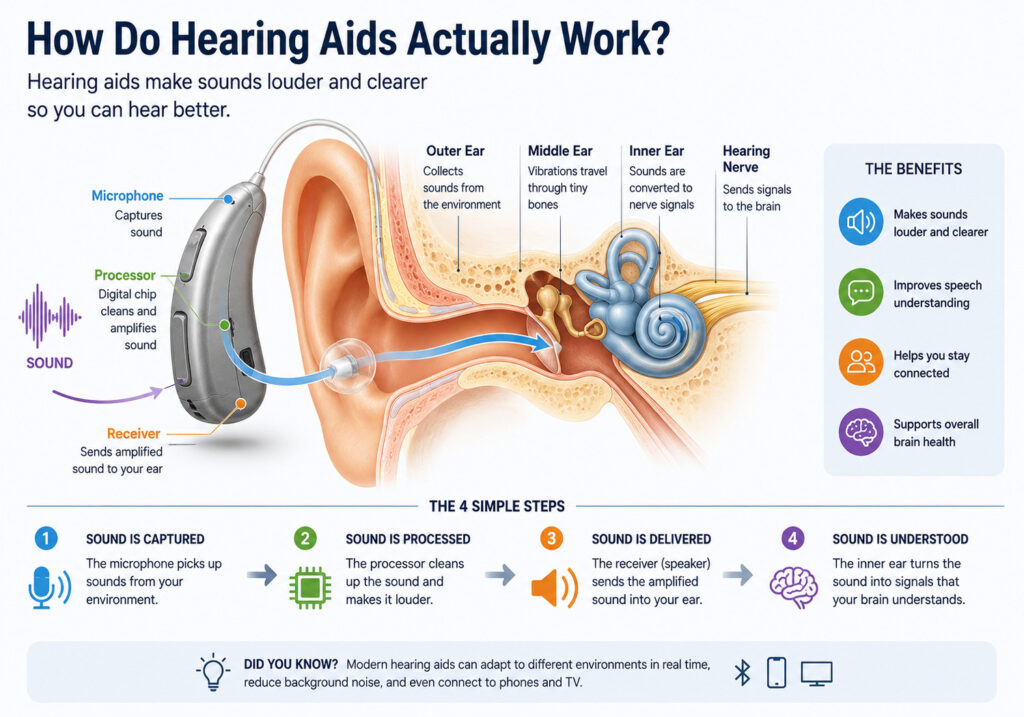
At its core, every hearing aid — regardless of style or price — performs the same fundamental function: it captures sound from the environment, processes it, and delivers amplified sound into the ear. Modern devices achieve this through four key components working together continuously:
- Microphone: The microphone captures incoming sound waves from the environment and converts them into electrical signals. High-end devices use multiple directional microphones that work together to focus on speech coming from in front of the user while suppressing noise from other directions.
- Processor / DSP chip: The digital signal processor (DSP) analyzes the incoming electrical signal in real time. It amplifies specific frequencies based on the user’s audiogram, applies noise reduction algorithms, detects feedback, and manages other sound-shaping functions — all within milliseconds.
- Receiver / Speaker: The processed signal converts back into sound waves and delivers them through a miniature speaker into the ear canal. The receiver sits either in the main device body or at the end of a thin wire that extends into the ear canal, depending on the style.
- Power source: A battery powers all of these processes. Traditional hearing aids use disposable zinc-air batteries, while most modern devices — including all Eargo models — use rechargeable lithium-ion batteries.
What Role Does Digital Signal Processing Play?
Digital signal processing represents the technological leap that transformed hearing aids from simple amplifiers into sophisticated sound management systems. Analog hearing aids, which preceded digital technology, amplified all frequencies equally and provided limited ability to fine-tune the output. Digital processors, by contrast, analyze sound in multiple frequency channels simultaneously and apply different levels of amplification to each channel.
This channel-based processing allows the audiologist or hearing professional to program the device precisely to the user’s audiogram — the map of their hearing loss across different frequencies. For example, a person with typical age-related hearing loss may hear low-frequency sounds (bass tones) well but struggle with high frequencies (speech consonants like ‘s’, ‘f’, and ‘th’). A digital hearing aid amplifies primarily the high-frequency channels while leaving low frequencies largely unchanged, resulting in clearer speech without an unnaturally boomy sound quality.
Modern processors also perform real-time environment classification. The DSP detects whether the user is in a quiet room, a noisy restaurant, outdoors, or on a phone call, and automatically adjusts processing parameters accordingly. Consequently, users experience more natural sound without manually switching programs throughout the day. Eargo‘s devices incorporate this type of automatic environment adaptation through their SoundAdjust+ technology, which the company’s engineers optimized specifically for the open-fit, in-canal form factor.
How Does Feedback Management Work?
Feedback — the high-pitched whistle that older hearing aids often produced — occurs when amplified sound leaks out of the ear canal and re-enters the microphone, creating a loop. Modern digital hearing aids use sophisticated feedback cancellation algorithms that detect the feedback loop and generate a counter-signal to suppress it before the user notices.
Eargo’s open-fit design, which does not seal the ear canal, could theoretically create more opportunity for feedback. However, the brand engineered its feedback cancellation specifically for this design, allowing the device to remain open and comfortable while still suppressing feedback effectively. This balance between openness and feedback control is one of the more technically challenging aspects of in-canal hearing aid design, and Eargo has invested considerable R&D in resolving it.
What Are the Main Types of Hearing Aids Available Today?
How Do the Primary Hearing Aid Technology Categories Differ?
Beyond physical style, hearing aids differ in their underlying technology and intended use case. The categories below reflect both technology generation and distribution channel, which together determine performance, convenience, and cost:
| Type | Description | Best For | Approx. Price Range |
|---|---|---|---|
| Prescription (Custom-Fitted) | Programmed by an audiologist based on a full audiogram; maximum customization | Moderate to profound hearing loss; complex auditory needs | $2,000 – $8,000+ per pair |
| OTC (Over-the-Counter) | Self-fitting devices for adults 18+ with mild to moderate hearing loss; no audiologist required | Mild to moderate hearing loss; budget-conscious buyers | $200 – $1,500 per pair |
| Direct-to-Consumer (DTC) | Sold online with remote professional support; combines convenience with expert guidance | Mild to moderate high-frequency loss; tech-savvy users | $1,000 – $3,000 per pair |
| PSAP (Sound Amplifiers) | Amplify all sounds; not classified as medical hearing aids by the FDA | Situational use; NOT for diagnosed hearing loss | $20 – $300 per pair |
| Cochlear Implants | Surgically implanted devices that bypass damaged hair cells; not hearing aids technically | Severe to profound hearing loss unresponsive to amplification | $50,000+ (surgical + device) |
Eargo operates primarily within the direct-to-consumer category. Its devices meet the FDA’s OTC hearing aid requirements and ship directly to the customer, who then receives remote support from Eargo’s licensed hearing professionals for programming adjustments. This approach positions Eargo as an accessible alternative to the full prescription channel while still providing more professional support than a purely self-fitting OTC device.
What Hearing Aid Styles Are Available, and How Do They Compare?
Which Physical Form Factors Do Manufacturers Offer?
The style of a hearing aid describes its physical design — where it sits relative to the ear and how it delivers amplified sound. Each style offers a different balance of power, discretion, comfort, and ease of handling. The right style depends on the degree of hearing loss, the user’s manual dexterity, cosmetic preference, and lifestyle.
| Style | Size | Visibility | Battery Life | Best Candidate |
|---|---|---|---|---|
| BTE (Behind-the-Ear) | Large | Visible | Up to 2 weeks (disposable) | Severe to profound loss; children; users needing easy handling |
| RIC / RITE (Receiver-in-Canal) | Small to medium | Moderately discreet | 3–5 days or rechargeable | Mild to severe loss; most popular style today |
| ITE (In-the-Ear) | Medium | Partially visible | 1–2 weeks (disposable) | Mild to severe loss; users who prefer in-ear comfort |
| ITC (In-the-Canal) | Small | Low visibility | 5–7 days (disposable) | Mild to moderate loss; discreet preference |
| CIC (Completely-in-Canal) | Very small | Very low visibility | 4–6 days (disposable) | Mild to moderate loss; cosmetic priority |
| IIC (Invisible-in-Canal) | Tiny | Nearly invisible | 2–4 days (disposable) | Mild to moderate loss; maximum discretion |
| Eargo (Open-Fit IIC) | Tiny | Nearly invisible | Up to 16 hours (rechargeable) | Mild to moderate high-frequency loss; discreet, rechargeable preference |
What Makes Behind-the-Ear Styles Different From In-Ear Styles?
Behind-the-ear (BTE) hearing aids house all electronics in a curved case that rests behind the ear. A thin tube or wire connects the case to a custom earmold or small receiver tip that sits in the ear canal. BTE devices offer the most amplification power, making them the standard choice for severe and profound hearing loss. They also accommodate the largest batteries, which translates to longer battery life and easier handling — an important factor for older users or anyone with limited finger dexterity.
Receiver-in-canal (RIC) devices, also called RITE or Erie depending on the brand, place the speaker (receiver) directly in the ear canal on a thin wire, with a much smaller housing behind the ear. This design produces more natural sound because the receiver delivers audio closer to the eardrum, and it reduces the occlusion effect — the sensation of hearing one’s own voice as boomy or echoing. RIC devices currently represent the bestselling hearing aid style globally, according to industry data from the Hearing Industries Association.
In-canal styles (ITC, CIC, IIC) sit entirely within the ear, offering increasing degrees of discretion as the device gets smaller. However, smaller devices have less room for battery capacity, microphones, and processing power, which places upper limits on the amplification they can deliver. Eargo‘s open-fit approach within the IIC category is notable because it maintains the size advantages of an invisible device while using its Flexi Fiber suspension to keep the ear canal partially open — a design choice that most IIC manufacturers avoid due to the feedback challenges it creates.
What Key Features Should You Look for in a Modern Hearing Aid?
Which Connectivity and Smart Features Matter Most?
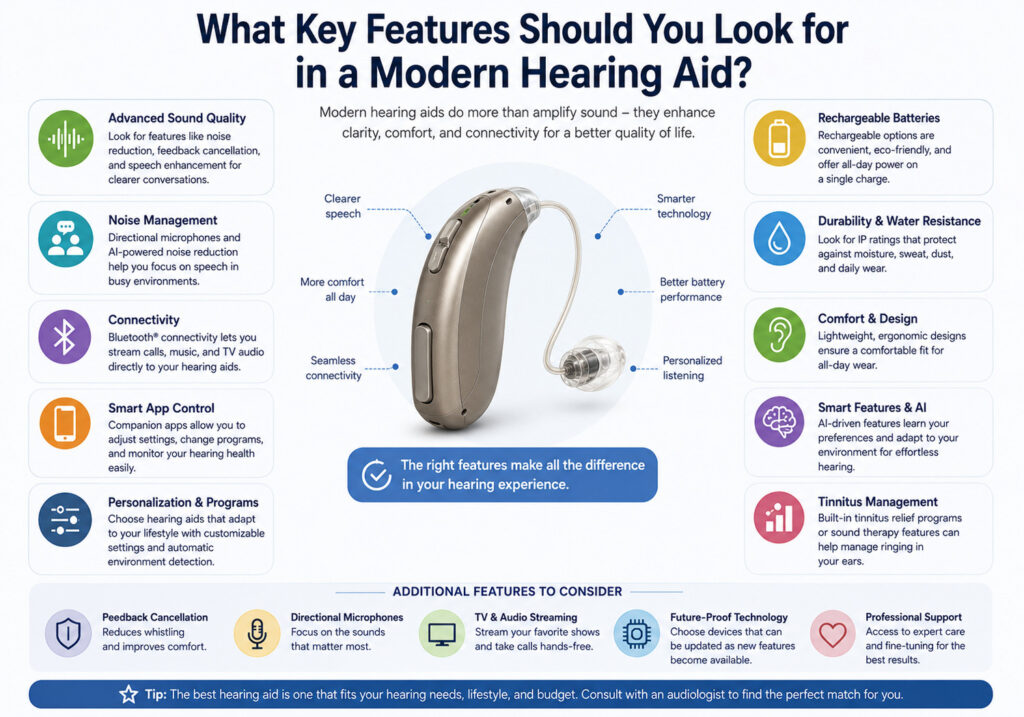
Modern hearing aids have evolved far beyond simple amplifiers. Today’s flagship devices offer a suite of connected features that integrate the hearing aid into the user’s broader digital life. The most impactful features include:
- Bluetooth streaming: Direct audio streaming from smartphones, televisions, and computers allows hearing aid users to receive clear audio without background noise interference. Most current RIC and BTE models support Bluetooth; Eargo models connect via Bluetooth for app control though they do not stream audio directly.
- Smartphone apps: Companion apps let users adjust volume, change programs, check battery level, and fine-tune sound settings without touching the device. Eargo’s Sound Match feature in its app allows users to personalize their hearing profile based on self-reported preferences.
- Rechargeable batteries: Disposable batteries require frequent replacement and can be difficult to handle. Rechargeable models, including all Eargo devices, eliminate this hassle. A typical charge cycle delivers a full day of use, and the charging case often doubles as a portable power bank.
- Telecoil (T-coil): A telecoil picks up magnetic signals from compatible telephones and loop systems installed in theaters, churches, and public buildings. This feature appears primarily in larger BTE and ITE devices, not in miniature in-canal styles like Eargo.
- Directional microphone systems: Adaptive directional microphones automatically steer toward the speaker in front of the user while attenuating noise from other angles. This capability significantly improves speech understanding in noisy environments.
- Tinnitus masking: Many devices include built-in tinnitus sound therapy features that play gentle background sounds to reduce the perception of ringing or buzzing in the ears.
How Important Is the Fitting and Adjustment Process?
Even the most technologically advanced hearing aid performs poorly if it does not match the user’s specific hearing loss profile. Fitting involves programming the device to the user’s audiogram — the prescription that describes how much amplification each frequency requires. With prescription hearing aids, a licensed audiologist performs this fitting in clinic using specialized software and conducts real-ear measurement to verify that the device delivers the target output at the eardrum.
Direct-to-consumer brands like Eargo approach fitting differently. Users complete an online hearing assessment, and Eargo’s hearing professionals use the results to configure the device remotely before shipping. After receiving the device, users can request further adjustments through the app or by phone with Eargo’s support team. This remote fitting model works well for mild to moderate high-frequency hearing loss — the pattern that Eargo targets — because these losses follow predictable patterns that respond well to standardized amplification profiles.
For more complex or severe hearing losses, however, in-person audiological evaluation remains essential. Directional microphone optimization, real-ear verification, and custom earmold fitting require equipment and expertise that remote channels cannot fully replicate. Consequently, understanding the severity and pattern of your own hearing loss before choosing a distribution channel is an important first step in the hearing aid selection process.
What Should You Know About Hearing Aid Maintenance?
Regular maintenance extends the lifespan of any hearing aid and ensures consistent sound quality. The most important maintenance tasks are:
- Daily cleaning: Earwax is the leading cause of hearing aid malfunction. Users should wipe the device with a dry cloth each evening and use the cleaning tools provided by the manufacturer to clear wax from microphone ports and receiver tips.
- Wax guards: Most in-canal devices include replaceable wax guards — small filters that block wax from entering the receiver. Eargo devices use their own wax guard system, and the company recommends replacing them according to a regular schedule.
- Moisture management: Sweat and humidity degrade electronic components over time. Storing hearing aids in a dry box or electronic dehumidifier overnight significantly extends device life. Most Eargo charging cases incorporate built-in drying capabilities.
- Software updates: Modern connected hearing aids receive firmware updates through companion apps, adding new features and improving performance over time. Eargo pushes these updates automatically, ensuring users always run the latest processing software.
How Do You Choose the Right Hearing Aid for Your Needs?

What Factors Should Guide Your Decision?
Selecting a hearing aid involves balancing several factors simultaneously. No single device suits every person, and the right choice depends on a combination of audiological, practical, and personal considerations:
- Degree and type of hearing loss: Mild and moderate high-frequency loss — the most common pattern — suits the widest range of devices, including Eargo‘s direct-to-consumer models. Severe or profound loss typically requires the greater amplification power of a prescription BTE or RIC device fitted by an audiologist.
- Lifestyle and listening environments: An active professional who frequently attends meetings and social events benefits from sophisticated directional microphone systems and Bluetooth streaming. A retired individual who primarily watches television at home may do well with a simpler, more affordable device.
- Dexterity and vision: Tiny in-canal devices require fine motor skill to insert and handle. Users with arthritis or reduced dexterity often manage BTE devices more comfortably. Rechargeable devices like Eargo eliminate the need to handle small disposable batteries entirely.
- Cosmetic preference: Many people prioritize discretion. Eargo’s nearly invisible design directly addresses this concern, which the company positions as a core brand differentiator.
- Budget: Prescription hearing aids carry the highest costs, including professional fitting fees. Direct-to-consumer devices like Eargo offer a middle ground — professional quality at a lower price point — while OTC devices offer the most affordable entry point for those with appropriate hearing loss patterns.
- Trial period and warranty: Reputable brands offer trial periods that allow users to test the device in their real-life environments. Eargo provides a 45-day trial period and a multi-year warranty, giving buyers confidence in their purchase decision.
When Should You See an Audiologist Before Buying?
While direct-to-consumer options like Eargo make hearing aids more accessible than ever, certain situations call for professional audiological evaluation before purchasing any device. You should consult a licensed audiologist or ENT physician if:
- You experience sudden hearing loss — this may indicate a medical emergency requiring immediate treatment.
- Your hearing loss affects primarily low frequencies or affects both ears asymmetrically — these patterns can signal underlying medical conditions that require diagnosis.
- You notice drainage, pain, or a sensation of fullness in the ear alongside hearing difficulty.
- You have previously tried hearing aids without success and need expert help identifying why.
- You have profound or severe hearing loss that may require maximum amplification power or a cochlear implant evaluation.
For the large majority of people experiencing gradual, symmetrical high-frequency hearing loss — particularly those over 50 — Eargo’s direct-to-consumer model provides an effective, convenient, and cost-efficient path to better hearing without requiring a clinic visit.
What Are the Most Important Takeaways About Hearing Aids?
Hearing aids have never been more capable, more comfortable, or more accessible than they are today. The combination of advanced digital signal processing, miniaturized components, rechargeable batteries, and wireless connectivity has produced devices that fit seamlessly into modern life while delivering genuine hearing improvement. Understanding the distinctions between types — prescription, direct-to-consumer, OTC — and between styles — BTE, RIC, ITC, CIC, IIC — empowers potential users to approach their hearing health decision with clarity rather than confusion.
Eargo stands out within this landscape as an innovative direct-to-consumer solution that specifically targets the most common hearing loss pattern: mild to moderate high-frequency decline. By combining an invisible in-canal design with rechargeable convenience, smartphone app control, and remote professional support, Eargo removes many of the traditional barriers to hearing aid adoption — cost, stigma, inconvenience, and the complexity of clinical fitting. For the right candidate, Eargo delivers a genuinely compelling experience that rivals many clinic-dispensed alternatives.
At the same time, not every person with hearing loss is the right candidate for a direct-to-consumer device. Severe hearing loss, unusual audiogram patterns, and underlying medical conditions all require professional audiological evaluation. Furthermore, the sheer variety of options across the market makes informed decision-making difficult without access to expert guidance.
This is precisely where Solution for Guru adds lasting value. By providing objective, personalized guidance through the hearing aid selection process, Solution for Guru helps individuals and healthcare providers alike find the right device for the right person at the right price. In a market this important — hearing loss affects quality of life, cognitive health, and social connection — having a trusted advisor makes all the difference.
Frequently Asked Questions
For mild to moderate high-frequency hearing loss — which represents the most prevalent pattern of hearing decline, particularly among adults over 50 — direct-to-consumer and OTC devices like those from Eargo can deliver results that compare favorably to prescription devices. The FDA’s OTC hearing aid category, established in 2022, created a regulated framework that ensures these devices meet safety and labeling standards appropriate for self-fitting use. Eargo’s devices incorporate the same core digital signal processing technology found in clinic-dispensed devices, and the company’s remote professional support adds an additional layer of personalized optimization. However, prescription devices maintain significant advantages for severe hearing loss, complex audiological profiles, or users who need custom earmolds, telecoil integration, or maximum output levels. Additionally, some people simply perform better with in-person audiological fitting and follow-up care, where the audiologist can perform real-ear measurements and make precise adjustments based on objective data.
Most hearing aids last between three and seven years with proper care and maintenance. The lifespan depends on the quality of the device, the user’s maintenance habits, the environment in which they wear the device, and how quickly the user’s hearing loss progresses. Physical wear, moisture damage, and earwax accumulation gradually degrade performance over time even with diligent care. You should consider replacing your hearing aids when: the devices require increasingly frequent repairs; the sound quality no longer meets your needs even after professional reprogramming; your hearing loss has changed significantly based on a new audiogram; or new technology has emerged that offers meaningful quality-of-life improvements. Eargo releases new models periodically, and its direct-to-consumer pricing makes upgrading more financially accessible than traditional prescription device replacement cycles.
How Can Solution for Guru Help You Navigate the Hearing Aid Market?
The hearing aid market is large, fast-moving, and often confusing. Hundreds of devices compete across multiple technology categories, price points, and distribution channels. Making the wrong choice — whether by selecting a device too powerful, too simple, or simply poorly matched to your lifestyle — wastes money and can discourage people from seeking the hearing help they need. Solution for Guru exists to simplify this process by providing expert guidance, product comparisons, and personalized recommendations tailored to each individual’s situation.
What Specific Advantages Does Partnering With Solution for Guru Offer?
Working with Solution for Guru offers a range of concrete benefits that go beyond what a manufacturer website or retail store can provide:
- Impartial product comparison: Solution for Guru evaluates devices from multiple brands — including Eargo and other leading manufacturers — based on objective performance criteria, giving clients an unbiased view of their options rather than a sales pitch for a single brand.
- Personalized needs assessment: Every client receives a structured consultation that maps their specific hearing loss profile, lifestyle, dexterity, budget, and aesthetic preferences to the most suitable device options.
- Access to exclusive deals and promotions: Solution for Guru maintains relationships with hearing aid brands and distributors, enabling clients to access pricing and promotions that may not be available through standard retail channels.
- Guidance through insurance and financing: Navigating insurance coverage, HSA/FSA eligibility, and financing options for hearing aids can be complicated. Solution for Guru helps clients understand what financial support is available and how to access it.
- Post-purchase support: The relationship does not end at the point of sale. Solution for Guru provides ongoing support to help clients get the most from their devices, troubleshoot issues, and evaluate upgrades as technology evolves.
- Healthcare provider partnerships: Clinics, audiology practices, and healthcare organizations work with Solution for Guru to improve the product knowledge and recommendation capabilities of their staff, ensuring that patients receive accurate, up-to-date guidance.
Ultimately, Solution for Guru acts as a trusted advisor in a market that can feel overwhelming. Whether you are a first-time hearing aid buyer considering Eargo or an experienced user ready to upgrade to the latest technology, the team at Solution for Guru provides the knowledge and support to ensure you make the right choice.
